Roles
Demolition Labourer: Duties, Tickets and Pay (2026)
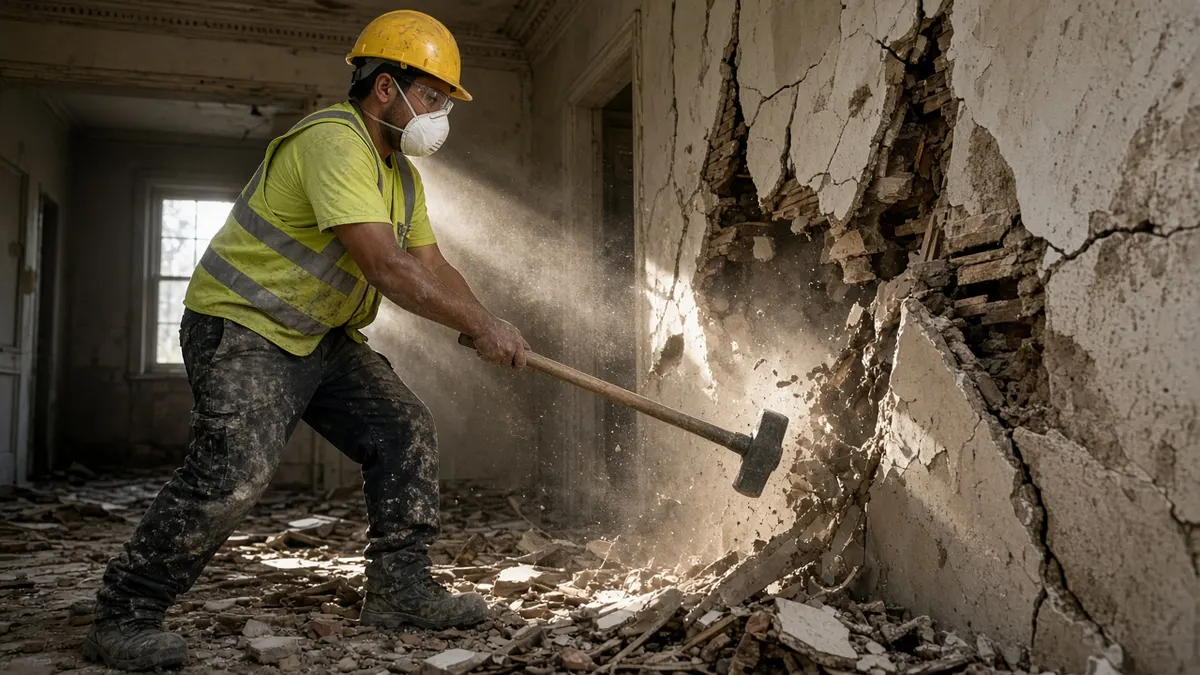
A demolition labourer strips out and pulls down parts of buildings by hand and with small plant, then sorts, loads and removes the waste. Typical work includes soft strip-outs of offices and shops, removing ceilings, partitions and flooring, breaking concrete, loading skips and keeping the site clean. You need a white card, and some work needs extra training or licences.
General information, not legal advice. Demolition is high-risk construction work and each state's WHS regulator sets licensing and training rules. Check with your regulator before taking on structural or asbestos-related work.
What does a demolition labourer do day to day?
Most demolition labouring is strip-out work, not dramatic building collapses. A typical week on a commercial or residential job looks like this:
- Soft strip: removing carpet, ceiling tiles, partitions, joinery, doors and fixtures before refurbishment.
- Manual demolition: breaking non-structural walls, render and tiles with hammers, bars, breakers and demo saws.
- Waste handling: separating metal, timber, plasterboard and concrete for recycling, loading skips, bins and trucks.
- Spotting: guiding excavator and skid steer operators and keeping exclusion zones clear.
- Site set-up: putting up barricades, hoarding and signage, and controlling dust with water sprays.
- Housekeeping: sweeping, clearing walkways and leaving the area safe for the next trade.
A typical strip-out day
On a shop refurbishment in Chatswood, the crew arrives at 6:30am for a toolbox talk covering the safe work method statement, the asbestos register and where the exclusion zones are. By 7am the labourers are pulling ceiling tiles and grid, bagging insulation and stacking plasterboard for recycling. After smoko they cut out partitions with demo saws, cart the waste to the loading dock in wheelie bins and load the skip so it can be swapped before lunch. The afternoon goes to lifting carpet, scraping adhesive and a final sweep so the electricians can start the next morning.
Common tools on a demolition crew
Expect to use crowbars, sledgehammers, wrecking bars, electric breakers and jackhammers, demo saws, reciprocating saws, grinders, floor scrapers, wheelbarrows and skip bins. Larger jobs add skid steers, mini excavators and scissor lifts, which need the right operator tickets or training.
Before any demolition starts, services must be isolated. Energy Safe Victoria, for example, warns that starting demolition before the electricity supply is removed is a serious hazard, and supply must be abolished first. Labourers should never assume a wall or ceiling is dead.
What tickets and courses does a demolition labourer need?
| Ticket or training | When you need it | Notes |
|---|---|---|
| White card (construction induction) | Any construction site | Recognised Australia-wide |
| Demolition worker course (NSW) | Licensed demolition work in NSW | CPCCDE3030, which superseded CPCCDE3016 |
| Asbestos awareness | Sites where asbestos may be present | Awareness is not a removal licence |
| Class B asbestos removal licence (held by the business) | Removing non-friable asbestos beyond the small-quantity exception | Workers need the matching training |
| Working at heights | Stripping ceilings, roofs and mezzanines | Often required by principal contractors |
| EWP or plant tickets | Operating scissor lifts, booms or machines | Requirements vary by machine |
The demolition labourer course in NSW
SafeWork NSW's page on the restricted demolition licence says that from 1 March 2025, demolition licence holders must ensure workers doing licensed demolition work have completed the approved course, CPCCDE3016 Identify hazards on demolition sites and apply risk management strategies, now superseded by CPCCDE3030. Workers who completed earlier listed demolition courses may not need to redo it. If you want regular work with NSW demolition contractors, this course is worth doing.
Who needs a demolition licence?
The licence is held by the business, not the labourer. In NSW, a restricted demolition licence covers demolishing load-bearing or structurally related parts of a structure between 6 and 15 metres high, or using load-shifting machinery on a suspended floor. Work over 15 metres or involving explosives needs an unrestricted licence. A SafeWork-approved named supervisor must be on site during licensed demolition work. Other states have their own rules, so check locally.
What are the asbestos rules for demolition labourers?
Many buildings constructed before 1990 contain asbestos in eaves, wet-area sheeting, vinyl floor tiles and switchboard backing. Safe Work Australia's asbestos duties guidance says you need a licence to remove asbestos, with limited exceptions in some states, such as removing 10 square metres or less of non-friable asbestos. In the ACT, removing any asbestos requires a licence. Class A removalists can remove all types; Class B removalists can remove only non-friable asbestos.
For labourers, the practical rule is simple: if you find suspect sheeting or lagging that is not on the asbestos register, stop, leave the area and tell the supervisor. Never break, drill or sweep it up.
What PPE does a demolition labourer wear?
- steel-capped boots with puncture-resistant soles
- hard hat, safety glasses and hi-vis clothing
- cut-resistant gloves
- hearing protection for breakers and saws
- a fitted P2 or higher respirator for dust, including silica dust from concrete and masonry
Hirers usually supply site-specific PPE such as respirators and harnesses. Labourers usually bring their own boots and basic gear. See what tools a labourer needs for a starter kit.
How much does a demolition labourer earn?
As indicative 2026 market observations, casual demolition labourers commonly earn around $35–48/hr, and ABN contractors around $40–58/hr. Workers with a demolition course, asbestos training and machine tickets sit at the top of the band, and night strip-outs in CBD buildings often pay more. Award minimums for site work usually come from the Building and Construction General On-site Award; check current rates in the Fair Work pay guides.
Costing a strip-out crew
A builder in Surry Hills needs a 400 square metre office floor stripped back to the slab before a new fit-out. The crew is four demolition labourers for two 8-hour days at $40–50/hr each, which comes to roughly $2,560–3,200 in labour, plus skip bins and tipping fees. Add casual loading, super and site allowances where they apply if the workers are employees.
How do you get demolition labourer jobs?
- Get your white card and, in NSW, the CPCCDE3030 demolition course.
- Add asbestos awareness and working at heights training to stand out.
- Buy good boots and gloves and be ready for early starts.
- Apply for strip-out, site clean and labouring jobs, which often lead to demolition crews.
Our guide to the labourer job description covers the wider duties hirers expect.
How to book a demolition crew or find demolition work on Yakka
Yakka Labour is the hiring marketplace, not the workwear brand with a similar name. Builders post jobs and agree rates directly with workers, without an agency margin on top.
- Hirers: post the job with the suburb, start time, crew size, tickets required (white card, demolition course, asbestos awareness) and an AUD rate, then message applicants and agree terms in writing. Licensed demolition and asbestos removal remain the principal contractor's responsibility.
- Workers: create a free profile in the Yakka app, list your tickets and apply for strip-out and labouring jobs near you.
Yakka is a marketplace rather than an employer, so the hirer and worker agree the engagement. Sydney builders can also see demolition labour hire in Sydney, and new workers should read what is a white card.
Frequently asked questions
Is demolition labouring a good job for beginners?
It can be. Strip-out and site clean work needs physical fitness and reliability more than trade skills, so many people start in demolition with only a white card. Crews teach tool use on the job. Progress comes from adding tickets such as the NSW demolition course, asbestos awareness, working at heights and machine tickets, which open better-paid roles.
Do I need a licence to be a demolition labourer?
Individual labourers usually do not hold a demolition licence. In NSW, the licence is held by the demolition business, which must have a named supervisor on site for licensed work and must ensure workers doing licensed demolition have completed the approved course. Every worker on a construction site still needs a white card.
What is the difference between strip-out and demolition?
Strip-out, often called soft strip, removes non-structural items such as ceilings, partitions, carpet, fixtures and services inside a building, usually before a refurbishment. Demolition removes structural elements or whole buildings. Demolishing load-bearing elements is high-risk construction work, which needs a safe work method statement and, in some states, a licensed demolition business.
Can a demolition labourer remove asbestos?
Only within strict limits. Safe Work Australia says a licence is needed to remove asbestos, with limited exceptions in some states for 10 square metres or less of non-friable asbestos, and none in the ACT. Larger quantities or friable asbestos need a licensed removalist business, and workers need the right training and protective equipment for the class of removal.
What hours do demolition labourers work?
Day shifts commonly start around 6 or 7am, especially on residential and suburban sites with noise restrictions. Commercial strip-outs in occupied CBD buildings are often done at night or on weekends to avoid disrupting tenants, and those shifts can attract penalty rates for employees. Many demolition jobs are short, intense blocks of a few days.
Official sources
Award rates, licences and safety rules change. Check the official source before you hire or take on a shift.
- Fair Work Ombudsman — pay guidesMinimum award rates, casual loading and penalty rates
- Fair Work Pay CalculatorWork out the minimum pay for a specific award and shift
- Safe Work AustraliaNational work health and safety framework, including high-risk work licences
- SafeWork NSWWhite cards, high-risk work licences and WHS rules in New South Wales
- Asbestos Safety and Eradication AgencyWhere asbestos is found in homes and how to deal with it safely
- Energy Safe VictoriaElectrician licensing in Victoria