Exterior cost guide
Roofing Cost Australia 2026: Roofer Rates and New Roof Prices
Typical cost in Australia (2026, inc. GST)
$12,000 to $32,000 per job
new roof on a new single-storey home, about 200 m² of roof, steel or concrete tile
Most Australian roofers charge $75 to $130 an hour, or $600 to $1,000 a day. A new roof on a new home costs about $55 to $110 per m² for steel and $60 to $160 per m² for concrete or terracotta tiles, so a typical 200 m² roof lands between $12,000 and $32,000. Material, pitch, storeys, access and roof shape move the price most.
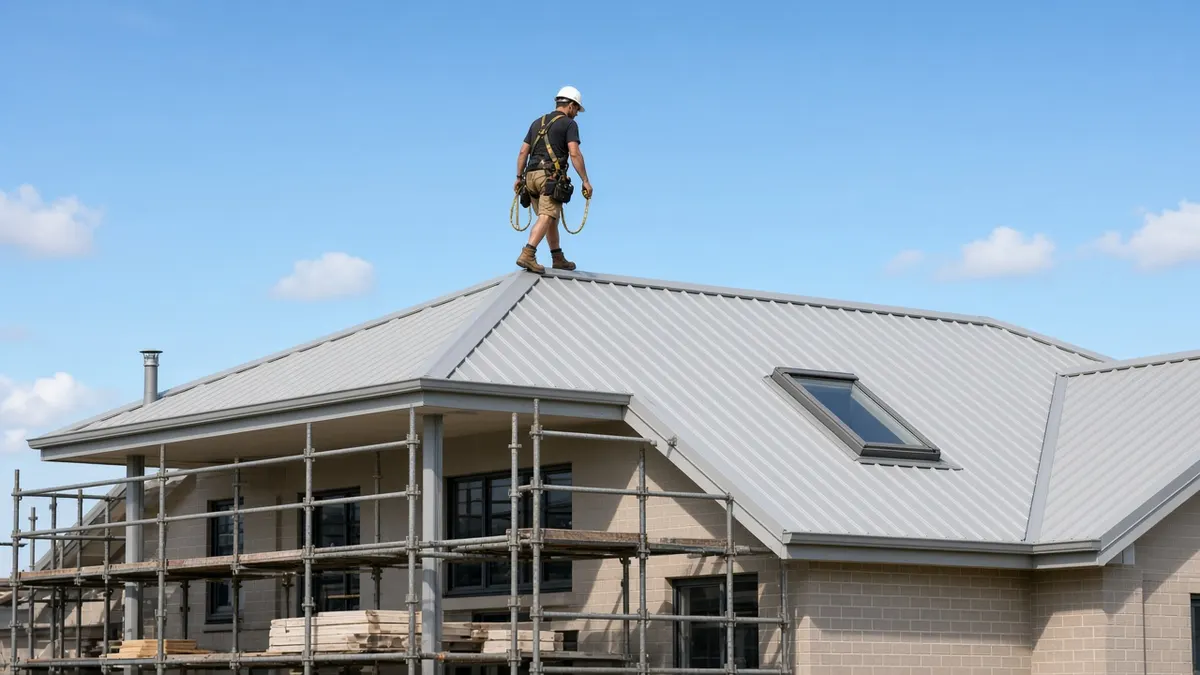
A roofer in Australia costs $75 to $130 an hour in 2026, and a brand new roof costs roughly $55 to $160 per square metre installed depending on what it is made of. For an average single-storey home with about 200 m² of roof, that works out to somewhere between $12,000 and $32,000 for a straightforward steel or concrete tile roof on a new frame.
This guide is the overview: who does roofing work, what they charge for their time, and what the main roofing materials cost per m². If you already know the job you need, the more specific guides go deeper. A full tear-off and re-roof of an existing house is covered in the roof replacement cost guide, bringing tired tiles or metal back to life is in the roof restoration cost guide, and drips through the ceiling are in the leaking roof repair guide.
All prices here are indicative, in Australian dollars and include GST. Roofing is one of the trades where quotes for the same house can differ by 30% or more, so get at least three written quotes before you commit.
What roofers charge for their time
Small jobs are usually charged by the hour with a minimum call-out. Bigger jobs are quoted as a fixed price, but the roofer still builds that price from labour hours, so it helps to know the going rates. Roofing crews are normally two people, and you pay for both of them.
| Trade | Hourly rate | Day rate | What they do |
|---|---|---|---|
| Roofer (tile or general) | $75 to $120 | $600 to $950 | Tile replacement, rebedding, repointing, re-roofing with tiles |
| Roof plumber | $90 to $140 | $750 to $1,100 | Metal roofing, flashings, gutters, downpipes, box gutters |
| Roof restorer or roof painter | $65 to $100 | $520 to $800 | Cleaning, coating, minor repairs |
| Roofing labourer | $45 to $65 | $360 to $520 | Stripping, loading out, carrying sheets and tiles, clean-up |
| Call-out fee (small jobs) | $100 to $200 | n/a | Often includes the first half hour or hour |
Expect after-hours and storm call-outs to cost 1.5 to 2 times the normal rate. After a big hail or wind event in your area, the price of getting anyone on a roof quickly goes up because every roofer in town is booked out for weeks.
New roof prices per m² by material
These rates are for supply and install on a new frame, which is the cheapest way to buy a roof because nothing has to come off first. They include battens or purlins where the roofer supplies them, sarking or blanket, flashings and standard ridge or capping. Gutters and downpipes are usually priced separately.
| Material | Installed price per m² | Typical lifespan | Notes |
|---|---|---|---|
| Zincalume (unpainted steel) | $55 to $90 | 25 to 40 years | Cheapest metal option, bright finish, common on sheds and rural homes |
| Colorbond steel, corrugated | $65 to $110 | 30 to 50 years | The default for most new Australian homes |
| Colorbond concealed-fix or standing seam | $90 to $150 | 30 to 50 years | Clean look, suits low pitches, more labour |
| Concrete tiles | $60 to $100 | 50 years or more | Heavy, needs a frame designed for tile load |
| Terracotta tiles | $90 to $160 | 80 years or more | Colour does not fade, higher material cost |
| Natural slate | $200 to $350 | 100 years or more | Specialist trade, mostly heritage work |
| Copper or zinc sheet | $250 to $450 | 60 years or more | Architectural jobs, few installers |
Colorbond has its own guide because it is so common: the Colorbond roofing cost guide breaks down profiles, steel thickness, coastal grades and colour choices.
How to work out your roof area
Your roof is bigger than your floor plan. Eaves usually overhang 450 mm to 600 mm on every side, and a pitched roof has more surface than the flat area it covers. On a typical 22.5 degree pitch, the roof surface is about 8% larger than its plan area. A single-storey house with 180 m² under roof (including the garage) often has 210 m² to 230 m² of actual roofing once eaves and pitch are counted.
Older roofers still talk in squares. One square is 100 square feet, or about 9.3 m², so a "22 square roof" is roughly 205 m². If a quote gives a price per square, divide it by 9.3 to compare it with a per-m² price.
Roof shape matters as much as size. A simple gable roof with two flat planes is the cheapest to cover. A hip roof with valleys, a few dormers and a chimney can take 30% to 50% more labour for the same area, because every hip and valley needs cutting, flashing and capping.
Typical roofing jobs and what they cost
Most people searching for roofing prices are not building a new house. Here is what common jobs on existing homes cost in 2026.
| Job | Typical price | Usual basis |
|---|---|---|
| Leak investigation and minor repair | $250 to $900 | Call-out plus hourly |
| Replace 5 to 10 broken tiles | $250 to $650 | Minimum charge plus tiles |
| Rebed and repoint ridge capping | $35 to $60 per linear metre | Per metre of ridge and hip |
| Roof clean only | $500 to $1,400 | Per job, about $3 to $7 per m² |
| Roof painting (coating only) | $3,000 to $7,000 | Per job, single-storey |
| Full tile or metal restoration | $4,500 to $11,000 | Per job, single-storey |
| Re-roof, tiles to Colorbond | $20,000 to $34,000 | About 200 m², includes strip-out |
| Skylight supply and install | $700 to $3,500 | Per unit |
Coating a sound roof is a different job from restoring a worn one. If the tiles are solid and only faded, a coating-only roof paint is the cheaper option, and our separate roof painting guide covers it.
Prices in each capital city
Labour is the biggest part of any roofing bill, so city rates follow local wages and how busy the trade is. Material prices are fairly even across the eastern states but carry a freight premium in Darwin, Hobart and remote areas.
| Location | Roofer hourly rate | Colorbond, new build per m² | Why it differs |
|---|---|---|---|
| Sydney | $90 to $130 | $75 to $115 | High labour costs, tight access, more two-storey homes |
| Melbourne | $85 to $125 | $70 to $110 | Metal roofing must be done by a licensed roof plumber |
| Brisbane | $80 to $115 | $65 to $105 | Storm season demand spikes from October to March |
| Perth | $85 to $120 | $65 to $105 | Large single-storey homes keep per-m² rates competitive |
| Adelaide | $75 to $105 | $60 to $95 | Lower labour costs, steady demand |
| Hobart | $75 to $110 | $65 to $105 | Fewer crews, freight on materials |
| Canberra | $90 to $125 | $70 to $110 | Small market, high trade wages |
| Darwin | $95 to $140 | $85 to $130 | Cyclone-rated fixings, freight, wet season delays |
| Regional areas | $70 to $115 | $60 to $110 | Cheaper labour, but travel time is often added |
What makes one roof cost more than another
- Storeys and pitch. A two-storey home needs scaffold or a full edge protection system, which can add $2,000 to $6,000. Roofs steeper than about 30 degrees slow everyone down and may need roof anchors and harnesses.
- Access. If a crane or materials hoist cannot reach the roof, every sheet and pallet of tiles goes up by hand. Narrow side paths, steep blocks and terrace houses with no rear lane all add hours.
- Roof shape. Hips, valleys, dormers, skylights, chimneys and solar panels each add flashing work.
- Material and grade. Coastal-grade steel, thicker sheet, premium tiles and copper all lift the material line.
- What is underneath. On an existing house, rotten battens, sagging rafters or no sarking are only found once the old roof is off. Good quotes include a rate for replacing battens per metre.
- Location rules. Bushfire-prone sites need materials and details that meet the required bushfire attack level under AS 3959, and cyclonic regions need extra fixings and tie-downs.
- Disposal. Old tiles and sheeting need a skip or truck. Asbestos cement roofing needs a licensed removalist and a licensed tip, which changes the budget completely.
Extras that often turn up on a roofing quote
The per-m² rate covers the roof covering itself. These items are often priced as separate lines, and they are where two quotes that look similar can end up thousands of dollars apart.
| Extra | Typical price | When you need it |
|---|---|---|
| Quad or half-round gutters | $40 to $80 per linear metre | New builds, or when old gutters are rusted through |
| Downpipes | $150 to $350 each | Usually one per 12 m or so of gutter |
| Fascia and barge cover or replacement | $40 to $90 per linear metre | Rotten timber fascias found at re-roof time |
| Replacement battens | $15 to $30 per linear metre | Old timber battens that are split or decayed |
| Roof blanket upgrade | $8 to $15 per m² | Steel roofs where rain noise and heat matter |
| Whirlybird or roof vent | $250 to $500 each | Hot roof spaces, condensation problems |
| Box gutter rebuild | $150 to $350 per linear metre | Terraces and parapet roofs with hidden gutters |
Gutters are the classic one. Some roofers include new gutters in a re-roof by default, some leave the old ones in place, and some price them as an option. Ask each quoter to show gutters as a separate line so you can compare like with like. If the old gutters are only a few years old and in good condition, there is no need to replace them with the roof.
Solar panels are the other surprise. If you already have panels, they must be removed and reinstalled for a re-roof or restoration. That is electrical work and must be done by a licensed electrician, usually a solar installer, and it costs roughly $1,000 to $3,000 for a typical home system depending on panel count and the condition of the racking.
Three worked examples
New Colorbond roof on a single-storey build in Werribee, Victoria
A four-bedroom brick veneer home, 210 m² of roof on new trusses, simple hip roof, corrugated Colorbond in a mid-grey, installed by a licensed roof plumber.
| Item | Cost |
|---|---|
| Colorbond sheeting, battens, fixings (210 m²) | $7,400 |
| Anticon blanket or sarking | $1,600 |
| Ridge, hip capping and flashings | $1,500 |
| Labour (two-person crew, about 4 days) | $6,200 |
| Edge protection hire | $1,800 |
| Total including GST | $18,500 |
That is about $88 per m², sitting in the middle of the range. Quad gutters and downpipes would add around $3,000 to $4,500.
Concrete tile roof on a two-storey build in Kellyville, NSW
A double-storey home with 240 m² of roof, several hips and valleys, standard profile concrete tiles.
| Item | Cost |
|---|---|
| Tiles, battens, sarking, fixings | $11,000 |
| Ridge and hip capping with flexible pointing | $2,600 |
| Valley irons and flashings | $1,400 |
| Labour (crew of three, about 6 days) | $9,500 |
| Tile lifting by crane truck | $900 |
| Total including GST | $25,400 |
About $106 per m². The scaffold is usually supplied by the builder on a new two-storey home, so it is not in this quote. On a renovation it would be.
Small repair on a 1970s brick home in Elizabeth, South Australia
Six cracked concrete tiles after a storm and a short length of loose ridge capping.
| Item | Cost |
|---|---|
| Call-out including first hour | $160 |
| Second-hand matching tiles (6) | $60 |
| Labour, extra 1.5 hours | $150 |
| Rebed and repoint 3 m of ridge | $150 |
| Total including GST | $520 |
Metal or tiles: the long-run sums
On a new build, steel and concrete tile cost about the same per m². The real differences show up over 30 years.
Colorbond is light, quick to install and needs little maintenance beyond keeping gutters clear and washing salt off in coastal areas. It handles low pitches, which suits modern skillion designs. It is noisier in rain unless a good blanket goes under it, and it can dent in big hail.
Concrete tiles are heavy, which helps with acoustic and thermal mass, but the frame must be designed for them. The tiles themselves last for decades. The weak point is the ridge capping and the surface coating, which usually need attention every 15 to 25 years. Terracotta keeps its colour and outlasts concrete, at a higher upfront price.
For an existing tiled house, swapping to steel is popular because it takes weight off an older frame and ends the cycle of repointing and recoating. That decision is covered in the re-roofing guide linked near the top of this page.
Licences and who is allowed to do the work
Roofing sits under state building and plumbing laws, and the rules differ more than most people expect.
- NSW: residential building work over the licensing threshold (currently $5,000 including labour and materials) needs a contractor licence from NSW Fair Trading, and larger jobs need home building compensation cover. Check current thresholds on the NSW Fair Trading website.
- Victoria: installing or repairing metal roofing, flashings and gutters is roof plumbing work and must be done by a licensed or registered plumber in the roofing class. Larger domestic building jobs also need a registered builder. The regulator is the Victorian Building Authority (VBA), now operating as part of the Building and Plumbing Commission.
- Queensland: building work valued over $3,300 needs a QBCC licence in the right class, such as roof and wall cladding or roof tiling. See the QBCC website to check a licence.
- WA, SA, Tasmania, ACT and NT: Building and Energy (WA), Consumer and Business Services (SA), CBOS (Tasmania), Access Canberra and the NT Building Practitioners Board each set their own thresholds. Check the current threshold with the regulator before you sign.
Any work on gas flues, electrical cabling for solar or exhaust fans, or stormwater drainage beyond the gutter is licensed trade work in every state.
Safety and the rules on site
Roof work is high-risk construction work under WHS laws once there is a risk of falling more than 2 metres, which covers almost every house. The roofer needs a safe work method statement and fall protection: guardrails, scaffold, or harnesses on anchor points. Safe Work Australia's guidance on working at heights sets out what that looks like. A roofer who turns up with no edge protection on a two-storey job is a red flag, and that safety gear is a legitimate line item in your quote.
Homes built before about 1990 may have asbestos cement roof sheets, eaves linings or flues. Do not let anyone cut, drill or pressure clean suspected asbestos. Get it tested first.
Getting a quote you can trust
A good written roofing quote includes:
- The licence number, ABN and proof of public liability insurance.
- Roof area in m² and the exact material, profile, colour and steel thickness or tile range.
- Sarking, blanket or insulation type, flashings and capping details.
- Scaffold or edge protection, waste removal and who pays for the skip.
- A rate for unexpected work, such as replacing battens per metre or rafters per length.
- Warranty on workmanship and the manufacturer's warranty on materials.
- A start date, expected duration and payment stages tied to progress.
Walk away from anyone who wants cash only, cannot show a licence, asks for a deposit above the legal limit in your state, or turns up after a storm offering a cheap deal on the spot. For more on checking a trade before you hire, read how to find trusted tradies.
How long roofing work takes
A tile replacement or small leak fix is a half-day job. Rebedding and repointing a typical house takes one to two days. A new steel roof on a new single-storey home takes three to five days for a two-person crew, and a tiled roof a little longer. A full re-roof of an existing home is usually four to eight working days, longer if rain stops work or rotten timber turns up. Book early in spring: storm season fills diaries fast in Queensland and NSW.
Spending less without a worse roof
- Keep the roof shape simple on a new build. Every valley you remove saves labour and a future leak point.
- Get repairs done early. A $400 ridge repoint now beats a $3,000 ceiling repair later.
- Bundle jobs. If scaffold is going up for a re-roof, replace gutters, add a skylight or fix eaves at the same time.
- Book outside storm season if the work is not urgent. Winter quotes in Brisbane and Sydney are often sharper.
- Ask about off-cut and leftover materials from the supplier for small sheds or patios, but never accept the wrong steel grade for a coastal site to save money.
Where Yakka can help
Yakka connects people with workers by the shift or job, including roofers and roof plumbers listed on the platform and general labourers for the heavy, non-licensed parts of a roofing project. That might be a labourer to strip and carry old tiles, load a skip, clean up the yard and gutters after the crew leaves, or clear the garage before materials arrive. You can find roofers near you or book rubbish removal for the old roof material.
Yakka does not replace a licensed roof plumber or builder for work that needs one. Check licence numbers yourself, and keep the licensed roofer in charge of the roof itself.
Frequently asked questions
How much does a roofer charge per hour in Australia?
Most roofers charge $75 to $120 an hour in 2026, and roof plumbers who work on metal roofing and gutters charge $90 to $140. Many add a call-out fee of $100 to $200 for small jobs, which often covers the first hour. Sydney, Canberra and Darwin sit at the top of the range, while Adelaide and regional areas are usually cheaper.
How much does a new roof cost per m2?
On a new frame, expect about $55 to $90 per m² for Zincalume, $65 to $110 for corrugated Colorbond, $60 to $100 for concrete tiles and $90 to $160 for terracotta. Slate and copper run well above $200 per m². Replacing a roof on an existing home costs more because the old roof has to come off and be disposed of first.
Is a metal roof cheaper than tiles?
On a new build, Colorbond and concrete tiles cost roughly the same per m² installed. Steel is usually cheaper over the long run because it needs less maintenance, with no ridge capping to repoint and no coating cycle. Tiles have better thermal mass and are quieter in rain. Terracotta costs more upfront than either but lasts the longest.
How many squares is an average Australian roof?
A typical single-storey three or four-bedroom home has about 20 to 25 squares of roof, which is roughly 185 m² to 230 m². One square equals 100 square feet or about 9.3 m². The roof is always larger than the floor area because of eaves overhangs and the extra surface created by the roof pitch.
Do I need a licensed roofer in Queensland?
In Queensland, building work over $3,300, including labour and materials, needs a QBCC licence in the correct class, such as roof tiling or roof and wall cladding. Below that value a licence is not required for most roofing, but you still want someone insured and experienced. Plumbing and drainage work needs a licensed plumber regardless of value.
How long does a new roof last in Australia?
Colorbond steel commonly lasts 30 to 50 years, less in harsh coastal or industrial spots unless you choose a coastal grade. Concrete tiles last 50 years or more, although ridge pointing and coatings need work every 15 to 25 years. Terracotta can last 80 years or longer, and natural slate can pass 100 years with good maintenance.
What time of year is cheapest to get roofing done?
Late autumn and winter are often the quietest months for roofers in Queensland and NSW, because storm season runs roughly from October to March. In Melbourne and Hobart, winter rain causes delays, so late summer and early autumn suit better. Urgent leaks should be fixed straight away regardless of season, because water damage costs more than any seasonal saving.
Official sources
Award rates, licences and safety rules change. Check the official source before you hire or take on a shift.
- Safe Work AustraliaNational work health and safety framework, including high-risk work licences
- Queensland Building and Construction Commission (QBCC)Contractor, plumbing and drainage licence search in Queensland
- Consumer and Business Services SALabour hire licensing in South Australia
- NSW Fair TradingTrade licence checks for electricians, plumbers and builders in New South Wales
- Building and Plumbing Commission (Victoria)Builder and plumber registration, domestic building insurance and licence checks in Victoria
- Asbestos Safety and Eradication AgencyWhere asbestos is found in homes and how to deal with it safely