Outdoor cost guide
Glass Pool Fencing Cost Australia: Frameless vs Semi (2026)
Typical cost in Australia (2026, inc. GST)
$280 to $700 per linear metre
1.2 m high glass pool barrier installed, semi-frameless (low) to frameless on spigots (high), gate extra
Glass pool fencing costs about $400 to $700 per linear metre installed for frameless 12 mm glass on spigots in 2026, and $280 to $450 for semi-frameless with posts, including GST. A glass gate with compliant hinges and latch adds $900 to $1,800. Mounting surface, hardware grade, slope, custom panels, removal of an old fence and compliance inspection fees drive the total.
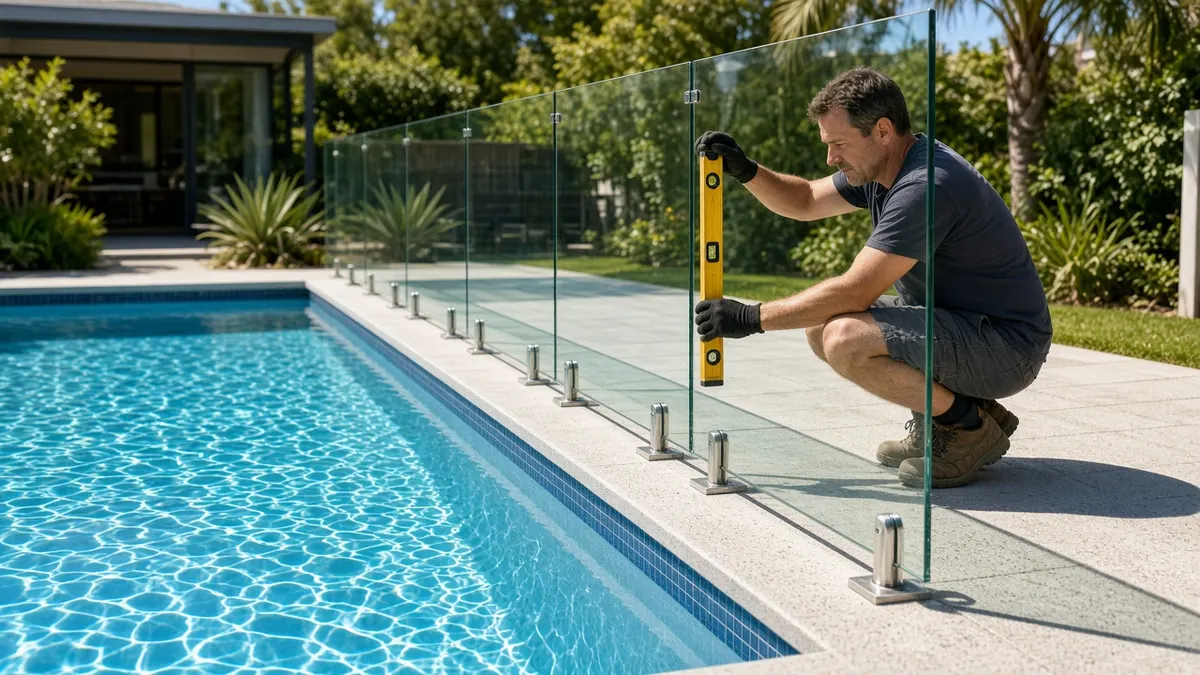
Frameless glass pool fencing costs about $400 to $700 per linear metre installed in 2026, and semi-frameless glass with posts costs about $280 to $450 per metre, GST included. A typical backyard pool needs 20 to 30 m of barrier plus a gate, so most homeowners end up spending between $8,000 and $20,000 for frameless glass.
Glass is the most popular pool barrier for new pools because it keeps the view open and makes a small yard feel bigger. It is also a safety barrier first and a design feature second, which means the price includes hardware, installation and certification that a normal boundary fence does not need. This guide covers the price of each glass system, the extras, the rules that apply in each state, and three costed jobs. Figures are indicative. Get at least three written quotes, and make sure each installer confirms the finished barrier will be compliant.
Prices for each type of glass pool fence
| System | Glass | Installed per linear metre | Best suited to |
|---|---|---|---|
| Frameless on spigots, core drilled | 12 mm toughened | $400 to $700 | New concrete or paved surrounds, uninterrupted views |
| Frameless on base-plate spigots | 12 mm toughened | $420 to $750 | Timber or composite decks, slabs that cannot be drilled deep |
| Frameless, side-fixed (standoff pins) | 12 to 15 mm toughened | $550 to $900 | Raised pool edges, retaining walls, maximum clean look |
| Semi-frameless with aluminium posts | 8 to 10 mm toughened | $280 to $450 | Tighter budgets, rental properties, uneven ground |
| Aluminium tubular (for comparison) | None | $150 to $300 | Lowest cost compliant barrier |
Frameless glass uses individual panels held by stainless steel spigots at the base, with no posts between them. Semi-frameless systems use slim aluminium posts with channels or clamps holding thinner glass, which costs less and is more forgiving on uneven ground, but the posts break up the view. Side-fixed glass bolts to the face of a wall or slab edge with large stainless pins and needs careful engineering, which is why it is the most expensive.
What is included and what costs extra
A per-metre price usually covers the glass panels, spigots or posts, clamps, installation and basic sealing of the core holes. These items are often extra:
| Item | Typical cost (incl. GST) |
|---|---|
| Frameless glass gate with soft-close hinges and latch | $900 to $1,800 |
| Semi-frameless or aluminium gate | $450 to $900 |
| Core drilling into concrete or pavers, per spigot | $30 to $70 |
| Custom-cut or raked panels for slopes and steps | $150 to $400 extra per panel |
| Duplex 2205 stainless hardware upgrade (salt pools, coast) | 10% to 20% on hardware |
| Removing and disposing of an old pool fence | $20 to $50 per metre |
| Frosted or tinted panels | $100 to $300 extra per panel |
| Compliance inspection and certificate | $150 to $500 depending on state and inspector |
Hardware grade matters more than most buyers realise. Pool water, salt chlorinators and coastal air all attack stainless steel. Grade 316 is a minimum near a pool, and many installers recommend duplex 2205 spigots and hinges for saltwater pools or homes close to the beach because they resist tea staining and pitting far better. Cheap hinges that corrode can stop a gate self-closing, which is a compliance failure.
The safety rules a pool barrier must meet
Every Australian state requires a compliant safety barrier around a swimming pool or spa that can hold more than 300 mm of water. The technical requirements come from the National Construction Code and the Australian Standard AS 1926.1, Swimming pool safety, Part 1: Safety barriers for swimming pools. Which edition of the standard applies to your pool depends on your state and when the pool was built, so your installer or certifier should confirm it for your property.
Under the current standard the key requirements most people deal with are:
- A barrier at least 1200 mm high, measured from the finished ground level on the outside.
- Gaps under the barrier and between panels no larger than 100 mm.
- A non-climbable zone around the outside of the barrier, so there are no pot plants, chairs, barbecues, retaining walls, trees or ledges that a child could use to climb over.
- Gates that swing outward, away from the pool, and close and latch on their own from any open position. The latch release generally sits at least 1500 mm above the ground, or is shielded if lower.
- Glass that is toughened safety glass of a thickness suited to the panel size and use, selected under the glass standard AS 1288.
Where a boundary fence forms part of the pool barrier, it usually has to be higher, typically 1800 mm, with no climbable rails on the pool side. Glass installers deal with these rules every day, but the responsibility for keeping the barrier compliant sits with the owner, including after you add new garden furniture or let a hedge grow against it.
State pool safety rules and certificates
On top of the national technical requirements, each state has its own system of registration, inspections and certificates. The rules change from time to time, so check the details with your council or state regulator before you buy, sell or lease a home with a pool.
- NSW: The Swimming Pools Act 1992 applies. Pools must be registered on the NSW Swimming Pool Register, and a certificate of compliance or other prescribed documentation is required when a property with a pool is sold or leased. Councils and accredited certifiers inspect barriers.
- Victoria: Pools and spas must be registered with the local council, and owners must lodge a certificate of barrier compliance from a registered building surveyor or inspector. Barriers must be re-inspected and a new certificate lodged every four years.
- Queensland: Pools must be listed on the pool safety register run by the QBCC. A pool safety certificate from a licensed pool safety inspector is needed when selling or leasing a property with a pool. New pool barriers usually need building approval.
- Western Australia: Local governments inspect private pool barriers at least once every four years.
- South Australia, Tasmania, the ACT and the NT: Each has its own requirements for barrier approval and compliance, including rules that apply at sale or lease in some cases. Check with your council or the relevant state or territory building regulator.
A new glass fence on an existing pool may also need approval through your council or a private certifier. Do not assume the installer has arranged it. Ask in writing who is responsible for approval and for the compliance certificate, and whether those fees are in the quote. The national code itself is published by the Australian Building Codes Board.
Three costed pool fence jobs
New frameless fence in Castle Hill, NSW
A new 8 m by 4 m concrete pool with a fresh paved surround. The barrier runs 26 m around three sides, with the house wall forming the fourth side (no doors open directly into the pool area). One frameless glass gate. Flat site, easy access.
| Item | Cost (incl. GST) |
|---|---|
| 12 mm toughened glass panels, 25 m of fence | $7,750 |
| Duplex 2205 spigots, clamps and core drilling | $2,350 |
| Installation labour | $2,400 |
| Glass gate with soft-close hinges and magnetic latch | $1,450 |
| Compliance inspection and certificate | $350 |
| Total | $14,300 |
The fence portion, excluding the gate and certificate, is $12,500 for 25 m, or $500 per metre, right in the middle of the frameless range. Because this is a new pool, the barrier would normally be checked as part of the pool approval and registered on the NSW register.
Semi-frameless fence on the Gold Coast before a sale
An older house in Burleigh Heads with an inground pool and a rusting tubular fence. The owners are selling and need a pool safety certificate. They replace 18 m of fence with semi-frameless 10 mm glass on aluminium posts and a matching gate.
| Item | Cost (incl. GST) |
|---|---|
| Remove and dispose of old tubular fence | $550 |
| Semi-frameless glass, posts and fittings, 17 m | $4,650 |
| Installation labour | $1,450 |
| Semi-frameless gate with hinges and latch | $750 |
| Pool safety inspection and certificate | $300 |
| Total | $7,700 |
The glass fence works out at $6,100 for 17 m, about $359 per metre. Frameless glass for the same job would have cost roughly $3,000 to $4,000 more. For a sale, semi-frameless gives most of the visual lift for less money.
Frameless glass on a timber deck in Doncaster, Melbourne
A fibreglass pool set into a merbau deck. The old aluminium fence is being replaced with frameless glass on base-plate spigots fixed into extra blocking added under the deck boards. 15 m of barrier plus one gate, and a new certificate of barrier compliance to lodge with the council.
| Item | Cost (incl. GST) |
|---|---|
| Remove old aluminium fence | $450 |
| Carpenter to add blocking under the deck | $900 |
| 12 mm glass panels and base-plate spigots, 14 m | $5,600 |
| Installation labour | $1,500 |
| Frameless gate and hardware | $1,400 |
| Barrier inspection and certificate lodgement | $450 |
| Total | $10,300 |
The glass fence alone is $7,100 for 14 m, or about $507 per metre, plus the carpentry needed to make the deck strong enough. Spigots fixed only into deck boards will loosen, so blocking or a steel sub-frame is not optional.
What changes the price on your site
The surface
New concrete is the easiest base for core-drilled spigots. Existing pavers can be drilled, but loose or thin pavers on sand need care, and some installers use base plates fixed to a footing below instead. Timber decks need structural blocking. Natural stone such as travertine or sandstone takes longer to drill and has a higher chance of cracking a paver, so expect a higher rate.
Slope and steps
Glass panels are rectangular, so a fence on a slope steps down panel by panel, and the gap under each panel must stay under 100 mm. That often means custom-height or raked panels made to measure, which add cost and lead time.
Layout
Every corner and change of direction adds hardware and makes panel layout trickier. A long straight run is the cheapest metre of glass you can buy. Short returns, hinge panels and tight corners cost more per metre.
Panel lead time
Standard panel sizes are often in stock. Custom panels are usually toughened to order and can take two to four weeks. If one breaks during install or arrives scratched, it is another wait.
Location
Sydney and Melbourne tend to sit at the higher end of each range. Brisbane, the Gold Coast and Perth have a lot of pool installers and competitive pricing. Darwin and regional areas carry freight on heavy glass panels and fewer installers, so prices are often higher.
Spas, plunge pools and above-ground pools
The barrier rules also cover smaller water. A spa, plunge pool or above-ground pool that can hold more than 300 mm of water generally needs a compliant barrier too. Small plunge pools often need a surprisingly long fence once you allow for the non-climbable zone and a sensible gate position, so get the barrier priced at the same time as the pool.
For spas, a lockable lid that meets the relevant requirements can be accepted in place of a barrier in some states, but not all. For above-ground pools, the pool wall itself may count as part of the barrier if it is high enough and not climbable, with a gated or removable ladder. These details vary, so ask your council or certifier before you buy anything.
From quote to certificate: a realistic timeline
For a straightforward job, expect one to two weeks for the measure and quote, one to four weeks for panels to be made, one or two days of installation, then a few days to a couple of weeks for the final inspection and certificate. If approval is needed before work starts, add the council or certifier's processing time. Selling a house with a deadline? Start at least two months out, because a failed inspection means fixing the problem and booking a re-inspection.
Glass, aluminium or something else?
Glass costs two to three times as much as aluminium tubular fencing, so it is worth being honest about why you want it. If the pool is right off the living area and the view matters, glass is worth it. If the pool is at the back of a large yard, a black aluminium fence does the same safety job for much less and is nearly invisible against a hedge.
Glass also needs cleaning. Pool splash, sprinklers and hard water leave spots, and in summer you might be wiping it down every week or two to keep it clear. Fingerprints and dog nose prints are part of life with glass. Aluminium needs almost nothing. Semi-frameless glass sits between the two on cost and looks.
For the wider picture, see the fencing cost guide for every fence material, or the swimming pool cost guide if you are budgeting for a new pool, since the barrier is usually 5% to 15% of the total project. If you are updating an older pool, the pool renovation cost guide covers resurfacing, coping and equipment.
Licensing and who can install it
Pool barriers are safety work, and several states treat them as building work that needs a licensed contractor above a set value. In Queensland most building work over $3,300 needs a QBCC licence, and pool safety inspectors are licensed separately. In NSW, residential building work over $5,000 generally needs a licensed contractor; check the licence categories with NSW Fair Trading. In Victoria, check registration requirements with the Building and Plumbing Commission, which replaced the VBA in 2025. Whatever state you are in, ask the installer for their licence number, insurance, and a written statement of which standard they are building to.
A glazier or pool fence specialist should handle the glass. Toughened panels cannot be cut or drilled after toughening, and a dropped 12 mm panel is heavy and dangerous. Any electrical work for pool lighting near the fence needs a licensed electrician.
Keeping a glass pool fence compliant
Most barrier failures are not the glass. They are gates that no longer self-close because a hinge has worn or been adjusted, latches that have dropped below the required height, and climbable objects that end up next to the fence. Check the gate every month: open it a little, let go, and make sure it closes and latches on its own. Do the same from fully open.
Keep the area outside the barrier clear of anything a child could climb. That includes pot plants, eskies, pool toys, ladders and even a tree branch that has grown over the top. Rinse stainless hardware with fresh water every few weeks, especially with a salt pool, and look for rust spots or loose spigots. Re-seal core holes if water is getting in. Hinges usually need replacing every five to ten years, which costs a few hundred dollars and is cheaper than failing an inspection when you sell.
Questions to ask before signing
- Which edition of the pool barrier standard are you building to, and who certifies the finished barrier?
- Is council or certifier approval needed, and is it in the price?
- What thickness of glass, what hardware grade, and what brand of hinges and latch?
- Are core drilling, removal of the old fence and making good the pavers included?
- How long is the warranty on glass, hardware and workmanship?
- What deposit do you require? A large deposit beyond what your state allows for home building work is a red flag.
For more on checking a contractor, read our guide on how to find trusted tradies.
Where Yakka fits
Glass pool fencing is specialist, certified work, and it should be done by a pool fence installer or glazier. Yakka is not a substitute for that. Where it can help is on the labour around the job: pulling out an old tubular fence, digging out garden beds or shifting pavers that need to move, carting rubbish and cleaning up the pool area after the install.
If you need the installer as well, you can find a pool fencing specialist through the platform. Keep the certification and approvals with the licensed professionals.
Frequently asked questions
How much does frameless glass pool fencing cost per metre?
Frameless 12 mm glass pool fencing on spigots costs about $400 to $700 per linear metre installed in 2026, including GST. Base-plate spigots on decks run slightly higher, and side-fixed glass $550 to $900 per metre. A glass gate with compliant hinges and latch adds $900 to $1,800. Get at least three written quotes for the same layout.
Is semi-frameless glass pool fencing cheaper?
Yes. Semi-frameless systems with aluminium posts and 8 to 10 mm glass usually cost $280 to $450 per metre installed, compared with $400 to $700 for frameless. The posts interrupt the view, but the system is more forgiving on uneven ground and cheaper to repair. It is a common choice when preparing a property for sale or lease.
How high does a glass pool fence need to be in Australia?
Under the current pool barrier standard, a pool fence must be at least 1200 mm high measured from the outside finished ground level, with gaps no larger than 100 mm and a clear non-climbable zone outside. Boundary fences that form part of the barrier usually need to be higher. The exact rules depend on your state and when the pool was built.
Do I need a pool safety certificate to sell my house?
In several states, yes. Queensland requires a pool safety certificate when selling or leasing, NSW requires a certificate of compliance or other prescribed documentation, and Victoria requires a lodged certificate of barrier compliance renewed every four years. Other states and territories have their own rules. Check with your council or state regulator early, because fixing a failed barrier can take weeks.
How long does glass pool fencing take to install?
Installation itself usually takes one to two days for a typical backyard pool. The longer wait is often for custom-cut panels, which are toughened to order and can take two to four weeks. Approval and the final compliance inspection add time on top, so allow four to eight weeks from quote to certificate.
What glass thickness is used for pool fencing?
Frameless glass pool fences in Australia normally use 12 mm toughened safety glass, and semi-frameless systems use 8 to 10 mm glass held in posts. Larger panels or side-fixed installations may use 15 mm. The glass must be selected to suit the panel size and loads under the glass standard, so rely on the installer's specification rather than choosing thickness yourself.
Is glass pool fencing worth it?
If the pool is next to your living area or outdoor entertaining space, glass usually is worth it because it keeps the view and makes the yard feel larger. If the pool is at the back of the block, an aluminium barrier does the same safety job for half the price or less. Glass also needs regular cleaning to look its best.
Official sources
Award rates, licences and safety rules change. Check the official source before you hire or take on a shift.
- Queensland Building and Construction Commission (QBCC)Contractor, plumbing and drainage licence search in Queensland
- NSW Fair TradingTrade licence checks for electricians, plumbers and builders in New South Wales
- Building and Plumbing Commission (Victoria)Builder and plumber registration, domestic building insurance and licence checks in Victoria