Outdoor cost guide
Colorbond Fencing Cost 2026: Price per Metre in Australia
Typical cost in Australia (2026, inc. GST)
$110 to $190 per linear metre
1.8 m high standard Colorbond steel fence, supply and install on flat, diggable ground
Colorbond fencing costs about $110 to $190 per linear metre installed for a standard 1.8 m fence in 2026, including GST. A typical 25 m side boundary comes to roughly $2,800 to $4,800 before removal of the old fence. Height, slope, rock, access, gates, plinths and whether an old asbestos fence has to go first are what push a quote up or down.
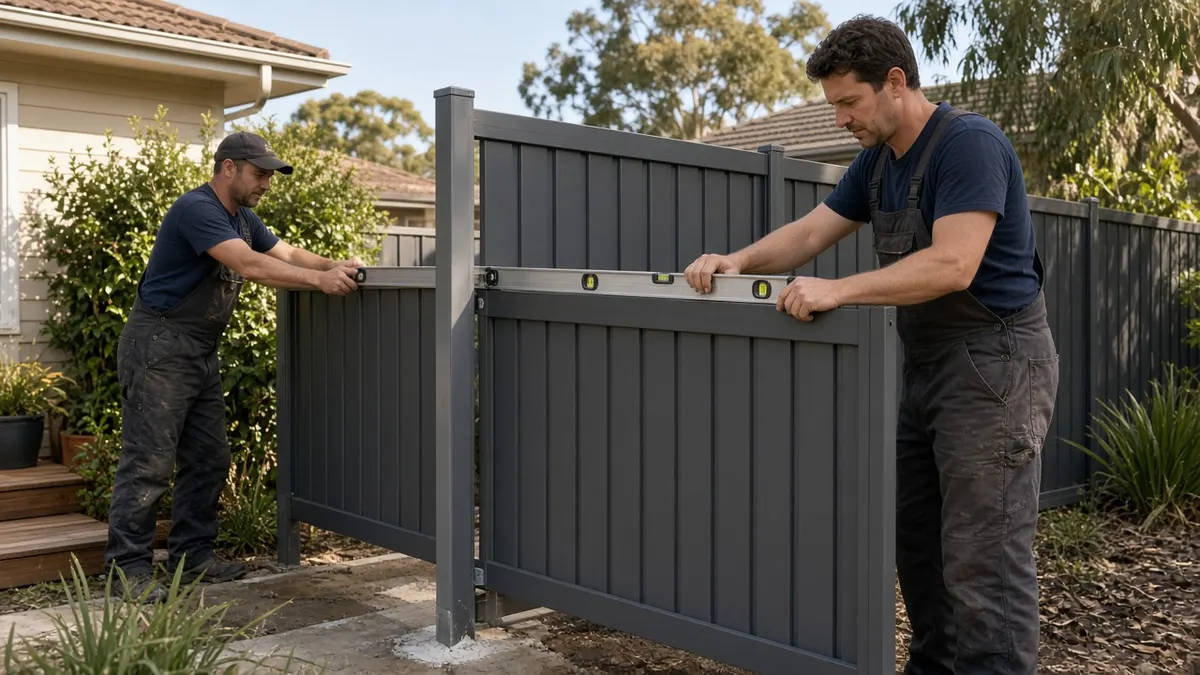
A standard 1.8 m Colorbond fence costs about $110 to $190 per linear metre installed in 2026, GST included. For a typical 25 m side boundary that is roughly $2,800 to $4,800, and if it divides two private properties your neighbour normally pays half.
Colorbond has become the default boundary fence in new estates and most suburban replacements because it is quick to put up, does not rot, does not need painting and termites cannot touch it. The price has crept closer to treated pine paling over the past few years, which has made the choice easier for a lot of people. Below is what goes into the price, where the extras hide, and three costed jobs from different cities. Treat every figure as indicative and get at least three written quotes for the same specification.
What you are paying for
A Colorbond fence is a simple kit. Steel posts, usually around 2.4 m long for a 1.8 m fence, are concreted into the ground at roughly 2.35 m centres. A top rail and bottom rail slide over or bolt to the posts, and the infill sheets drop into the rails. Sheets are pre-painted steel in a ribbed profile, made from BlueScope's Colorbond steel and sold under various fence system names by different manufacturers.
That simplicity is why installation is fast. Most of the labour goes into setting out a straight line, digging and concreting the posts at the right height and spacing, then coming back once the concrete has firmed up to fit the rails and sheets. On flat sandy ground a two-person crew can put up 40 m or more in a day. On rocky, sloping or tight sites it can be half that.
On an average job the split is roughly 55% materials and 45% labour, though that shifts with steel prices and how hard the ground is.
Colorbond fence prices by height and style
| Fence specification | Installed price per metre | Notes |
|---|---|---|
| 1.5 m standard | $100 to $170 | Common for side returns and low-privacy runs |
| 1.8 m standard | $110 to $190 | The default boundary fence in most suburbs |
| 2.1 m standard | $135 to $225 | May need council approval; check before ordering |
| 1.8 m with 300 mm lattice top | $150 to $240 | Extra height without a solid wall look |
| 1.8 m slat-look steel panels | $180 to $320 | Flat-faced or slatted panels in Colorbond colours |
| Cyclone-rated 1.8 m (northern Australia) | $160 to $260 | Heavier posts, deeper footings, engineered design |
The two sides of a Colorbond fence are usually the same colour, though most systems let you order a different colour on each side if neighbours disagree. Single-sided colour sheets with a plain grey back are slightly cheaper but rarely make sense on a dividing fence. Popular choices include greys such as Woodland Grey and Monument and lighter tones that reflect more heat. A darker sheet gets very hot in summer sun, which matters if you plan to grow plants against it.
The extras that change the final number
The per-metre rate covers the fence itself. These items are often listed separately, and they can add 20% to 50% to the total on a difficult block.
| Extra | Typical cost (incl. GST) |
|---|---|
| Remove and dispose of old timber or steel fence | $15 to $40 per metre |
| Licensed removal of old fibro (asbestos) fence | $40 to $90 per metre plus disposal |
| Concrete or steel plinth under sheets on a slope | $20 to $60 per metre |
| Colorbond pedestrian gate, 900 mm, installed | $450 to $900 |
| Double Colorbond driveway gates | $1,200 to $2,800 |
| Lattice extension added to an existing fence | $40 to $90 per metre |
| Rock drilling or core drilling for post holes | $20 to $50 per hole |
| Hard access surcharge (everything carried in) | $150 to $600 per job |
Plinths deserve a closer look. Colorbond sheets should not sit in soil or have garden beds piled against them, because trapped moisture breaks down the paint and the steel underneath rusts from the bottom up. Most manufacturers say this can void the warranty. A plinth also stops dogs digging under and fills the gaps on stepped fences. If the soil levels on either side of the boundary differ by more than about 150 to 200 mm, you probably need a small retaining wall, not a plinth. The retaining wall cost guide covers sleeper and block walls if your block falls away.
Gates are worth thinking about early. A Colorbond pedestrian gate on a steel frame is the cheapest option and matches the fence, but it is light and can rattle in the wind. For a driveway, many people step up to an aluminium slat gate or an automated slider. See the driveway gate cost guide for motor and electrician costs.
A 25 m Colorbond fence in five cities
Same job, different places: replacing a 25 m old timber boundary fence with a 1.8 m Colorbond fence, including removal and one pedestrian gate, on reasonable ground with good access.
| City | Typical total (incl. GST) | What moves the price |
|---|---|---|
| Sydney | $4,500 to $6,700 | High labour rates, sandstone, tight terrace and semi lots |
| Melbourne | $4,200 to $6,200 | Reactive clay needs deeper footings; plenty of fencers |
| Brisbane | $4,000 to $6,000 | Wind ratings on exposed sites, sloping blocks in older suburbs |
| Perth | $3,700 to $5,700 | Sand digs fast; limestone walls often needed first on slopes |
| Adelaide | $3,700 to $5,700 | Lower labour rates, clay in some suburbs |
Hobart and Canberra usually price close to Melbourne and Sydney respectively. Darwin and far north Queensland run higher because of freight and cyclone-rated construction, and regional towns tend to be cheaper on labour but may add travel for outlying properties.
Three costed jobs
New estate in Werribee, Victoria
A new four-bedroom house on a 448 m² lot needs Colorbond on both side boundaries and the rear: 26 m plus 26 m plus 17 m, 69 m in total. No old fence to remove, flat ground, good access before the landscaping goes in. Each boundary is shared with a neighbour who has also just built, so the costs split three ways across the different neighbours.
- 69 m of 1.8 m Colorbond at $125 per metre: $8,625
- One pedestrian gate on the side return: $600
- Total: $9,225
With every boundary shared, the owner's half of the fence comes to about $4,310, plus the full $600 for the gate. Some developers in new estates offer fencing rebates or require a particular colour under the estate design guidelines, so read the contract of sale and covenants before choosing a colour.
Fibro fence replacement in Morley, Perth
A 1960s house on a 700 m² block has 32 m of old corrugated fibro fence along one side. Fences like this contain asbestos. The removal has to be done by a licensed asbestos removalist because the area is well over the 10 m² limit for unlicensed business removal of non-friable asbestos.
- Licensed removal, wrapping and disposal of 32 m fibro fence: $2,400
- Clearance or air monitoring if required: $300
- 32 m of 1.8 m Colorbond at $130 per metre: $4,160
- Concrete plinths on the lower 12 m where the ground falls: $480
- Total: $7,340
The asbestos removal adds roughly 40% to the job. Under the WA Dividing Fences Act, the neighbour would usually share the cost of a sufficient replacement fence, and the removal of the old fence is normally treated as part of that work, but agree it in writing first. The asbestos removal cost guide covers removal pricing in more detail.
Lattice extension in Mitcham, Adelaide
The fence is only five years old but a new two-storey house next door looks straight into the back yard. The owners add a 300 mm Colorbond lattice extension along 18 m of the fence.
- Extension posts or brackets, lattice panels and rails, 18 m: $760
- Labour: $560
- Total: $1,320, or about $73 per metre
Extensions like this are usually not covered by dividing fence cost sharing unless the neighbour agrees, because the existing fence is already sufficient. Check with the council if the total height ends up above 2.1 m.
Splitting the bill with your neighbour
Every state has a dividing fence law, and the basic rule is the same: two private neighbours share the cost of a sufficient fence equally. In most suburbs a plain 1.8 m Colorbond or timber paling fence counts as sufficient, so a standard Colorbond job is usually a straight 50/50 split. If you want extras your neighbour does not need, such as a 2.1 m height, a lattice top or slat-look panels, expect to pay the difference yourself.
The practical steps are to talk first, agree on the colour for each side and the contractor, and get it in writing. If you cannot agree, each state has a formal notice process and a set waiting period before you can go to mediation or a court or tribunal. Building first and asking for money later often means you cannot recover anything. The state-by-state rules, including which court or tribunal handles disputes, are summarised in the main fencing cost guide.
Two common sticking points: a neighbour who wants the sheets in a different colour on their side, which most systems can do for little or no extra cost, and a neighbour who wants to keep the old fence because it still stands. In the second case, the law in most states looks at whether the existing fence is still sufficient, not whether it is attractive.
On the day of installation
On a typical two-day job, the crew arrives early on day one, pulls out the old fence and stacks it for removal, then runs a string line along the boundary. Post holes are dug by hand or with a petrol auger, and posts are concreted in and checked for height and plumb. If the neighbour's side is overgrown, expect the crew to need access through their yard as well, so organise that beforehand.
Day two, usually after the concrete has had at least overnight to firm up, is rails, sheets, any plinths and the gate. A careful crew finishes by picking up offcuts, screws and metal filings. Steel swarf left on the sheets or the ground rusts and leaves orange stains, so ask the crew to sweep and blow down the fence at the end.
Dogs and kids are the main concern while the boundary is open. Plan to keep pets inside or at a friend's place for the day or two the fence is down.
Looking after it
Colorbond is low maintenance, not no maintenance. Hose it down once or twice a year, more often near the coast or a busy road, to stop dirt and salt sitting on the paint. Keep garden beds, mulch, compost bins and soil away from the bottom of the sheets. Use a line trimmer carefully along the base, because a nylon line chips the paint over time and exposes the steel.
Scratches can be touched up with the matching touch-up paint sold by fence suppliers. A dented sheet can usually be swapped out on its own by lifting off the top rail, which costs far less than replacing a section of timber fence. If posts start to lean, it is usually because of poor footings, a tree root or soil moving after heavy rain, and catching it early stops the sheets from buckling.
Colorbond compared with timber
Treated pine paling is still a little cheaper in most cities, usually by $20 to $40 per metre. Over 20 years the comparison usually flips. Timber needs staining every three to five years to look good, palings split and warp, and posts eventually rot at the base. Colorbond needs an occasional hose-down and that is about it.
Timber does win in some situations. It is easier to repair one section at a time, it can be built to any height on a sloping block without awkward steps, and many people simply prefer how it looks, particularly hardwood lapped and capped or a slat screen. It also stays cooler, which matters along a north-facing vegetable garden. The timber fencing cost guide covers species and styles, and the broader fencing cost guide compares every material side by side and explains the dividing fence rules in each state.
Wind, coast and bushfire
Colorbond fences act like a sail. In normal suburban conditions a well-built fence handles it fine, but exposed coastal sites, hilltops and new estates without established trees and houses put more load on the posts. Ask your fencer what post size and footing depth they are using, and whether they follow the manufacturer's wind rating tables for your area.
In cyclone regions such as Darwin, Townsville and Cairns, fences need a heavier engineered design with bigger posts, closer spacing and deeper footings, which is why prices run higher there.
Close to the surf, salt spray attacks any painted steel. Manufacturers have coastal guidance and some systems use a more corrosion-resistant grade of steel for severe marine sites. Ask the supplier which product suits your distance from the beach, and rinse the fence with fresh water a few times a year.
In bushfire-prone areas, a steel fence is non-combustible, which is one reason it is often recommended near houses in higher bushfire attack level zones. Check your council's requirements if you are rebuilding after a fire or building in a mapped bushfire area.
Can you put up a Colorbond fence yourself?
Plenty of handy owners do. Hardware stores and fencing suppliers sell Colorbond fence kits by the panel, and materials alone typically cost $60 to $100 per metre for a 1.8 m fence. The hard parts are setting a dead straight string line, getting post heights and spacing exact so the rails and sheets fit, and digging 20 or more post holes to the right depth. A hired post hole auger helps on soft ground and is useless on rock.
The legal side is simple for most suburban fences, but there are a few traps:
- Licensing applies to contractors you pay, not owners doing their own work, but thresholds matter. In NSW a contractor doing residential building work over $5,000 generally needs a licence from NSW Fair Trading. In Queensland the QBCC threshold for most building work is $3,300. In WA, check the current rules with Building and Energy.
- Lodge a free Before You Dig Australia enquiry. Post holes along a boundary regularly find water, gas, power or NBN lines.
- Never cut, drill or smash an old fibro fence. Treat any pre-1990 fibro as asbestos until tested.
- Serve a dividing fence notice before you build if you want your neighbour to contribute.
For a boundary that shows from the street or a neighbour's living room, many people decide the time saved and the neat finish are worth paying a fencer, and do the demolition and clean-up themselves.
Getting a sharper price
- Agree with your neighbour first. Having both owners sign off on the quote, colour and timing avoids delays and halves your cost.
- Stick to standard heights. 1.8 m sheets and 2.4 m posts are stock items. Odd heights mean cutting and waste.
- Clear the boundary before the crew arrives. Shrubs, vines, old garden edging and rubbish along the line all cost time at a fencer's rate.
- Ask about off-season pricing. Late autumn and winter are quieter for fencers than spring and early summer.
- Bundle the gate and any small retaining. One visit is cheaper than two.
Checking the quote
A good Colorbond quote lists total metres, height, sheet profile and colour (on both sides), post size and spacing, footing depth, and what happens with the old fence and the rubbish. It should spell out extras such as plinths, rock clauses and gates, and include the contractor's ABN, licence number where required and public liability insurance. Check the manufacturer warranty on the sheets is passed on to you, and ask what the installer's own workmanship warranty covers.
Watch for a large deposit on a small job, a price that is far below every other quote, and no mention of where the boundary is. If the boundary is uncertain, a surveyor's peg-out before work starts can save a very expensive argument later.
Yakka for the labour side
The fencer's time is the expensive part, so it makes sense to get the grunt work done separately. Yakka connects you with workers by the shift to pull out old timber fences, break out old footings, clear the boundary, carry sheets through a narrow side gate and run loads to the tip. A day of help often costs less than a fencer's removal charge on a long run. Our guide to hiring a labourer for a day explains how it works and what to budget.
For the install itself, you can find a fencer near you, or source panels from fencing suppliers if you plan to build it yourself. Asbestos removal, and anything your state requires a licensed contractor for, still needs the appropriate licence holder.
Frequently asked questions
How much does a Colorbond fence cost per metre?
A standard 1.8 m Colorbond fence costs about $110 to $190 per linear metre installed in 2026, including GST. A 2.1 m fence is around $135 to $225 per metre, and slat-look steel panels run $180 to $320. Removal of the old fence, plinths, gates and rock drilling are usually extra. These are indicative figures, so compare three written quotes.
How much is a 20 metre Colorbond fence?
A 20 m run of 1.8 m Colorbond fence typically costs $2,200 to $3,800 installed. Add $300 to $800 to remove and dispose of an old timber fence and $450 to $900 for a pedestrian gate. If it is a dividing fence and your neighbour agrees to share, your half would usually be $1,100 to $1,900 for the fence itself.
Is Colorbond fencing cheaper than timber?
Not upfront in most cities. Treated pine paling is usually $20 to $40 per metre cheaper to install. Colorbond tends to be cheaper over its lifetime because it does not need staining, does not rot and is not affected by termites. Hardwood lapped and capped timber fencing often costs the same as or more than Colorbond.
How long does a Colorbond fence last?
A properly installed Colorbond fence typically lasts 25 to 30 years or more in normal suburban conditions. Coastal salt spray, soil or garden beds piled against the sheets, and damage from mowers and whipper snippers shorten its life. Keeping the bottom of the sheets clear of soil and rinsing the fence in coastal areas helps it last.
Do I need council approval for a Colorbond fence?
Most side and rear Colorbond fences up to about 1.8 m do not need council approval, but rules differ between councils and states. Fences over 1.8 m, front fences, fences on top of retaining walls, corner blocks and properties in heritage or bushfire areas may need approval. Check with your local council before you order materials.
Can I paint my side of a Colorbond fence a different colour?
You can paint Colorbond with a suitable primer and exterior paint, but it adds maintenance and may affect the manufacturer warranty. A better option is to order sheets with different colours on each side when the fence is installed. Most fence systems offer this, and it avoids arguments with neighbours who prefer a different colour.
How long does it take to install a Colorbond fence?
Most suburban Colorbond fences take one to two days. The crew removes the old fence, sets out the line and concretes the posts first, then returns once the concrete has firmed up to fit the rails, sheets and gates. Rock, slopes and narrow access can add a day. Booking lead times in spring are often four to eight weeks.
Official sources
Award rates, licences and safety rules change. Check the official source before you hire or take on a shift.
- Queensland Building and Construction Commission (QBCC)Contractor, plumbing and drainage licence search in Queensland
- NSW Fair TradingTrade licence checks for electricians, plumbers and builders in New South Wales
- Asbestos Safety and Eradication AgencyWhere asbestos is found in homes and how to deal with it safely
- Building and Energy (WA)Electrical, plumbing and building licensing in Western Australia