Exterior cost guide
Gutter Cleaning Cost in Australia: 2026 Price Guide
Typical cost in Australia (2026, inc. GST)
$150 to $450 per job
single-storey house, 40-60 linear metres of gutter, standard access
A professional gutter clean costs about $150 to $450 for a typical single-storey house with 40 to 60 linear metres of gutter, and roughly $300 to $800 for a two-storey home. Per-metre rates sit around $3.50 to $8 at single-storey height. Roof height and pitch, how packed the gutters are, blocked downpipes, gutter guards and green waste disposal are what move the price.
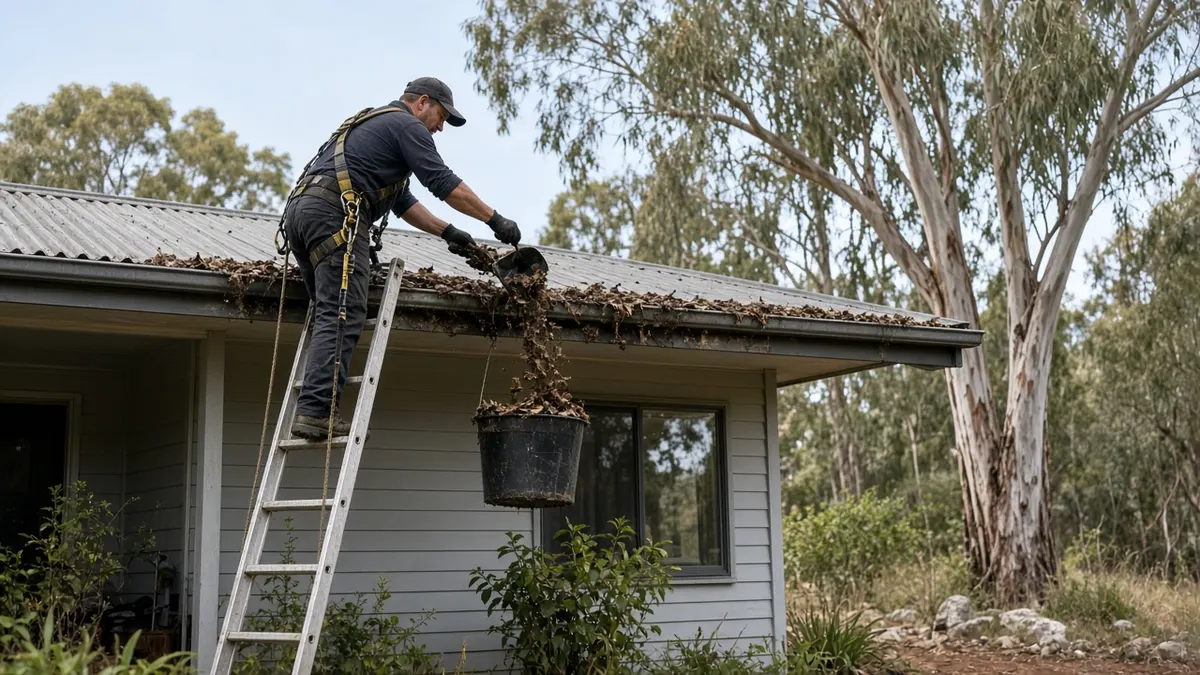
Most Australians pay between $150 and $450 to have the gutters on a single-storey house cleaned, and between $300 and $800 for a two-storey home. The low end is a small, flat-ish roof with light leaf build-up; the high end is a big or steep roof under gum trees with blocked downpipes and green waste to cart away.
Gutter cleaning is one of the cheaper exterior jobs you can book, but it is also one of the most skipped. A clean gutter costs a few hundred dollars a year. An overflowing one rots fascia boards, stains eaves, pushes water back under the roof sheets and, in fire-prone areas, gives embers a dry fuel bed right at the roofline. The figures below are indicative 2026 prices including GST. Use them to sanity-check quotes, and get at least three written quotes before you book.
Gutter cleaning prices at a glance
Most operators quote a fixed price per visit after looking at the house on Google Maps or in person. These are typical ranges for a full clean of all gutters, with debris bagged and downpipes checked.
| Home type | Typical gutter length | Typical price (incl. GST) |
|---|---|---|
| Small single-storey (unit, villa, 2-bed cottage) | 25 to 40 m | $150 to $280 |
| Standard single-storey (3 to 4 bed) | 40 to 60 m | $200 to $380 |
| Large single-storey or L-shaped | 60 to 80 m | $280 to $480 |
| Two-storey (standard) | 45 to 65 m | $300 to $550 |
| Two-storey, steep pitch or complex roof | 60 m and up | $450 to $800 |
| Highset Queenslander or split-level on a slope | 50 to 70 m | $350 to $650 |
Common add-ons are priced on top. Clearing a properly blocked downpipe runs about $40 to $120 each, depending on whether a hose and plumber's snake will shift it or whether the downpipe needs to be pulled apart at the bend. Removing and refitting gutter guards to clean underneath can add 20 to 50 percent to the job. Green waste disposal is often included, but some operators charge $30 to $80 if there are several bags.
How the job gets priced
There are three pricing models in the market, and it helps to know which one you are being quoted on.
Fixed price per visit
This is the most common for houses. The operator looks at roof size, storeys, pitch and tree cover and gives one number. It protects you from a slow worker and protects them from a messy surprise only if they quoted with some margin, which is why fixed quotes for leafy blocks tend to be higher.
Per linear metre
Some companies quote by the metre, usually $3.50 to $8 per metre for single-storey work and $6 to $12 per metre at two-storey height. A typical three-bedroom house has 40 to 60 metres of gutter, so 50 metres at $4 to $7 lands at $200 to $350. Per-metre pricing is easy to compare between quotes, but check the minimum charge, which is often $150 to $200.
Hourly rate
Handypeople and general labourers often charge by the hour, roughly $70 to $120 per hour per worker, with a one or two hour minimum and sometimes a call-out fee of $50 to $120. A competent worker with the right ladder setup gets through a standard single-storey roof in two to three hours. Hourly suits small jobs, such as a single blocked section over the back door, and owners who want other small tasks done in the same visit. For comparison, see our guide to handyman hourly rates in Australia.
What pushes a gutter cleaning quote up or down
Height and roof pitch
Height is the biggest single factor. A single-storey roof with a low pitch can often be cleaned from a ladder or by walking the roof safely. A two-storey home, or any roof steeper than about 25 to 30 degrees, usually means harnesses, roof anchors or edge protection, a second worker for safety and more time moving gear. That is why two-storey jobs cost close to double, even with the same gutter length.
Roof material
Colorbond and other metal roofs are quick to walk and do not crack. Concrete and terracotta tiles break if trodden on wrong, so the worker moves slower or works from a ladder around the perimeter. Old asbestos cement (fibro) roofs, found on some houses built before the 1990s, should not be walked on at all because they are brittle and a fall through the sheet is a real risk. Those jobs are done entirely from ladders or a cherry picker and cost more.
How packed the gutters are
A gutter cleaned last autumn holds a few centimetres of loose leaves. A gutter left for three years under a eucalypt holds compacted sludge with grass growing out of it. The second one takes twice as long and fills more bags. Expect the price to reflect it if you have skipped a few years.
Trees, valleys and box gutters
Roof valleys, where two roof planes meet, trap leaves before they reach the gutter and need clearing by hand. Box gutters, the internal gutters that run behind parapets on some modern and older terrace homes, are slow to clean and critical to keep clear because when they overflow the water goes inside the house. Each adds time.
Downpipes and stormwater
Most quotes include a quick flush of each downpipe. If a downpipe is blocked at the bend or underground at the stormwater connection, a cleaner can usually clear the above-ground part, but a blocked underground pipe is a job for a plumber with a drain camera or jetter.
Access and parking
Narrow side passages, steep blocks, pools under the eaves, glass roofs and no street parking all slow the job. Inner-city terraces with no rear access can cost more than a bigger suburban house for this reason.
Travel and season
Regional and outer-suburban jobs may carry a travel fee. Autumn is the busiest time in the southern states, and late spring is busy in bushfire-prone areas, so quotes can be firmer then. Booking in late winter usually means more availability and less waiting.
Prices by city
The table below assumes a standard single-storey house with about 50 metres of gutter and normal access. City differences mostly come down to labour rates, travel and parking time, and how many operators compete in the area.
| City or region | Standard single-storey clean | Why it differs |
|---|---|---|
| Sydney | $230 to $420 | Higher labour rates, parking and traffic time, many leafy suburbs |
| Melbourne | $210 to $400 | Heavy autumn demand in the eastern suburbs and the Dandenongs |
| Brisbane | $200 to $380 | Highset homes and big storm seasons add to some jobs |
| Perth | $200 to $370 | Long travel distances across a spread-out metro area |
| Adelaide | $190 to $350 | Lower labour costs, mostly single-storey housing stock |
| Hobart | $200 to $370 | Fewer operators, steep blocks in many suburbs |
| Canberra | $220 to $400 | Large deciduous street trees and solid autumn demand |
| Darwin | $250 to $450 | Heat limits working hours, fewer operators, pre-wet season rush |
| Regional towns | $180 to $400 plus travel | Lower rates, but travel fees can add $30 to $100 |
Three jobs, costed line by line
These examples show how a real quote breaks down. All amounts include GST, and the GST share is shown for reference.
Single-storey brick veneer in Penrith, NSW
A three-bedroom brick veneer with a Colorbond roof, 48 metres of quad gutter, four downpipes and two big gums along the back fence. Cleaned about 18 months ago. One worker, ladder and roof access.
| Item | Cost |
|---|---|
| Labour, 2.5 hours at $90 per hour | $225 |
| Clearing one blocked downpipe at the bend | $60 |
| Green waste removal (four bags) | $30 |
| Total | $315 |
| GST included in total | about $29 |
Two-storey home with gutter guards in Doncaster, VIC
A 1990s two-storey with a concrete tile roof, 70 metres of gutter and aluminium mesh gutter guards that have not been touched in four years. Two workers for safety, because the tiles cannot be walked freely and the upper gutters need ladder stand-offs.
| Item | Cost |
|---|---|
| Labour, two workers for 3 hours each at $95 per hour | $570 |
| Lifting and refitting mesh guards (included in labour) | $0 |
| Downpipe flush and check, six downpipes | $40 |
| Green waste disposal | $40 |
| Total | $650 |
| GST included in total | about $59 |
Highset Queenslander in Ashgrove, QLD
A timber Queenslander on stumps with a steep corrugated iron roof, 62 metres of gutter and a mango tree over one side. The pitch means the worker sets a roof anchor and works in a harness.
| Item | Cost |
|---|---|
| Roof anchor and harness setup | $80 |
| Labour, 3.5 hours at $95 per hour | $333 |
| Clearing two downpipes | $100 |
| Green waste disposal | $30 |
| Total | $543 |
| GST included in total | about $49 |
Notice the pattern. The gutters themselves are not the expensive part; time at height is. If two quotes differ by $200 for the same house, ask each operator how they plan to access the roof. The cheaper one may be planning to skip safety gear.
Gutter guards: what they cost and whether they pay off
Gutter guards are mesh or inserts that sit over or inside the gutter to keep leaves out. They reduce how often you need a clean, but they do not remove the need entirely. Fine debris, seed pods and dust still collect, and mesh can trap leaves on top that need brushing off.
| Guard type | Installed cost per linear metre | Notes |
|---|---|---|
| Plastic or PVC mesh | $12 to $25 | Cheap and DIY-friendly, becomes brittle in strong UV within a few years |
| Brush or foam inserts | $10 to $20 (often DIY) | Easy to fit, but trap fine debris and need pulling out to clean |
| Aluminium mesh, professionally fitted | $25 to $45 | The most common choice, colour-matched to Colorbond, long life |
| Steel or aluminium ember-guard mesh | $35 to $60 | Fine aperture, non-combustible, used in bushfire-prone areas |
For a standard single-storey house with 50 metres of gutter, aluminium mesh costs about $1,250 to $2,250 installed. If you are currently paying $300 for a clean twice a year, and guards drop that to one lighter clean every year or two, the guards pay for themselves in roughly four to seven years. Under heavy tree cover or for a home on rainwater tanks, the case is stronger. On a house with no nearby trees, guards are rarely worth it.
In bushfire-prone areas, homes built to a bushfire attack level under AS 3959 generally need any gutter or valley guards to be non-combustible. Check with your council or certifier before fitting plastic guards on a house in a designated bushfire zone, and see the gutter and roof advice from the NSW Rural Fire Service or your state fire authority.
How often gutters need cleaning
There is no single right answer. Tree cover drives it far more than the calendar.
- Under eucalypts, pines or big deciduous trees: every three to four months. Gums drop bark and leaves year-round, and pine needles mat into a dense layer.
- Normal suburban block with a few trees: twice a year, typically late autumn after leaf drop and late winter or spring before storm and fire season.
- No trees within about 20 metres: once a year is usually enough. Dust, moss and bird nests still build up.
- Homes on rainwater tanks: more often than average, because rotting leaves taint the water and clog first-flush diverters.
- Tropical north: before the wet season, usually October or November, so the first heavy storms do not overflow into the eaves.
Doing it yourself: the real cost and the real risk
Cleaning a low single-storey gutter yourself is entirely legal and, for many people, perfectly doable. The gear for a basic DIY clean costs roughly $300 to $700 if you are starting from nothing:
- A good extension or platform ladder rated for at least 120 kg: $200 to $500
- A ladder stand-off or stabiliser, so the ladder rests on the roof and not the gutter: $60 to $120
- Gutter scoop, gloves, bucket with a hook and a hose with a trigger nozzle: $40 to $80
The money is not really the issue. Falls from ladders and roofs are a well-known cause of serious injury in Australia, and many of them happen during jobs exactly like this one. Rules of thumb any roof worker will tell you: keep three points of contact, set the ladder on firm level ground at roughly a one-in-four angle, never lean out past the rails, do not work on a wet or dewy roof, have someone at home while you are up there, and stay well clear of the overhead service line that runs from the street to your house. Safe Work Australia has plain guidance on working safely at heights that is worth reading even for a one-off home job.
My honest view: if the house is single-storey with a low-pitch metal roof and you are comfortable on a ladder, do it yourself and save the $250. If it is two storeys, steep, tiled or fibro, pay someone with the right gear. A broken wrist costs more than a decade of gutter cleans.
Licences, insurance and roof safety rules
Gutter cleaning on its own does not need a trade licence in any Australian state. That changes once the job moves into repairs. Replacing gutters, re-routing downpipes, fixing a sagging run or connecting to the stormwater system is roof plumbing or plumbing work, which is licensed in most states. If your cleaner says a section needs replacing, the quote for that work should come from a licensed roof plumber or plumber, not a general cleaner. Our gutter replacement cost guide covers who can do it and what it costs.
Anyone working on your roof for payment has duties under work health and safety laws to manage the risk of falls. In practice, that means a business cleaning two-storey gutters should be using edge protection, roof anchors and harnesses, or a hired boom lift, not a single ladder. Ask what they will use.
Insurance matters more than licensing here. A reputable operator carries public liability insurance, commonly $5 million to $20 million, which covers damage to your property such as cracked tiles or a ladder through a window. If they employ staff, they also need workers compensation. If an uninsured worker is injured on your roof, sorting out who pays can get messy. Ask for a certificate of currency before the job.
A note on older homes: if your house has fibro eaves, a fibro roof or an old fibro garage, assume it may contain asbestos unless it has been tested. Cleaners should not water-blast, scrape or break these materials. A gutter clean with a scoop and hose does not disturb them, but a careless roof walk can.
When a clean is not enough
A good cleaner will tell you if they spot problems. These are the ones worth acting on:
- Rust holes or split joints in steel gutters, usually from years of wet leaf sludge sitting in them. Small patches can be sealed for $80 to $200; widespread rust means replacement.
- Gutters that hold water after rain, which means the fall is wrong or the brackets have sagged.
- Water stains on eaves or fascia rot, a sign of long-term overflow. Timber fascia often needs replacing at the same time as the gutters.
- Cracked or slipped roof tiles, or loose ridge capping, spotted while on the roof. A small tile repair is cheap now and expensive after the next storm. Our roof leak repair guide covers typical prices.
- Moss and lichen across the roof, which washes into the gutters every time it rains. A proper roof clean can be timed with the gutter clean to save a second visit.
How to keep the bill down
- Stick to a schedule. Two regular cleans a year are faster, and usually cheaper in total, than one heavy clean every three years.
- Bundle jobs. Ask for a combined price for gutters, roof valleys, solar panel rinse and window cleaning. Operators save on setup and travel, and most will pass some of that on.
- Go in with the neighbours. Two or three houses on the same street booked on the same day often get a discount, since the travel and setup is shared.
- Trim overhanging branches. Cutting back limbs that hang over the roof reduces debris for years. Big trees near power lines or over the house need an arborist.
- Book off-peak. Late winter is quieter than autumn in the southern states.
- Keep the green waste. If you have a garden bin or compost, ask for the leaves to be bagged and left on site to shave off the disposal fee.
What a good quote looks like
For a job this size, a quote can be a short email or text, but it should still be in writing and should say:
- The full price including GST, and whether it is fixed or hourly
- Which areas are included: all gutters, valleys, box gutters, downpipe flushing
- How debris is handled: removed from site, bagged on site or into your green bin
- What happens if a downpipe is blocked underground
- How they will access the roof and what safety equipment they use
- Their ABN and confirmation of public liability insurance
- Whether before and after photos are provided, which is useful when you cannot see the gutters from the ground
Red flags include a door-knocker offering a cheap clean today and then finding expensive roof problems once up there, cash-only pricing with no ABN, refusal to show insurance, and a large deposit for what is a half-day job. A gutter clean should be paid on completion.
On the day: what to expect
Most single-storey cleans take two to three hours; two-storey and steep roofs take a half day or more with two workers. The crew will usually walk the perimeter first, set up ladders or roof anchors, scoop debris into bags, then flush each run with a hose to check the water flows to the downpipes. Expect some splatter on paths and windows below. Good operators rinse it off before they leave. Move cars out of the driveway, bring in pets and leave side gates open so they can reach every corner.
Booking gutter cleaning through Yakka
Gutter cleaning is labour-heavy work that suits Yakka Labour well. You can post the job and hire a handyperson or labourer for a few hours, either for a standard single-storey clean or to bag and cart away the leaf litter after a big clean-up day. Many owners combine it with garden tidying, trimming branches off the roof line or carting green waste. Browse gutter cleaning workers near you or local handypeople to compare profiles and rates.
For anything beyond a clean, such as replacing rusted sections, fixing the fall of a gutter or clearing an underground stormwater blockage, use a licensed roof plumber or plumber. Whoever you book, confirm they have the right gear for the height of your roof and current insurance before they climb up.
Frequently asked questions
How much does gutter cleaning cost per metre in Australia?
Per-metre pricing usually sits around $3.50 to $8 per linear metre for single-storey homes and $6 to $12 per metre at two-storey height. Most operators also have a minimum charge, often $150 to $200, so very small jobs cost more per metre. Heavily packed gutters, steep roofs and gutter guards that need lifting push the rate toward the top of the range.
How long does it take to clean gutters on a house?
A standard single-storey house with 40 to 60 metres of gutter takes one experienced worker about two to three hours, including flushing the downpipes and bagging debris. Two-storey homes, steep or tiled roofs and gutters that have not been cleaned for several years can take a half day or longer, often with two workers on site for safety.
How often should I get my gutters cleaned?
Twice a year suits most suburban homes, usually after autumn leaf drop and again before storm or bushfire season. If you live under eucalypts or pines, every three to four months is more realistic. Homes with no trees nearby can often stretch to once a year. Houses on rainwater tanks benefit from more frequent cleaning to protect water quality.
Are gutter guards worth it in Australia?
Gutter guards are worth it on leafy blocks, homes on rainwater tanks and properties in bushfire-prone areas, where non-combustible mesh is often required anyway. Professionally installed aluminium mesh costs about $25 to $45 per metre. Guards cut how often you need a clean but do not remove the need, because fine debris and dust still build up underneath.
Do you need a licence to clean gutters?
No state requires a trade licence to clean gutters. You should still choose someone with public liability insurance and proper equipment for working at heights. Once the job becomes repairs, such as replacing gutter sections, changing downpipes or connecting to stormwater, it becomes roof plumbing or plumbing work, which is licensed in most states.
Is it cheaper to clean gutters myself?
For a low single-storey roof, DIY saves around $200 to $400 a visit once you own a decent ladder and stabiliser. The real cost is risk. Falls from ladders and roofs cause serious injuries, so for two-storey, steep, tiled or fibro roofs, paying a professional with harnesses or edge protection is the safer and usually smarter choice.
Does home insurance cover damage from blocked gutters?
Many home insurance policies exclude damage caused by poor maintenance, which can include water damage from gutters left blocked for a long time. Policies differ, so read your product disclosure statement. Keeping invoices or dated photos from regular gutter cleans is a simple way to show you have maintained the property if you ever need to claim.
Official sources
Award rates, licences and safety rules change. Check the official source before you hire or take on a shift.
- Safe Work AustraliaNational work health and safety framework, including high-risk work licences
- Asbestos Safety and Eradication AgencyWhere asbestos is found in homes and how to deal with it safely