Exterior cost guide
Asbestos Removal Cost Australia (2026): Testing, Removal, Disposal
Typical cost in Australia (2026, inc. GST)
$1,200 to $6,000 per job
licensed removal of 10 to 70 m² of bonded asbestos, including disposal and clearance
Licensed removal of non-friable (bonded) asbestos sheeting usually costs $40 to $90 per m², with most household jobs landing between $1,200 and $6,000 including disposal and clearance. Small jobs carry minimum charges of about $800 to $1,500. Friable asbestos such as pipe lagging needs a Class A licensed removalist, air monitoring and an enclosure, and often costs $5,000 or more even for a small area.
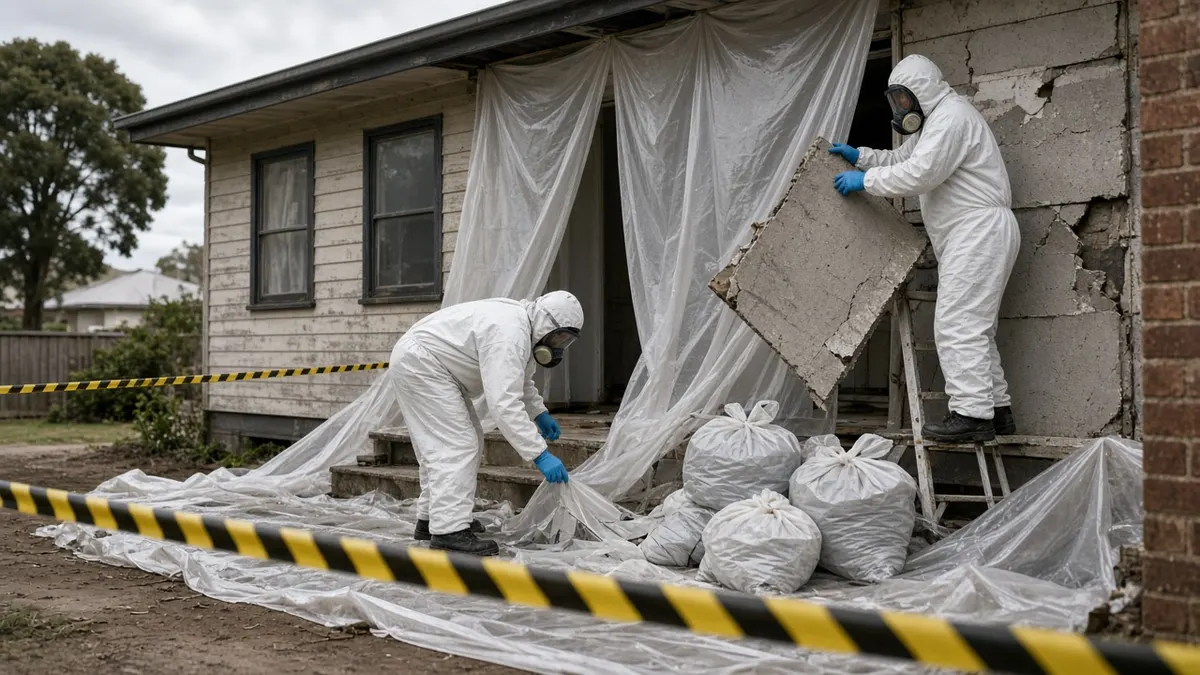
Removing bonded asbestos from an Australian home typically costs $40 to $90 per m² when done by a licensed removalist, and most household jobs, such as a fibro garage, a bathroom with asbestos wall sheeting or a run of eaves, cost between $1,200 and $6,000 all up. Friable asbestos is a different category: it must be removed by a Class A licensed removalist under controlled conditions, and even a small job often costs $5,000 or more.
The figures in this guide are indicative 2026 prices in AUD including GST. Asbestos jobs vary a lot with access, the type of material and how much there is, so get at least three written quotes from licensed removalists, and get the material tested before anyone touches it.
Friable or non-friable: the difference that sets the price
Every asbestos price starts with one question: is the material friable or non-friable?
- Non-friable (bonded) asbestos is asbestos fibre locked into a solid material, usually cement. Fibro wall and eave sheeting, corrugated "super six" roofing, fibro fences, flue pipes and the backing on some old vinyl floor tiles are typical examples. In good condition and left alone, it releases few fibres. Cutting, drilling, breaking, sanding or weathering changes that.
- Friable asbestos can be crumbled or reduced to powder by hand pressure when dry. Pipe and boiler lagging, sprayed insulation, some old heater and stove insulation, and loose-fill insulation are examples. Bonded asbestos that is badly weathered, fire-damaged or crushed can also become friable.
The licensing rules follow that split, and the price follows the licensing.
Who is allowed to remove it
Asbestos removal is regulated under work health and safety laws in every state and territory. The core rules are consistent across most of the country:
- Friable asbestos, any amount: must be removed by a removalist holding a Class A asbestos removal licence. There is no quantity small enough to make it a job for an unlicensed person.
- Non-friable asbestos over the state limit, commonly 10 m²: must be removed by a removalist holding at least a Class B licence. A Class A licence holder can also do this work.
- Clearance after removal: after Class A work, an independent licensed asbestos assessor carries out air monitoring and the clearance inspection. After Class B work, an independent competent person carries out the clearance inspection and issues a clearance certificate.
The law sets out what a licence is needed for, but this guide does not recommend removing any amount of asbestos yourself. Small amounts are still hazardous, the disposal rules are strict, and a mistake can contaminate your home, your yard and your neighbours' properties. Licensed removalists have the training, equipment, decontamination procedures and disposal arrangements to do it safely.
Thresholds and procedures can differ in detail between states, so check the current rules with your state WHS regulator: SafeWork NSW, WorkSafe Victoria, WorkSafe Queensland, WorkSafe WA, SafeWork SA, WorkSafe Tasmania, WorkSafe ACT or NT WorkSafe. Ask any removalist for their licence class and number, and check it on the regulator's public register.
Testing and assessment costs
You cannot tell whether a sheet is asbestos by looking at it. Fibre cement made after the late 1980s looks almost identical to the old product. Testing is cheap compared with removal, and it stops you paying for asbestos removal on material that turns out to be safe.
| Service | Typical cost (inc. GST) | What you get |
|---|---|---|
| Laboratory analysis of a sample | $50 to $150 per sample | Result from a NATA-accredited lab, often in one to three days |
| Site visit and sampling by an assessor or hygienist | $300 to $700 | Samples taken safely, with a short report |
| Full asbestos inspection of a house before renovating | $500 to $1,200 | Room-by-room survey, sample results and condition notes |
| Air monitoring for Class A work | $400 to $900 per day | Monitoring before, during and after removal |
| Clearance inspection and certificate | $250 to $600 | Visual inspection and certificate, more for friable jobs |
Taking a sample yourself means breaking off a piece of possibly asbestos material, which is the exact thing you want to avoid. A professional assessor does it under controlled conditions, seals the sample point and sends it to the lab. If you are buying a pre-1990 home, an asbestos check is worth adding to the building and pest inspection. Our building inspection cost guide covers combined inspection pricing.
Removal prices by material
These ranges are for licensed removal including labour, protective equipment, wrapping, transport and disposal. Clearance certificates are sometimes included and sometimes extra.
| Material | Licence class | Typical cost (inc. GST) |
|---|---|---|
| Flat fibro wall or eave sheeting | Class B over the limit | $45 to $90 per m² |
| Corrugated asbestos cement roof | Class B | $35 to $70 per m², plus scaffold or edge protection |
| Fibro fence panels | Class B | $60 to $120 per linear metre |
| Bathroom or laundry wall sheeting behind tiles | Class B | $1,500 to $3,500 per room |
| Vinyl floor tiles or sheet vinyl with asbestos backing | Class A or B, depending on condition and backing | $40 to $100 per m² |
| Flue pipes and small fittings | Class B | Minimum job charge, often $800 to $1,500 |
| Pipe or boiler lagging | Class A | $3,000 to $10,000+ depending on length and access |
| Fire-damaged or badly broken bonded asbestos | Often Class A | Quoted per job, usually well above bonded rates |
Per-m² rates fall on bigger jobs. A crew that has to set up, wear full protective equipment, wrap the waste and drive to a licensed tip has the same fixed costs for 12 m² as for 60 m², which is why small jobs often work out at $80 to $120 per m² once the minimum charge applies.
What pushes the price up
Access and height
A fibro garage wall at ground level is straightforward. A two-storey eave line or a steep roof needs scaffold or edge protection, which can add $1,000 to $4,000 on its own. Tight subfloors and roof spaces slow the crew and increase the risk of breakage.
Condition of the material
Sheets that come off whole are the cheapest to remove. Brittle, weathered or broken sheets have to be wetted down and handled piece by piece, and if the material has become friable, the job moves into Class A territory with enclosures, negative air units and air monitoring.
Friable work controls
Class A jobs need a sealed enclosure, negative pressure air units with HEPA filters, a decontamination unit for the workers, independent air monitoring and a licensed assessor's clearance. That set-up is the main reason friable work costs so much more per m² than bonded work.
Disposal
Asbestos waste must be wrapped in heavy-duty plastic, labelled and taken to a facility licensed to accept it. Disposal fees vary by facility and state and are usually built into the quote. In NSW, loads of asbestos waste are tracked through an online system run by the EPA, and other states have their own transport and disposal rules. Asbestos must never go in a general skip bin; our skip bin hire cost guide explains what can.
Making good
Removal leaves a gap: bare framing where wall sheeting was, open eaves, a roof with no cover. Replacement cladding, new eave lining, plastering or a new roof are separate costs, and should be in a separate quote from a builder or the relevant trade.
Rates by city
For removal of bonded wall or eave sheeting on a mid-sized job of 30 to 60 m², expect roughly:
| City or area | Typical rate per m² (inc. GST) | Why it differs |
|---|---|---|
| Sydney | $50 to $85 | High labour costs, disposal fees and travel to licensed sites |
| Melbourne | $45 to $80 | Large supply of licensed removalists |
| Brisbane | $45 to $75 | Many fibro and Queenslander renovations, competitive market |
| Perth | $45 to $80 | Long travel distances to licensed facilities from outer suburbs |
| Adelaide | $40 to $75 | Lower labour costs |
| Hobart | $45 to $80 | Smaller pool of licensed removalists |
| Canberra | $50 to $90 | Higher labour costs, strong regulatory focus after loose-fill |
| Darwin | $55 to $95 | Small market, freight and fewer disposal sites |
| Regional areas | Metro rate plus travel | Crews may travel long distances to the job and the tip |
Breakdowns from three typical jobs
Fibro garage in Woy Woy, NSW
A detached 1960s garage with 42 m² of flat fibro wall sheeting and a 30 m² corrugated asbestos cement roof, being demolished to make room for a new carport. Testing confirmed chrysotile in both. The whole 72 m² is bonded and in fair condition, so a Class B removalist does the work.
| Line item | Cost (inc. GST) |
|---|---|
| Assessor site visit and two lab samples | $350 |
| Removal labour, two-person crew for about 1.5 days | $2,600 |
| PPE, plastic sheeting, wetting and decontamination consumables | $250 |
| Wrapping, transport and disposal at a licensed facility | $600 |
| Independent clearance inspection and certificate | $400 |
| Total | $4,200 |
Removal and disposal come to about $48 per m², inside the normal bonded range. The timber frame and slab were then demolished separately as ordinary building waste.
1960s bathroom in Wavell Heights, QLD
Before a bathroom renovation, testing found asbestos in 18 m² of wall sheeting behind the tiles and in the backing of 5 m² of old vinyl flooring. Both were bonded and in good condition.
| Line item | Cost (inc. GST) |
|---|---|
| Sampling and lab analysis (two samples) | $250 |
| Removal of tiles, sheeting and vinyl by Class B crew, one day | $1,500 |
| Consumables and decontamination | $150 |
| Transport and disposal | $250 |
| Clearance inspection and certificate | $350 |
| Total | $2,500 |
That works out at roughly $83 per m² for removal and disposal, higher than the bigger garage job because of the small area and the fiddly work around plumbing. The renovation itself is covered in our bathroom renovation cost guide.
Friable pipe lagging in Moonah, TAS
Under a 1950s weatherboard house, about 14 metres of old heating pipe is wrapped in deteriorating lagging. Testing confirms friable asbestos, so a Class A removalist is required, with an independent licensed assessor for air monitoring and clearance.
| Line item | Cost (inc. GST) |
|---|---|
| Assessor inspection, sampling and removal scope | $500 |
| Class A removal: enclosure, negative air unit, decontamination unit, crew for 1.5 days | $4,800 |
| Independent air monitoring before, during and after | $1,100 |
| Wrapping, transport and disposal | $400 |
| Clearance inspection and certificate by licensed assessor | $500 |
| Total | $7,300 |
A short length of friable lagging costs more than a whole bonded garage. That is normal, and it reflects the controls friable work needs.
Asbestos roofs
Corrugated asbestos cement roofs were common on houses, garages and sheds until the 1980s. Removing the roof from an average single storey house of 150 to 200 m² typically costs $7,000 to $15,000 including scaffold or edge protection and disposal, before the new roof goes on. Replacing it with Colorbond adds the cost of new battens where needed, sheeting, flashings, gutters and insulation. Our roof replacement cost guide covers the full job.
Never let anyone water blast, power wash or grind an asbestos cement roof. WHS laws prohibit using high-pressure water spray and compressed air on asbestos, and power tools can only be used with strict dust controls, because they release fibres into the air and spread contaminated slurry across your yard and your neighbours'. Painting or sealing a sound asbestos roof without high-pressure cleaning is sometimes an option, but get advice from an assessor first.
Leave it, seal it or remove it
Bonded asbestos in good condition that you are not going to disturb does not have to be removed. Many houses have fibro eaves that have sat quietly for 60 years. The options are:
- Leave it alone if it is intact, out of harm's way and not part of planned work. Keep a note of where it is so future trades know.
- Seal or encapsulate it with a suitable paint or coating if it is sound but slightly weathered. This should be done without sanding or high-pressure cleaning, and an assessor can advise whether it suits your situation.
- Remove it if it is damaged, deteriorating, friable, or in the way of renovation or demolition.
Any renovation in a pre-1990 home should start with a check for asbestos in the areas being worked on. Drilling a hole for a downlight, cutting an eave for a gutter or ripping out a bathroom wall without testing are common ways homeowners and trades get exposed.
Where asbestos hides in Australian homes
Asbestos products were used widely in Australian building from the 1940s until the mid-1980s, and all use and import was banned from the end of 2003. If your home was built or renovated before 1990, assume it may contain asbestos until tested. Common locations include:
- Fibro wall cladding, eave linings and gable ends.
- Wet area wall sheeting behind tiles in bathrooms and laundries.
- Vinyl floor tiles and the backing of sheet vinyl.
- Corrugated roofing on houses, garages, carports and sheds.
- Fibro fences, especially in older suburbs of Sydney, Brisbane and Perth.
- Flue pipes from old heaters and hot water units.
- Lagging on old pipes and boilers.
- Loose-fill insulation in the roof space of some homes in the ACT and parts of NSW, which is friable and has been the subject of government programs.
The Asbestos and Silica Safety and Eradication Agency has a guide to where asbestos was used in homes and how to handle renovation safely.
What happens on removal day
A licensed removalist will usually notify the state WHS regulator before the job, commonly at least five days ahead for licensed work, so do not expect an asbestos job to start the next morning unless it is an emergency.
On the day, the crew sets up a work zone with warning signs and barrier tape and covers the ground with plastic sheeting. They wear disposable coveralls and respirators, wet the material down to keep fibres from becoming airborne, and remove sheets whole wherever possible by unscrewing or carefully prying them off rather than breaking them. Waste is double-wrapped in heavy plastic, labelled and loaded for transport. The work area is then cleaned with a HEPA vacuum and wet wiping, and the crew decontaminates before leaving the zone.
For friable work, the crew builds a sealed plastic enclosure first, runs negative air units so air flows into the enclosure rather than out, and sets up a decontamination unit. Air monitoring runs before, during and after the job. Nobody else should go near the work area until the clearance inspection is passed and the certificate issued.
Most bonded jobs take one to two days. Friable jobs take longer because of the set-up and clearance steps. Keep the clearance certificate with your house records. You may need it when selling, and future trades will want to see it.
Neighbours, tenants and strata
Good removalists let neighbours know before work starts and keep the work zone clear of shared fences and windows. Some states require notice to adjoining properties for certain jobs, so ask your removalist what applies.
Landlords should tell tenants about asbestos work and organise for them to be out of the affected area. In strata buildings, asbestos in common property such as roofs, eaves and service risers is the owners corporation's responsibility, and many buildings keep an asbestos register as part of their workplace obligations.
Comparing quotes from removalists
A good written quote from an asbestos removalist should include:
- The licence class and licence number, and the business ABN.
- The material, location and approximate area or length to be removed.
- Whether the material is treated as friable or non-friable, and why.
- Control measures: wetting, plastic sheeting, enclosures, air units and decontamination.
- Waste wrapping, transport and the disposal facility.
- Who carries out air monitoring (for Class A) and the clearance inspection, and that they are independent of the removalist.
- Whether the clearance certificate is included in the price.
- What is excluded, such as replacement cladding, roofing or plastering.
- Public liability insurance and workers compensation cover.
Red flags include no licence number, a "we'll just break it up and put it in a skip" approach, offers to water blast an asbestos roof, cash-only pricing, no mention of a clearance certificate and a quote far below the others without explanation.
Keeping the cost down safely
- Test before you quote. If testing shows a sheet is not asbestos, the removal can be done as ordinary building work at a fraction of the price.
- Bundle the work. If several areas need removal, do them in one visit. Set-up, disposal trips and clearance are fixed costs.
- Plan around the renovation. Remove asbestos at the start of a renovation so the builder is not paying idle trades while you wait.
- Clear the work area. Move furniture, cars and stored items out of the way before the removalist arrives so they are not paying a crew to shift things in protective gear.
- Ask about government programs. Some councils and states have run asbestos disposal or loose-fill programs. Check what currently applies in your area with your council or state regulator.
Where Yakka can help, and where it cannot
Yakka workers do not handle, remove or clean up asbestos. That work belongs with licensed removalists, and you can find licensed asbestos removalists listed on the platform. Always check their licence class and number with your state regulator before booking.
Where Yakka fits is the work around it. Before the removalist arrives, a worker can empty the garage, move furniture and stored goods out of the work area, and clear access. After the clearance certificate is issued, workers can help with the non-asbestos strip-out, demolition of clean materials, and rubbish removal of ordinary building waste. That keeps the expensive licensed crew focused only on the asbestos.
Frequently asked questions
How much does asbestos removal cost per m2?
Licensed removal of bonded asbestos sheeting usually costs $40 to $90 per m² in Australia, including disposal. Large jobs over about 50 m² sit at the lower end, while small jobs often work out at $80 to $120 per m² once minimum charges of $800 to $1,500 apply. Friable asbestos removal costs much more because it needs enclosures, air monitoring and a Class A licence.
Do I need a licence to remove asbestos?
Friable asbestos of any amount must be removed by a Class A licensed removalist. Non-friable asbestos over the state limit, commonly 10 m², must be removed by a removalist holding at least a Class B licence. Rules differ in detail between states, so check with your state WHS regulator. We do not recommend removing any amount of asbestos yourself.
How much does an asbestos test cost?
Laboratory analysis usually costs $50 to $150 per sample. Having an assessor or occupational hygienist visit, take samples safely and write a short report typically costs $300 to $700. A full asbestos inspection of a house before a renovation is usually $500 to $1,200. Results from a NATA-accredited lab often come back within one to three business days.
How do I know if my house has asbestos?
If your home was built or renovated before 1990, it may contain asbestos in fibro sheeting, eaves, wet area walls, vinyl flooring backing, roofing, fences or flue pipes. You cannot identify asbestos reliably by sight, because newer fibre cement looks almost the same. The only way to know is to have a professional take samples for laboratory analysis.
How long does asbestos removal take?
Most bonded asbestos jobs on houses take one to two days on site. Friable jobs take longer because of the enclosure, air monitoring and clearance steps. Licensed removalists usually need to notify the state WHS regulator several days before work starts, commonly at least five days, so allow a week or more between accepting a quote and removal day.
Can I stay in my house during asbestos removal?
For external bonded jobs such as eaves, fences or a garage, you can usually stay home but should keep windows and doors closed and stay out of the work zone. For internal work and all friable removal, the affected area is sealed off and you may need to leave the house until the clearance inspection is passed. Your removalist will advise.
How much does it cost to remove an asbestos roof?
Removing an asbestos cement roof from a typical single storey house of 150 to 200 m² usually costs $7,000 to $15,000, including scaffold or edge protection, wrapping and disposal. The new roof is extra. Never have an asbestos roof water blasted or power washed, as WHS laws prohibit high-pressure water on asbestos.
Official sources
Award rates, licences and safety rules change. Check the official source before you hire or take on a shift.
- SafeWork NSWWhite cards, high-risk work licences and WHS rules in New South Wales
- WorkSafe VictoriaConstruction induction, high-risk work licences and WHS rules in Victoria
- Workplace Health and Safety QueenslandHigh-risk work licences and the Electrical Safety Office in Queensland
- WorkSafe WAHigh-risk work licences and WHS rules in Western Australia
- SafeWork SAHigh-risk work licences and WHS rules in South Australia
- WorkSafe ACTWHS rules and licensing in the Australian Capital Territory