More cost guide
Gas Installation Cost Australia 2026: Gasfitter Prices
Typical cost in Australia (2026, inc. GST)
$200 to $600 per job
single appliance connection or bayonet point near an existing gas line
Gas installation in Australia costs about $200 to $600 in 2026 for simple jobs like connecting a cooktop or adding a bayonet near an existing line, including GST. New gas pipe runs cost roughly $80 to $200 per metre, and connecting a house to mains gas for the first time often totals $2,500 to $6,000 once distributor fees and pipework are included. All gas work must be done by a licensed gasfitter.
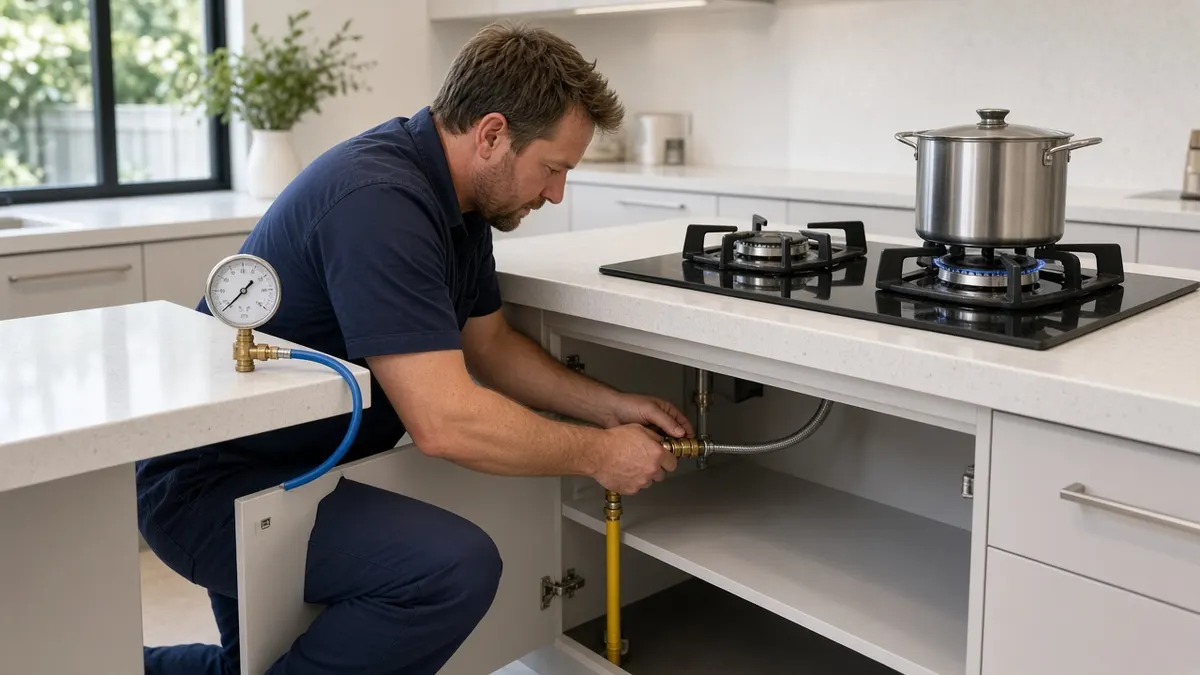
Gas installation in Australia costs about $200 to $600 in 2026 for a single straightforward job, such as connecting a new cooktop to an existing gas point or adding a bayonet a few metres from an existing line, with GST included. Longer pipe runs add roughly $80 to $200 per metre, and connecting a house to the mains gas network for the first time often totals $2,500 to $6,000 once the distributor's charges, trenching and internal pipework are added up.
Every part of a gas installation, from running pipe to connecting an appliance, must be done by a licensed gasfitter. That is the law in every state and territory, and it is there for good reason: a poorly made joint or a badly flued heater can cause a fire, an explosion or carbon monoxide poisoning. The prices below are indicative. Get at least three written quotes, check each gasfitter's licence, and make sure you receive a compliance certificate when the job is done.
Gas fitting prices for common jobs
These ranges cover labour and standard fittings on a weekday in a capital city. They do not include the appliance itself.
| Job | Indicative cost (inc. GST) |
|---|---|
| Connect a gas cooktop to an existing point | $200 to $450 |
| Connect a freestanding gas oven or upright cooker | $250 to $500 |
| New indoor bayonet point near an existing line | $250 to $600 |
| New outdoor bayonet for a barbecue or patio heater | $300 to $700 |
| New gas line run | $80 to $200 per metre |
| Install a flued gas wall heater (heater supplied) | $800 to $2,000 |
| Convert an appliance between natural gas and LPG | $150 to $400 |
| LPG cylinder setup with changeover regulator | $500 to $1,200 |
| Gas leak detection | $150 to $400 |
| Gas leak repair at an accessible joint | $200 to $800 |
| Gas appliance service or safety check | $150 to $300 |
| Cap off a disused gas point | $150 to $350 |
| Gas meter relocation | $1,000 to $3,500, including distributor charges |
Gas hot water has its own pricing quirks, including tempering valves and sizing; see our gas hot water system cost guide for that.
What gasfitters charge in each city
Most gasfitters are also licensed plumbers and charge similar rates. Some charge a little more for gas work because of the testing and paperwork involved. Rates are highest in Sydney, Canberra and Darwin, and lower in Adelaide and Hobart.
| Location | Hourly rate | Call-out fee | Mains gas availability |
|---|---|---|---|
| Sydney | $120 to $175 | $100 to $180 | Widespread across established suburbs |
| Melbourne | $115 to $165 | $90 to $170 | Widespread, but state policy is shifting homes to electric |
| Brisbane | $110 to $160 | $90 to $160 | Patchy; many homes use LPG |
| Perth | $115 to $165 | $90 to $170 | Common in established suburbs |
| Adelaide | $100 to $150 | $80 to $150 | Common in established suburbs |
| Hobart | $100 to $155 | $80 to $150 | Limited reticulated network; LPG is common |
| Canberra | $120 to $170 | $100 to $180 | Existing network, but no new connections for most new builds |
| Darwin | $125 to $180 | $100 to $190 | Very limited; LPG for most gas appliances |
Connecting to mains gas for the first time
If your street has a gas main but your house is not connected, there are two separate parts to the job, and they are usually billed separately.
The first is the network connection. The gas distributor for your area, not your retailer, runs the service pipe from the main to your property boundary and fits the meter. Distributors set their own connection charges, which vary with the distance from the main, which side of the street it is on, whether the footpath or road has to be opened and whether you are connecting a standard residential meter. Some standard connections attract a modest fee; complex ones can cost a few thousand dollars. You arrange the connection through a gas retailer or directly with the distributor, depending on the network, and lead times of several weeks are common.
The second part is the consumer piping: everything from the meter to your appliances. A licensed gasfitter sizes the pipe for the total load of all appliances you plan to run, digs or arranges the trench, lays and joins the pipe, runs it under the floor or through the roof space to each appliance, pressure tests the system and lodges the compliance paperwork.
Because a new connection only makes sense if you will use enough gas to justify the daily supply charge, think about the long-term plan before you start. Connecting gas for a single cooktop rarely pays off; connecting for hot water, heating and cooking might. Many households now go the other way and disconnect gas entirely. More on that below.
LPG instead of mains gas
Where there is no mains gas, LPG is the usual alternative. The simplest setup is two 45 kg cylinders on a manifold with an automatic changeover regulator, so the supply switches to the second bottle when the first runs out. Installing that, with a short line to the house, typically costs $500 to $1,200. Larger users may get a bulk tank filled on site.
Gas suppliers usually charge an annual rental per cylinder, plus a delivery charge per refill. LPG generally costs more per unit of energy than natural gas, so for heavy users the running costs add up. Appliances must be set up for LPG; a natural gas cooktop cannot simply be connected to a bottle. Most can be converted with a kit by a licensed gasfitter.
Cylinders must be located to meet the gas standard's clearance rules, away from openings into the house, drains and ignition sources such as air conditioner condensers and power points. Your gasfitter will site them correctly; do not move them yourself.
Three worked examples
All figures include GST.
Electric to gas cooktop in a Ryde kitchen, NSW
A 1970s brick house with mains gas already connected for hot water. The owners swapped a tired electric cooktop for a 900 mm gas cooktop during a kitchen refresh. The gasfitter ran a new line under the floor from the existing hot water supply pipe.
| Item | Cost |
|---|---|
| New gas line, 6 m under the floor (labour and materials) | $780 |
| Cooktop connection, testing and commissioning | $250 |
| Licensed electrician to disconnect and terminate the old cooktop circuit | $220 |
| Carpenter to enlarge the benchtop cut-out | $200 |
| Compliance certificate | Included |
| Total | $1,450 |
The electrician's line is easy to forget. Removing an electric cooktop means making its circuit safe, and that is licensed electrical work. Our electrician cost guide covers small-job pricing.
Outdoor barbecue bayonet in Carindale, QLD
A Brisbane home on mains natural gas. The owners wanted a bayonet on the back deck for a built-in barbecue, 12 m from the nearest gas pipe.
| Item | Cost |
|---|---|
| New gas line, 12 m through the subfloor at $120 per metre | $1,440 |
| Outdoor bayonet fitting, testing and commissioning | $250 |
| Total | $1,690 |
A bayonet means the barbecue can be disconnected for cleaning or moving without a gasfitter, which is handy on a deck.
First-time mains connection in Salisbury, SA
A 1980s home with electric everything and a gas main in the street. The owners connected to run a gas continuous flow hot water unit and a cooktop. The trench from the meter to the house was dug by hired labourers to the depth and route the gasfitter marked.
| Item | Cost |
|---|---|
| Distributor connection and meter (varies by distributor; example only) | $900 |
| Labourers to dig and backfill a 15 m trench, one day for two workers | $700 |
| Gasfitter: meter to house and internal runs, 22 m at $110 per metre | $2,420 |
| Appliance connections, two at $250 | $500 |
| Pressure test and compliance certificate | Included |
| Total | $4,520 |
This excludes the hot water unit and cooktop themselves. Before you sign up for a project like this, compare the total with the cost of an electric heat pump and an induction cooktop, which avoid both the connection and the ongoing gas supply charge.
Why pipe runs cost what they do
The per-metre rate covers more than pipe. It includes the time to plan the route, cut access, fix the pipe, make joints, and test the whole system for leaks under pressure. A run that is easy for one installer can be slow for another, and that shows in the quote.
- Pipe material. Copper is the traditional choice. Multilayer composite pipe with crimped or pressed fittings is now common and often quicker to install. Both are approved materials when installed correctly; your gasfitter will choose based on the job and the standard.
- Pipe size. The pipe must be sized for the total gas load and the length of the run. A continuous flow hot water unit draws far more gas than a cooktop, so adding one may mean upsizing the main line from the meter.
- Access. A high, open subfloor is quick. A slab-on-ground house may need the pipe run through the roof space or around the outside wall in protective conduit. Double-brick walls are slow to penetrate.
- Trenching. Underground pipe needs a trench of the right depth along an approved route, with marker tape above the pipe. Hand-digging through clay or rock takes time; concrete paths may need cutting and patching.
- Existing installation. Older pipework may need to be brought up to standard before new work is connected to it.
The law on gas work, state by state
All gasfitting in Australia must be done by a licensed gasfitter. That includes installing or extending gas pipe, connecting and disconnecting fixed appliances, converting appliances between gas types and repairing leaks. Householders can plug a portable appliance into an existing bayonet or connect an LPG cylinder to a portable barbecue, but nothing beyond that. A handyman cannot legally do gas work either; our article on whether a handyman can do plumbing covers how gas sits within the licensing rules.
- NSW: gasfitters are licensed by NSW Fair Trading, and completed gas work needs a certificate of compliance.
- Victoria: gasfitters are registered or licensed by the Building and Plumbing Commission, while Energy Safe Victoria regulates gas safety. Compliance certificates are required for most gasfitting.
- Queensland: gas work licences are issued by Resources Safety and Health Queensland, separate from QBCC plumbing licences.
- WA: Building and Energy licenses gasfitters and requires notices for completed gas work.
- SA: Consumer and Business Services licenses gasfitters; the Office of the Technical Regulator oversees gas safety.
- Tasmania and ACT: CBOS and Access Canberra license gasfitters.
- NT: check current gasfitting licence requirements with NT WorkSafe and the relevant licensing board.
Gas installations must comply with the gas installation standard, AS/NZS 5601.1, which covers pipe sizing, materials, flueing, ventilation and clearances. Your gasfitter will know it; you only need to make sure the person doing the work is licensed and that you receive the paperwork.
Should you add gas at all?
Ten years ago, most renovators asked for a gas cooktop without a second thought. The picture is different in 2026. Victoria stopped new gas connections for new homes that need a planning permit from 1 January 2024 and has announced further measures to move existing homes towards electric appliances. The ACT has stopped most new residential gas network connections and plans to phase gas out of the territory. Rules and start dates have changed more than once, so check the current position with Energy Safe Victoria or the Victorian Government, or with Access Canberra, before you spend money on new gas work.
Elsewhere, gas is still allowed, but it is worth running the numbers. Every gas connection carries a daily supply charge whether you use much gas or not. If gas only runs a cooktop, that fixed charge can make it an expensive way to cook. Induction cooktops have become much cheaper, and heat pump hot water and reverse-cycle air conditioning can replace gas hot water and heating. If you are thinking about heating, our air conditioning installation cost guide covers reverse-cycle prices.
Gas still makes sense for some households: those with a large existing gas setup that works well, homes where the switchboard cannot easily take extra electrical load, and people who simply prefer cooking with a flame. Just go in with your eyes open about the running costs and the policy direction.
Taking gas out instead
Gasfitters also do the reverse job. When you replace your last gas appliance with an electric one, the gasfitter disconnects it and caps the line safely, usually for $150 to $350 per point. That stops the appliance being a hazard, but the meter stays connected and the daily supply charge keeps coming until you deal with the account.
To stop paying for gas, you need to ask your retailer to close the account and arrange either a meter removal or a permanent disconnection, which the distributor carries out. Distributors set their own fees for this, the options differ between networks, and the rules have been under review in some states. Ask your retailer and distributor what applies to your address before you assume a price. Leaving a capped but live meter in place is also an option if you think a future owner might want gas.
Gas safety at home
A properly installed and maintained gas system is safe. Problems come from poor installation, old appliances and blocked flues.
- Leaks. Natural gas and LPG both have an added odour, often described as rotten eggs. If you smell gas, turn off the supply at the meter or cylinder, do not use switches, phones or flames near the smell, open doors and windows, leave the building and call your gas distributor's emergency line or a licensed gasfitter.
- Carbon monoxide. Faulty or poorly ventilated gas heaters can produce carbon monoxide, which has no smell. Have gas heaters serviced at the interval the manufacturer recommends, often every two years, and never block the vents. A carbon monoxide alarm is a cheap extra layer of protection.
- Unflued heaters. Some states restrict unflued gas heaters, and their use in bedrooms and bathrooms is unsafe. Check the rules in your state before buying one.
- Cylinders. Keep LPG cylinders upright, outdoors and away from drains and ignition sources. Never bring a full-size cylinder indoors.
Getting the price down safely
Plan all your gas work at once. If you are adding a cooktop now and might add an outdoor bayonet or a heater later, ask the gasfitter to size the main line for the final load and to leave capped tees where future lines will branch off. Running one larger pipe today costs far less than adding a second run later.
Choose appliance positions with the pipe route in mind. A cooktop on an outside wall near the meter is cheaper to connect than one on an island bench in the middle of a slab floor.
Dig the trench separately if your gasfitter agrees. Hand-digging a long trench is slow, and paying a gasfitter's hourly rate for it adds up. Many gasfitters are happy for labourers to dig and backfill to the depth and route they mark, as long as they inspect the trench before the pipe goes in. The pipe laying, joining and testing remain the gasfitter's job.
Book weekday work and avoid emergency rates. Unless you have a leak, gas work can almost always wait for business hours.
What a gas installation quote should show
- The gasfitter's name, ABN and gas licence number.
- Each appliance or point to be installed, with the pipe route and approximate length.
- Pipe material and size.
- Any work by others, such as an electrician, carpenter or trench digging, and who arranges it.
- Distributor or meter charges, listed separately if the gasfitter is passing them on.
- Pressure testing and the compliance certificate.
- Making good: who patches walls, floors or paths afterwards.
- Warranty on workmanship, and payment terms.
Walk away from cash-only offers, quotes with no licence number, and anyone who suggests skipping the compliance paperwork. You can compare licensed gasfitters near you, and our plumber cost guide lists general rates if you are bundling plumbing jobs into the same visit.
How long gas jobs take
Connecting an appliance to an existing point takes one to two hours. A new bayonet or a short new line usually takes half a day. A full first-time connection runs on the distributor's timetable: allow several weeks for the network connection and meter, then a day or two for the gasfitter's pipework and appliance connections once the meter is in.
Where Yakka fits
Gasfitting is licensed work, and Yakka Labour does not supply workers for it. What a Yakka worker can do is the labour that comes before and after: digging a trench by hand to the depth and route the gasfitter sets, backfilling once the gasfitter has laid and inspected the pipe, clearing a subfloor or kitchen so the gasfitter can work, and removing an old cooktop or heater once it has been disconnected.
That keeps the licensed trade's hours for the licensed work. The pipe, the joints, the appliance connections, the testing and the compliance certificate must stay with a licensed gasfitter, so check their licence number with your state regulator before work starts.
Frequently asked questions
How much does a gasfitter charge per hour?
Most licensed gasfitters in Australian capital cities charge $100 to $180 per hour in 2026, including GST, plus a call-out fee of around $80 to $190. Rates are highest in Sydney, Canberra and Darwin. Many simple jobs, such as connecting a cooktop to an existing point, are quoted as a fixed price of $200 to $450.
How much does it cost to connect a house to mains gas?
A first-time mains gas connection often totals $2,500 to $6,000. That includes the distributor's charge for the service pipe and meter, which varies by network and distance from the main, plus the gasfitter's pipework from the meter to each appliance. Long trenches, concrete cutting and multiple appliances push the cost higher.
Can I install a gas cooktop myself?
No. Connecting a gas cooktop is gasfitting work and must be done by a licensed gasfitter in every Australian state and territory. The gasfitter tests the connection for leaks and issues a compliance certificate. You can buy the cooktop yourself, but unlicensed gas work is illegal, dangerous and can void your home insurance.
How much does it cost to install a gas bayonet?
A new indoor gas bayonet close to an existing line usually costs $250 to $600, and an outdoor bayonet for a barbecue or patio heater $300 to $700. If the bayonet is a long way from the nearest pipe, expect to add $80 to $200 per metre for the extra line.
Is it worth getting gas connected in 2026?
It depends on how much gas you would use. Every gas connection has a daily supply charge, so connecting for a single cooktop is rarely worthwhile. Victoria and the ACT are moving away from gas for homes, and electric options such as induction cooktops and heat pumps have become cheaper. Compare both before deciding.
How much does LPG gas installation cost?
Setting up two 45 kg LPG cylinders with an automatic changeover regulator and a short line to the house typically costs $500 to $1,200. Appliances must be set up for LPG, and converting a natural gas appliance costs about $150 to $400. Suppliers also charge annual cylinder rental and delivery fees.
What should I do if I smell gas?
Turn off the gas at the meter or cylinder if it is safe to do so, avoid using switches, phones or flames near the smell, open doors and windows and leave the building. Then call your gas distributor's emergency line or a licensed gasfitter. Do not try to find or fix the leak yourself.
Official sources
Award rates, licences and safety rules change. Check the official source before you hire or take on a shift.
- Queensland Building and Construction Commission (QBCC)Contractor, plumbing and drainage licence search in Queensland
- Consumer and Business Services SALabour hire licensing in South Australia
- NSW Fair TradingTrade licence checks for electricians, plumbers and builders in New South Wales
- Building and Plumbing Commission (Victoria)Builder and plumber registration, domestic building insurance and licence checks in Victoria
- Consumer, Building and Occupational Services (Tasmania)Building, plumbing and electrical licensing in Tasmania
- Access CanberraConstruction occupation licences and building approvals in the ACT