Exterior cost guide
Skylight Installation Cost in Australia (2026 Price Guide)
Typical cost in Australia (2026, inc. GST)
$700 to $3,500 per unit
installed, from a tubular skylight to a fixed framed skylight with shaft
Installing a skylight in Australia costs about $700 to $1,800 for a tubular skylight and $1,500 to $3,500 for a fixed framed skylight with a plasterboard shaft in 2026. Electric or solar-powered opening roof windows run $3,500 to $6,500 or more. Roof type, shaft length, ceiling style, glazing and any electrical work set the price.
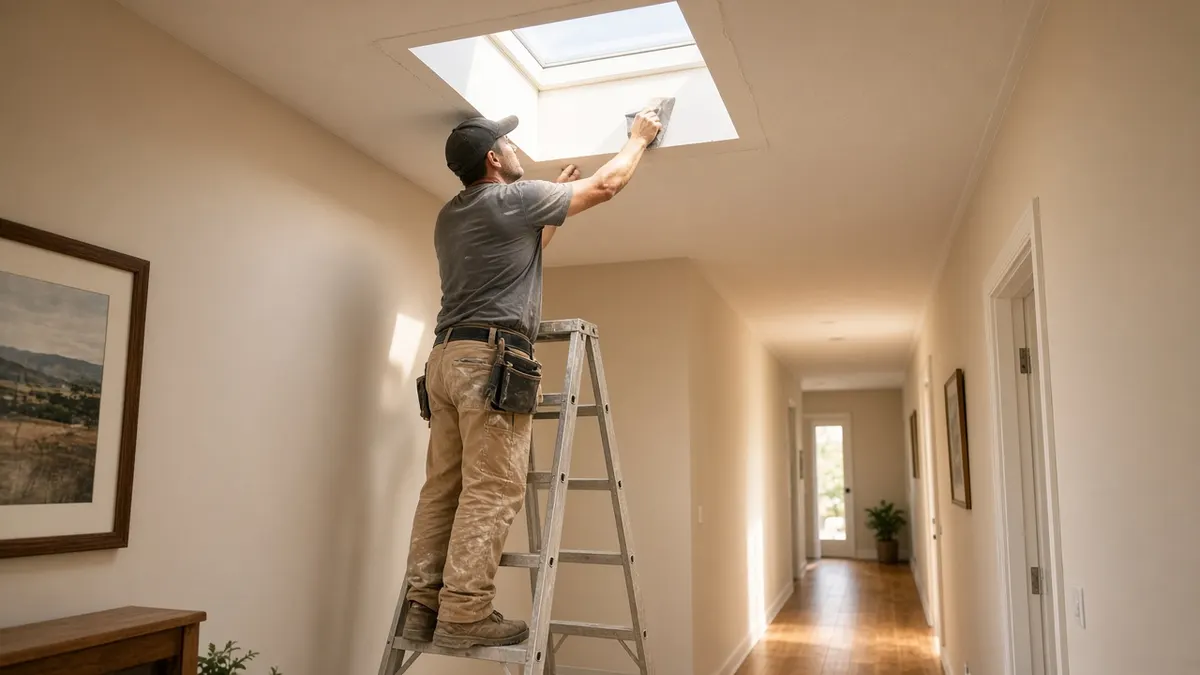
A skylight costs $700 to $3,500 to supply and install in most Australian homes in 2026. Tubular skylights sit at the bottom of that range at around $700 to $1,800 each, a fixed framed skylight with a plasterboard light shaft usually costs $1,500 to $3,500, and an electric opening roof window with a rain sensor can reach $3,500 to $6,500 or more.
Skylights are a roofing job, a carpentry job, a plastering job and sometimes an electrical job rolled into one, which is why the installed price is often double the price of the unit itself. This guide covers new skylights and replacing old ones. If an existing skylight is leaking and you only want it fixed, the roof leak repair guide covers reseal and reflash prices. For general roofer rates, see the roofing cost guide.
Prices are indicative and include GST. Get at least three written quotes that name the exact product, size, glazing and what finishing work is included.
Skylight prices by type
| Type | Unit only | Installed price | Best for |
|---|---|---|---|
| Tubular skylight, 250 mm | $300 to $600 | $700 to $1,300 | Hallways, bathrooms, walk-in robes, laundries |
| Tubular skylight, 350 mm or larger | $450 to $900 | $900 to $1,800 | Kitchens and larger rooms |
| Fixed framed skylight with shaft | $500 to $1,500 | $1,500 to $3,500 | Living areas, kitchens, stairwells |
| Manual opening roof window (within reach or pole operated) | $900 to $2,000 | $2,500 to $4,500 | Raked ceilings, attic rooms, ventilation |
| Electric or solar opening skylight with rain sensor | $1,800 to $3,500 | $3,500 to $6,500 | Kitchens and bathrooms needing ventilation, high ceilings |
| Replace old dome or framed skylight | $300 to $1,500 | $800 to $2,500 | Yellowed, cracked or leaking older units |
Add-ons push the price up. A blind for a framed skylight costs $300 to $900 installed, and a remote or motorised blind costs more. Upgrading to low-E or double glazing adds roughly $300 to $900 per unit.
Tubular or framed?
A tubular skylight is a small dome on the roof connected to a reflective tube that carries daylight down to a diffuser in the ceiling. It is cheaper, quicker to install, needs no framing between rafters, and adds very little heat in summer. It gives a soft, even light but no view of the sky. It suits dark hallways, ensuites without windows and walk-in robes. A typical 250 mm tube lights a hallway or bathroom well, and a larger tube or two suits a kitchen.
A framed skylight is a proper glazed window in the roof with a light shaft lined in plasterboard down to the ceiling. It gives far more light, a view of sky and trees, and with an opening model, ventilation. It needs a hole cut in the roof framing, trimmers to carry the load, a roof flashing kit, plasterboard shaft lining and painting. It also brings more heat in summer and loses more in winter, so glazing choice and size matter.
| Factor | Tubular | Framed |
|---|---|---|
| Installed cost | $700 to $1,800 | $1,500 to $6,500 |
| Install time | 2 to 4 hours | 1 to 3 days including plastering |
| Framing changes | None, fits between rafters | Trimming between rafters, sometimes engineering |
| Light and view | Diffused light, no view | Strong light and sky view |
| Heat gain in summer | Low | Moderate to high, depends on glazing and blinds |
| Ventilation option | Only with add-on vent kits | Yes, with opening models |
Choosing where it goes
Where the skylight sits on the roof changes how it performs as much as what it costs. A few things installers and building designers look at:
- Orientation. A skylight on a south-facing roof plane gives softer, more even light with less heat. North-facing planes give strong winter sun, which is welcome in Melbourne or Hobart and less so in Darwin. West-facing skylights catch harsh afternoon sun and are the most likely to overheat a room.
- The room below. Kitchens, hallways, stairwells and bathrooms benefit most. Over a television, a computer desk or a bed, glare and early morning light can become annoying, so plan blinds or choose a different spot.
- What is in the roof space. Ducted air-conditioning runs, hot water units, solar inverter cables and downlight wiring all compete for space. Moving a duct adds to the bill, so a good installer checks before choosing the final position.
- Solar panels. A skylight on the same roof plane as an array can shade or block panel layout. If you plan solar later, keep the north planes clear and put skylights elsewhere.
Moving the skylight 600 mm to sit neatly between two rafters can save hundreds of dollars in framing, with almost no difference to the light in the room.
Labour rates behind the price
A framed skylight can involve three or four trades. Specialist skylight companies bundle them into one price, but if you are coordinating the job yourself, these are typical 2026 rates:
| Trade | Hourly rate | Role on a skylight job |
|---|---|---|
| Skylight installer or roofer | $75 to $120 | Cutting the roof, fitting the unit and flashing |
| Roof plumber | $90 to $140 | Flashing into steel roofs, required in Victoria |
| Carpenter | $70 to $110 | Trimming rafters, framing the light shaft |
| Plasterer | $65 to $100 | Lining, setting and sanding the shaft |
| Electrician | $90 to $140 | Wiring electric skylights and blinds |
Coordinating separate trades can save a little, but it adds waiting time between stages. Most homeowners are better off with a single installer who handles the lot and gives one warranty.
What an installation involves
For a framed skylight on a pitched roof with a flat ceiling, the usual sequence is:
- The installer checks the roof space to find the rafters or trusses, any wiring, ducts and pipes, and confirms where the skylight can go.
- Tiles are lifted or steel sheets are cut, and an opening is made in the roof between framing members.
- Where a rafter has to be cut, trimmers and headers are fitted to carry the load. Engineered trusses should not be cut without engineering advice.
- The skylight frame is fixed and the flashing kit is fitted to suit the roof profile, then tiles are relaid or sheets refixed and sealed.
- The ceiling is cut, the light shaft is framed and lined with plasterboard, then set, sanded and painted.
- If it is an electric model, a licensed electrician connects the power and controls.
A tubular skylight skips most of this. The installer cuts a round hole in the roof and ceiling, fits the dome and flashing, runs the tube, and clips in the ceiling diffuser. A good installer will be in and out in a morning.
What pushes the price up
- Roof type. Concrete and terracotta tiles are the easiest, because tiles lift out and flashing kits are made for them. Steel roofs need a flashing that suits the sheet profile and careful sealing. Low-pitch and flat roofs often need a raised upstand or curb so water drains away from the skylight, which adds cost.
- Shaft length. A deep roof space or high ceiling means a longer shaft or tube. Each extra metre of framed shaft adds labour and plasterboard, often $200 to $800.
- Raked or cathedral ceilings. These can be cheaper, because there is no shaft, but cutting into insulated raked ceilings and lining the reveal needs care.
- Structure. Cutting a rafter to fit a wide skylight means extra framing. Trusses usually mean choosing a size that fits between them or getting an engineer involved.
- Glazing and features. Low-E, laminated or double glazing, blinds, rain sensors, remote controls and solar operation all add to the unit price.
- Access. Two-storey roofs need more fall protection, and steep roofs slow the work.
- Bushfire areas. Skylights on homes in bushfire-prone areas need to meet the site's bushfire attack level under AS 3959, which can limit product choices and add cost.
Skylight installation costs by city
| City | Tubular installed | Fixed framed installed | Notes |
|---|---|---|---|
| Sydney | $800 to $1,900 | $1,800 to $3,800 | Higher labour, many older homes with deep roof spaces |
| Melbourne | $750 to $1,800 | $1,700 to $3,600 | Flashing into steel roofs is roof plumbing work |
| Brisbane | $700 to $1,700 | $1,500 to $3,400 | Heat gain is the main design concern |
| Perth | $700 to $1,700 | $1,500 to $3,400 | Strong sun, tubular skylights very popular |
| Adelaide | $650 to $1,600 | $1,400 to $3,200 | Lower labour rates |
| Hobart | $750 to $1,800 | $1,600 to $3,500 | Double glazing worth considering for winter heat loss |
| Canberra | $750 to $1,800 | $1,700 to $3,600 | Cold winters favour better glazing |
| Darwin | $850 to $2,000 | $1,900 to $4,000 | Cyclone-rated products and freight |
Three skylight jobs, costed
Tubular skylight in a windowless bathroom, Mount Gravatt, Queensland
A 1970s low-set brick home with a concrete tile roof and an internal bathroom with no window.
| Item | Cost |
|---|---|
| 250 mm tubular skylight kit with tile flashing | $450 |
| Installation (about 3 hours) | $400 |
| Extension tube for a deeper roof space | $80 |
| Total including GST | $930 |
Fixed framed skylight in a living room, Bentleigh, Victoria
A 1960s weatherboard with a Colorbond roof and flat plasterboard ceilings. The owners wanted a 780 mm by 980 mm fixed skylight with low-E glass over a dark family room.
| Item | Cost |
|---|---|
| Fixed skylight with low-E glazing | $900 |
| Flashing kit for steel roof profile | $250 |
| Roof plumber to cut in, flash and seal | $900 |
| Carpenter to trim the framing and build the shaft | $500 |
| Plasterboard shaft lining, setting and sanding | $700 |
| Painting the shaft and ceiling patch | $200 |
| Total including GST | $3,450 |
Flashing a skylight into a steel roof in Victoria is roof plumbing, so it must be done by a licensed roof plumber.
Electric opening roof window in a raked kitchen ceiling, Fremantle, Western Australia
A renovated home with a raked ceiling over the kitchen and a tiled roof. The owners wanted ventilation to let cooking heat out on summer evenings.
| Item | Cost |
|---|---|
| Electric opening roof window with rain sensor | $2,400 |
| Motorised blind | $450 |
| Installation and tile flashing | $1,400 |
| Licensed electrician to run power and connect controls | $450 |
| Plaster reveal and painting | $500 |
| Total including GST | $5,200 |
Heat, light and energy efficiency
A skylight lets in a lot more light per square metre than a wall window, and a lot more heat. A large clear skylight on a north or west-facing roof can turn a living room into a hothouse in a Brisbane or Perth summer, and lose heat through a Canberra winter night. Size and glazing matter more than the brand.
Practical rules of thumb: choose the smallest skylight that gives the light you want, use low-E or tinted glazing in hot climates, add a blind to framed skylights, and consider a tubular skylight where you only need daylight and not a view. The Australian Government's YourHome guide to skylights and roof windows explains the trade-offs clearly. For new homes and renovations, the National Construction Code's energy-efficiency requirements cover roof lights, so your installer or building designer should check the size and glazing for your climate zone.
Is an opening skylight worth the extra?
An opening skylight costs roughly $1,000 to $3,000 more than a fixed one of the same size once the motor, rain sensor and electrician are counted. The payoff is ventilation. Hot air rises and collects under the ceiling, and an open skylight lets it escape, pulling cooler air in through windows below. In a kitchen, it clears cooking heat and smells. In a bathroom without a window, it helps with steam and mould.
If the skylight is out of reach, an opening model needs a pole, a manual winder or a motor. Electric and solar models with automatic rain sensors are the practical choice for high ceilings, because they close themselves when the first drops land. A manual unit left open during a summer storm is a fast way to soak a kitchen floor.
For a hallway or walk-in robe, a fixed or tubular skylight is all you need. Save the opening budget for rooms where heat and steam are a real problem.
Approvals and council rules
Most skylights in existing homes do not need a full development application, but there are exceptions:
- NSW: many skylights and roof windows can go in as exempt development under the state's exempt and complying development codes if they meet the conditions, which exclude things such as heritage items. Check the conditions on the NSW Planning website or with your council.
- Heritage areas: skylights visible from the street may need approval, and some councils restrict them on front roof planes.
- Structural work: if rafters or trusses are being cut and reframed, some states require a building permit or a certifier's sign-off. Check with a building surveyor or certifier in your state.
- Strata: in a townhouse or unit, the roof is usually common property, so you need the owners corporation's approval first.
Licences: who does what
- Roof work: in Victoria, cutting a skylight into a metal roof and flashing it is roof plumbing and needs a licensed roof plumber. In NSW and Queensland, work over the licensing threshold (currently $5,000 in NSW and $3,300 in Queensland, including labour and materials) needs a licensed contractor. In other states, check the current threshold with Building and Energy (WA), Consumer and Business Services (SA), CBOS (Tasmania), Access Canberra or the NT Building Practitioners Board.
- Electrical work: any 240-volt wiring for an electric skylight, blind or rain sensor must be done by a licensed electrician in every state. In Victoria that is regulated by Energy Safe Victoria, and in Queensland by the Electrical Safety Office. Solar-powered units avoid mains wiring.
- Plastering and painting: lining and finishing the shaft is usually done by the installer's plasterer. In NSW and Queensland, plastering and painting jobs above the licensing threshold need the right licence.
The electrician cost guide covers typical rates if you need to book one separately.
Replacing or removing an old skylight
Older acrylic dome skylights go yellow, brittle and cloudy after 15 to 20 years in Australian sun, and the seals around them perish. Replacing the dome alone is sometimes possible for $300 to $800 installed. Replacing the whole unit with a modern framed or tubular skylight usually costs $800 to $2,500, often reusing the existing shaft.
Removing a skylight altogether costs about $500 to $1,500. That covers taking out the unit, framing and closing the roof opening with matching tiles or sheet, and patching and painting the ceiling. Matching old tiles or faded steel can be the hardest part, so a roofer with salvaged tiles helps.
Leaks and upkeep
A well-installed skylight should not leak. When they do, it is usually because of a poor flashing, a perished seal, a cracked dome or leaves building up on the upslope side of the skylight and diverting water under the flashing. Fixing a leaking skylight typically costs $250 to $900.
Upkeep is simple. Clear leaves from around the skylight when you clean the gutters, wash the outside glass or dome with water and a soft brush every year or two, and check the ceiling around the shaft for stains after heavy rain. If the shaft plaster ever gets water damaged, the plaster repair cost guide covers ceiling repairs.
Condensation in the shaft
On cold mornings, especially in Canberra, Hobart and the southern highlands, warm moist air from the house can condense on the inside of single-glazed skylights and drip down the shaft. It looks like a leak but is not. Better glazing, an insulated shaft, and good ventilation in bathrooms and kitchens reduce it. If you are in a cold climate, ask the installer about double glazing and insulating around the shaft before you choose the cheapest unit.
DIY skylight kits
Hardware stores sell tubular skylight kits for about $300 to $600, and a confident DIYer can install one on a single-storey tile roof in a day. The risks are working on the roof, cutting into a ceiling where wiring may run, and getting the flashing wrong, which is the main cause of skylight leaks. Many product warranties also require professional installation. Framed skylights are not a sensible DIY job, because of the structural framing, flashing and plastering involved.
What to check in a skylight quote
- The exact product, size and glazing type, and whether it suits your roof profile and bushfire rating if relevant.
- Whether the price includes framing, shaft lining, setting, painting and making good the ceiling.
- Who does the flashing, and their licence where your state requires one.
- Electrical work, if any, by a licensed electrician, and whether it is in the price.
- Blinds, remote controls and rain sensors itemised separately.
- The product warranty, the installer's workmanship warranty and what happens if it leaks.
Red flags include quotes that do not mention flashing, a price that includes "shaft" but not plastering or painting, and installers who want to cut trusses without engineering advice.
Where Yakka fits
A skylight installation is mostly specialist work, but there are jobs around it that do not need a licence. Through Yakka you can book a handyperson or labourer to clear furniture out of the room, lay drop sheets, clean up plaster dust afterwards, and help clear the roof space of stored boxes so the installer can get to the framing. You can also browse skylight installers and find a licensed electrician for electric models.
Flashing into the roof, structural framing and electrical connections need licensed trades. Yakka does not replace them, so check licences before work starts.
Frequently asked questions
How much does it cost to install a skylight in Australia?
Most skylights cost $700 to $3,500 to supply and install in 2026. A tubular skylight runs about $700 to $1,800, a fixed framed skylight with a plasterboard shaft about $1,500 to $3,500, and an electric or solar opening roof window $3,500 to $6,500 or more. Roof type, shaft length and electrical work affect the final price.
Are tubular skylights worth it?
Tubular skylights are good value for dark hallways, windowless bathrooms, laundries and walk-in robes. They cost less than framed skylights, install in a few hours, need no structural changes and add little heat in summer. They give soft diffused light but no view of the sky, so for living areas many people prefer a framed skylight.
Do skylights make a house hotter?
Framed skylights can add a lot of heat in summer, especially large clear ones on north or west-facing roofs in hot climates. Choosing a smaller size, low-E or tinted glazing and a blind reduces heat gain. Tubular skylights add much less heat. In cold climates, better glazing also reduces heat loss through the skylight in winter.
Do I need council approval for a skylight?
Many skylights do not need a development application. In NSW, skylights and roof windows can often be installed as exempt development if they meet the state code conditions, which exclude heritage items. Heritage areas, structural changes and strata properties may need approval. Check with your council, certifier or owners corporation before installing.
How long does it take to install a skylight?
A tubular skylight usually takes two to four hours. A framed skylight takes one to three days in total, because the roof work, framing and shaft lining are done first, and the plaster then needs setting, sanding and painting. Electric models need a licensed electrician to connect power, which may be on a separate visit.
Why is my skylight leaking?
Skylight leaks usually come from failed flashing, perished seals, a cracked dome or leaves piling up on the upslope side and diverting water under the flashing. Condensation inside the shaft can also look like a leak in cold weather. A roofer can usually reseal or reflash a leaking skylight for $250 to $900, or recommend replacement.
Can you put a skylight in a metal roof?
Yes. Skylights can be installed in Colorbond and other steel roofs using a flashing kit made for the sheet profile. Low-pitch steel roofs often need a raised upstand so water drains around the skylight. In Victoria, cutting into and flashing a metal roof is roof plumbing work that must be done by a licensed roof plumber.
Official sources
Award rates, licences and safety rules change. Check the official source before you hire or take on a shift.
- Workplace Health and Safety QueenslandHigh-risk work licences and the Electrical Safety Office in Queensland
- Consumer and Business Services SALabour hire licensing in South Australia
- Consumer, Building and Occupational Services (Tasmania)Building, plumbing and electrical licensing in Tasmania
- Access CanberraConstruction occupation licences and building approvals in the ACT
- Energy Safe VictoriaElectrician licensing in Victoria
- Building and Energy (WA)Electrical, plumbing and building licensing in Western Australia