Outdoor cost guide
Fibreglass Pool Cost in Australia: 2026 Installed Prices
Typical cost in Australia (2026, inc. GST)
$45,000 to $85,000 per pool
standard 6-10 m shell installed with excavation, crane, filtration and coping, before fencing, paving and landscaping
A fibreglass pool typically costs $45,000 to $85,000 installed in Australia in 2026, including GST, for a 6 to 10 metre shell with excavation, crane, filtration and coping. Plunge pools start around $30,000. Add fencing, paving, heating and landscaping and most finished projects land between $65,000 and $120,000. Rock, poor access, crane size and approvals are the biggest variables.
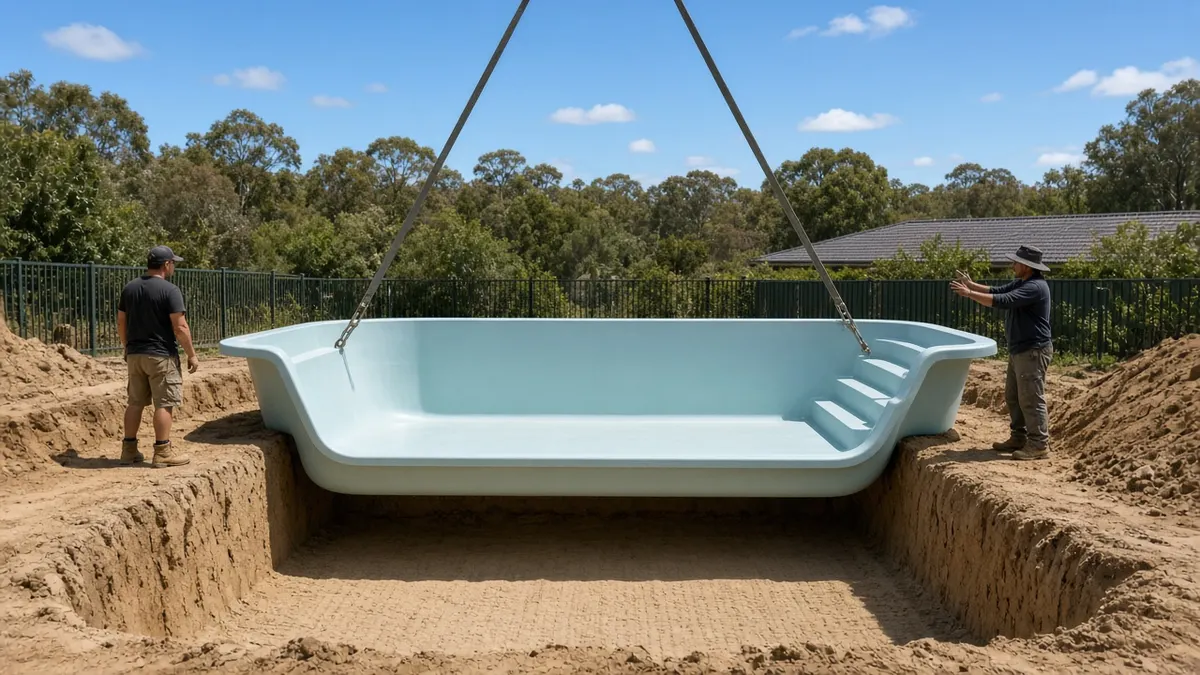
A fibreglass pool in Australia costs about $45,000 to $85,000 installed in 2026 for a standard 6 to 10 metre shell, including GST. That covers the shell, delivery, crane, excavation, plumbing, filtration and coping. Once you add compliant fencing, paving and a heater, most families spend somewhere between $65,000 and $120,000 on the finished backyard.
The gap between the advertised "from" price and the final invoice is where most budgets come unstuck. Pool companies often quote the shell and a basic install, while fencing, paving, landscaping, electrical work and dealing with rock are listed as exclusions. This guide breaks the job down line by line so you can see where the money goes and what to ask before signing.
All figures are indicative. Get at least three written, itemised quotes from licensed pool builders, ideally after a site inspection.
Installed price by pool size
| Pool type and size | Shell only (supply) | Typical installed price | Finished project with fence and paving |
|---|---|---|---|
| Plunge pool, 4 to 5.5 m | $10,000 to $20,000 | $30,000 to $50,000 | $45,000 to $75,000 |
| Small pool, 6 to 7 m | $15,000 to $25,000 | $40,000 to $60,000 | $55,000 to $90,000 |
| Medium pool, 7.5 to 9 m | $20,000 to $32,000 | $50,000 to $75,000 | $65,000 to $110,000 |
| Large pool, 10 to 12 m | $28,000 to $42,000 | $65,000 to $95,000 | $85,000 to $140,000 |
| Lap pool, 10 to 14 m (narrow) | $25,000 to $40,000 | $60,000 to $95,000 | $80,000 to $135,000 |
Fibreglass shells are made in a factory and trucked to site, so the width is limited by what can travel on the road, generally a bit over 4 metres for most residential models. If you want something wider or an unusual shape, concrete is usually the only option. Our swimming pool cost guide compares fibreglass, concrete and vinyl side by side.
Line by line: what a fibreglass pool costs to install
| Item | Typical cost | Notes |
|---|---|---|
| Fibreglass shell | $15,000 to $40,000 | Size, depth profile, features such as bench seats and swim-outs, gelcoat colour |
| Delivery and crane | $1,500 to $5,000 | Bigger cranes cost more; lifting over a house can push this higher |
| Excavation and spoil removal | $4,000 to $12,000 | Assumes normal soil and machine access; spoil volume is often 40 to 80 m³ |
| Rock removal | $3,000 to $20,000+ | Usually charged per hour of rock hammering or per cubic metre |
| Base and backfill | $2,000 to $5,000 | Crushed rock or sand-cement mix, compacted around the shell |
| Plumbing, pump, filter and salt chlorinator | $5,000 to $10,000 | Higher for variable-speed pumps, glass media filters and automation |
| Electrical connection | $1,000 to $3,000 | Licensed electrician; more if the switchboard needs upgrading |
| Coping | $3,000 to $8,000 | Bullnose pavers, natural stone or tiles around the edge |
| Approvals, engineering and certification | $2,000 to $5,000 | Certifier or council fees, engineering, surveys, inspections |
| Pool fencing | $5,000 to $20,000 | Aluminium is cheapest; frameless glass is the most expensive |
| Paving around the pool | $6,000 to $20,000 | Depends on area and material |
| Heating | $4,000 to $9,000 | Heat pump, solar or gas |
| Lighting, cover, cleaner | $1,500 to $6,000 | LED lights, solar blanket and roller, robotic cleaner |
Most pool companies bundle the first eight or nine lines into a single installed price and quote the rest separately or leave them to you. Check exactly where the line falls on every quote, because two quotes $10,000 apart can be describing very different scopes.
Three fibreglass pool projects, priced
These worked examples use 2026 prices including GST.
Werribee, VIC: 7 m family pool on a flat clay block
A new-estate home with good side access, reactive clay and no rock. Aluminium fencing and a plain concrete surround keep the budget in check.
| Item | Cost |
|---|---|
| 7 m x 3.5 m shell, delivered | $24,000 |
| Crane | $2,500 |
| Excavation and spoil removal | $7,500 |
| Base and backfill | $3,500 |
| Filtration, salt chlorinator and plumbing | $7,000 |
| Electrical connection | $1,800 |
| Coping | $4,500 |
| Building permit, engineering and survey | $3,000 |
| Aluminium pool fence, 30 linear metres at $180 | $5,400 |
| Concrete surround, 35 m² at $130 | $4,550 |
| Total | $63,750 |
Paddington, QLD: 5 m plunge pool with a tight backyard
An inner-city Queenslander with no side access. The shell has to be lifted over the house by a larger crane, and the excavator hits rock at about 1 metre.
| Item | Cost |
|---|---|
| 5 m plunge shell, delivered | $14,000 |
| Larger crane to lift over the house, plus road permit | $4,500 |
| Mini excavator, hand digging and rock hammering | $9,000 |
| Filtration, plumbing and backfill | $6,000 |
| Heat pump, supplied and installed | $5,500 |
| Electrical work | $2,000 |
| Coping and waterline tiles | $4,000 |
| Approvals and certifier | $3,000 |
| Frameless glass fence, 18 linear metres at $450 | $8,100 |
| Porcelain paving, 20 m² at $180 | $3,600 |
| Total | $59,700 |
A small pool, but a big bill per square metre of water. Access and rock cost almost as much as the shell.
Baldivis, WA: 10 m pool on sand
A large family pool on a sandy Perth block, with solar heating, semi-frameless glass fencing and limestone-look paving.
| Item | Cost |
|---|---|
| 10 m x 4 m shell, delivered | $32,000 |
| Crane | $2,000 |
| Excavation (sand) and spoil removal | $5,000 |
| Base and backfill | $3,000 |
| Filtration, chlorinator, plumbing and automation | $8,000 |
| Solar heating | $5,500 |
| Electrical connection | $1,800 |
| Coping | $5,500 |
| Building permit and inspections | $2,000 |
| Semi-frameless glass fence, 35 linear metres at $300 | $10,500 |
| Paving, 50 m² at $140 | $7,000 |
| Total | $82,300 |
Sandy soil keeps excavation cheap, but sand walls can collapse, so the builder may need shoring or a fast turnaround between digging and setting the shell.
Shell features that add to the price
Two shells of the same length can be $8,000 apart. The difference is usually in the build and the extras moulded into it.
- Laminate quality. Better shells use more layers, a vinyl ester barrier coat to resist osmosis and stronger structural ribs. Ask what the layers are and how thick the shell is.
- Bench seats, swim-outs and wide entry steps. Handy for kids and lounging, but they take up swimming space and add to the price.
- Depth profile. A flat 1.4 to 1.5 metre depth suits families and is easier to play in. Deep ends cost more to excavate and need more water.
- Colour. Darker gelcoats warm the water a little and look more natural, but some show fading and chalking sooner. Sparkle or glitter finishes cost extra.
- Integrated spa. A spa moulded into the shell, with its own jets and blower, can add $6,000 to $15,000 including equipment.
- Tiled waterline or feature walls. These help hide the scum line and lift the look, at extra cost.
Heating: comparing the three main options
| Heating type | Installed cost | Running cost | Best for |
|---|---|---|---|
| Solar (roof collectors) | $4,000 to $8,000 | Very low, just pump time | Extending the season in sunny climates; needs suitable roof space |
| Heat pump | $4,000 to $9,000 | Moderate, $500 to $1,500 a year | Reliable heating in most cities, especially with a cover |
| Gas heater | $3,500 to $7,000 plus gas fitting | High if run often | Fast heating for occasional use or spas |
In Melbourne, Canberra and Hobart, unheated pools are cold for most of the year, so heating plus a cover is worth budgeting from the start. Running conduit and plumbing for a future heater during construction costs little and saves digging up paving later.
Prices in each capital city
Typical installed prices for a medium 7.5 to 9 metre fibreglass pool, before fencing and paving.
| City | Installed price | What affects it |
|---|---|---|
| Sydney | $55,000 to $85,000 | Sandstone rock is common, tight access, high tip fees for spoil |
| Melbourne | $52,000 to $80,000 | Reactive clay in many suburbs, building permit process |
| Brisbane | $50,000 to $78,000 | Strong demand, rock in hilly suburbs, sloping blocks |
| Perth | $45,000 to $72,000 | Sand makes excavation quick and cheap; competitive market |
| Adelaide | $48,000 to $75,000 | Reactive clay, moderate labour costs |
| Canberra | $55,000 to $85,000 | Fewer builders, rock and clay, shorter swimming season |
| Hobart | $55,000 to $88,000 | Freight from mainland factories, rock, heating almost essential |
| Darwin | $58,000 to $90,000 | Freight, wet season delays, high water tables in some areas |
Site conditions that change the price most
Rock
Rock is the single biggest unknown. Pool builders generally quote excavation for "normal soil" and charge rock extra, either per hour of hammering or per cubic metre. Sydney sandstone, Brisbane's hilly suburbs and parts of Canberra and Hobart are notorious. Ask whether the builder will do a test dig or soil test, and get the rock rate in writing.
Access
A fibreglass shell arrives in one piece. If a crane can't reach the hole from the street or driveway, a larger crane is needed to lift over the house, or the job may not be possible at all. Excavators also need a path in and out, typically 1.5 to 2.5 metres wide depending on the machine.
Slope
Sloping blocks often need retaining walls and engineering. That work can add $5,000 to $30,000 depending on height and length. Get the retaining walls priced as part of the pool quote so nothing falls between two contractors.
Water table and soil
Fibreglass pools are effectively boats in the ground. In areas with a high water table, emptying the pool can let groundwater lift it, so a hydrostatic valve and proper drainage are standard. Reactive clay needs an engineered base and backfill.
Services in the way
Sewer lines, stormwater pipes and easements in the backyard can block the ideal location or require relocation by a licensed plumber.
Approvals, safety barriers and who must be licensed
Every state requires approval for an inground pool and a compliant safety barrier before the pool is filled or used. Rules differ between states, so let your pool builder or certifier handle the detail, but know the basics.
- NSW. Pools need approval either through a development application or, if the design meets the criteria, a complying development certificate. Every pool must be registered on the NSW Swimming Pool Register. Pool builders must be licensed by NSW Fair Trading.
- Victoria. A building permit is required for pools and spas that can hold more than 300 mm of water, and the pool must be registered with council. Barrier compliance certificates are needed on an ongoing basis. Builders must be registered with the Building and Plumbing Commission (BPC).
- Queensland. Pools need building approval, usually through a private certifier, and must be listed on the pool safety register. The QBCC licenses pool builders and has guidance on swimming pools and pool safety.
- Western Australia. A building permit is needed, and local governments inspect pool barriers periodically. Building and Energy publishes the rules for pools and spas.
- SA, Tasmania, ACT and NT. Approval and barrier rules also apply. Check with Consumer and Business Services (SA), CBOS (TAS), Access Canberra or the NT Building Practitioners Board, plus your local council.
Pool barriers are built to AS 1926.1. Glass panels, gate latches and climbable zones all have specific requirements, and getting them wrong means a failed inspection and an empty pool until it is fixed.
Electrical work for pumps, lights and heat pumps must be done by a licensed electrician; in Victoria that falls under Energy Safe Victoria and in Queensland the Electrical Safety Office. Gas heaters need a licensed gasfitter. Connecting backwash lines to sewer is plumbing work and may need approval from your water utility. On larger contracts, check your state's home warranty insurance threshold and maximum deposit with the regulator before paying anything.
Fibreglass strengths and weaknesses
Fibreglass suits many Australian backyards, but it is not perfect.
On the plus side, installation is fast. Once approvals are through and the shell is ready, the on-site work is often one to three weeks. The gelcoat surface is smooth and non-porous, so algae has less to grip and you tend to use less acid and chlorine than with a concrete pool. It is also gentle on feet and swimwear.
The trade-offs: you are limited to the moulds a manufacturer offers. Width is capped by transport limits, and odd shapes or custom depths are not possible. Repairs to the gelcoat need specialist work, and colour can fade over many years in strong sun. Poorly made shells can develop osmosis blisters. Check the manufacturer's structural and surface warranties carefully; they are not the same thing.
Well-made fibreglass pools commonly last 25 years or more. The pump, filter and chlorinator wear out sooner, usually somewhere between 5 and 15 years depending on the component.
Running costs after the build
Budget for the pool's ongoing costs before you commit, because they last as long as the pool does.
| Ongoing cost | Typical yearly cost |
|---|---|
| Electricity for pump and chlorinator | $400 to $1,200 |
| Chemicals, salt and test kits | $300 to $800 |
| Heating (heat pump running costs) | $500 to $1,500 |
| Professional servicing, if used | $600 to $2,000 |
| Water top-ups | $50 to $300 |
| Equipment replacement (averaged over time) | $300 to $800 |
A variable-speed pump costs more upfront but can cut pump running costs significantly. A good cover reduces evaporation, heat loss and leaf litter. In southern states, heating is the difference between a pool used for four months a year and one used for seven.
Will a pool add value to the house?
Sometimes, but rarely dollar for dollar. In warm cities and family suburbs where buyers expect a pool, a well-kept one with good landscaping can make a home easier to sell and lift what buyers will pay. In cooler climates, on small blocks or where most buyers are retirees or young couples, some buyers see a pool as a cost and a safety worry rather than a feature.
Build a pool because your household will use it. If resale is a big part of the reasoning, talk to a couple of local agents about what buyers in your street actually want before you spend $70,000 on it. A tired, green pool with a non-compliant fence can drag a sale price down.
How long the whole project takes
- Design and quotes: 2 to 6 weeks
- Approvals: 2 to 12 weeks, depending on state and whether a DA is needed
- Shell manufacture or delivery: 2 to 8 weeks; peak season backlogs can be longer
- Excavation to backfill and coping: 1 to 3 weeks on site
- Fencing, paving and landscaping: another 1 to 4 weeks
The installation itself follows a set order. The site is marked out and the hole is dug slightly larger than the shell. A compacted crushed-rock base is laid and levelled, since a shell sitting on an uneven base will stress and crack. The crane lifts the shell in, the builder checks it is level, and plumbing lines are connected. Backfilling happens while the pool is filled with water, so pressure stays even inside and out. Then the coping goes on, the equipment is connected and commissioned, and a temporary or permanent barrier goes up before anyone swims.
From first quote to first swim, two to four months is realistic. If you want to swim by Christmas, start talking to builders by late winter. Booking in autumn or winter often means shorter queues and sometimes better pricing.
Saving money on a fibreglass pool
- Pick a smaller shell. A 6 or 7 metre pool is enough for most families and can save $10,000 or more once excavation, fencing and paving shrink too.
- Plan the fence early. Using existing boundary fences as part of the barrier, where compliant, cuts fencing length.
- Stage the landscaping. Get the pool, barrier and essential paving done, then add gardens and features later.
- Choose equipment on running cost. A slightly dearer energy-efficient pump often pays back within a few years.
- Do the labour-heavy prep yourself. Clearing old gardens, sheds and rubbish from the pool area before the builder arrives saves on their hourly rates.
Quote checklist and warning signs
A good pool quote should include:
- Shell model, dimensions, depth profile and colour
- Exactly what excavation includes, the rock rate and spoil disposal
- Equipment brands and models
- Who handles approvals, engineering and the barrier inspection
- A clear exclusions list: fencing, paving, electrical, landscaping, water fill
- The builder's licence number and home warranty insurance details where required
- A progress payment schedule tied to stages of work
Red flags: a deposit above your state's legal limit, a "from" price with no site visit, no licence number on the quote, verbal promises about rock, and pressure to sign before you have seen the contract.
Where Yakka fits in a pool project
Pool building, plumbing, electrical and fencing compliance are jobs for licensed trades. Yakka Labour does not replace them. Where it helps is the labour around the edges: clearing the site before excavation, removing old garden beds and sheds, carrying pavers, spreading soil and cleaning up once the trades leave.
You can browse pool builders, pool fencing specialists and pool heating installers, and book general labourers by the shift for the landscaping and clean-up work.
Next steps in planning
Fencing is a big part of the budget. The glass pool fencing cost guide breaks down frameless and semi-frameless prices. For the surround, the paving cost guide compares materials. If you are buying a home with an older pool rather than building new, the pool renovation cost guide covers resurfacing and equipment upgrades.
Frequently asked questions
How much does a fibreglass pool cost in Australia?
A fibreglass pool typically costs $45,000 to $85,000 installed in 2026 for a 6 to 10 metre shell with excavation, crane, filtration and coping. Plunge pools start around $30,000. Once fencing, paving, heating and landscaping are added, most finished projects cost between $65,000 and $120,000, more with rock or difficult access.
Is a fibreglass pool cheaper than concrete?
Usually, yes. A comparable fibreglass pool generally costs less to install than a concrete pool and goes in faster. Fibreglass also tends to use fewer chemicals and does not need periodic resurfacing like concrete. Concrete wins on design freedom, as it can be any shape, size or depth, which fibreglass shells cannot match.
How long does it take to install a fibreglass pool?
On-site work from excavation to coping usually takes one to three weeks. Approvals, shell manufacture and delivery, fencing and paving add to that. From first quote to first swim, two to four months is typical, longer during the spring and summer rush or if a development application is needed.
Do I need council approval for a fibreglass pool?
Yes. Every state requires approval for an inground pool, through council or a private certifier depending on the state and design. The pool also needs a compliant safety barrier, inspection before use and, in several states, registration on a pool register. Your pool builder or certifier normally manages the application.
How long do fibreglass pools last?
A well-made fibreglass pool commonly lasts 25 years or more. The gelcoat surface may fade or need repair over that time, and equipment such as pumps, filters and chlorinators usually needs replacing every 5 to 15 years. Check the manufacturer warranty, which normally covers structure and surface separately.
What is the cheapest way to get a fibreglass pool?
Choose a small or plunge-sized shell, pick a flat site with easy crane and excavator access, use aluminium rather than glass fencing and keep paving to the essential area. Staging landscaping for later and doing the site clearing and clean-up yourself also helps. Never cut corners on the barrier or approvals.
Can a fibreglass pool pop out of the ground?
It can if the pool is emptied when groundwater is high, because the shell is buoyant. That is why builders fit a hydrostatic valve and drainage in areas with high water tables. Never drain a fibreglass pool without advice from the builder or a pool technician, especially after heavy rain.
Official sources
Award rates, licences and safety rules change. Check the official source before you hire or take on a shift.
- Workplace Health and Safety QueenslandHigh-risk work licences and the Electrical Safety Office in Queensland
- Queensland Building and Construction Commission (QBCC)Contractor, plumbing and drainage licence search in Queensland
- Consumer and Business Services SALabour hire licensing in South Australia
- NSW Fair TradingTrade licence checks for electricians, plumbers and builders in New South Wales
- Building and Plumbing Commission (Victoria)Builder and plumber registration, domestic building insurance and licence checks in Victoria
- Consumer, Building and Occupational Services (Tasmania)Building, plumbing and electrical licensing in Tasmania