More cost guide
Solar Hot Water Cost in Australia: What You'll Pay in 2026
Typical cost in Australia (2026, inc. GST)
$4,500 to $9,500 per job
supplied and installed 300-315 L system, before STC discount and any state rebate
A solar hot water system in Australia costs about $4,500 to $9,500 installed in 2026, including GST, before federal small-scale technology certificates (STCs) are taken off. Roof-mounted close-coupled systems sit at the lower end; split and evacuated tube systems with gas boosting cost more. STCs usually come off as a point-of-sale discount, and state rebates change often, so check current offers with your state energy agency.
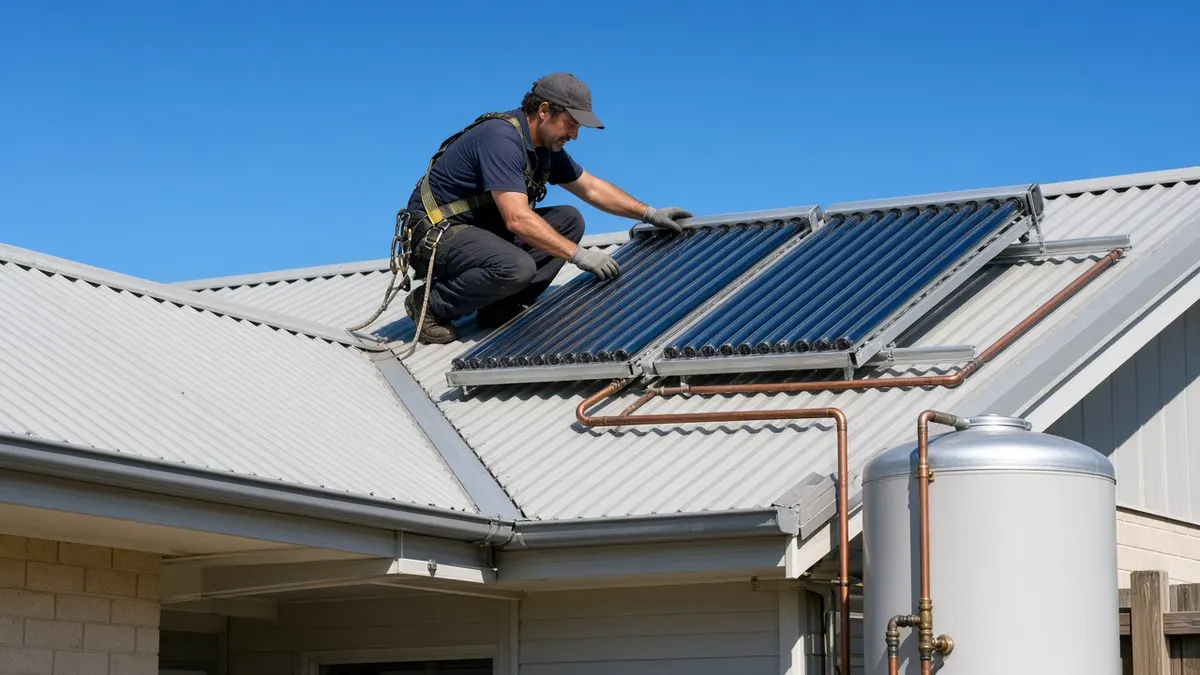
A solar hot water system costs about $4,500 to $9,500 installed in Australia in 2026, including GST, before any government incentives. Most households pay towards the middle of that range for a 300 to 315 litre system with an electric booster. The federal small-scale technology certificate (STC) scheme then takes a meaningful amount off the upfront price, and some states add their own rebates on top.
Installing a solar water heater involves plumbing, electrical work for an electric booster or gasfitting for a gas booster, and roof work. The plumbing must be done by a licensed plumber, the booster connection by a licensed electrician or gasfitter, and the roof work must follow working-at-heights safety rules. All prices here are indicative. Incentives move often, so check what applies to you before you sign, and get at least three written quotes on comparable systems.
Solar hot water prices at a glance
These are typical supply and install prices for a family-sized system in a capital city, before STCs and state rebates.
| System type | Installed price before incentives (inc. GST) | Best for |
|---|---|---|
| Close-coupled flat plate, 300 L, electric boost | $4,500 to $7,000 | Warm, frost-free areas with a strong north-facing roof |
| Split system flat plate, 300 to 315 L, electric boost | $5,000 to $8,000 | Homes where the roof cannot take a tank, or where looks matter |
| Split evacuated tube, 300 to 315 L, electric boost | $5,500 to $9,000 | Cooler and frost-prone climates |
| Solar with gas continuous flow boost | $6,000 to $9,500 | Homes with mains gas and high hot water use |
| Replacement solar storage tank only | $2,500 to $4,500 | Existing collectors in good condition |
| Replacement collector panel | $800 to $1,800 per panel | Cracked glass, hail damage or failed absorber |
Bigger households may need a 400 litre tank or extra collectors, which adds roughly $800 to $2,000. Two-storey homes, steep roofs and complicated pipe runs also push prices up, mainly because of the extra safety equipment and labour.
How federal STCs reduce the price
Solar water heaters and air source heat pumps are eligible under the federal Small-scale Renewable Energy Scheme, which is administered by the Clean Energy Regulator. When an eligible system is installed, it can create small-scale technology certificates, or STCs. Each certificate represents a set amount of electricity displaced by the system, and certificates have a market value.
In practice, almost nobody sells their own certificates. You sign a form assigning the STCs to the retailer or installer, and they take the value off your invoice as a point-of-sale discount. That is why many solar hot water quotes show a "price after STCs" figure.
How many certificates your system creates depends on the model, the zone you live in and the installation date. The scheme is scheduled to end in 2030, and the number of certificates a new system can create shrinks as that date gets closer, so the discount on a given system tends to fall each year. The certificate market price also moves. Treat any STC figure in a quote as a snapshot, and ask the installer to show the number of certificates and the price per certificate separately so you can compare quotes properly.
To be eligible, the system model must be on the Clean Energy Regulator's register, and the installation must comply with local plumbing and electrical rules. The certificate paperwork has a deadline after installation, but a reputable installer handles all of it for you.
State rebates change, so check before you buy
On top of STCs, several states and territories have offered rebates, discounts or low-interest loans for solar hot water and heat pumps at various times. These programs open, close, change eligibility rules and adjust amounts regularly, sometimes with little notice. Some are means-tested, some only apply to owner-occupiers, and some require you to use an approved installer and get pre-approval before the work starts.
Do not rely on a rebate amount you read in an old article or hear from a salesperson. Check the current offer directly with your state energy agency before you sign anything. The federal energy.gov.au rebates finder lists current state and federal programs by postcode, and in Victoria the Solar Victoria website covers that state's programs. If a quote is conditional on a rebate, make sure the contract says what happens to the price if the rebate is not approved.
Types of solar hot water systems
Close-coupled (tank on the roof)
The collector panels and the storage tank sit together on the roof. Water heated in the collectors rises naturally into the tank above them, so there is no pump. Close-coupled systems are the simplest and usually the cheapest. The drawbacks are weight and looks. A full 300 litre tank and its frame weigh several hundred kilograms, so the installer must check that the roof structure can carry it, and some older tiled roofs need extra support. Tanks on the roof also suit warm, frost-free areas best, because the tank and pipes are exposed.
Split systems (tank on the ground)
The collectors go on the roof and the tank sits on the ground, usually where the old hot water system was. A small pump circulates water or a heat-transfer fluid between them, controlled by a sensor. Split systems put less load on the roof and look tidier, but they cost more and the pump uses a little electricity.
Flat plate or evacuated tube collectors
Flat plate collectors are glass-covered panels with a dark absorber inside. They are durable and cost-effective in sunny climates. Evacuated tube collectors use rows of glass tubes with a vacuum layer that cuts heat loss, so they perform better in cold weather and low winter sun. They are a common choice in Hobart, Canberra, the Victorian highlands and other frost-prone areas.
Direct or indirect heating
Direct systems heat the household water itself as it passes through the collectors. Indirect systems run a separate closed loop of heat-transfer fluid, often a glycol mix, and pass the heat to the tank water through a heat exchanger. Indirect systems cope better with frost and hard water, which can block collectors with scale over time. In areas with very hard bore or town water, ask your installer which type they recommend.
Boosting
On cloudy days and in winter, solar alone will not always reach the required temperature, so every system has a booster. Electric boost uses an element in the tank, ideally on an off-peak or controlled-load tariff, or timed to run in the middle of the day if you have rooftop solar panels. Gas boost usually uses a continuous flow gas unit fitted after the tank that tops up the temperature only when needed.
Prices around Australia
Sun, frost and local labour rates all move the price. Sunny, frost-free cities can use cheaper close-coupled flat plate systems; colder cities often need evacuated tubes or frost protection, which cost more.
| Location | Typical installed price before incentives | Common setup |
|---|---|---|
| Sydney | $5,000 to $8,500 | Flat plate, close-coupled or split, electric or gas boost |
| Melbourne | $5,500 to $9,000 | Split systems, evacuated tube popular; check Victorian rules on gas boost |
| Brisbane | $4,500 to $7,500 | Close-coupled flat plate, electric boost |
| Perth | $4,500 to $7,500 | Close-coupled flat plate is very common |
| Adelaide | $4,800 to $8,000 | Flat plate, some hard-water areas suit indirect systems |
| Hobart | $5,500 to $9,500 | Evacuated tube split systems; heat pumps often compared |
| Canberra | $5,500 to $9,500 | Frost-protected or evacuated tube, electric boost |
| Darwin | $5,000 to $8,500 | Flat plate close-coupled, cyclone-rated mounting where required |
Regional areas can be cheaper for labour, but freight on large tanks and installer travel add cost. In cyclone regions, mounting frames and fixings must meet the higher wind rating, which adds to materials.
Three worked examples
All figures include GST. The STC line in each example is for illustration only; the real figure depends on the model, your zone, the installation date and the certificate price on the day.
Close-coupled system in Mandurah, WA
A single-storey brick and tile home with a failed 250 litre electric storage unit and a north-facing roof. The owners chose a 300 litre close-coupled flat plate system with electric boost on a controlled-load tariff.
| Item | Cost |
|---|---|
| 300 L close-coupled flat plate system | $3,900 |
| Installation: roof mounting, plumbing, removal of old unit | $1,500 |
| Licensed electrician to connect booster | $250 |
| Tempering valve | $220 |
| Disposal of old tank | $100 |
| Subtotal | $5,970 |
| STC point-of-sale discount (example only) | -$900 |
| Total paid | $5,070 |
Evacuated tube split in Toowoomba, QLD
A 1980s timber home on the Darling Downs, where winter frosts are common. The owners wanted the tank on the ground and chose a split evacuated tube system with electric boost.
| Item | Cost |
|---|---|
| 315 L split evacuated tube system with pump controller | $4,800 |
| Installation: collectors, roof penetrations, pipe runs, tank on slab | $1,800 |
| Licensed electrician: booster and pump connection | $300 |
| Tempering valve | $220 |
| Disposal of old tank | $100 |
| Subtotal | $7,220 |
| STC point-of-sale discount (example only) | -$1,000 |
| Total paid | $6,220 |
Heat pump instead of solar in Hobart, TAS
A weatherboard cottage with a south-west facing roof and heavy shading from a neighbour's trees. Solar collectors would have performed poorly, so the installer recommended an air source heat pump, which is also eligible for STCs.
| Item | Cost |
|---|---|
| 270 L heat pump water heater | $3,000 |
| Plumbing installation and removal of old unit | $900 |
| Licensed electrician: new dedicated circuit | $450 |
| Tempering valve | $220 |
| Disposal | $100 |
| Subtotal | $4,670 |
| STC point-of-sale discount (example only) | -$800 |
| Total paid | $3,870 |
The Hobart example is a reminder that solar hot water is not the right answer for every roof. If your roof faces the wrong way or is heavily shaded, a heat pump often does the same job for less.
Solar, heat pump, gas or electric?
| Type | Upfront cost (inc. GST) | Running cost | Watch-outs |
|---|---|---|---|
| Solar, electric boost | $4,500 to $9,000 before STCs | Low in sunny areas, higher in winter | Needs good unshaded north-facing roof space |
| Solar, gas boost | $6,000 to $9,500 before STCs | Low, with gas covering cloudy days | Gas supply charge, state gas policy |
| Heat pump | $3,500 to $6,500 before STCs | Low, works day and night | Some noise from the fan; check placement near bedrooms |
| Gas continuous flow | $1,800 to $3,800 | Moderate, tied to gas prices | Gas policy changing in some states |
| Electric storage | $1,500 to $3,000 | Highest unless timed to cheap or solar power | Cheapest to buy, dearest to run in most cases |
If you already have rooftop solar panels, a heat pump or an electric storage unit timed to run in the middle of the day can use your own solar power, which changes the comparison. Our gas hot water system cost guide covers the gas options in detail, and the federal Your Home hot water guide compares running costs and emissions across types.
Sizing the tank and collectors
Solar systems are sized by tank volume and collector area. Too small and the booster runs constantly; too big and you pay for capacity the sun cannot fill in winter. As a starting point:
- One to two people: a 160 to 250 litre tank with one or two collector panels, or the equivalent in evacuated tubes.
- Three to four people: a 300 to 315 litre tank with two collector panels, the most common family setup.
- Five or more people: a 400 litre tank, often with three collector panels.
Your installer should adjust this for your climate, roof orientation and habits. A household that runs the dishwasher and washing machine on hot, or has teenagers who take long showers, needs more capacity than the headcount suggests. In colder areas, installers often add a collector or choose evacuated tubes so the system still contributes in winter.
Remember that a bigger tank also means more weight on the roof for a close-coupled system, and more standby heat loss overnight. Size for the household you will have over the next ten years, not the one you had when the old system went in.
What drives the installed price
- Roof type and pitch. Tin roofs are quicker to mount on than tiles. Steep or two-storey roofs need more fall protection, such as edge protection or scaffolding, and more labour.
- Roof strength. Close-coupled tanks are heavy. If the installer or an engineer decides the roof needs strengthening, that is extra carpentry.
- Orientation and shading. Collectors work best facing north at a tilt close to your latitude. East or west roofs may need extra collectors or tilt frames.
- Pipe runs. Split systems need insulated pipes between the roof and the tank. Long runs cost more and lose more heat.
- Booster type. Gas boost adds a gas unit and gasfitting. Electric boost may need a new circuit or a controlled-load connection.
- Frost and water quality. Frost protection, indirect loops and water treatment add cost in cold or hard-water areas.
- Removal of the old system. Taking an old tank off a roof is more work than removing one from the ground.
Licences and safety rules
All plumbing work on a solar hot water system must be done by a licensed plumber in every state and territory, including connecting the tank, collectors and tempering valve. Connecting an electric booster or a pump to the switchboard must be done by a licensed electrician, and connecting a gas booster must be done by a licensed gasfitter. A handyman cannot legally do any of this; our article on whether a handyman can do plumbing sets out the state rules.
Plumbers are licensed by NSW Fair Trading, the Building and Plumbing Commission in Victoria, the QBCC in Queensland, Building and Energy in WA, Consumer and Business Services in SA, CBOS in Tasmania, Access Canberra and the NT Plumbers and Drainers Licensing Board. Ask for licence numbers on the quote and check them on the regulator's public register.
Roof work comes under state WHS laws administered by SafeWork and WorkSafe bodies. Installers must use appropriate fall protection when working at height, such as edge protection, scaffolding or harness systems, depending on the roof. A quote that is far cheaper than the others may be skipping this.
New hot water installations need a tempering valve so that water at bathroom outlets is delivered at no more than 50 degrees Celsius. The tank itself must be heated high enough, regularly, to control bacteria such as Legionella. The booster and controller are set up to handle this; do not ask the installer to turn the booster off permanently to save money.
Running costs and how much the sun covers
How much of your hot water the sun provides depends on where you live, the season, the size of the system and how your household uses hot water. In sunny climates, a well-sized system can cover most of the year's water heating, with the booster doing more work in winter. In cooler southern cities, the booster does a larger share of the work over the year.
You can make a big difference to running costs with the booster settings. On an electric boost system, set the booster to run late in the day, after the sun has done its work, rather than first thing in the morning. On a controlled-load tariff, check that the booster is on the cheaper circuit. Showering in the evening rather than early morning also lets the sun heat the tank before it is drawn down.
Lifespan and maintenance
A good-quality solar hot water system can last 15 to 20 years or more, longer than most gas or electric storage units. Collectors often outlast tanks, which is why replacing only the tank is common.
- Operate the pressure and temperature relief valve lever every six months or as the manual says, and replace the valve at the recommended interval.
- Check the sacrificial anode in the tank every few years and replace it when worn.
- On indirect systems, have the heat-transfer fluid checked and topped up at the interval in the manual.
- Keep collectors clear of leaves, and hose dust off the glass if rain does not do it for you.
- Book a service every few years, usually $200 to $400, to check the pump, controller, valves and frost protection.
Check the warranty terms. Manufacturers typically offer longer warranties on collectors and tanks than on pumps and controllers, and some require regular servicing to keep the warranty valid.
Getting quotes and avoiding problems
Ask each installer for the exact model numbers of the collectors and tank, the tank size, the booster type, the number of STCs and the price per certificate, the installed price before and after STCs, who does the electrical and gas work, what fall protection will be used, removal of the old system and the warranty on parts and labour.
Be wary of door-to-door or phone sales that push a decision on the day, "free" systems, quotes that only show an after-rebate price, and any installer who cannot give you a plumbing licence number. Get at least three written quotes. You can compare hot water system installers near you and licensed plumbers in your area, and our plumber cost guide has hourly rates for any extra work.
Before you commit, look at the state of your roof. If it needs restoring or replacing in the next few years, do that first; taking collectors off and putting them back later costs money. Our roof restoration cost guide can help you plan.
Timeframes on install day
A like-for-like close-coupled replacement usually takes most of a day. A first-time split system installation, with new roof penetrations, pipe runs and an electrician's visit, can take a full day or spill into a second. You will be without hot water for part of that time. Once the system is running, it can take a sunny day or two for the tank to reach full solar temperature, and the booster covers the gap in the meantime.
How Yakka can help
Installing a solar hot water system is licensed plumbing and electrical work, often on a roof, so Yakka Labour does not do it. Where a Yakka worker can help is with the jobs around it: clearing the side of the house or garage so the installer can reach the old tank, carrying packaging away and taking the old tank to the tip if the installer does not.
Any plumbing, electrical, gas or roof work must stay with licensed trades who follow working-at-heights rules. Book a licensed installer and check their licence numbers with your state regulator.
Frequently asked questions
How much does a solar hot water system cost in Australia?
Most solar hot water systems cost $4,500 to $9,500 installed in 2026, including GST, before incentives. Close-coupled flat plate systems are at the lower end, while split evacuated tube systems and gas-boosted systems cost more. Federal STCs usually reduce the price at the point of sale, and some states offer extra rebates that change over time.
What are STCs for solar hot water?
STCs are small-scale technology certificates created under the federal Small-scale Renewable Energy Scheme when an eligible solar water heater or heat pump is installed. Most households assign them to the installer, who takes their value off the invoice. The number of certificates depends on the model, your zone and the installation date, and the scheme ends in 2030.
Are there state rebates for solar hot water?
Some states and territories have offered rebates, discounts or loans for solar hot water and heat pumps, but these programs change often and have eligibility rules. Check the current offer with your state energy agency or the energy.gov.au rebates finder before you sign a contract, and do not rely on amounts quoted in older articles.
Is solar hot water worth it?
It is usually worth it in sunny areas for households that use a lot of hot water and have a good north-facing roof. It costs more upfront than gas or electric storage but costs much less to run. If your roof is shaded or faces south, a heat pump is often a better choice for a similar price.
Is a heat pump better than solar hot water?
It depends on your roof and climate. Heat pumps do not need roof space or sun, work day and night and are often cheaper to install, but they make some fan noise and use a little more electricity. Solar suits sunny, unshaded roofs. Both are eligible for STCs, so compare quotes for each.
How long does a solar hot water system last?
A good-quality system can last 15 to 20 years or more. Collectors often outlast tanks, so replacing only the tank is common later on. Regular maintenance helps, including operating the relief valve, checking the anode, checking the heat-transfer fluid on indirect systems and booking a service every few years.
Can a solar hot water system go on any roof?
Most roofs can take collectors, but close-coupled systems put a heavy tank on the roof, so the structure must be strong enough. Collectors work best facing north and unshaded. Steep, two-storey or fragile roofs cost more to work on. A split system with the tank on the ground suits roofs that cannot carry the weight.
Official sources
Award rates, licences and safety rules change. Check the official source before you hire or take on a shift.
- Queensland Building and Construction Commission (QBCC)Contractor, plumbing and drainage licence search in Queensland
- Consumer and Business Services SALabour hire licensing in South Australia
- NSW Fair TradingTrade licence checks for electricians, plumbers and builders in New South Wales
- Building and Plumbing Commission (Victoria)Builder and plumber registration, domestic building insurance and licence checks in Victoria
- Consumer, Building and Occupational Services (Tasmania)Building, plumbing and electrical licensing in Tasmania
- Access CanberraConstruction occupation licences and building approvals in the ACT