Interior cost guide
How Much Does a Plumber Cost in Australia? 2026 Rates
Typical cost in Australia (2026, inc. GST)
$100 to $160 per hour
standard weekday rate for a licensed plumber in a capital city, call-out fee extra
A licensed plumber in Australia typically charges $100 to $160 per hour in 2026, plus a call-out fee of $80 to $180, including GST. Small jobs such as fixing a dripping tap or clearing a blocked toilet usually cost $150 to $400 in total. After-hours and emergency work costs roughly 1.5 to 2 times the standard rate, and drain or hot water jobs run into the thousands.
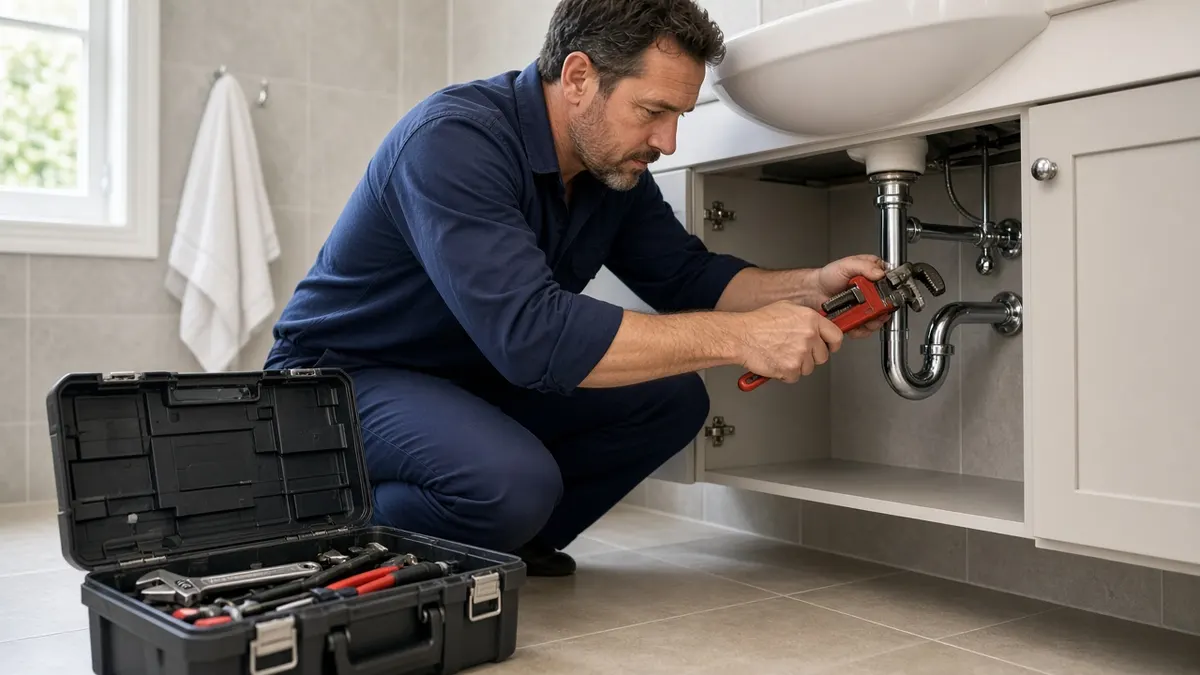
A licensed plumber in Australia usually charges $100 to $160 an hour in 2026, plus a call-out fee of around $80 to $180, with GST included. That puts most small household jobs, like a dripping tap, a running toilet or a blocked sink, at $150 to $400 all up. Emergency work at night or on a public holiday can easily double that, and bigger jobs like a new hot water system or a sewer repair start in the low thousands.
Every figure here is indicative. Rates shift with your city, the time of day, how easy the job is to get to and the parts involved. For anything beyond a quick repair, get at least three written quotes, and for every job, check the plumber's licence before they start. Plumbing is licensed work in every Australian state and territory, and that is not a formality: unlicensed work can void your home insurance and leave you liable for water damage to the neighbours.
Hourly rates and call-out fees
Plumbers bill in one of three ways: an hourly rate with a call-out fee, a fixed price for a defined job, or a call-out fee that includes the first 30 minutes or hour. Ask which one applies before the van leaves the depot.
| Charge type | Indicative cost (inc. GST) | What it covers |
|---|---|---|
| Call-out or attendance fee | $80 to $180 | Travel and the first visit; sometimes includes 15 to 30 minutes |
| Standard hourly rate | $100 to $160 | Weekdays, roughly 7 am to 4 pm |
| Apprentice or second worker | $60 to $95 per hour | Added when a job needs two people |
| After-hours hourly rate | $150 to $250 | Evenings and Saturdays |
| Emergency call-out | $150 to $350 | Nights, Sundays, public holidays |
| Minimum charge | $150 to $250 | Some firms bill one hour minimum regardless of time on site |
Many plumbers bill in 15 or 30 minute blocks after the first hour. A ten-minute fix may still cost you the call-out plus a full first hour, which is why bundling small jobs into one visit is the easiest saving available.
Prices for common plumbing jobs
These ranges include labour and standard parts on a weekday in a capital city. They exclude the cost of new fixtures you choose, like a designer mixer or a new toilet suite.
| Job | Indicative total (inc. GST) |
|---|---|
| Fix a dripping tap (washer or cartridge) | $120 to $250 |
| Replace a kitchen or basin mixer (tap supplied) | $200 to $450 |
| Clear a blocked toilet | $150 to $350 |
| Clear a blocked sink or shower drain | $150 to $350 |
| Clear a blocked sewer with an electric eel | $200 to $450 |
| High-pressure water jetting of drains | $350 to $800 |
| CCTV drain camera inspection | $250 to $500 |
| Leak detection (concealed leak) | $300 to $800 |
| Repair an accessible burst pipe | $200 to $600 |
| Fix a running toilet cistern (inlet valve or outlet) | $150 to $350 |
| Replace a toilet suite like-for-like (labour) | $250 to $500 |
| Install a dishwasher (existing connections) | $150 to $300 |
| Add a new garden tap | $200 to $450 |
| Replace a pressure limiting valve | $250 to $500 |
| Replace an electric storage hot water system | $1,500 to $3,000 |
| Pipe relining | $600 to $1,200 per metre plus setup |
| Excavate and replace a section of sewer | $2,000 to $8,000+ |
Toilet swaps have enough variables to need their own page; our toilet replacement cost guide covers suites, set-outs and wall-hung conversions. For hot water, see the gas hot water system cost guide.
What plumbers charge around Australia
Plumbers in Sydney, Canberra and Darwin tend to charge the most per hour. Sydney and Canberra have high labour costs and strong demand; Darwin adds freight on parts and a smaller trade pool. Adelaide and Hobart are generally a little cheaper. Expect regional towns to have lower hourly rates but more travel time on the invoice.
| Location | Standard hourly rate | Typical call-out fee |
|---|---|---|
| Sydney | $120 to $170 | $100 to $180 |
| Melbourne | $110 to $160 | $90 to $170 |
| Brisbane | $105 to $150 | $85 to $160 |
| Perth | $110 to $160 | $90 to $170 |
| Adelaide | $95 to $140 | $80 to $150 |
| Hobart | $95 to $145 | $80 to $150 |
| Canberra | $115 to $165 | $100 to $180 |
| Darwin | $120 to $175 | $100 to $190 |
| Regional areas | $90 to $140 | Often replaced by a travel charge |
After-hours and emergency pricing
A burst pipe at 11 pm on a Sunday is a different price bracket. Expect an emergency call-out fee of $150 to $350 and an hourly rate of $150 to $250, so a one-hour emergency visit commonly costs $350 to $600 before parts. Public holidays can be higher again.
Before you call anyone, find your water meter and turn off the main stopcock. In most houses it sits near the front boundary, often in a small box in the lawn or garden bed. In units it may be in a cupboard in the hallway or a meter room. Stopping the water buys you time to decide whether the job can wait until morning, which can halve the bill. Turning off the power to an electric hot water system and the gas to a gas one is also sensible if the leak is from the heater.
Jobs that genuinely cannot wait include burst pipes you cannot isolate, a sewer overflowing inside the house, a gas leak (call your gas distributor's emergency line first, and get out of the house if the smell is strong) and a hot water system leaking near electrics. A dripping tap, a slow drain or a toilet that runs on can wait for business hours.
Three typical invoices
All figures include GST.
Weekday visit to a Parramatta townhouse
A slow-draining kitchen sink and a dripping bathroom basin tap, booked together for a Tuesday morning.
| Item | Cost |
|---|---|
| Call-out fee | $120 |
| Labour, 1.5 hours at $130 | $195 |
| Tap cartridge and O-rings | $35 |
| Total | $350 |
Booking both problems in one visit saved a second call-out fee of around $120.
Saturday night burst hose in Geelong
A braided flexible hose under a vanity split and started spraying water across the bathroom. The owner turned off the main but needed water back on for the weekend.
| Item | Cost |
|---|---|
| After-hours call-out | $250 |
| Labour, 1 hour at $210 | $210 |
| Two new braided hoses | $40 |
| Total | $500 |
Braided hoses have a limited life, often quoted at around 5 to 10 years. A plumber can swap every hose in the house on a weekday visit for a fraction of one emergency call.
Tree roots in a 1960s sewer line in Chermside, Brisbane
Repeated blockages in the yard gully. A camera showed roots entering two joints in the old clay pipe.
| Item | Cost |
|---|---|
| Call-out fee | $120 |
| CCTV camera inspection and report | $350 |
| High-pressure jetting to clear roots | $550 |
| Relining setup and mobilisation | $400 |
| Pipe relining, 3 m at $800 per metre | $2,400 |
| Total | $3,820 |
Digging up and replacing that run would have meant pulling up a concrete path and part of a garden bed, and the reinstatement alone could have cost more than the relining.
Why one quote is higher than another
- Access. Pipes under a slab, inside a double-brick wall or in a tight subfloor take far longer than pipes under a sink. Two-storey homes with plumbing in the ceiling add time too.
- Age of the house. Galvanised steel water pipes, clay sewer pipes and old copper with lead-soldered joints are more fragile. A plumber who finds a corroded fitting may need to replace more than the bit that leaked.
- Parts markup. Plumbers buy from trade suppliers and mark up parts. That is normal, as they carry the stock and warrant the part, but markups vary.
- Equipment. Jetters, drain cameras and relining rigs are expensive machines. Jobs that need them carry a higher fixed charge.
- Making good. Cutting into plasterboard or tiles to reach a pipe is the plumber's job; patching and painting afterwards usually is not, and it costs extra.
- Compliance paperwork. Many jobs need a compliance certificate lodged with the state regulator. The cost is built into the price.
- Day and time. Monday mornings and the days after heavy rain are peak times for blocked drains. Mid-week bookings are easier to get.
Specialist plumbing work and what it costs
"Plumber" covers a lot of ground. Some plumbers do a bit of everything; others specialise, and specialists often charge more per hour but finish faster.
Drainage
Drainers handle sewer and stormwater lines outside the house. Blockages, root intrusion, collapsed pipes and new connections are their bread and butter. Expect the jobs to be quoted in stages: clear the blockage, camera the line, then quote the repair. Pipe relining avoids digging but costs more per metre than open-trench replacement where access is easy. On a clear run of lawn with no concrete over it, digging and replacing can be the cheaper option, and you can find drainage specialists near you to compare both methods.
Hot water
Hot water replacement is one of the most common big-ticket plumbing jobs. A like-for-like electric storage unit installed costs about $1,500 to $3,000, gas storage or continuous flow about $1,800 to $3,800, and a heat pump $3,500 to $6,500 before any rebates. Switching types costs more because the plumber may need to move pipes, upgrade the gas line or have an electrician add a circuit. Every new installation needs a tempering valve to limit the temperature at the bathroom taps.
Gas fitting
Gas work needs a gasfitting licence, which many plumbers hold alongside their plumbing licence. Connecting a cooktop, adding a bayonet, running a new line to a heater or fixing a leak are all gasfitting. Rates are similar to plumbing, sometimes slightly higher.
Backflow prevention
Homes with rainwater tanks plumbed to the house, irrigation systems or some pool setups may need a backflow prevention device, and in many areas these must be tested every year by a plumber with a backflow endorsement. Annual testing typically costs $100 to $250 per device.
What to expect when the plumber arrives
A good plumber will ask you to show them the problem, look at it for a few minutes and tell you what they think is wrong before doing anything chargeable beyond the attendance fee. If it is a straightforward job, they should give you a price on the spot. If it is not, they should explain what they need to do to find out, such as running a camera or cutting an inspection hole, and roughly what that will cost.
Clear the area beforehand. Empty the cupboard under the sink, move cars from the driveway if the drain access point is there, and lock away pets. Five minutes of clearing can save fifteen minutes of paid time.
Once the work is done, ask the plumber to show you what they replaced, and keep the old part if you want to. Run the taps, flush the toilet and check for drips before they leave. For work that needs a compliance certificate, ask when you will receive your copy. Keep it with your house documents, as you may need it for insurance claims or when you sell.
Licensing rules in each state
All plumbing and drainage work in Australia must be done by a licensed plumber, or by a registered apprentice under supervision. That covers water supply, sanitary drainage, stormwater connected to the street system, hot water, gas and backflow devices. The Plumbing Code of Australia, published by the Australian Building Codes Board, sets the technical requirements, and each state licenses the people who do the work.
- NSW: plumbers, drainers and gasfitters are licensed by NSW Fair Trading. Plumbing is specialist work, so a licence is needed whatever the job value.
- Victoria: plumbers must be registered or licensed with the Building and Plumbing Commission, which took over plumbing regulation from the Victorian Building Authority. Many jobs need a compliance certificate; check the current value threshold with the Commission.
- Queensland: plumbing and drainage work needs a QBCC licence. Gas work is licensed separately by Resources Safety and Health Queensland.
- WA: plumbers are licensed through the Plumbers Licensing Board, administered by Building and Energy.
- SA: Consumer and Business Services licenses plumbers and gasfitters.
- Tasmania: CBOS licenses plumbers and issues the permits for some plumbing work.
- ACT: Access Canberra licenses plumbers, drainers and gasfitters.
- NT: the Plumbers and Drainers Licensing Board licenses plumbers.
Ask for the licence number and look it up on the regulator's public register. A legitimate plumber will give it to you without fuss, and it should also be printed on the quote and invoice.
The small jobs you can do yourself
Householders can generally do a few basic maintenance tasks without a licence: changing a tap washer, swapping a screw-on shower head, cleaning an aerator, plunging a blocked sink or toilet and cleaning out a sink trap that unscrews by hand. The exact list differs between states, so check with your regulator if you are unsure.
Anything beyond that, such as moving or adding a pipe, replacing a tap body, installing a toilet, touching a hot water system or working on drains, needs a licensed plumber. The same rule applies to handymen. Our article on whether a handyman can do plumbing sets out the state-by-state detail, and it is worth reading before you hire anyone for a mixed bag of jobs.
Fixed price or hourly?
For routine jobs, a fixed price is usually the better deal for you. A plumber who has replaced hundreds of mixers knows how long it takes and will price accordingly, and you carry no risk if a nut is seized. Fixed pricing also makes it easy to compare quotes.
Hourly billing makes sense when nobody can know the scope in advance, such as tracking down a concealed leak or clearing a drain of unknown condition. In those cases, agree an hourly rate, a cap or check-in point (for example, "call me before going past two hours") and what happens if the job turns into a bigger repair.
Watch out for "upfront pricing" that is presented only once the plumber is on site and the call-out fee is already spent. It is a legitimate model, but you should feel free to say no and pay only the attendance fee if the price seems high.
Getting a fair quote
For anything over a few hundred dollars, a written quote should include:
- The plumber's name, business name, ABN and licence number.
- A clear description of the work and the parts to be used, with brands or models where it matters.
- Whether the price is fixed or an estimate, and the hourly rate for any variations.
- Who removes old fixtures and rubbish.
- Whether a compliance certificate will be lodged, and that you will receive a copy.
- Warranty on labour and on parts.
- Payment terms.
Red flags include no licence number, cash-only pricing, pressure to sign on the spot, a large deposit for a small job, and a quote that changes dramatically once work starts without a written variation. Our guide to hiring a plumber near you has more on vetting tradies, and you can browse licensed plumbers in your area to compare.
Ways to spend less on plumbing
Bundle jobs. Make a list of every drip, slow drain and loose tap in the house and get them done in one visit. The call-out fee is the most expensive part of a small job.
Know where your shut-off valves are. Isolating a leak yourself turns an emergency into a weekday booking.
Fix small leaks early. A toilet that runs on can waste thousands of litres a year, and a weeping pipe joint can rot a floor. Both are cheap to fix early and expensive to fix late.
Look after your drains. Keep fat, wipes and cotton buds out of them. Wet wipes labelled "flushable" are a common cause of sewer blockages. Plant trees well away from sewer lines, especially fig, willow and other thirsty species.
Supply your own fixtures only after checking with the plumber. Most will install owner-supplied tapware and toilets, but they will not warrant the product, and an incompatible part can turn a one-hour job into two visits.
Where Yakka fits
Yakka Labour does not supply plumbers for licensed work. What it can help with is the labour around a plumbing job: digging by hand to expose a section of sewer line where the plumber marks it, clearing a cluttered subfloor or garage so the plumber can get to the pipes, moving heavy furniture, carrying old fixtures out and taking the rubbish away afterwards.
That can save a plumber's hourly rate on work that does not need a licence. The pipework itself, any connection to water or sewer, and the compliance certificate stay with a licensed plumber. If you are planning a larger job, such as a full bathroom, our bathroom renovation cost guide explains how the trades fit together.
Frequently asked questions
How much does a plumber charge per hour in Australia?
Most licensed plumbers in Australian capital cities charge $100 to $160 per hour in 2026, including GST, on weekdays. A call-out fee of $80 to $180 is usually added. After-hours rates of $150 to $250 an hour are common, and emergency call-outs at night or on public holidays can cost $150 to $350 before labour starts.
What is a plumber call-out fee?
A call-out fee covers the plumber's travel and the time to attend and assess the job. It typically costs $80 to $180 on weekdays and more after hours. Some plumbers include the first 15 to 30 minutes of work in the fee, while others charge it on top of the hourly rate. Ask which applies when you book.
How much does it cost to unblock a drain?
Clearing a simple blocked sink or shower drain usually costs $150 to $350. A sewer blockage cleared with an electric eel costs around $200 to $450, and high-pressure jetting for tree roots or heavy build-up runs $350 to $800. A CCTV camera inspection, at $250 to $500, is worth it if blockages keep coming back.
Can I do my own plumbing in Australia?
Only very basic tasks. Householders can generally change a tap washer, replace a screw-on shower head, clean an aerator and plunge a blocked drain. Almost everything else, including installing taps and toilets, moving pipes and working on hot water or drains, must be done by a licensed plumber. The exact list varies by state.
How much does an emergency plumber cost?
An emergency plumber usually charges a call-out fee of $150 to $350 plus $150 to $250 per hour, so a one-hour visit often costs $350 to $600 before parts. Public holidays can be higher. Turning off the water at the meter yourself can often turn an emergency into a cheaper weekday booking.
How do I check if a plumber is licensed?
Ask for their licence number, then search it on your state regulator's public register. That is NSW Fair Trading in NSW, the Building and Plumbing Commission in Victoria, the QBCC in Queensland, Building and Energy in WA, CBS in South Australia, CBOS in Tasmania, Access Canberra in the ACT and the Plumbers and Drainers Licensing Board in the NT.
Is it cheaper to get a fixed-price quote from a plumber?
For routine jobs like replacing a tap, toilet or hot water system, a fixed price is usually better value and easier to compare. For jobs with an unknown scope, such as finding a hidden leak, hourly billing is more common. In that case, agree a rate and a point at which the plumber must check in before continuing.
Official sources
Award rates, licences and safety rules change. Check the official source before you hire or take on a shift.
- Queensland Building and Construction Commission (QBCC)Contractor, plumbing and drainage licence search in Queensland
- Consumer and Business Services SALabour hire licensing in South Australia
- NSW Fair TradingTrade licence checks for electricians, plumbers and builders in New South Wales
- Building and Plumbing Commission (Victoria)Builder and plumber registration, domestic building insurance and licence checks in Victoria
- Consumer, Building and Occupational Services (Tasmania)Building, plumbing and electrical licensing in Tasmania
- Access CanberraConstruction occupation licences and building approvals in the ACT