Build & Renovate cost guide
Rendering Cost in Australia (2026): Price per m² and Whole House
Typical cost in Australia (2026, inc. GST)
$50 to $110 per m²
cement or acrylic render over brick, single-storey, standard prep, excluding paint and scaffolding
Rendering usually costs $50 to $110 per square metre in 2026 for cement or acrylic render over brick, plus $15 to $30 per square metre to paint it. A typical single-storey brick veneer home with about 150 m² of wall costs $10,000 to $19,500 rendered and painted. Two-storey homes need scaffolding and often reach $20,000 to $45,000. Substrate, preparation, finish and access set the price.
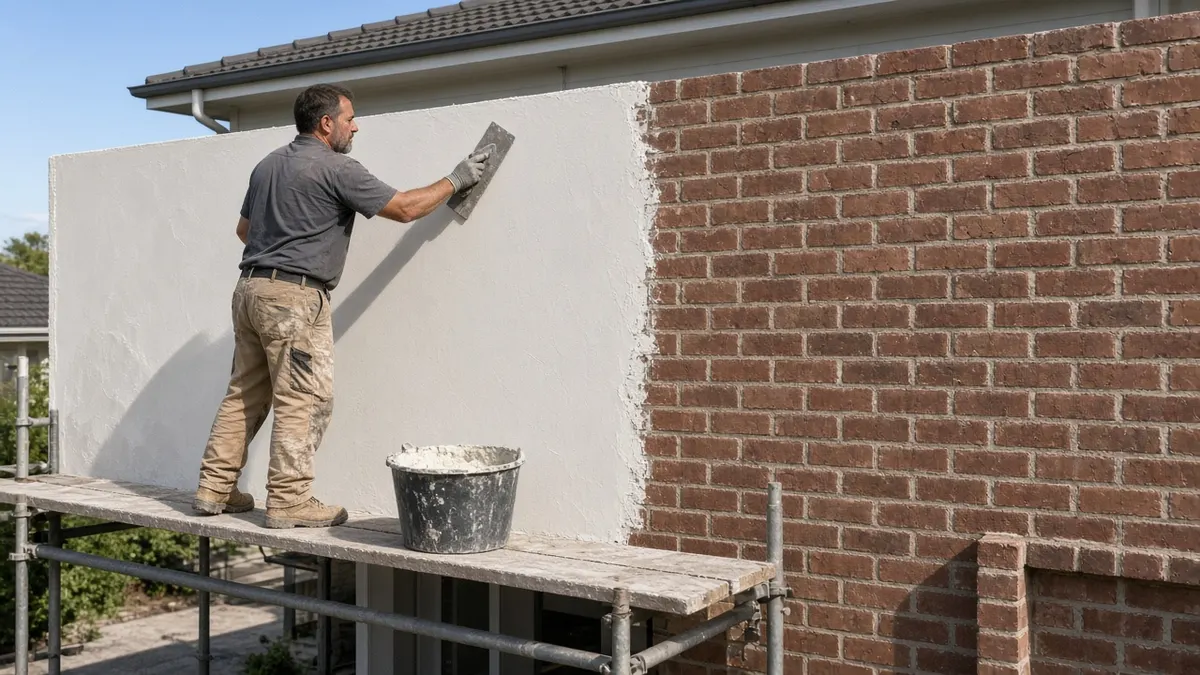
Rendering costs about $50 to $110 per square metre in Australia in 2026 for a standard cement or acrylic render applied over brick, and painting it adds another $15 to $30 per square metre. For a single-storey three-bedroom brick veneer house with around 150 m² of external wall, that means roughly $10,000 to $19,500 for the full job. Two-storey homes, heritage lime work and elaborate detailing cost more.
Render is the go-to facelift for tired 1970s and 1980s brick homes, and it is the standard finish on lightweight AAC and foam-clad new builds. It can transform a house. It can also crack, drum and stain if the wall was not prepared properly or the renderer rushed. The prices below are indicative and include GST. Use them to judge quotes, and always get at least three written quotes for the same scope.
Price per square metre by render type
These rates cover supply and application by a professional renderer at single-storey height, including standard preparation such as cleaning the wall and fixing corner beads. Painting and scaffolding are extra unless stated.
| Render type | Typical rate (incl. GST) | Best suited to |
|---|---|---|
| Bagging (thin slurry over brick) | $25 to $45 per m² | Softening brick texture while keeping the brick outline visible |
| Roll-on texture coating | $30 to $60 per m² | Refreshing existing render or fibre cement |
| Cement render, two coats, sponge or float finish | $45 to $85 per m² | Brick and block walls, fences, retaining walls |
| Acrylic render | $55 to $100 per m² | Brick, block and existing render where some flexibility helps |
| Render coat over AAC or foam cladding panels | $50 to $90 per m² | New builds, extensions and second storeys |
| Through-coloured mono render (no paint needed) | $70 to $120 per m² | Owners who want low maintenance and no repainting |
| Lime render | $90 to $160 per m² | Heritage homes, sandstone and soft brick |
| Exterior paint over render, two coats | $15 to $30 per m² | Any painted render system |
Cement render is the traditional sand and cement mix, often with lime added for workability, applied in one or two coats about 10 to 20 mm thick. Acrylic render is cement-based with polymer additives, applied thinner, and copes with slight movement better. In practice, many renderers use a polymer-modified cement render for the base coat and an acrylic texture or membrane paint on top.
Typical totals for common jobs
| Job | Approximate area | Rendered and painted (incl. GST) |
|---|---|---|
| Front facade or feature wall only | 30 to 50 m² | $2,000 to $6,500 |
| Single-storey brick veneer, whole house | 130 to 170 m² | $10,000 to $19,500 |
| Large single-storey, whole house | 180 to 230 m² | $13,000 to $28,000 |
| Two-storey, whole house, including scaffolding | 250 to 320 m² | $20,000 to $45,000 |
| Front brick fence with piers | 40 to 70 m² (both faces) | $3,000 to $8,000 |
| Garden or retaining wall, one face | 15 to 30 m² | $1,000 to $3,500 |
To measure your own walls, multiply each wall's length by its height, add them up and subtract large openings such as garage doors and sliding doors. Do not subtract small windows; the extra work on window reveals usually cancels out the saved area.
What decides the price
What you are rendering over
Clean, unpainted brick or block is the easiest substrate: render bonds to it well and needs little preparation. Painted brick is harder, because paint stops render bonding properly. The paint has to be removed, scabbled or treated with a bonding agent, and some renderers add a fibreglass mesh. Existing cracked render may need to be hacked off entirely. Lightweight AAC panels and foam cladding come with their own render systems, which must be applied to the manufacturer's specification to keep the warranty.
Preparation and repairs
Preparation is where cheap quotes cut corners. A proper job includes pressure washing the walls, repairing cracked bricks and open joints, fitting corner beads and stop beads, forming control joints that line up with the brickwork's own articulation joints, and masking windows, doors, paving and gardens. Skip the control joints and the render will crack along the line of least resistance, usually from the corners of windows.
Finish
A sponge finish is the most common and forgiving. A smooth steel-trowelled finish shows every ripple and costs more. Heavy textured finishes hide imperfections but collect dirt. Matching an existing finish for a patch or extension takes extra care.
Height and access
Single-storey walls are done from trestles and planks. Anything higher generally needs scaffolding, which typically adds $2,500 to $7,000 for a two-storey house depending on perimeter, height and hire period. Steep sites, narrow side setbacks and boundary walls with no access from next door add time.
Architectural details
Window reveals, arches, columns, bands, quoins and parapet cappings all take longer than flat wall. A house with lots of corners and openings can cost 20 to 30 percent more than a simple box with the same wall area.
Weather
Render should not go on in rain, strong wind or direct hot sun, because it cures too fast and cracks. In summer, renderers chase the shade around the house; in winter, they lose days to rain. A quote should allow for this.
What rendering costs in each city
The figures below are for a single-storey house with about 150 m² of wall, rendered and painted.
| City | Typical total | Local factors |
|---|---|---|
| Sydney | $12,500 to $21,000 | Highest labour rates, tight access on small blocks |
| Melbourne | $11,500 to $19,500 | Big market for rendering 1970s and 1980s brick veneer homes |
| Brisbane | $11,000 to $18,500 | Summer heat and storms affect scheduling |
| Perth | $10,500 to $18,000 | Double brick and render are common, so renderers are plentiful |
| Adelaide | $10,000 to $17,500 | Lower labour costs, many sandstone and brick homes |
| Hobart | $11,500 to $19,500 | Fewer renderers, cooler curing conditions |
| Canberra | $12,000 to $20,500 | Small trade pool, frost limits winter work |
| Darwin | $12,500 to $22,000 | Heat, humidity and wet season delays |
| Regional | $10,000 to $19,000 plus travel | Rates vary widely with local availability |
Renderers typically charge $65 to $100 per hour or $550 to $850 per day per person, and usually work in crews of two or three with a labourer mixing and carrying.
Where the money goes: labour versus materials
Render is a labour-heavy trade. On a typical job, materials make up only about 20 to 30 percent of the render price, and labour the rest. A 20 kg bag of render covers somewhere around 1 to 2 m² at normal thickness, so a 150 m² house might use 100 or more bags plus sand, beads, mesh and bonding agents. At trade prices, that is a few thousand dollars. The remainder is three people working for one to two weeks.
That split explains why quotes vary so much. A renderer who is booked out for months prices high because they can. A crew that has just finished a big builder contract may sharpen its pencil. It also explains why preparation is where cheap quotes save money: every hour not spent on beads, control joints and masking is margin. Paint follows a similar pattern; the paint itself is perhaps a quarter of the painting cost.
Picking a colour and finish
Colour affects cost more than people expect. Light and mid tones hide hairline cracks, dust and patching, and they reflect heat. Very dark colours look sharp on modern homes but show every flaw, fade faster on sunny walls and push surface temperatures up, which adds stress to the render. Some paint and render manufacturers limit their warranty on dark colours or require a specific heat-reflective product, so check before you fall in love with charcoal.
For finish, a sponge or float finish has a fine sandy texture that is easy to patch and hides minor waviness. A smooth finish looks crisp but highlights every imperfection when the sun is low. Coarse textures, such as a scratch or swirl coat, were popular in the 1990s and now tend to date a house. Ask your renderer for a sample board in your chosen colour and finish, and look at it outside at different times of day.
What happens on a render job, step by step
Day one is usually setup: trestles or scaffolding, masking windows and doors with plastic, laying drop sheets over paving, and pressure cleaning the walls. Next comes preparation, with crack repairs, beads at corners and openings, and control joints marked to line up with the brickwork. On painted walls, this is when the old paint is ground back or a bonding agent goes on.
The base coat follows, applied by trowel or spray machine, ruled flat with a straight edge and left to firm up. The finish coat goes on after the base has cured enough, which can be the same day or several days later depending on the product and weather. Paint usually waits at least a few days to a couple of weeks, depending on the render system's curing requirements. Expect dust, the noise of a mixer, and wet render smell for the duration. Keep cars clear of the walls, because render splatter on duco is hard to remove once dry.
Three rendering jobs, costed
All amounts include GST.
1980s brick veneer in Narre Warren, VIC
A three-bedroom single-storey house with orange brick, 155 m² of net wall area, and an owner who wants a modern white finish. Unpainted brick, a few cracked bricks under the windows.
| Item | Cost |
|---|---|
| Preparation: pressure clean, crack repairs, corner and stop beads | $1,200 |
| Acrylic render, 155 m² at $65 per m² | $10,075 |
| Two coats of exterior membrane paint, 155 m² at $20 per m² | $3,100 |
| Waste removal and clean-up | $300 |
| Total | $14,675 |
That works out to about $95 per square metre all in, which is typical for a straightforward single-storey job.
Two-storey brick home in Carindale, QLD
A 1990s two-storey brick house with 270 m² of wall, plenty of windows, and a sponge-finish cement render with paint on top.
| Item | Cost |
|---|---|
| Scaffolding, erect, three weeks hire and dismantle | $4,500 |
| Preparation, beads and control joints | $1,800 |
| Cement render, 270 m² at $60 per m² | $16,200 |
| Exterior paint, 270 m² at $22 per m² | $5,940 |
| Disposal | $400 |
| Total | $28,840 |
Front fence in Joondalup, WA
An 18-metre double-brick front fence, 1.5 metres high, with four piers. Rendered on both faces and the caps, then painted to match the house.
| Item | Cost |
|---|---|
| Cement render, about 60 m² at $60 per m² | $3,600 |
| Pier caps and top capping detail | $400 |
| Exterior paint, 60 m² at $18 per m² | $1,080 |
| Total | $5,080 |
Rendering over old brick: is it a good idea?
For a plain 1970s or 1980s brick veneer with dated face brick, rendering is one of the biggest visual upgrades you can buy for the money, and the change from the street is immediate. On a well-kept brick home in a heritage street, it is usually a mistake. Face brick that has lasted 100 years needs no paint, and once rendered, there is no going back without a huge cost.
Before committing, think about:
- Maintenance. Painted render needs repainting every 8 to 12 years. Face brick needs almost nothing. Through-coloured render avoids repainting but costs more upfront and is harder to patch invisibly.
- Cracking. Brick walls move slightly with temperature and moisture. Render must have control joints that follow the brickwork's articulation joints, or it will crack.
- Damp. Render over a wall with rising damp traps moisture and fails. Fix the damp first.
- Brick condition. If the mortar is crumbling, the wall may need repointing or repairs first. Our repointing cost guide explains that option, which keeps the brick look.
- Heritage controls. In a heritage conservation area, rendering face brick may need council consent and may be refused.
New builds, extensions and lightweight cladding
On new homes and extensions, render is often applied over AAC panels or expanded polystyrene foam cladding rather than brick. These systems are lighter and faster to build, which is why they are popular for second-storey additions. The render coat on these systems costs roughly the same per square metre as render over brick, but the panels themselves add significantly. Our cladding cost guide covers panel prices and how render compares with weatherboards and other options.
Two cautions. First, these systems must be installed and rendered to the manufacturer's tested specification, including mesh, joint treatments and approved render products, or the warranty and compliance can be lost. Second, foam cladding has fire performance limits. In bushfire-prone areas and on some building types, it may not be acceptable or may need specific detailing. Check with your certifier before choosing it.
Licences, approvals and safety
Rendering is plastering work under most state licensing schemes.
- NSW: wet plastering, which includes rendering, is a licensed trade for residential work worth more than $5,000 including labour and materials. Look up the licence at NSW Fair Trading. Home building compensation cover is also needed for residential jobs over $20,000.
- Queensland: solid plastering is a QBCC licence class, and work over the $3,300 threshold needs a licensed contractor. Check the register at the QBCC.
- Victoria: domestic building work above a set value needs a registered builder or registered practitioner; check the current threshold with the Building and Plumbing Commission (formerly the VBA).
- Other states and territories: check with Building and Energy (WA), Consumer and Business Services (SA), CBOS (TAS), Access Canberra or the NT Building Practitioners Board.
Rendering an existing house usually does not need council approval, but heritage listings, conservation areas, estate covenants and strata by-laws can restrict colours and finishes. Check before signing.
On safety, cutting, grinding and sanding cement render or masonry creates respirable crystalline silica dust, which causes silicosis. Work health and safety laws require controls such as dust extraction, water suppression and respirators. Safe Work Australia covers this on its silica hazard page. If your home has fibro walls or eaves from before 1990, assume they may contain asbestos until tested. They should not be drilled, sanded or rendered over without proper advice.
DIY rendering: realistic or not?
Small jobs such as a low garden wall, a letterbox pier or a short retaining wall are realistic for a handy owner. A bag of premixed render costs $15 to $30, and the basic tools (hawk, steel trowel, float, sponge, straight edge, mixing paddle) cost $150 to $300.
Whole walls on a house are a different story. Getting render flat, consistent and crack-free across 30 square metres while it cures at the right pace takes years of practice. Most DIY render looks wavy in the afternoon light, and fixing it means hacking it off. Roll-on texture coatings over existing render are more forgiving and a sensible DIY refresh.
Cutting the cost sensibly
- Render the street-facing walls only. Many owners render the front facade and the visible sides, and paint or leave the back. It can halve the cost.
- Choose a sponge finish. It is quicker than smooth and more forgiving.
- Keep details simple. Skip extra bands and quoins unless they suit the house.
- Do the prep yourself. Removing creepers, downpipe brackets, hose reels and wall-mounted fittings before the crew arrives saves paid hours.
- Book in spring or autumn. Mild weather means fewer lost days and better curing.
- Combine with painting. If you are repainting eaves and trims anyway, use one crew and one scaffold. Our house painting cost guide covers repaint budgets.
Lifespan and upkeep
Good render on a sound wall lasts 30 years or more. The paint on top is the maintenance item, typically needing a recoat every 8 to 12 years depending on colour, exposure and paint quality. Dark colours on west-facing walls fade and heat up faster. A soft wash every couple of years keeps mould and dirt off; our pressure cleaning guide explains why render should be soft washed rather than blasted.
Hairline cracks are common and mostly cosmetic; flexible membrane paints bridge many of them. Wider cracks, or render that sounds hollow when tapped, known as drummy render, mean it has lost its bond and needs patching or replacing.
Checking a rendering quote
A good written quote should state:
- Walls included and area in square metres
- Render system and products, number of coats and finish
- Preparation steps: cleaning, crack repairs, removing paint, bonding agents, mesh
- Bead and control joint details
- Whether painting is included, with the paint brand, system and colour
- Scaffolding, masking, protection of paving and gardens, and clean-up
- Licence number where required, ABN, insurance and workmanship warranty
- Deposit and payment schedule within your state's limits
Red flags: no mention of control joints, rendering straight over painted brick without preparation, a price far below the others, pressure to pay a big deposit, or a renderer who cannot show recent jobs you can drive past.
How Yakka can help with a rendering job
Rendering crews rely on labourers to mix, carry and clean up, and that is the part of the job Yakka Labour fits. You can hire a labourer for a day to strip creepers and old fittings off the walls, pressure clean the brickwork, move render bags and sand, or clean up the site at the end. Some renderers listed on the platform also take on smaller jobs such as fences and feature walls.
For the render itself on a larger job, compare local renderers and check licences where your state requires them. If you need scaffolding on a two-storey home, scaffolding companies can quote separately so you can compare that cost clearly.
Frequently asked questions
How much does rendering cost per m2 in Australia?
Rendering usually costs $50 to $110 per square metre for cement or acrylic render over brick, including standard preparation. Bagging and roll-on texture coatings are cheaper at about $25 to $60 per square metre. Through-coloured and lime renders cost more. Painting adds $15 to $30 per square metre, and scaffolding for second-storey walls is extra.
How much does it cost to render a three-bedroom house?
A single-storey three-bedroom brick veneer home with about 130 to 170 square metres of external wall typically costs $10,000 to $19,500 to render and paint. Rendering only the front and visible sides can cut that roughly in half. Two-storey homes, heavy preparation such as removing old paint, and complex details push the cost higher.
Is acrylic render better than cement render?
Acrylic render is a little more flexible and applied thinner, so it copes better with slight wall movement and suits existing render or block. Traditional cement render is cheaper and well suited to brick and fences. Many modern jobs use a polymer-modified cement base coat with an acrylic finish or membrane paint, which combines strength and flexibility.
How long does it take to render a house?
A single-storey house usually takes one to two weeks for a crew of two or three, including preparation, render coats, curing and painting. Two-storey homes take two to four weeks, partly because of scaffolding. Rain, wind and very hot weather cause delays, since render should not be applied in those conditions or it cracks.
Do you need a licence to render in NSW?
In NSW, rendering falls under wet plastering, which needs a contractor licence for residential work valued over $5,000 including labour and materials. Jobs over $20,000 also need home building compensation cover. You can check a renderer licence on the NSW Fair Trading register. Small jobs under the threshold can be done without a licence.
Does rendering add value to a house?
Rendering a dated brick veneer home often improves street appeal and buyer perception, which can help sale price, although no fixed return can be promised. It works best when the result suits the street and is done well. Poorly done render with cracks or stains can reduce appeal. Rendering heritage face brick usually adds little and may need council consent.
Can you render over painted brick?
Yes, but the paint must be dealt with first, because render does not bond well to a painted surface. Renderers either strip or grind back the paint, scabble the surface, or apply a bonding agent and sometimes fibreglass mesh. This preparation adds cost, often $10 to $25 per square metre, but skipping it is a common cause of render failing.
Official sources
Award rates, licences and safety rules change. Check the official source before you hire or take on a shift.
- Safe Work AustraliaNational work health and safety framework, including high-risk work licences
- Queensland Building and Construction Commission (QBCC)Contractor, plumbing and drainage licence search in Queensland
- Consumer and Business Services SALabour hire licensing in South Australia
- NSW Fair TradingTrade licence checks for electricians, plumbers and builders in New South Wales
- Building and Plumbing Commission (Victoria)Builder and plumber registration, domestic building insurance and licence checks in Victoria
- Asbestos Safety and Eradication AgencyWhere asbestos is found in homes and how to deal with it safely