Build & Renovate cost guide
Cladding Cost Guide 2026: Australian Prices per m² by Material
Typical cost in Australia (2026, inc. GST)
$90 to $220 per m²
supply and install of common cladding materials, single-storey, excluding painting and removal
External cladding typically costs $90 to $220 per square metre supplied and installed in 2026, before painting. Vinyl sits at the low end, fibre cement weatherboards in the middle, and timber, express-joint panels, aluminium and stone veneer at the top. Recladding a single-storey house with about 150 m² of wall usually costs $18,000 to $45,000 including removal of old cladding and painting. Asbestos, scaffolding and bushfire rules add more.
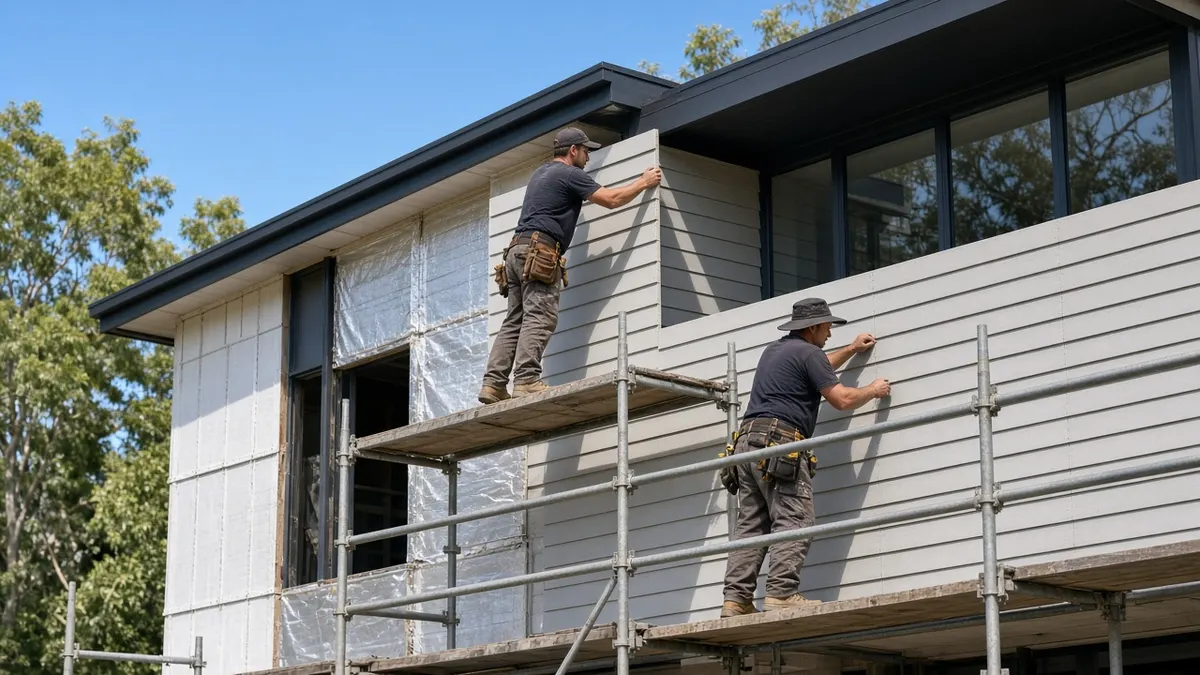
Cladding costs between $90 and $220 per square metre supplied and installed for most materials Australians put on houses, with vinyl at the cheap end and cedar, express-joint panels and aluminium at the top. Recladding a whole single-storey home of around 150 m² of wall usually comes to $18,000 to $45,000 once you add removal of the old cladding, building wrap, trims and painting. Stone veneer, two-storey access and asbestos removal can push it well past that.
Cladding is the skin of the house. It keeps the weather out, carries much of the look, and in bushfire areas it is part of what keeps the house standing. That makes it a job where the cheapest square-metre rate is rarely the cheapest outcome. The figures below are indicative 2026 prices including GST. Get at least three written quotes that specify the same material, system and finish.
Cladding prices by material
These are supply and install rates at single-storey height over a prepared frame, including fixings and basic trims. Painting, removal of old cladding, insulation and scaffolding are extra.
| Material | Installed cost per m² (incl. GST) | Paint needed? |
|---|---|---|
| Vinyl weatherboards | $60 to $120 | No |
| EPS foam cladding, rendered | $70 to $120 | Yes, render finish |
| Steel cladding, corrugated or similar profiles | $80 to $150 | No, pre-finished |
| Fibre cement weatherboards | $90 to $160 | Yes |
| Treated pine or hardwood weatherboards | $100 to $180 | Yes, or oil |
| Fibre cement express-joint or panel systems | $110 to $200 | Yes |
| AAC panels, rendered | $110 to $180 | Yes, render and paint |
| Composite or engineered timber-look boards | $120 to $220 | Usually pre-finished |
| Western red cedar or premium hardwood | $150 to $250 | Oil or stain |
| Steel standing seam | $150 to $250 | No, pre-finished |
| Aluminium panels or non-combustible composite panels | $150 to $300 | No, pre-finished |
| Stone veneer or stacked stone | $150 to $350 | No |
| Brick slips (thin brick) | $180 to $300 | No |
Most homes in Australia end up choosing between fibre cement, timber and steel. Fibre cement is the all-rounder: stable, termite-proof, non-combustible and good value. Timber gives the warmest look but needs the most maintenance. Steel is fast to install, low maintenance and has moved well beyond the farm shed, especially on modern extensions.
The extras that sit on top of the material price
- Removing old cladding: $15 to $40 per m² for timber or vinyl, including disposal. Asbestos cement sheeting is a different job priced separately, often $40 to $100 per m² plus air monitoring and a clearance certificate.
- Building wrap or sarking: $5 to $12 per m².
- Cavity battens: $15 to $30 per m². A cavity behind the cladding lets moisture drain and dry, and many systems require it.
- Wall insulation while the walls are open: $15 to $30 per m² for bulk batts.
- Window and door trims, flashings and corner details: often $1,000 to $3,000 for a house, depending on the number of openings.
- Painting: $20 to $35 per m² for primer and two top coats on fibre cement or timber.
- Scaffolding: $3,000 to $8,000 for a two-storey house, depending on perimeter and hire period.
- Frame repairs: rotten studs, sole plates and termite damage found when the old cladding comes off. Ask for a day rate or per-item price in advance.
Whole-house and part-house costs
| Scope | Approximate area | Typical total (incl. GST) |
|---|---|---|
| Feature cladding on a facade or entry | 15 to 30 m² | $2,500 to $9,000 |
| Rear extension walls | 40 to 60 m² | $5,000 to $15,000 |
| Single-storey reclad, fibre cement weatherboards | 130 to 170 m² | $20,000 to $40,000 |
| Single-storey reclad, any common material | 130 to 170 m² | $18,000 to $45,000 |
| Upper storey reclad on a two-storey home | 90 to 130 m² | $22,000 to $45,000 |
| Full two-storey reclad | 250 to 320 m² | $45,000 to $95,000 |
The fibre cement single-storey figure is built from about 150 m² at $90 to $160 per m² for the boards ($13,500 to $24,000), plus removal, wrap and battens, trims and painting. If the old cladding contains asbestos, add the removal cost covered in our asbestos removal cost guide.
Prices across Australia
This table assumes a single-storey reclad of about 150 m² in fibre cement weatherboards, with removal of non-asbestos timber boards and painting included.
| City | Typical total | Why it differs |
|---|---|---|
| Sydney | $24,000 to $42,000 | Highest carpentry rates, tight blocks, council requirements |
| Melbourne | $22,000 to $39,000 | Large weatherboard housing stock and strong competition |
| Brisbane | $21,000 to $37,000 | Timber homes common; highset houses add access work |
| Perth | $22,000 to $39,000 | Mostly brick housing, so fewer cladding specialists |
| Adelaide | $20,000 to $35,000 | Lower labour costs |
| Hobart | $22,000 to $39,000 | Weatherboard-heavy but limited trades, freight on materials |
| Canberra | $23,000 to $41,000 | Busy building market and cold-climate insulation upgrades |
| Darwin | $25,000 to $45,000 | Cyclone fixings, freight and humidity |
| Regional | $20,000 to $40,000 plus travel | Varies with how far trades and materials travel |
Carpenters who install cladding usually charge around $70 to $110 per hour or $600 to $900 per day each, often working in pairs with a labourer.
Three cladding jobs, costed
All amounts include GST.
Post-war fibro cottage in Wyong, NSW
A 1950s cottage with original flat fibro sheeting, tested positive for asbestos. About 120 m² of wall. Owner wants fibre cement weatherboards and a painted finish.
| Item | Cost |
|---|---|
| Licensed asbestos removal and disposal, 120 m² at $60 per m² | $7,200 |
| Air monitoring and clearance certificate | $600 |
| Building wrap and cavity battens, 120 m² at $20 per m² | $2,400 |
| Fibre cement weatherboards, supply and install, 120 m² at $120 per m² | $14,400 |
| Window trims, flashings and corners | $1,500 |
| Prime and two coats of paint, 120 m² at $28 per m² | $3,360 |
| Skip bin for general waste | $600 |
| Total | $30,060 |
Rear extension in Brunswick, VIC
New lightweight rear extension with 45 m² of wall to clad in corrugated steel, already framed and wrapped by the builder.
| Item | Cost |
|---|---|
| Corrugated steel cladding over battens, 45 m² at $110 per m² | $4,950 |
| Extra sarking at junctions | $350 |
| Flashings, corner and window trims | $900 |
| Total | $6,200 |
Upper floor reclad in Redland Bay, QLD
A 1990s two-storey near the bay with rotting timber weatherboards on the upper floor, about 110 m². Replacing them with fibre cement panels with a modern express-joint look.
| Item | Cost |
|---|---|
| Scaffolding, four weeks | $5,500 |
| Remove and dispose of timber weatherboards, 110 m² at $25 per m² | $2,750 |
| Wrap and cavity battens, 110 m² at $22 per m² | $2,420 |
| Fibre cement panel system, 110 m² at $160 per m² | $17,600 |
| Paint, 110 m² at $28 per m² | $3,080 |
| Disposal and clean-up | $700 |
| Total | $32,050 |
The Redland Bay job shows how much the access and preparation cost. The panels were just over half of the total.
Choosing a material for your climate and block
Coastal homes
Salt air attacks steel and fixings. Within a few hundred metres of breaking surf, use cladding and fasteners rated for severe marine environments, such as stainless fixings and marine-grade steel or aluminium. Fibre cement and vinyl cope well with salt. Ask the supplier for the corrosion zone rating for your address.
Bushfire-prone areas
If your property has a bushfire attack level, or BAL, the cladding must meet AS 3959 for that level. At lower BALs, many materials are fine. At higher levels, the options narrow to non-combustible materials such as fibre cement, steel, masonry and some specially tested systems, and timber species and thicknesses are restricted. Check your BAL before choosing; changing cladding late is expensive.
Cyclone regions
In northern Queensland, the Top End and northern WA, cladding fixings and spacings are designed for higher wind loads. Expect more fixings, more labour and higher prices.
Termites
Fibre cement, steel and vinyl are not termite food. Timber cladding should be treated or naturally durable, and kept clear of the ground and garden beds so termites cannot bridge the barrier.
Cold climates
In Canberra, Hobart, the alpine regions and the tablelands, recladding is the ideal time to upgrade wall insulation and add a vapour-permeable wrap. The insulation cost is small compared with the cladding job, and the comfort difference is large.
Combustible cladding and the rules around it
The cladding issues in the news since the London Grenfell fire mostly involve aluminium composite panels with a polyethylene core, and expanded polystyrene, on apartment towers and other multi-storey buildings. The National Construction Code limits combustible external walls on those building types, and several states, including NSW and Victoria, have banned or restricted particular high-risk products on certain buildings.
For a detached house, the rules are less strict, but common sense still applies. Never buy cheap composite panels with an unknown core. Ask for the product's fire test documentation. In bushfire areas, follow AS 3959. The Australian Building Codes Board publishes the National Construction Code and explains how external wall requirements work.
Licences, approvals and insurance
Recladding a house is residential building work, so licensing and home warranty rules apply once the job passes state thresholds.
- NSW: a contractor licence is needed for residential building work worth more than $5,000, and home building compensation cover is required for jobs over $20,000. Deposits are capped at 10 percent. Check licences with NSW Fair Trading.
- Queensland: work over $3,300 needs a QBCC licence, and residential jobs above that value are covered by the Queensland Home Warranty Scheme when done by a licensed contractor.
- Victoria: domestic building work above a set value needs a registered builder, and domestic building insurance applies to larger jobs. Check the current thresholds with the Building and Plumbing Commission, which replaced the Victorian Building Authority in 2025.
- Western Australia: larger building work needs a registered builder and home indemnity insurance. Check thresholds with Building and Energy.
- SA, TAS, ACT and NT: check with Consumer and Business Services, CBOS, Access Canberra or the NT Building Practitioners Board.
Council or certifier approval depends on the scope. Replacing cladding with a similar material is often straightforward, while changing to a different material, working on a heritage-listed home or in a conservation area, or building in a bushfire zone can trigger approval requirements. Check with your council or a private certifier before you sign.
Asbestos in older cladding
Flat and textured fibro sheeting on houses built before 1990 very often contains asbestos. It is generally safe if left undamaged and painted, but cutting, drilling, sanding, water blasting or breaking it releases fibres. Removing more than a small area needs a licensed asbestos removalist in every state, and the exact DIY limits and rules vary. Have suspect sheeting tested before any cladding work. The Asbestos Safety and Eradication Agency has plain-English information on where asbestos is found in homes.
An alternative some owners consider is cladding over the top of intact fibro. It avoids removal costs, but it can complicate future renovations and disclosure when selling, and fixing through the fibro still disturbs it. Get professional advice before taking that route.
Lifespan and upkeep by material
| Material | Typical life | Maintenance |
|---|---|---|
| Vinyl | 20 to 40 years | Wash occasionally; colour can fade |
| Fibre cement | 40 to 50 years and more | Repaint every 10 to 15 years |
| Timber | 30 to 50 years and more with care | Repaint every 7 to 10 years, or re-oil every 1 to 3 years |
| Steel | 30 to 40 years and more | Wash sheltered areas, more in coastal zones |
| Aluminium | 40 years and more | Occasional washing |
| Stone veneer | 50 years and more | Check joints and sealing |
Over 30 years, a cheaper material that needs no painting can come out ahead of a dearer one that needs repainting three times. Factor in maintenance, not only the install price.
Energy efficiency: do not waste the opportunity
With the old cladding off, the wall cavity is open, which makes adding insulation cheap and easy. Bulk batts in a standard 90 mm stud wall add noticeable comfort in both summer and winter, and a good wrap reduces draughts. The Australian Government's Your Home guide explains insulation levels for different climates. Many cladding contractors can supply and fit batts, or you can bring in an insulation installer for a day before the new boards go on.
Can you install cladding yourself?
A handy owner can clad a shed, a cubby or a small garden studio in steel or timber. On a house, it is more complicated. Licensing thresholds in most states mean a job of any real size needs a licensed contractor, and owner-builder permits have their own conditions. The technical risks are real too: poorly lapped wrap, missing head flashings over windows or wrong fixings let water into the frame, and the damage often stays hidden for years.
Cutting fibre cement also creates silica dust. Score-and-snap tools, shears and dust-reducing blades with extraction are the safe methods. Never dry-cut fibre cement with an ordinary saw in an enclosed space.
Ways to keep the price under control
- Clad only the walls that need it. Many homes reclad the front and the weathered west side and leave sheltered walls for later.
- Mix materials thoughtfully. A feature panel in premium cladding at the entry, with fibre cement weatherboards elsewhere, gives the look for less.
- Use standard board sizes and profiles. Custom profiles and special-order colours cost more and take longer.
- Do the strip-out with help. Removing non-asbestos timber or vinyl boards is labour-heavy, and using a labourer for this, under the builder's direction, can save carpenter hours.
- Pair it with other work. If you are adding an extension or a second storey, reclad the existing house at the same time to share scaffolding, approvals and site setup. Our house extension cost guide and second storey addition guide cover those budgets.
- Consider render instead. On a brick house that only needs a new look, our rendering cost guide shows a cheaper path than cladding over the brick.
How a reclad unfolds on site
Most reclads follow the same order. The crew sets up scaffolding or trestles and protects gardens, paths and windows. If asbestos is present, the licensed removalist goes first, with the area sealed off, and the clearance certificate must be issued before anyone else starts. Then the old cladding comes off one wall at a time, so the house is never fully exposed to weather.
With the frame bare, the builder checks studs, noggings and bottom plates for rot and termite damage. This is the moment of truth for the budget. Small repairs are routine; a section of termite-eaten frame is not, and it is why a quote should include rates for frame repairs. Insulation goes in next if you are adding it, followed by wrap, flashings around windows and doors, cavity battens and finally the cladding. Trims, corners and painting finish the job.
Expect noise, a skip bin in the driveway and some disruption to windows and doors for a few days per wall. Rooms stay usable throughout, but plan around builders needing access to every side of the house.
Labour, materials and where the money goes
On a typical fibre cement weatherboard reclad, materials such as boards, wrap, battens, trims and fixings make up roughly a third of the cost, and labour the rest. Premium materials such as cedar, standing seam steel or stone veneer flip that balance, because the product itself is expensive. Labour-heavy details, like lots of windows, corners, a steep site or two storeys, push the labour share up.
That is why two quotes using the same product can differ by $10,000 on the same house. One crew may have priced a cavity, proper flashings and allowance for frame repairs, and the other may not. Compare scopes line by line before comparing totals.
Reading a cladding quote
A good written quote should list:
- The exact product, profile and thickness, and the walls to be clad, with square metres
- Wrap, battens and cavity details, and whether insulation is included
- Window and door flashing details
- Removal and disposal of the old cladding, with asbestos testing or removal clearly separated
- Painting system and number of coats, or the factory finish
- Scaffolding, site protection and clean-up
- Rates for frame repairs found once the old cladding is off
- Licence number, ABN, insurance, home warranty cover where required, and a payment schedule within state deposit limits
Red flags: a quote with no product name, no mention of flashings, no allowance for asbestos testing on a pre-1990 home, pressure to pay a large deposit, or a contractor who suggests skipping approvals in a bushfire or heritage area.
Where Yakka helps on a cladding job
A reclad has a lot of heavy, simple work around the skilled carpentry, which is where Yakka Labour fits. You can hire labourers to strip non-asbestos weatherboards or vinyl under the builder's direction, carry boards and scaffold planks, load skips and keep the site tidy, or help with painting prep once the new boards are on. Browse demolition workers for strip-out help, or cladding installers listed on the platform for the install itself.
Asbestos removal is not a labourer's job. If testing shows asbestos, use a licensed removalist, and keep everyone else off site until the clearance certificate is issued.
Frequently asked questions
How much does cladding cost per m2 in Australia?
Supply and install of common cladding materials costs about $90 to $220 per square metre in 2026. Vinyl can be as low as $60 to $120, fibre cement weatherboards are typically $90 to $160, timber $100 to $250 depending on species, and aluminium or stone veneer $150 to $350. Removal of old cladding, painting and scaffolding are usually extra.
How much does it cost to reclad a house?
Recladding a single-storey house with around 150 square metres of wall usually costs $18,000 to $45,000, including removing the old cladding, new wrap and battens, trims and painting. Asbestos removal adds several thousand dollars. A full two-storey reclad, with scaffolding, typically costs $45,000 to $95,000 depending on the material and access.
What is the cheapest cladding for a house?
Vinyl weatherboards and rendered EPS foam cladding are usually the cheapest to install, at roughly $60 to $120 per square metre. Steel cladding in standard profiles is also good value and needs no painting. Fibre cement weatherboards cost a little more upfront but are durable, termite-proof and non-combustible, which often makes them the better long-term value.
Do I need council approval to reclad my house?
It depends on your council, the materials and the property. Like-for-like replacement is often straightforward, but changing to a different material, working on a heritage-listed home or in a conservation area, or building in a bushfire-prone area can need approval. Check with your local council or a private certifier before you sign a contract.
Is fibre cement cladding better than timber?
Fibre cement is cheaper, termite-proof, non-combustible and needs repainting less often, so it suits most budgets and bushfire areas. Timber has a warmer, natural look and is easier to repair, but needs regular painting or oiling and may be restricted at higher bushfire attack levels. Many owners combine fibre cement with a timber feature area.
How long does it take to reclad a house?
A single-storey reclad typically takes two to four weeks for a small crew, covering removal, wrap and battens, cladding, trims and painting. Asbestos removal adds a few days, plus time to get clearance. Two-storey homes take longer because of scaffolding. Frame repairs discovered once the old cladding is off can also extend the job.
Can you put new cladding over old cladding?
It is sometimes possible to clad over existing weatherboards or intact fibro using battens, which saves removal costs. However, it hides the condition of the frame, can complicate window and door details, and fixing through fibro still disturbs asbestos. Many builders prefer full removal so the frame can be inspected, insulated and properly wrapped.
Official sources
Award rates, licences and safety rules change. Check the official source before you hire or take on a shift.
- Queensland Building and Construction Commission (QBCC)Contractor, plumbing and drainage licence search in Queensland
- Consumer and Business Services SALabour hire licensing in South Australia
- NSW Fair TradingTrade licence checks for electricians, plumbers and builders in New South Wales
- Building and Plumbing Commission (Victoria)Builder and plumber registration, domestic building insurance and licence checks in Victoria
- Asbestos Safety and Eradication AgencyWhere asbestos is found in homes and how to deal with it safely
- Consumer, Building and Occupational Services (Tasmania)Building, plumbing and electrical licensing in Tasmania