More cost guide
Gas Hot Water System Cost (2026): Australian Installed Prices
Typical cost in Australia (2026, inc. GST)
$1,800 to $3,800 per job
like-for-like replacement of a gas continuous flow or storage unit, supplied and installed
A gas hot water system in Australia costs about $1,800 to $3,800 installed in 2026 for a like-for-like replacement, including GST. Continuous flow units start around $1,800 installed and gas storage tanks around $2,000. Switching from storage to continuous flow, upgrading the gas line or moving the unit pushes the total to $3,000 to $4,500 or more. Installation must be done by a licensed plumber and gasfitter.
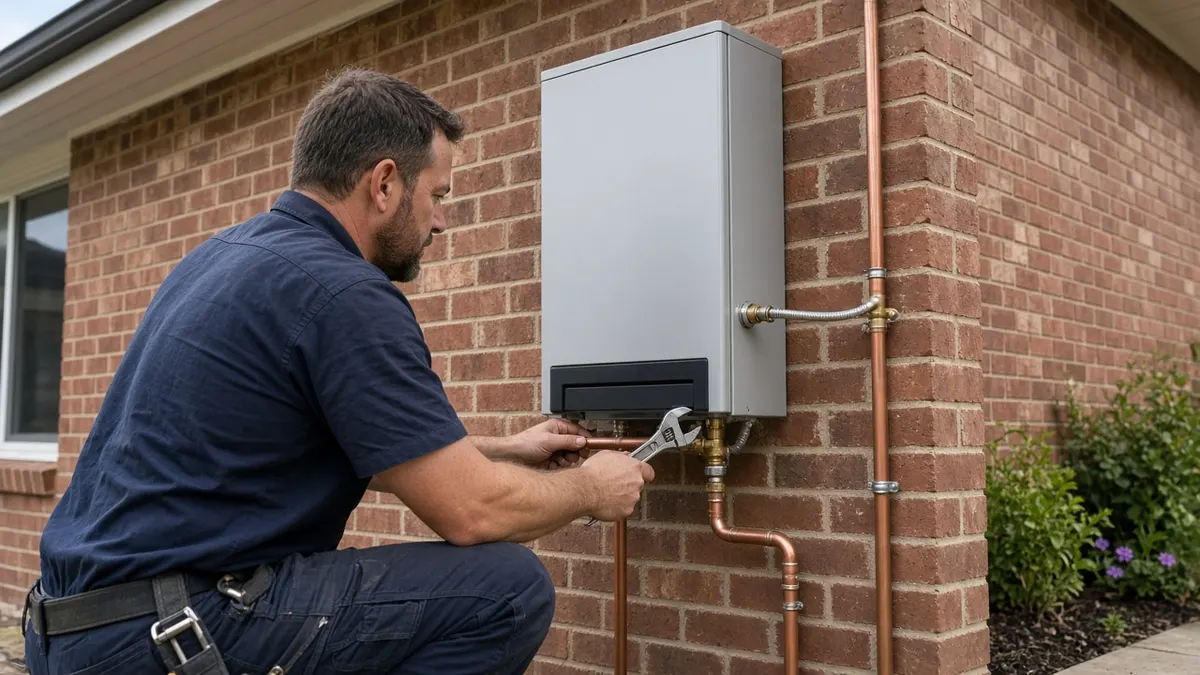
A new gas hot water system costs about $1,800 to $3,800 installed in Australia in 2026, including GST, when you replace like with like. A mid-size continuous flow unit swapped onto an existing bracket and gas line sits at the lower end; a 170 litre storage tank with a new tempering valve and a tricky install sits towards the top. Converting from one type to another, or from electric to gas, costs more because the pipes, gas supply and power may all need changing.
Hot water installation involves water, gas and sometimes electrical work. The water side must be done by a licensed plumber and the gas side by a licensed gasfitter; most hot water installers hold both licences. If the new unit needs a power point, that must be installed by a licensed electrician. The prices below are indicative, so get at least three written quotes and make sure each one is for the same size and type of unit.
Installed prices for common gas systems
| System | Unit only | Installed, like-for-like (inc. GST) | Suits |
|---|---|---|---|
| Continuous flow, 16 to 20 L/min | $800 to $1,400 | $1,800 to $2,800 | Units and small homes, one bathroom |
| Continuous flow, 26 to 27 L/min | $1,100 to $1,900 | $2,000 to $3,200 | Family homes, two bathrooms |
| Continuous flow, 32 L/min | $1,500 to $2,400 | $2,500 to $3,800 | Large homes, three or more bathrooms |
| Gas storage, 135 L | $1,100 to $1,700 | $2,000 to $3,000 | One to three people |
| Gas storage, 170 L | $1,300 to $2,100 | $2,200 to $3,500 | Three to five people |
| Internal flued unit (either type) | $1,400 to $2,600 | $3,000 to $5,500 | Apartments and homes without an outdoor location |
LPG versions of most models cost about the same to buy. The difference is the fuel supply: you need LPG cylinders or a tank on site, and LPG generally costs more per unit of energy than mains natural gas. If you are not yet connected to gas at all, read our gas installation cost guide for connection and pipework prices before deciding.
Continuous flow or storage?
Continuous flow (sometimes called instantaneous) systems heat water only when a hot tap is turned on. There is no tank to keep hot, so no standby heat loss, and you cannot run out of hot water as long as the unit is big enough. They are compact and wall-mounted, which frees up space beside the house.
The catches are gas supply and flow. A large continuous flow unit draws a lot of gas at once, and an older house with a small gas pipe or a low-capacity meter may not deliver enough. If the pipe is undersized, the water runs lukewarm when two showers are on. Continuous flow units also need a 240 volt power point for the electronics and ignition, and there is a short wait for hot water to arrive at the tap.
Storage systems keep a tank of water hot, ready to go. They are simple, they do not need power (on most outdoor models), and they suit houses with a small gas supply. The downsides are standby heat loss from the tank, the space it takes up and the fact that a big household can run the tank dry. Storage tanks also have a shorter typical life than continuous flow units.
As a rough guide, continuous flow suits most families with mains gas and an adequate gas line. Storage suits smaller gas supplies, homes where power to the unit is awkward, and households that use hot water in short bursts.
Getting the size right
An undersized system is the most common complaint after a new hot water install. Here is a starting point; your plumber should confirm it against your household and the number of outlets that run at once.
- 16 L/min continuous flow: one bathroom, one or two people, one shower at a time.
- 20 L/min: one to two bathrooms, two to four people.
- 26 L/min: two bathrooms, a family of four or five, a shower and the kitchen tap at the same time.
- 32 L/min: three or more bathrooms, or homes with high-flow shower heads.
- 135 L storage: one to three people.
- 170 L storage: three to five people.
Cold winter mains water, such as in Hobart, Canberra and inland Victoria, means a continuous flow unit has to raise the temperature further, so it delivers less hot water per minute than in Brisbane or Perth. Plumbers in cold climates often size up one step.
What a gas hot water install costs around Australia
These are typical installed prices for a like-for-like 26 L/min continuous flow replacement in each city, including GST.
| Location | Typical installed price | Local notes |
|---|---|---|
| Sydney | $2,300 to $3,400 | High labour rates; mains gas widely available |
| Melbourne | $2,200 to $3,300 | Check current Victorian electrification rules before replacing gas |
| Brisbane | $2,100 to $3,200 | Mains gas less common in some suburbs; LPG installs are frequent |
| Perth | $2,100 to $3,200 | Mains gas common in established suburbs |
| Adelaide | $2,000 to $3,000 | Lower labour rates |
| Hobart | $2,200 to $3,400 | Limited reticulated gas; many homes on LPG |
| Canberra | $2,300 to $3,500 | ACT policy is moving homes away from gas; check before replacing |
| Darwin | $2,400 to $3,600 | Little mains gas; electric and solar are more common |
Three real-world installs
All amounts include GST.
Like-for-like continuous flow in Hornsby, NSW
A 15-year-old 26 L/min unit on the side wall of a four-bedroom brick home had a failed heat exchanger. The gas line and power point were already in place.
| Item | Cost |
|---|---|
| 26 L/min continuous flow unit | $1,450 |
| Installation labour, removal of old unit, compliance paperwork | $650 |
| New tempering valve | $220 |
| Isolation valves, fittings and gas connector | $120 |
| Total | $2,440 |
Storage to continuous flow in Morphett Vale, SA
A family of five kept running out of hot water from their 135 litre gas tank. They switched to a 26 L/min continuous flow unit, which needed a bigger gas pipe from the meter and a new outdoor power point.
| Item | Cost |
|---|---|
| 26 L/min continuous flow unit | $1,450 |
| Plumbing and gasfitting labour, pipe relocation to new wall position | $950 |
| Gas line upgrade, about 8 m from the meter | $650 |
| Licensed electrician: weatherproof outdoor power point | $320 |
| Tempering valve | $220 |
| Removal and disposal of old tank | $100 |
| Total | $3,690 |
The gas line upgrade was the line item the family had not expected. A good installer checks the gas pipe size and meter capacity before quoting a conversion. For the power point side, our electrician cost guide covers call-out and small-job prices.
Weekend emergency storage swap in Joondalup, WA
A 135 litre gas storage tank started leaking from the base on a Saturday morning. The owners chose a like-for-like tank so the job could be done the same day.
| Item | Cost |
|---|---|
| 135 L gas storage unit | $1,350 |
| Installation labour at weekend rates | $850 |
| Tempering valve | $220 |
| Fittings and valves | $100 |
| Disposal of old tank | $80 |
| Total | $2,600 |
Had they turned off the gas and cold water at the tank and waited until Monday, the labour would likely have been $200 to $300 less.
Comparing gas with other hot water types
Gas is no longer the default it once was. Electricity prices, rooftop solar and government policy have all shifted the maths, so it is worth comparing before you replace like with like.
| Type | Typical installed cost (inc. GST) | Trade-offs |
|---|---|---|
| Gas continuous flow | $1,800 to $3,800 | Endless hot water, needs adequate gas supply and power point |
| Gas storage | $2,000 to $3,500 | Simple, no power needed on most models, standby losses |
| Electric storage | $1,500 to $3,000 | Cheap to buy, can be expensive to run unless on an off-peak or solar-timed tariff |
| Heat pump | $3,500 to $6,500 before certificates | Much lower running cost than standard electric, eligible for federal certificates |
| Solar with gas or electric boost | $4,500 to $9,500 before certificates | Lowest running cost in sunny areas, roof space and higher upfront cost |
Heat pumps and solar water heaters can attract federal small-scale technology certificates, which reduce the upfront price, and some states offer extra rebates. Our solar hot water cost guide explains how that works. The federal government's Your Home guide to hot water systems is a good neutral comparison of running costs and emissions.
State rules that affect gas hot water
Policy on household gas is changing, and it varies by state. Victoria stopped new gas connections for new homes that need a planning permit from 1 January 2024 and has announced further rules to move existing homes towards electric hot water when gas units reach the end of their life. The ACT has also stopped most new residential gas network connections and plans to phase out gas. The details and start dates have changed more than once, so check the current position with Energy Safe Victoria or the Victorian Government, or with Access Canberra in the ACT, before you buy a new gas unit.
In other states, replacing a gas hot water system with another gas unit is allowed, but energy efficiency rules apply. New gas water heaters must meet minimum energy performance requirements, and many installs must comply with the gas installation standard AS/NZS 5601.1, which covers flue clearances from windows, doors and boundaries. An outdoor unit that was legal when installed 15 years ago may not meet current clearances, and the installer may need to move it.
Licences, compliance and safety
Installing a gas hot water system is both plumbing and gasfitting work. In every state and territory it must be done by a licensed plumber and a licensed gasfitter, or one person who holds both licences. That includes disconnecting the old unit. A handyman cannot legally do any part of it, and our article on whether a handyman can do plumbing explains why.
- NSW: plumbers and gasfitters are licensed by NSW Fair Trading, and gas work requires a certificate of compliance.
- Victoria: plumbers and gasfitters are registered or licensed with the Building and Plumbing Commission; Energy Safe Victoria oversees gas safety. A compliance certificate is required for most gas work.
- Queensland: the plumbing side needs a QBCC licence, and the gas side needs a gas work licence from Resources Safety and Health Queensland.
- WA: Building and Energy licenses plumbers and gasfitters and requires a notice of completion for gas work.
- SA, Tasmania, ACT and NT: plumbers and gasfitters are licensed by Consumer and Business Services, CBOS, Access Canberra and the relevant NT boards respectively.
Every new hot water installation needs a tempering valve or equivalent so that hot water at bathroom outlets is delivered at no more than 50 degrees Celsius, while the system itself keeps stored water hot enough to control bacteria. Your installer will set this up; do not ask them to bypass it.
If you smell gas near the unit, turn off the gas at the meter, avoid using switches or flames, get out of the house and call your gas distributor's emergency line. Do not try to repair a gas appliance yourself.
Running costs and lifespan
Gas running costs depend heavily on your tariff, the gas price in your state, the number of people in the house and how long everyone showers. Continuous flow units avoid the standby losses of a tank, so for most households they cost less to run than an equivalent storage unit. Look at the energy rating label when comparing models; a higher star rating means less gas for the same hot water.
Gas storage tanks commonly last 8 to 12 years. Hard water and lack of maintenance shorten that. Continuous flow units often last 12 to 20 years, with occasional parts such as igniters and flow sensors replaced along the way.
Simple maintenance helps. Gently operate the pressure and temperature relief valve lever on a storage tank about every six months, as most manufacturers recommend, and have the valve replaced at the interval in your manual, often about five years. Storage tanks have a sacrificial anode that protects the tank lining; replacing it every few years, usually for $200 to $400, can add years to the tank's life. Continuous flow units benefit from a service every few years. Check the manufacturer's manual for the exact intervals, as warranties may depend on them.
Signs your system is on the way out
- Water pooling around the base of a storage tank, or rust stains on the tank jacket.
- Rusty or discoloured hot water.
- Hot water running out faster than it used to.
- The pilot light going out often, or a continuous flow unit showing error codes.
- Popping or rumbling noises from a storage tank, which usually means sediment build-up.
- A system older than about ten years for storage, or fifteen for continuous flow, that needs a significant repair.
Replacing a failing unit on your own schedule is cheaper than an emergency swap, and it gives you time to compare gas with a heat pump or solar.
LPG hot water: what changes
Plenty of Australian homes, especially in regional areas, Hobart, parts of Brisbane and new estates without mains gas, run hot water on LPG. The units look the same as natural gas models but are built or converted for LPG, and the two are not interchangeable without a factory conversion kit fitted by a gasfitter. Buy the right version from the start.
An LPG setup needs cylinders, usually two 45 kg bottles on a changeover regulator so you can swap one while the other keeps running, or a larger tank filled on site. Your gas supplier may charge an annual rental per cylinder, and bottle delivery is priced per refill. Continuous flow units can empty a bottle faster than people expect in winter, so ask the installer to size the bottle setup to your usage.
Because LPG usually costs more per unit of energy than mains gas, the running cost gap between gas and a heat pump is often wider for LPG households. If you are on LPG and your system has failed, it is worth getting a heat pump quote alongside the gas one.
Ways to keep the cost down
Replace before it fails. A planned swap on a weekday is cheaper than a weekend emergency, and you can shop around for the unit. If your storage tank is past ten years old and showing rust, get quotes now.
Stick with the same type and location where it makes sense. Like-for-like swaps avoid new gas pipe runs, relocated water pipes and electrical work, which are where conversion budgets blow out.
Get the gas line checked before you commit to a conversion. A bigger continuous flow unit is pointless if the existing pipe cannot feed it, and finding out after the unit is on the wall costs a return visit.
Ask about the unit warranty and who honours it. Some low-priced units have short warranties or no local service agent, which can make a cheap unit expensive when a part fails in year three.
What a good quote includes
Ask each installer to list the exact make and model, the flow rate or tank size, labour, removal and disposal of the old unit, the tempering valve, any gas line or pipework changes, any electrical work and who does it, the compliance certificate and the warranty on both the unit and the labour.
Red flags include a quote with no licence numbers, a price far below the others that excludes the tempering valve or disposal, an installer who will not check the gas supply before quoting a conversion, and pressure to pay in cash. You can compare hot water specialists near you or licensed gasfitters in your area, and our plumber cost guide lists hourly rates if you are getting smaller jobs done at the same visit.
How long the job takes
A like-for-like swap takes two to four hours, and most installers can do it the same day or next day if the unit is in stock. Conversions that need a new gas line or a power point take most of a day and may need a second visit from an electrician. Plan to be without hot water for at least half a day.
Where Yakka fits
Installing a gas hot water system is licensed plumbing and gasfitting work, so Yakka Labour does not do it. A Yakka worker can help with the parts around the install, such as clearing an overgrown side passage so the installer can get the old tank out, carrying a heavy unit to an awkward location, and taking away packaging and rubbish afterwards.
Disconnection of the old unit, the gas and water connections and any electrical work must stay with licensed trades. Book a licensed plumber and gasfitter for the install and check their licence numbers with your state regulator.
Frequently asked questions
How much does it cost to replace a gas hot water system?
Replacing a gas hot water system like for like usually costs $1,800 to $3,800 in 2026, including the new unit, installation, a tempering valve and disposal of the old unit. Converting from storage to continuous flow, upgrading the gas line or relocating the unit can push the total to $3,000 to $4,500 or more.
Is continuous flow cheaper to run than gas storage?
For most households, yes. Continuous flow units heat water only when you need it, so they avoid the standby heat loss of a storage tank. The saving depends on your gas tariff and how much hot water you use. Continuous flow units need an adequate gas supply and a power point, which can add to installation cost.
What size gas hot water system do I need?
As a rough guide, a 16 to 20 L/min continuous flow unit suits one bathroom and up to four people, 26 L/min suits a family with two bathrooms, and 32 L/min suits larger homes. For storage, 135 litres suits one to three people and 170 litres suits three to five. Your plumber should confirm sizing for your home.
Can I install a gas hot water system myself?
No. Installing a gas hot water system involves plumbing and gasfitting, which must be done by licensed trades in every Australian state and territory. Any new power point must be installed by a licensed electrician. Unlicensed gas work is dangerous, illegal and can void your home insurance.
How long does a gas hot water system last?
Gas storage tanks commonly last 8 to 12 years, and continuous flow units often last 12 to 20 years. Hard water shortens the life of both. Replacing the sacrificial anode in a storage tank, testing the relief valve regularly and servicing a continuous flow unit as the manufacturer recommends all help extend its life.
Can I still install gas hot water in Victoria?
Victoria has stopped new gas connections for new homes that need a planning permit and has announced rules to move existing homes towards electric hot water when gas systems wear out. The details and start dates have changed over time. Check the current rules with Energy Safe Victoria or the Victorian Government before replacing a gas unit.
Should I replace gas hot water with a heat pump?
It is worth comparing. A heat pump costs more upfront, about $3,500 to $6,500 installed before federal certificates, but often costs much less to run than gas, especially with rooftop solar. If you plan to disconnect gas entirely, you also save the gas supply charge. Ask for quotes on both and compare.
Official sources
Award rates, licences and safety rules change. Check the official source before you hire or take on a shift.
- Queensland Building and Construction Commission (QBCC)Contractor, plumbing and drainage licence search in Queensland
- Consumer and Business Services SALabour hire licensing in South Australia
- NSW Fair TradingTrade licence checks for electricians, plumbers and builders in New South Wales
- Building and Plumbing Commission (Victoria)Builder and plumber registration, domestic building insurance and licence checks in Victoria
- Consumer, Building and Occupational Services (Tasmania)Building, plumbing and electrical licensing in Tasmania
- Access CanberraConstruction occupation licences and building approvals in the ACT