Interior cost guide
Floor Sanding and Polishing Cost in Australia (2026)
Typical cost in Australia (2026, inc. GST)
$30 to $70 per m²
sand and three coats on existing timber floors, minimum charges apply
Sanding and polishing a timber floor in Australia usually costs $30 to $70 per m² in 2026 for three sanding passes and three coats. Solvent-based polyurethane sits at the lower end, water-based in the middle and hardwax oils at the top. A buff and recoat on a sound floor costs $15 to $25 per m². Stairs, board repairs, staining and minimum charges of $600 to $1,000 add to the bill.
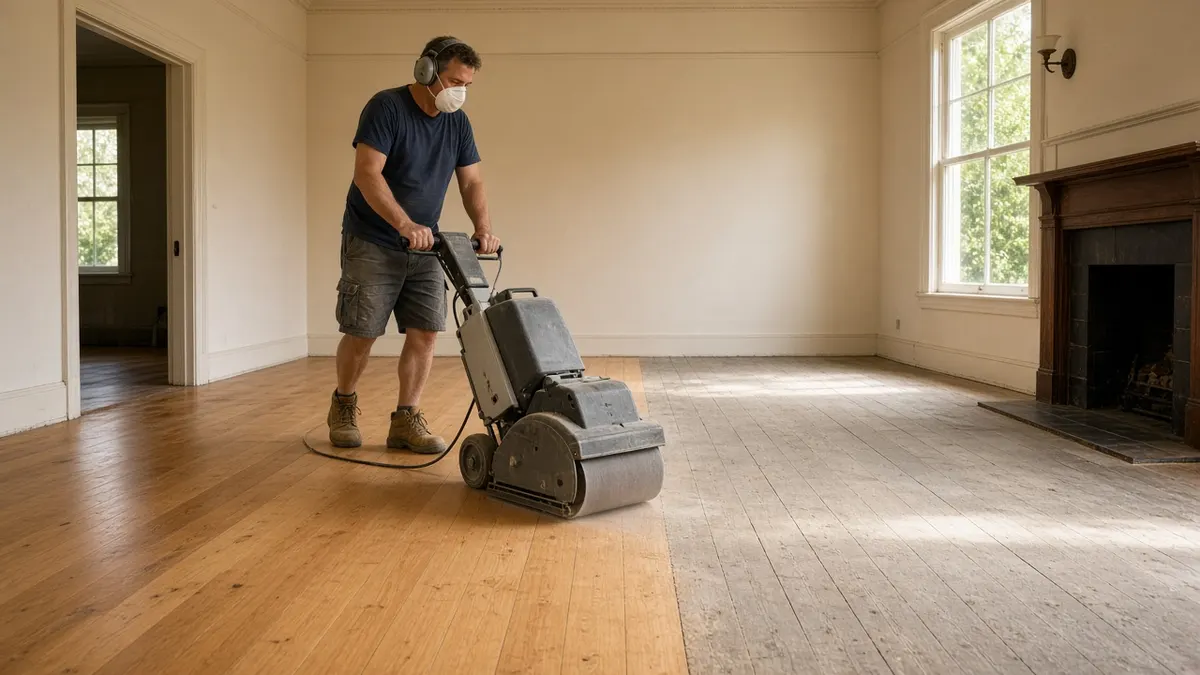
Floor sanding and polishing costs most Australian households $30 to $70 per m² in 2026, which puts a typical 60 m² living area and hallway at roughly $2,000 to $4,000. The finish you choose, the condition of the boards and whether stairs are involved decide where your job lands.
All prices here include GST and are indicative only. Floor sanders price differently from one another, and the state of a floor is hard to judge until the carpet is up. Get at least three written quotes, ideally after each contractor has seen the boards.
Price per m² by finish
In Australia, floor polishing almost always means sanding back an existing timber floor and applying a new protective coating. The rates below cover three sanding passes, edging, standard gap filling with putty and three coats of finish.
| Finish | Typical cost per m² | Look and feel | Usual recoat interval |
|---|---|---|---|
| Solvent-based polyurethane (two-pack) | $30 to $50 | Hard wearing, warms timber to an amber tone, strong odour while curing | 8 to 12 years |
| Water-based polyurethane | $35 to $55 | Clearer, more natural colour, low odour | 7 to 10 years |
| Oil-modified or tung oil finishes | $40 to $60 | Soft lustre, traditional look | 5 to 8 years |
| Hardwax oil | $45 to $70 | Matt, natural, spot-repairable | Maintenance coat every few years |
| Stain under any coating | Add $8 to $15 | Changes colour, shows sanding marks if rushed | Same as coating |
| Buff and recoat, no full sand | $15 to $25 | Refreshes a worn but intact coating | Every 3 to 6 years |
Most contractors set a minimum charge of $600 to $1,000, so a single bedroom of 12 m² will cost well above the per-m² rate. Grouping rooms into one booking is the easiest saving there is.
What the rate covers, and what costs extra
A standard sand and polish assumes bare, sound boards in an empty room. Real floors are rarely that tidy. These extras come up on most older homes.
| Extra | Typical cost (incl GST) |
|---|---|
| Lift carpet, underlay and tack strips | $5 to $10 per m² |
| Punch nails below the surface | $3 to $5 per m² |
| Remove glue, paint or old lino residue | $10 to $25 per m² |
| Replace damaged boards | $80 to $150 per board, depending on access and matching timber |
| Fill wide gaps with timber slivers | $10 to $20 per m² |
| Stair treads | $60 to $120 per tread, risers and stringers extra |
| Replace scotia after sanding | $8 to $12 per linear metre |
| Move furniture | $100 to $300 per job |
Matching timber for board replacement can be the slow part. Old Baltic pine, Tasmanian oak or jarrah boards are sometimes salvaged from a wardrobe floor or a recycled timber yard. A good floor sander will tell you if the repair will show once coated, because new timber rarely matches old timber exactly.
Sand and polish costs in each capital
Rates follow local labour costs and demand. The figures below are for a full sand and three coats of water-based polyurethane on a standard floor.
| City or area | Typical cost per m² | Notes |
|---|---|---|
| Sydney | $40 to $65 | Highest labour rates, many terraces with narrow access and stairs |
| Melbourne | $35 to $60 | Lots of period homes with pine floors under carpet |
| Brisbane | $32 to $55 | Queenslanders often have large areas of hardwood or pine |
| Perth | $35 to $58 | Jarrah floors are common and hard, which wears paper faster |
| Adelaide | $30 to $50 | Lower labour costs |
| Hobart | $32 to $55 | Smaller market, book ahead |
| Canberra | $38 to $62 | Rates near Sydney levels |
| Darwin | $42 to $70 | Freight on coatings and humid curing conditions |
| Regional | $30 to $55 | Travel may be charged on top |
Three worked examples
Each example uses rates inside the ranges above. Totals include GST.
Federation cottage in Marrickville, 65 m²
An inner-west Sydney cottage with original pine boards under 1980s carpet. The house was empty between tenants, and the owner chose a satin water-based finish.
| Line item | Cost |
|---|---|
| Lift carpet, underlay and tack strips, 65 m² at $8 | $520 |
| Punch nails and replace four damaged boards | $480 |
| Sand and three coats water-based, 65 m² at $48 | $3,120 |
| Total (incl GST of about $375) | $4,120 |
About $63 per m² all in. The carpet removal is the piece many owners do themselves or with a labourer to save a few hundred dollars.
Jarrah floors in a 1960s Perth home, 90 m²
A brick home in Perth's eastern suburbs with jarrah boards that had been polished decades ago and gone grey and scratched. The owners chose a gloss two-pack finish for durability with two large dogs.
| Line item | Cost |
|---|---|
| Sand and three coats two-pack polyurethane, 90 m² at $40 | $3,600 |
| Timber slivers in the widest gaps, 15 m² at $18 | $270 |
| New scotia, 70 linear metres at $9 | $630 |
| Total (incl GST of about $409) | $4,500 |
The family stayed with relatives for two nights because of the solvent odour, which is common advice with two-pack finishes.
Buff and recoat with stairs in a Canberra townhouse
A 2000s townhouse with 45 m² of spotted gum downstairs, still with an intact coating, and 12 stair treads worn through to bare timber.
| Line item | Cost |
|---|---|
| Buff and recoat downstairs, 45 m² at $20 | $900 |
| Full sand and three coats on 12 treads at $90 | $1,080 |
| Move furniture | $150 |
| Total (incl GST of about $194) | $2,130 |
A full sand downstairs would have added roughly $1,200 to $1,600. Because the coating was still bonded and only scuffed, a recoat was the better call.
Where the money goes: labour, materials and gear
Labour is the largest part of a floor sanding bill, usually 60 to 70 percent of the total. Coatings come next. A quality polyurethane costs the contractor somewhere around $5 to $10 per m² across three coats, and hardwax oils more. Abrasives are a real cost too: hard timbers such as jarrah, spotted gum and blackbutt chew through sandpaper much faster than pine. The rest covers the sanding machines, dust extraction, vehicle and insurance.
That split explains why small jobs cost so much per m². The crew still has to load the machines, travel, set up and pack down, whether the room is 12 m² or 80 m².
Timber species and why hardness matters
Australian homes have a mix of softwoods and very hard eucalypts, and each behaves differently under the sander. Baltic pine and Cypress pine, common in older southern and Queensland homes, are soft. They sand quickly but dent easily, and they can show machine marks if the operator is careless. A satin finish suits them because it hides the dents that come with daily life.
Hardwoods such as jarrah, blackbutt, spotted gum, Sydney blue gum and Tasmanian oak resist wear well but are slower and harder to sand. Some contractors charge a little more per m² for the hardest species. Jarrah and other red timbers darken further under solvent-based coatings, while blonde timbers like Tasmanian oak can yellow. A sample patch before the main coats go on tells you how your floor will look.
Common floor problems and what fixing them costs
- Squeaky boards: usually loose boards moving on nails. Screwing or nailing them down costs a few hundred dollars across a house if access is easy.
- Cupping: boards that curl up at the edges usually point to moisture from below, such as poor subfloor ventilation or a leak. Fix the cause first, or the problem returns after sanding.
- Water-stained boards: black marks near old pot plants, kitchens and bathrooms often go deep. Sanding may lighten them, but replacing boards is sometimes the only fix.
- Termite or rot damage: soft or hollow boards should be checked before sanding. Replacing boards and any damaged bearers or joists is carpentry work and can cost from a few hundred to several thousand dollars.
- Wide gaps: timber shrinks in dry weather. Putty fills fine gaps but may crack as boards move, so wide gaps are better filled with timber slivers glued into one side.
A careful contractor will walk the floor with you before quoting and point out these issues. If someone quotes from a phone photo without asking about the subfloor, expect variations later.
Full sand or buff and recoat
A buff and recoat lightly abrades the existing coating and adds a fresh coat on top. It costs less than half of a full sand, takes a day, and removes far less timber, which matters on floors that have already been sanded several times.
It only works when the existing coating is intact. If you can see bare grey timber in walkways, deep scratches through the finish, water marks under the coating or peeling, the floor needs a full sand. A recoat also needs to be compatible with the old coating. A floor sander will usually test a small area first, especially if nobody knows what was used last time.
As a rule of thumb, booking a buff and recoat every few years before the coating wears through is the cheapest way to own a polished floor over the long run.
Choosing a finish you will be happy with
Solvent-based two-pack polyurethane is very hard wearing and slightly cheaper, but it gives off strong fumes and yellows pale timbers over time. Most people move out for one to three days. Water-based polyurethane keeps the timber closer to its natural colour, has much less odour and lets you stay in other parts of the house, though some products are less tough than two-pack. Quality water-based systems have closed most of that gap.
Oils and hardwax oils sink into the timber and leave a matt, natural finish. Scratches can be spot-repaired without resanding the whole room, which suits people who do not want a plastic look. The trade-off is more frequent maintenance.
Gloss level matters more than people expect. High gloss shows every scratch and dust mark. Satin or matt finishes hide wear better in family homes and with pets. Ask to see a sample board of your actual timber with the chosen finish before the job starts.
Floors that cannot be sanded, and the risks to check first
Laminate and hybrid floors have no real timber to sand. Engineered timber can be sanded only if the wear layer is thick enough, commonly 2 mm or more, and even then only once or twice. Old tongue-and-groove floors that have been sanded many times can end up with the tongues showing through. A floor sander will check board thickness at a floor vent or the edge of a room.
Painted floors and old coatings in homes built before about 1970 may contain lead. Sanding lead paint creates dangerous dust, so test any painted surface before sanding and use a contractor who knows how to manage lead safely. Old lino and vinyl glued to boards in pre-1990 homes can contain asbestos in the backing, so test before lifting.
If your floor is concrete, polishing is a different trade with different equipment and prices. Our concrete flooring cost guide covers grind and seal and mechanically polished concrete, and the epoxy flooring cost guide covers coated garage and workshop floors.
How long the job takes and when you can move back
A two-person crew can usually sand 50 to 80 m² in a day, depending on the timber and the number of rooms. Coatings then go on over the next one to three days. Water-based coats can often be applied a few hours apart. Solvent-based coats usually need overnight drying between them. A typical three-bedroom floor takes three to five days from start to finish.
Most finishes allow light foot traffic in socks after about 24 hours. Furniture can go back after a few days with felt pads underneath. Rugs should stay off for two to four weeks while the coating fully cures, because a rug laid too early can mark the finish. Modern sanders with dust extraction cut down mess a great deal, but some fine dust still settles, so remove curtains and cover anything you cannot move.
Best time of year to book
Coatings cure best in mild, dry conditions. Very cold weather slows drying, which is why some southern contractors take longer between coats in winter. Hot, humid weather in Brisbane, Darwin and the north can affect how coatings flow and dry, and timber swells in humid months and shrinks in dry ones. Gaps filled in a humid summer can open up again by winter.
Demand peaks in spring and before Christmas, when people want floors done before hosting or selling. Late autumn and winter are often quieter, and you may get an earlier start date. If you are renovating, book the floor sanding as one of the last jobs, after painters and other trades have finished, so the new coating is not scratched by ladders and tools.
DIY floor sanding: what it costs and where it goes wrong
Hiring the gear for a weekend is cheaper on paper. A drum or belt sander costs roughly $100 to $150 a day to hire, an edger $60 to $100 a day, and sandpaper is usually charged by the sheet used, which can run $100 to $300 on a medium job. Good coatings cost $100 to $200 per 4 litres. For a 40 m² room, DIY usually comes to $700 to $1,200 including two days of hire.
The risk is real. Drum sanders gouge floors if you pause with the drum down, and edgers leave swirl marks that show under gloss. Those marks are hard to remove without taking off more timber. Many owners who try it end up paying a contractor to fix the result. If you are tempted, practise on a spare room or a bedroom that will be covered by a bed.
Licensing depends on the state and the value of the work. In NSW, residential building work valued at more than $5,000 in labour and materials including GST needs a contractor licence, and the NSW Government residential building work page explains the definition, which includes repairs and protective treatments. Check with NSW Fair Trading which category applies to your contractor. In Queensland, the QBCC requires a licence for building work valued over $3,300, as explained on its page about when you need a licence. Other states have their own thresholds, so check with the BPC, Building and Energy, Consumer and Business Services, CBOS or Access Canberra.
Keeping polished floors in good shape
Grit is the main enemy of a coated floor. Put mats at external doors, vacuum or sweep regularly and clean with a barely damp mop and a pH-neutral cleaner made for coated timber. Avoid steam mops, which can damage coatings and swell the timber, and avoid generic cleaners that leave residue.
Felt pads under chairs and tables stop most scratches. Keep pets' claws trimmed. Close blinds in rooms that get strong afternoon sun, since UV changes the colour of timber over time and leaves outlines around rugs. With that care, a polished floor typically needs a buff and recoat every three to six years and a full sand every 10 years or so.
Polished boards help at sale time, especially in older suburbs where buyers expect them. Pulling up worn carpet and polishing the original boards underneath is one of the more cost-effective pre-sale jobs, provided the timber is in reasonable shape.
What to look for in a floor sanding quote
- Area measured, room by room, and whether stairs are included.
- Number of sanding passes and number of coats, with the product named.
- Gloss level, and whether a sample will be done first.
- Gap filling method: putty, timber slivers or none.
- Board repairs priced per board, or an allowance.
- Who removes carpet, tack strips and scotia, and who moves furniture.
- Drying times and when you can walk on the floor and move back in.
- Licence number where your state requires one, and proof of public liability insurance.
Be wary of quotes far below the others, cash-only deals, and requests for big deposits. Ask how the contractor handles dust and ventilation. You can browse floor sanding and polishing specialists and other timber flooring tradies in our directory. If the boards are beyond saving, compare the cost of a new floating floor.
Where Yakka can help
Yakka Labour connects you with local workers for the physical work around a floor polishing job. That includes pulling up carpet and underlay, removing tack strips and staples, carrying furniture into the garage and back, and taking old carpet to the tip or loading a trailer. Doing that prep before the floor sanders arrive keeps their quote to the sanding and coating. If you have a lot of waste, our directory also lists rubbish removal services.
Floor sanders listed on Yakka can quote the sanding itself. As with any contractor, check that they have insurance and, where your state requires it, the right licence before work begins.
Frequently asked questions
How much does it cost to polish floorboards per m2?
Sanding and polishing floorboards usually costs $30 to $70 per m² in 2026, covering three sanding passes and three coats. Solvent-based polyurethane is usually the cheapest finish, water-based sits in the middle and hardwax oils cost the most. Expect a minimum charge of $600 to $1,000 for small jobs.
How much does it cost to sand and polish a three-bedroom house?
A three-bedroom house with 80 to 110 m² of timber floors typically costs $2,800 to $6,500 for a full sand and three coats. Carpet removal, board repairs, stairs and staining push the total up. A buff and recoat on an intact floor of the same size costs roughly $1,200 to $2,700.
Is water-based or solvent-based floor coating better?
Solvent-based two-pack polyurethane is very tough and slightly cheaper, but it has a strong odour and gives timber an amber tone. Water-based finishes keep timber looking more natural, have far less odour and let you stay in the house more easily. Good water-based systems are now durable enough for most family homes.
How long do I have to stay off newly polished floors?
Most finishes allow light foot traffic in socks after about 24 hours. Furniture can usually go back after two to four days with felt pads, and rugs should wait two to four weeks while the coating cures fully. With solvent-based finishes, many families stay elsewhere for one to three nights because of the fumes.
Can engineered timber floors be sanded and polished?
Often yes, if the real timber wear layer is thick enough, commonly 2 mm or more. Even then, it can usually be sanded only once or twice in its life. Laminate and hybrid floors cannot be sanded at all. Check the product specifications or ask a floor sander to inspect the board edge.
Is it worth polishing floorboards before selling?
In many older suburbs, yes. Buyers often expect polished timber, and replacing worn carpet with sanded original boards can make rooms look larger and brighter. It is usually cheaper than new flooring. If the boards are badly damaged or very thin, get a floor sander's opinion before committing.
How often should timber floors be recoated?
A buff and recoat every three to six years keeps most coated floors protected before the finish wears through. A full sand and recoat is typically needed every 10 years or so, depending on traffic, pets and the finish used. Oiled floors need more frequent maintenance coats but can be spot-repaired.
Official sources
Award rates, licences and safety rules change. Check the official source before you hire or take on a shift.
- Queensland Building and Construction Commission (QBCC)Contractor, plumbing and drainage licence search in Queensland
- Consumer and Business Services SALabour hire licensing in South Australia
- NSW Fair TradingTrade licence checks for electricians, plumbers and builders in New South Wales
- Building and Plumbing Commission (Victoria)Builder and plumber registration, domestic building insurance and licence checks in Victoria
- Asbestos Safety and Eradication AgencyWhere asbestos is found in homes and how to deal with it safely
- Consumer, Building and Occupational Services (Tasmania)Building, plumbing and electrical licensing in Tasmania