Build & Renovate cost guide
Concreting Cost per m² in Australia: 2026 Price Guide
Typical cost in Australia (2026, inc. GST)
$75 to $180 per m²
paths, patios, driveways and shed slabs, plain to decorative finishes, excluding demolition
Residential concreting in Australia typically costs $75 to $120 per m² for plain concrete and $110 to $180 per m² for decorative finishes in 2026, including GST. Ready-mix concrete is about $300 to $380 per m³ in the cities, and concreters charge roughly $60 to $100 an hour. Small jobs attract minimum charges, and demolition, pumps, slope and access add to the price.
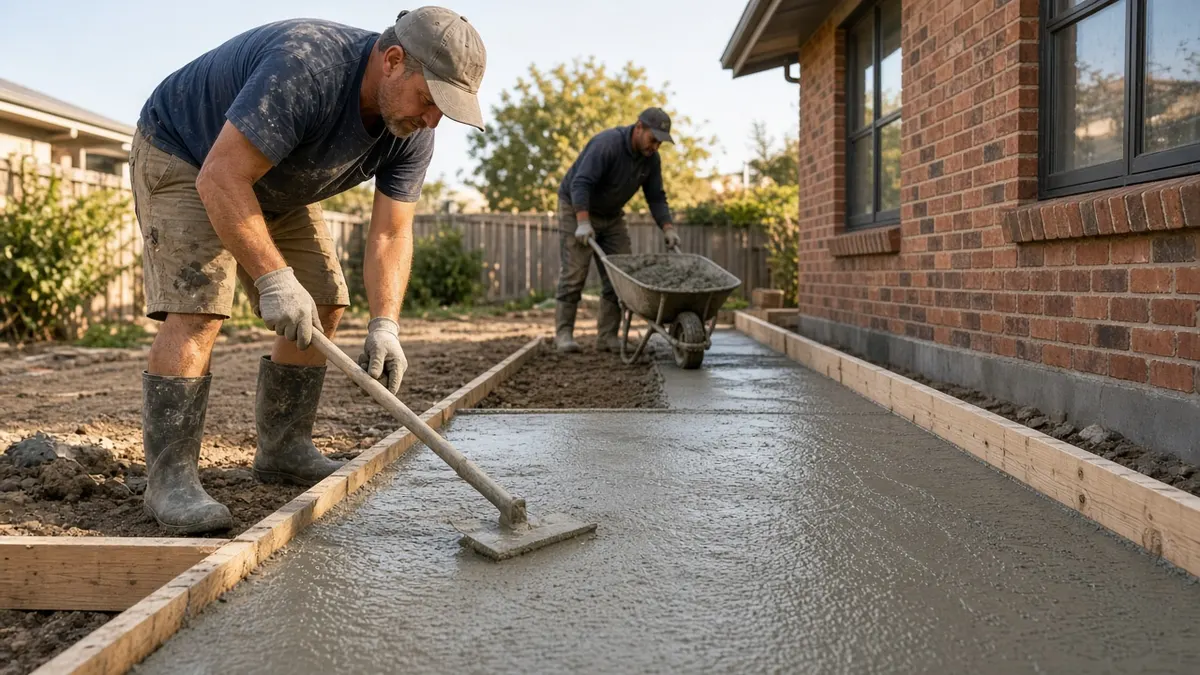
Concreting costs about $75 to $180 per m² in Australia in 2026, including GST, for typical residential work such as paths, patios, driveways and shed slabs. Plain grey concrete on an easy site sits at the bottom of that range, and decorative finishes like exposed aggregate or stamped concrete sit at the top.
Concreting is a broad trade, so this guide is the overview. It covers what concrete itself costs per cubic metre, what crews charge for labour, how finishes change the price, minimum charges on small jobs, demolition and repairs, plus licensing and how to compare quotes. Where a job type has its own detailed guide, you will find a link. Every figure here is indicative, and you should get at least three written quotes for the same specification before committing.
Concreting prices by job type
| Job | Typical price (incl. GST) | Notes |
|---|---|---|
| Garden path, plain | $90 to $150 per m² | Narrow shapes mean more formwork per m². |
| Patio or alfresco slab, plain | $85 to $130 per m² | Falls away from the house, work near doors. |
| Driveway, plain broom finish | $75 to $120 per m² | Larger pours keep the rate down. |
| Driveway or patio, exposed aggregate | $110 to $160 per m² | Decorative mix, wash-off visit, sealing. |
| Stamped or stencilled concrete | $110 to $180 per m² | Skilled finishing crew, sealer needed. |
| Shed or garage slab | $90 to $140 per m² | Thickened edges, often pad footings. |
| House slab (waffle pod, M class) | $110 to $170 per m² | Excludes soil test, engineering and site cuts. |
| Polished concrete floor (interior) | $85 to $160 per m² | Grinding and polishing an existing or new slab. |
| Resurfacing a sound slab | $40 to $90 per m² | Spray-on, stencil or microtopping overlays. |
| Removing old concrete | $35 to $70 per m² | Up to about 125 mm thick, including disposal. |
| Concrete steps, formed in place | $250 to $600 per step | Depends on width, landing and finish. |
| Strip footings for walls or fences | $150 to $350 per linear metre | Depends on depth, width and reinforcement. |
For deeper detail on the most common jobs, see the guides to concrete driveway costs, house and shed slab costs, exposed aggregate concrete and polished concrete floors.
How a concreting quote is built
Almost every concreting price is made up of the same parts. Once you know them, quotes become much easier to compare, and you can see where a cheap quote has left something out.
- Site preparation. Excavating topsoil, levelling, removing spoil and compacting a crushed rock base.
- Formwork. Timber or steel edge forms that hold the concrete in shape and set the levels and falls.
- Reinforcement. Steel mesh or bar on plastic chairs so it sits in the right place in the slab, plus a vapour barrier under building slabs.
- Concrete supply. Ready-mix from a plant, priced per cubic metre, with extra fees for small loads, waiting time and additives.
- Placement. Direct from the truck chute, by barrow, or through a concrete pump where access is limited.
- Finishing. Screeding, floating, edging, the final finish (broom, trowel, exposed, stamped), then curing.
- Joints and sealing. Saw-cut control joints and, for decorative concrete, an acid wash and sealer.
- Clean-up and disposal. Removing formwork, spoil and waste.
On a typical 50 m² plain driveway, concrete supply is often 25 to 35 percent of the price, labour 30 to 40 percent, and the rest is base, steel, pump, formwork and margin. Decorative work shifts more of the cost into labour.
What concrete costs per cubic metre
Ready-mix concrete in Australian capital cities generally costs about $300 to $380 per m³ including GST in 2026 for standard 20 to 32 MPa mixes. Regional areas often pay $330 to $450 per m³, more where the plant is a long drive away. Prices vary by supplier and change during the year, so treat these as a starting point.
| Item | Typical cost (incl. GST) |
|---|---|
| Standard 20 to 25 MPa ready-mix, metro | $300 to $350 per m³ |
| 32 MPa ready-mix, metro | $320 to $380 per m³ |
| Exposed aggregate or coloured mix | $340 to $450 per m³ |
| Short-load fee (small orders, often under 3 to 4 m³) | $100 to $300 per load |
| Waiting time beyond the free unloading allowance | Charged per minute or per hour |
| Saturday, early start or after-hours delivery | Surcharge per m³ or per load |
| Additives (accelerator, retarder, fibres) | $10 to $40 per m³ |
| Bagged premix, 20 kg bag | $8 to $14 per bag |
Bagged concrete is convenient for post holes and tiny pads, but at roughly 100 to 110 bags per cubic metre it works out at about $900 to $1,400 per m³, plus a lot of mixing. Above about half a cubic metre, a mini-mix truck or ready-mix delivery is usually cheaper and gives a more consistent result.
Working out how much concrete you need
Multiply length by width by thickness in metres, then add 5 to 10 percent for waste, uneven base and spillage. A 6 m by 4 m patio at 100 mm thick is 6 x 4 x 0.1 = 2.4 m³, so you would order about 2.6 m³. Thickened edges and beams add more, which is why concreters calculate building slabs from the engineering drawings.
Labour, pumps and machine hire
Concreters in Australia commonly charge around $60 to $100 per hour for a qualified concreter and $40 to $60 per hour for a labourer, including GST, though most residential jobs are quoted as a fixed price rather than by the hour. Placing and finishing labour usually works out to $20 to $45 per m² depending on the finish and access. The concreter hourly rate guide has a fuller breakdown of labour rates by state and experience.
| Equipment or service | Typical cost (incl. GST) |
|---|---|
| Line pump, residential pour | $600 to $1,000 minimum |
| Boom pump | $1,200 to $2,000 for a half day, more for big reaches |
| Bobcat or mini excavator with operator | $100 to $160 per hour, often with a minimum |
| Concrete saw cutting | $8 to $15 per linear metre |
| Core drilling through concrete | $100 to $300 per hole |
| Skip bin for concrete rubble | $350 to $900 depending on size and city |
Pumps are the extra that surprises people most. If the truck cannot reach within its chute length of the formwork, the choice is barrowing, which takes time and more hands, or a pump. On most suburban backyard jobs, the pump is cheaper than the extra labour.
Small jobs and minimum charges
Concreters, concrete plants and pump operators all have minimum charges. A crew of two or three, a truck and the gear cost much the same for a 3 m² bin pad as for a 30 m² patio. That is why small jobs look expensive per square metre.
| Small job | Typical size | Typical price (incl. GST) |
|---|---|---|
| Air conditioner condenser pad | about 1 m² | $250 to $600 (precast pads are cheaper) |
| Bin or clothesline pad | 2 to 4 m² | $500 to $1,200 |
| Rainwater tank base | 4 to 8 m² | $800 to $1,800 |
| Short side path | 10 to 15 m² | $1,500 to $2,800 |
| Small patio, 4 m x 4 m | 16 m² | $1,800 to $2,800 |
| Three or four formed steps with landing | about 1.2 m wide | $1,000 to $2,500 |
The best way to beat minimum charges is to bundle jobs. If you need a bin pad, a tank base and a path, have them formed and poured on the same day from one truck.
How finishes change the price
| Finish | Rough premium over plain broom finish | Upkeep |
|---|---|---|
| Broom finish | Baseline | Wash occasionally, sealing optional |
| Steel trowel (smooth) | Small, mainly labour | Slippery when wet outdoors, best under cover |
| Coloured through the mix | $15 to $25 per m² | Seal to keep the colour rich |
| Exposed aggregate | $30 to $50 per m² | Reseal every 2 to 3 years |
| Stencilled | $30 to $50 per m² | Reseal every 2 to 3 years |
| Stamped | $40 to $70 per m² | Reseal every 2 to 3 years |
| Honed or polished | $40 to $100 per m² on top of the slab | Low for mechanical polish, recoat for topical sealers |
Indoor floors are their own topic. Garage and workshop coatings are covered in the epoxy flooring cost guide.
Concreting prices by city
These are typical ranges for a plain 100 mm slab of 30 to 60 m² on a straightforward site, alongside typical concreter hourly rates.
| Location | Plain concreting per m² | Concreter per hour | Why it differs |
|---|---|---|---|
| Sydney | $90 to $130 | $75 to $110 | Highest labour and tipping costs, tight access. |
| Melbourne | $85 to $125 | $70 to $105 | Large market, reactive clay in many suburbs. |
| Brisbane | $80 to $115 | $65 to $100 | Sloping blocks, summer storms interrupt pours. |
| Perth | $75 to $110 | $65 to $95 | Sandy sites keep base work simpler. |
| Adelaide | $70 to $105 | $60 to $90 | Lower labour rates, reactive clay on the plains. |
| Canberra | $85 to $125 | $70 to $105 | Smaller trade pool, cold-weather pours in winter. |
| Hobart | $80 to $120 | $65 to $100 | Rock and slopes, fewer crews. |
| Darwin | $95 to $140 | $75 to $115 | Freight on materials, wet season, heat. |
| Regional | $70 to $115 | $60 to $95 | Lower labour, higher delivery and travel costs. |
Three typical jobs, broken down
Coloured patio and side path in Blacktown
A 24 m² patio off the family room plus an 18 m² side path, 42 m² in total, in a charcoal colour with a broom finish and sealer. Side access only, so a line pump was used.
| Item | Cost |
|---|---|
| Excavation and spoil removal, 42 m² at $14 | $588 |
| Roadbase supply and compaction, 42 m² at $9 | $378 |
| Formwork and mesh, 42 m² at $14 | $588 |
| Coloured 25 MPa concrete, 4.6 m³ at $340 | $1,564 |
| Line pump | $750 |
| Placing and finishing, 42 m² at $28 | $1,176 |
| Saw cutting control joints | $250 |
| Sealer, 42 m² at $7 | $294 |
| Subtotal (ex GST) | $5,588 |
| GST | $558.80 |
| Total | $6,146.80 (about $146 per m²) |
The narrow path and the pump pushed this above the typical coloured driveway rate. A single large rectangle with truck access would have come in closer to $115 to $125 per m².
Replacing a sunken path and step in Geelong
A 20 m² path along the side of a 1960s weatherboard had sunk and cracked, with a trip hazard at the back step.
| Item | Cost |
|---|---|
| Break out and remove old path, 20 m² at $45 | $900 |
| Base repair and compaction, 20 m² at $12 | $240 |
| Formwork, mesh and step forming | $570 |
| 25 MPa concrete, 2.4 m³ at $320 | $768 |
| Short-load fee | $150 |
| Placing and broom finishing, 20 m² at $35 | $700 |
| Saw cuts and edging | $150 |
| Subtotal (ex GST) | $3,478 |
| GST | $347.80 |
| Total | $3,825.80 |
Without demolition, the new path cost about $142 per m² including GST. Barrow access and the short load explain why it is above the plain driveway rate.
Four small jobs in one day in Canberra
An air conditioner pad, a bin pad, a clothesline footing and an 8 m² path to the side gate, about 15 m² in total. Pouring them together avoided four separate minimum charges.
| Item | Cost |
|---|---|
| Preparation and formwork for four areas | $650 |
| Mesh and bar chairs | $180 |
| Concrete, 1.8 m³ at $330 | $594 |
| Short-load fee | $200 |
| Two-person crew for the day | $1,100 |
| Clothesline footing and sleeve set-out | $150 |
| Spoil disposal | $200 |
| Subtotal (ex GST) | $3,074 |
| GST | $307.40 |
| Total | $3,381.40 (about $225 per m²) |
That per m² rate looks steep, but four separate visits would easily have cost $4,500 or more.
Breaking out old concrete
Many concreting jobs start with demolition. The price depends on thickness, reinforcement, access for machines and how far the rubble has to travel.
| Type of concrete | Typical removal price per m² (incl. GST) |
|---|---|
| Unreinforced path, 75 to 100 mm | $35 to $55 |
| Reinforced driveway or patio, 100 to 125 mm | $45 to $70 |
| Thick or heavily reinforced slab, 150 mm or more | $70 to $120+ |
| Hand removal where no machine fits | Add 30 to 60 percent |
Clean concrete rubble is often accepted at recycling yards for less than mixed waste, so keep it separate from soil and green waste. Before demolishing anything near a house built before 1990, check for fibro or other materials that may contain asbestos, since old sheeting is sometimes buried under paths or used as formwork. The asbestos removal cost guide covers testing and licensed removal.
Repairs, resurfacing and crack fixing
Not every tired slab needs replacing. Before you pay for demolition, ask whether one of these options will do the job.
- Crack filling. Hairline and shrinkage cracks can be cleaned and filled with a flexible sealant or epoxy. A small repair visit often costs $300 to $800. Filling stops water and weeds getting in but will not hide the crack.
- Resurfacing. Polymer cement overlays, spray-on finishes, stencil overlays and microtoppings give a new surface over sound concrete for about $40 to $90 per m². Browse concrete resurfacing specialists for this kind of work.
- Lifting sunken slabs. Slab lifting by pumping grout or expanding foam under the concrete can level a few sunken bays without demolition. Pricing varies widely by method and size, so get it quoted against replacement.
- Partial replacement. Cutting out and replacing one or two bays between control joints is often cheaper than a whole new driveway, though the new concrete will not match the old colour exactly.
- Concrete cancer. Rusting reinforcement that cracks and pops the concrete (spalling) is a structural issue, common on older balconies and coastal buildings. It needs an engineer's assessment and a remedial specialist, not a cosmetic patch.
What pushes concreting prices up
- Access. No truck access means a pump or barrows. Steep driveways, narrow side paths, power lines and upstairs work all add time.
- Slope and levels. Sloping sites need more excavation, steps or retaining, and more care to keep concrete from slumping downhill.
- Soil. Reactive clay, soft ground and fill need a deeper base or engineered footings.
- Thickness and steel. Areas for caravans, boats or trucks need thicker slabs and heavier reinforcement.
- Finish. Decorative finishes add materials, skilled labour and sealing.
- Drainage. Grated drains and stormwater connections add materials and a plumber's time.
- Demolition and disposal. Removing old surfaces and spoil is often a third of a replacement job.
- Timing. Weekend pours, early starts in summer heat and wet-season rescheduling all cost money.
- Council requirements. Crossovers on council land need permits, inspections and specific construction details.
Licences, approvals and safety by state
Concreting counts as residential building work in every state once it passes a dollar threshold, and some states have a dedicated concreting licence class. Exact thresholds change, so check with your regulator before signing.
| State or territory | Regulator | What to check |
|---|---|---|
| NSW | NSW Fair Trading | Licence and written contract for residential work over $5,000 in labour and materials. Home building compensation cover applies to larger jobs; check the current threshold. |
| Victoria | Building and Plumbing Commission | Registration and domestic building contract requirements, which depend on the value and type of work. |
| Queensland | QBCC | Concreting is a QBCC licence class. A licence is required for building work valued over $3,300. |
| Western Australia | Building and Energy | Builder registration rules and home indemnity insurance thresholds. |
| South Australia | Consumer and Business Services | Building work contractor licensing and contract requirements. |
| Tasmania | CBOS | Licensing for residential building work and owner-builder rules. |
| ACT | Access Canberra | Construction occupation licensing. |
| Northern Territory | NT Building Practitioners Board | Registration requirements for residential building work. |
You can check a NSW licence on the NSW Fair Trading website and a Queensland licence through the QBCC. Deposits are capped in several states, for example at 10 percent in NSW, and lower limits apply in Victoria and Queensland depending on the contract value, so a request for a large upfront payment is a warning sign.
Some parts of a concreting job always need another licensed trade. Stormwater connections and under-slab drainage are plumbing work. Conduits for power and lighting need a licensed electrician. Building slabs need engineering and a pre-pour inspection under the building approval, and crossovers need council approval.
On safety, cutting, grinding and drilling concrete releases crystalline silica dust, which causes silicosis. Crews should use water suppression or on-tool extraction and suitable respirators; Safe Work Australia's silica guidance explains the controls. Wet concrete is also caustic and can cause serious skin burns, so anyone handling it needs gloves, long sleeves and eye protection. Lodge a free Before You Dig Australia enquiry before excavating.
DIY concreting: where it makes sense
Small jobs are well within reach for a handy owner. Setting fence or pergola posts in bagged concrete, pouring an air conditioner pad, or a small shed base of a few square metres are good starter projects. You need formwork timber, a level, mesh and chairs for anything bigger than a stepping stone, a screed board, a float, an edger and patience.
Things get harder quickly. A cubic metre of concrete weighs about 2.4 tonnes. Once a truck is involved, you have a limited window to place, screed and finish before the concrete sets, and that window shrinks on hot days. A driveway or large patio needs a practised crew of three or four. Common DIY problems include a poor base that sinks, mesh lying on the ground instead of in the slab, no control joints and finishing too early or too late.
A middle path works well: do the preparation, demolition and clean-up yourself or with hired help, and pay a concreter for the pour and finish.
What happens on pour day
Most residential concreting follows a similar rhythm, and knowing it helps you plan around the work.
In the days before the pour, the crew excavates, lays and compacts the base, sets up formwork to the agreed levels and falls, and positions the mesh on chairs. If a council crossover or building slab is involved, an inspector checks the formwork and steel before concrete is ordered. This is the time to walk the site with the concreter and confirm heights at doorways, falls away from the house and where the control joints will go. Changing your mind after the truck arrives is not an option.
On the day, crews often start early, especially in summer. The truck, and the pump if needed, usually arrive mid-morning. Expect noise, a truck blocking the driveway or street for an hour or two, and a busy crew who will not have time to chat. Keep kids, pets and cars well clear. Once placed, the concrete is screeded, floated and finished over the next few hours, and edges are tooled.
Saw cutting of control joints normally happens later the same day or the next morning. Exposed aggregate needs a wash-off visit the following morning. Sealing, where it is part of the job, comes a few weeks later once the concrete has cured. Formwork is stripped within a day or two, and the crew should leave the site clean, with spoil and offcuts removed as quoted.
After the pour, keep foot traffic off for about 24 hours, keep cars off for at least seven days, and water the surface lightly in hot, dry weather if the concreter asks you to.
Weather and the best time to pour
Concrete can be poured year round in most of Australia, but conditions matter. In summer heat, concrete sets faster, so crews start early, may add a retarder and need to cure the slab carefully to avoid surface cracking. In southern winters, cold slows setting and strength gain, and frost can damage fresh concrete in Canberra, Hobart and inland areas. Rain on a fresh pour can ruin the finish. In the tropical north, the wet season limits pour days, and crews book up quickly in the dry.
Spring and the lead-up to Christmas are peak season for outdoor concreting in the south, when everyone wants a new driveway or patio before summer. Late autumn and mild winter weeks can be easier to book.
Choosing a concreter and comparing quotes
Ask every concreter to quote the same specification, so you are comparing prices, not guesses. A good written quote includes:
- Area, thickness, concrete strength (MPa) and reinforcement type.
- Base depth and material, and how it is compacted.
- Finish, colour or aggregate name, and sealing.
- Control joint layout and saw cutting.
- Demolition, disposal, pump, drains and permits listed separately.
- Start date, expected duration and what happens if rain delays the pour.
- Licence number where required, public liability insurance and a written warranty.
- A payment schedule tied to stages, with a deposit within your state's legal limit.
Red flags include a quote far below the others, no written contract on jobs over your state threshold, cash-only pricing, a crew that cannot tell you the MPa or mesh size, and pressure to pour without a council permit on a crossover. Ask to see photos or addresses of recent jobs of the same type. If you want help finding a reliable tradie in general, the steps in our guide on how to find trusted tradies apply well to concreters.
Concrete or another surface?
For outdoor areas, concrete is not the only choice. Pavers cost a similar amount to decorative concrete once laid on a proper base, and individual pavers can be lifted for repairs or to reach services, but they can move and weeds grow in the joints. Asphalt is cheaper for long driveways but softens in heat. Gravel is cheapest of all but needs topping up and is messy. The paving cost guide compares paver types and prices if you are weighing the two up.
How long concrete lasts and what it costs to keep
A well-built concrete path, patio or driveway lasts 30 to 50 years. Plain concrete needs little more than an occasional wash. Decorative finishes need resealing every two to three years, often $8 to $15 per m² if you pay someone. Fix cracks early to stop water getting under the slab, keep tree roots in mind when planting near paths, and keep heavy vehicles off surfaces that were not designed for them. Properly maintained, concrete is one of the cheapest outdoor surfaces to own over its lifetime.
Getting labour for a concreting job through Yakka
Concreting jobs have a lot of plain physical work around the pour. Breaking up old paths, barrowing rubble to a skip, digging out turf and topsoil, moving pavers and pot plants, carrying formwork and cleaning up afterwards can all be done by workers you book through Yakka Labour by the hour or day. Our guide to how to hire a labourer for a day explains rates and how it works, and agreeing that split with your concreter upfront can trim their quote.
The concrete work itself should go to an experienced concreter with the right licence for your state. You can compare local concreters on Yakka, ask each for a written quote against the same specification, and keep plumbing and electrical connections with licensed trades.
Frequently asked questions
How much does concreting cost per m2 in Australia?
In 2026, residential concreting usually costs $75 to $120 per m² for plain concrete and $110 to $180 per m² for decorative finishes such as exposed aggregate, stencilled or stamped concrete, including GST. Small jobs, narrow paths, difficult access, pumps and demolition push the rate higher, while large simple pours come in lower.
How much is a cubic metre of concrete in 2026?
Ready-mix concrete in Australian capital cities generally costs about $300 to $380 per m³ including GST for standard 20 to 32 MPa mixes. Regional deliveries often cost $330 to $450 per m³. Expect extra fees for small loads, waiting time, additives, decorative mixes and weekend or early deliveries.
How much do concreters charge per hour?
Concreters commonly charge around $60 to $100 per hour including GST, with labourers on the crew at about $40 to $60 per hour. Rates are higher in Sydney and Darwin and lower in Adelaide and many regional areas. Most residential concreting jobs are quoted as a fixed price rather than charged by the hour.
What is the minimum charge for a small concrete job?
Many concreters have a minimum charge of around $1,000 to $2,500 for small pours, depending on the location, access and whether a pump is needed. Concrete plants also charge short-load fees for small orders. Bundling several small jobs into one pour is the easiest way to get better value.
Do I need a licence to do concreting work?
Concreting is residential building work once it passes your state's dollar threshold. In NSW, work over $5,000 in labour and materials needs a licensed contractor and written contract. Queensland has a specific QBCC concreting licence class. Other states have their own thresholds, so check with your regulator before hiring or doing the work yourself.
Is it cheaper to concrete or pave?
Plain concrete is usually cheaper than pavers, at roughly $75 to $120 per m² against $100 to $200 for most laid pavers. Decorative concrete and mid-range concrete pavers cost about the same. Pavers are easier to repair in small sections, while concrete has no joints for weeds and is less likely to shift.
How long does concrete take to cure before use?
You can usually walk on new concrete after about 24 hours. Cars should stay off driveways for at least seven days, and heavy vehicles for longer. Concrete reaches most of its design strength in about 28 days, so avoid heavy point loads until then and keep the surface damp or use a curing compound early on.
Can I concrete over existing concrete?
Sometimes. A thin resurfacing overlay can go over sound, stable concrete for about $40 to $90 per m². A full new topping slab raises levels, which can cause problems at doors, drains and weep holes. Concrete that is cracked through, sinking or lifted by roots should be removed and replaced, since problems will come back through any overlay.
Official sources
Award rates, licences and safety rules change. Check the official source before you hire or take on a shift.
- Safe Work AustraliaNational work health and safety framework, including high-risk work licences
- Queensland Building and Construction Commission (QBCC)Contractor, plumbing and drainage licence search in Queensland
- Consumer and Business Services SALabour hire licensing in South Australia
- NSW Fair TradingTrade licence checks for electricians, plumbers and builders in New South Wales
- Building and Plumbing Commission (Victoria)Builder and plumber registration, domestic building insurance and licence checks in Victoria
- Asbestos Safety and Eradication AgencyWhere asbestos is found in homes and how to deal with it safely