More cost guide
Aircon Repair Cost Australia 2026: Service, Regas and Fault Prices
Typical cost in Australia (2026, inc. GST)
$150 to $900 per repair
common split system repairs including the call-out; compressor and ducted system repairs cost more
Most split system air conditioner repairs in Australia cost $150 to $900 in 2026, including a diagnostic call-out of $99 to $180. A standard service is $120 to $250 per unit, a leak repair and regas $400 to $900, and a fan motor or circuit board $350 to $1,200. Compressor failures can cost $1,200 to $3,000, which often makes replacement the better choice.
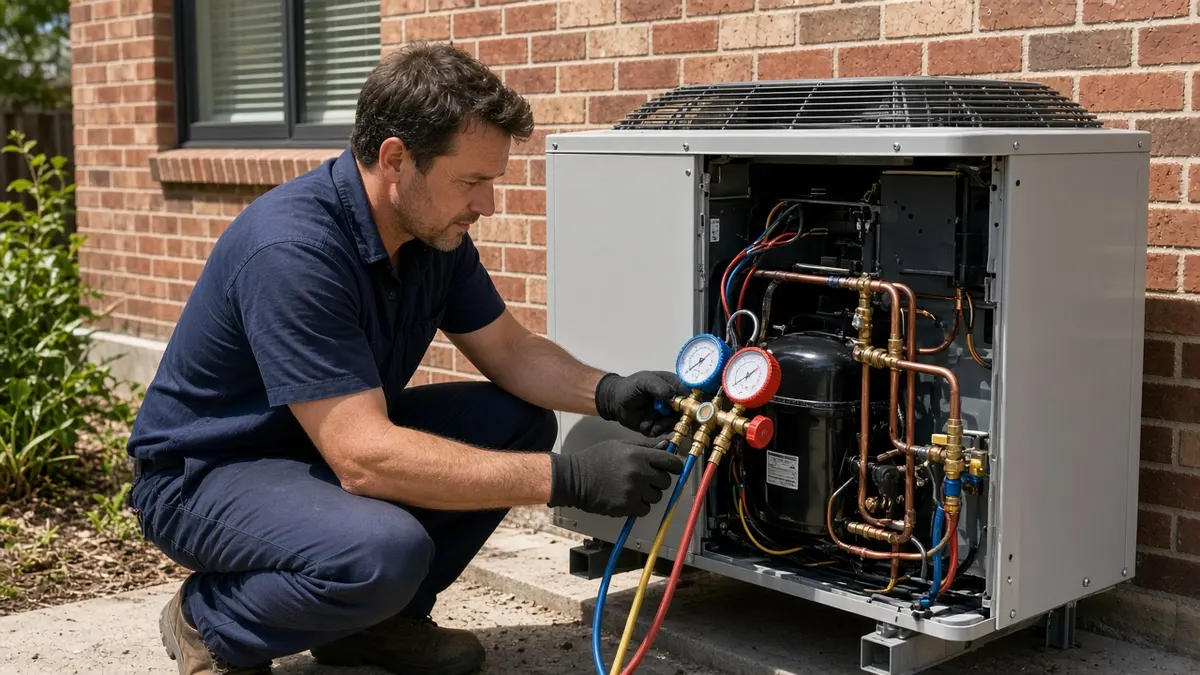
Most air conditioner repairs in Australia cost between $150 and $900 in 2026, including the technician's call-out. A simple fix like a blocked drain or a failed sensor sits at the bottom of that range. A refrigerant leak repair with a regas, a new fan motor or a replacement circuit board sits towards the top. A failed compressor is the expensive one, often $1,200 to $3,000, and on an older unit that usually tips the decision towards replacement.
The first cost on any repair is the diagnostic visit, typically $99 to $180. After that, the price depends on the fault, the part, the brand and whether parts are in stock. This guide covers repair and service prices, what common symptoms usually mean, the free checks worth doing before you call, how to decide between repairing and replacing, and the licences a technician needs. Prices include GST and are indicative. For anything beyond a simple service, get more than one written quote, ideally three.
What air conditioner repairs cost
| Repair | Typical price, split system (inc GST) | Notes |
|---|---|---|
| Diagnostic call-out | $99 to $180 | Often includes the first 30 minutes; sometimes credited to the repair |
| Hourly labour after the first period | $100 to $160 | Higher after hours and on weekends |
| Blocked condensate drain cleared | $150 to $350 | Common cause of water dripping from the indoor unit |
| Temperature sensor (thermistor) replaced | $150 to $350 | Part is cheap; most of the cost is labour |
| Run or fan capacitor replaced | $200 to $450 | Common cause of a fan or compressor that will not start |
| Leak found and repaired, plus regas | $400 to $900 | Depends on where the leak is and how much refrigerant is needed |
| Regas only, no leak repair | $250 to $600 | Rarely the right answer on its own; see below |
| Indoor fan motor replaced | $350 to $750 | Parts availability varies by brand |
| Outdoor fan motor replaced | $350 to $800 | Outdoor motors fail more in coastal and dusty areas |
| Main circuit board (PCB) replaced | $400 to $1,200 | Inverter boards for larger units cost the most |
| Condensate pump replaced | $250 to $450 | Only for units that cannot drain by gravity |
| Compressor replaced | $1,200 to $3,000 | Often uneconomic on units over 8 to 10 years old |
Parts for premium brands are usually easier to source and sometimes cheaper than parts for little-known budget brands, which may need to be ordered from overseas or may not be available at all. If your unit is an obscure brand, ask about parts availability before you approve the diagnosis.
Servicing and cleaning prices
A lot of repair calls are really overdue services. Here is what servicing typically costs.
| Service | Typical price (inc GST) | What it includes |
|---|---|---|
| Standard split system service | $120 to $250 per unit | Filters, indoor coil spray clean, drain check, outdoor unit check, performance test |
| Deep clean or bag wash | $180 to $350 per unit | Covers removed, coil and fan barrel washed with a catchment bag |
| Additional split units on the same visit | $90 to $180 each | Most businesses discount extra units |
| Ducted system service | $200 to $450 | Return air filter, indoor unit, outdoor unit, drain, controls |
| Outdoor unit coil clean | $80 to $180 extra | Worth it in coastal, dusty or leafy areas |
A typical home with two or three split systems might pay $300 to $550 for a service visit. Most manufacturers recommend professional servicing every one to two years, and more often for units that run most of the year or sit near the coast. Cleaning the filters yourself every few weeks in heavy use is the single best thing you can do between services. It is not electrical work: the filters lift out from behind the front panel. Check the manual for your model.
Common faults and what they usually mean
Blowing air but not cooling or heating
The most common complaint. Causes range from a clogged filter or blocked outdoor coil to low refrigerant from a leak, a failed capacitor or a faulty sensor. A technician will check pressures, temperatures and electrical components before guessing. Expect $150 to $900 depending on the cause.
Water dripping from the indoor unit
Usually a blocked or kinked condensate drain, a dirty coil that overflows the drain tray, or a failed condensate pump. Turn the unit off if water is running near power points or down the wall, and book a service. Typical cost: $150 to $450.
Ice on the pipes or indoor coil
Often a sign of low refrigerant, poor airflow from dirty filters, or a fan that is not running properly. Turn the unit off and let it thaw. Running it iced up can damage the compressor.
Loud noises
Rattling can be a loose panel or mount. Grinding or squealing often points to a fan motor bearing. A loud bang followed by no cooling is worth a call straight away. Fan motor repairs typically cost $350 to $800.
Bad smells
A musty smell usually means mould and bacteria in the coil and fan barrel, which a deep clean usually fixes. A burning smell is different: turn the unit off at the isolator and call a technician.
Error codes and flashing lights
Most modern units display an error code. The manual or the manufacturer's website often explains what the code means, which helps you describe the problem when you call. Some codes are minor and clear after a reset. Others point to sensors, boards or communication faults between the indoor and outdoor units.
Will not turn on at all
Check the remote batteries and the circuit breaker first. If the breaker has tripped, you can reset it once. If it trips again, leave it off and call a licensed technician or electrician, because repeated tripping means a fault that needs testing.
Free checks before you book
None of these involve opening the unit or touching wiring, and they solve more problems than you might expect.
- Replace the remote batteries and check the mode. Plenty of units sit in fan or dry mode by accident.
- Set a realistic temperature. A unit set to 24 degrees will not feel cold on a 40 degree afternoon in a west-facing room.
- Clean the indoor filters following the manual.
- Clear leaves, plants and stored items from around the outdoor unit so it can breathe. Most manufacturers recommend clear space around it.
- Check the switchboard for a tripped breaker and reset it once only.
- Look for the error code and note it down for the technician.
Do not remove covers, touch electrical components or try to top up refrigerant. Refrigerant handling and electrical repairs are licensed work, covered below.
Regassing: why a top-up is rarely the whole answer
Split systems are sealed. Refrigerant is not used up like fuel, so if a system is low on gas, it has leaked. A technician who simply tops it up without finding the leak is selling you a repeat visit, and releasing refrigerant into the atmosphere is exactly what the licensing rules are designed to prevent.
A proper repair involves finding the leak with an electronic detector, nitrogen pressure testing or bubble solution, fixing it, pulling a vacuum on the system and then charging it with the correct amount of refrigerant by weight. Flare joints at the indoor unit are a common leak point, especially on installations where the flares were not made properly. Leaks in the indoor or outdoor coil are harder and sometimes mean replacing the coil or the whole unit. A leak repair with regas typically costs $400 to $900 on a split system. If someone offers a $150 regas without mentioning a leak, ask what they plan to do about where the gas went.
Repair or replace?
A practical rule of thumb many technicians use: if the unit is more than about eight to ten years old and the repair costs more than about half the price of a new installed unit, replacement usually makes more sense. A new inverter system will also be more efficient, quieter and covered by a fresh warranty.
| Unit age | Repair under $500 | Repair $500 to $1,200 | Repair over $1,200 |
|---|---|---|---|
| Under 5 years | Repair; check warranty first | Repair; check warranty first | Repair if under warranty, otherwise compare |
| 5 to 10 years | Repair | Usually repair | Get a replacement quote |
| Over 10 years | Repair if the unit is otherwise sound | Compare with replacement | Usually replace |
| Older refrigerant such as R22 | Repair only for minor faults | Usually replace | Replace |
Units using older refrigerants such as R22 are increasingly costly to recharge, because supply has been phased down under international agreements and Australian law. For any major repair on an R22 unit, a replacement quote is worth getting. Our split system installation cost guide covers replacement prices, including swapping a unit into an existing position.
Ducted system repairs
Ducted systems have the same core parts as split systems plus ductwork, zone dampers and a central controller, and they cost more to diagnose and repair because the indoor unit is usually in the roof space. Typical ducted repair costs include $250 to $600 for a zone damper motor, $300 to $700 for a wall controller, $300 to $1,500 for duct repairs or replacement sections, and $500 to $1,500 for a circuit board. Compressor failures on large ducted systems can run to $2,500 to $5,000. Roof space work in summer is hot and slow, and technicians usually prefer morning appointments. See our ducted air conditioning cost guide for replacement figures if your system is near the end of its life.
Prices by city
| City | Diagnostic call-out | Standard split service | Local factor |
|---|---|---|---|
| Sydney | $120 to $190 | $140 to $260 | Higher labour and travel costs |
| Melbourne | $110 to $180 | $130 to $250 | Demand peaks in both summer and winter |
| Brisbane | $100 to $170 | $120 to $240 | Long cooling season, humidity-related drain faults |
| Perth | $110 to $180 | $130 to $250 | Dust and heat stress outdoor units |
| Adelaide | $99 to $160 | $120 to $230 | Lower labour rates, extreme heat spikes |
| Hobart | $110 to $180 | $130 to $250 | Heating-heavy use, fewer technicians |
| Canberra | $120 to $190 | $140 to $260 | Heavy winter heating use |
| Darwin | $130 to $210 | $150 to $280 | Year-round use, mould and corrosion issues |
In Darwin, Cairns and Townsville, air conditioners can run for most of the year, so services every six to twelve months are common, and mould in the indoor unit is a frequent call-out. In coastal areas everywhere, salt corrosion on outdoor coils and fan motors is a major cause of failure.
Three repairs, costed
Warm air from a Sunnybank split system, Queensland
A five-year-old 3.5 kW unit in a Brisbane bedroom is running but blowing barely cool air. The technician finds a leaking flare joint at the indoor unit, re-makes it, pressure tests, vacuums and recharges the system.
| Item | Cost (inc GST) |
|---|---|
| Diagnostic call-out, including first 30 minutes | $150 |
| Leak detection, 1 hour at $130 | $130 |
| New flare nut and fittings | $40 |
| Pressure test, vacuum and refrigerant recharge | $280 |
| Total | $600 (expect $500 to $800) |
Outdoor fan failure in Marion, South Australia
A six-year-old 7 kW unit keeps shutting down on hot afternoons. The outdoor fan is not spinning. The technician tests the capacitor, which is fine, and replaces the failed fan motor.
| Item | Cost (inc GST) |
|---|---|
| Diagnostic call-out | $130 |
| Labour, 1.5 hours at $120 | $180 |
| Outdoor fan motor | $280 |
| Total | $590 (expect $500 to $850) |
Dead compressor in Frankston, Victoria
A twelve-year-old 7 kW unit in the living room has stopped cooling and heating. The diagnosis, which costs $150 either way, finds a failed compressor. The owner compares two options.
| Item | Repair (inc GST) | Replace (inc GST) |
|---|---|---|
| Compressor or new 7 kW unit | $1,000 | $2,300 |
| Labour | $840 (6 hours at $140) | $900 (replacement install) |
| Refrigerant recovery and recharge | $400 | Included |
| Sundries | $160 | Included |
| Total | $2,400 | $3,200 |
For $800 more, the owner gets a new, more efficient unit with a full manufacturer's warranty instead of a twelve-year-old unit with one new part. Replacement is the clear choice here.
Warranties, licences and who can work on your unit
Before you pay for any repair, check the warranty. Many manufacturers offer five years or more on parts and the compressor for split systems, sometimes conditional on the original installation being done by a licensed installer and the unit being serviced. Installer workmanship warranties are separate. Under Australian Consumer Law, you may also have rights to a repair or replacement for major failures beyond the stated warranty period if the product has not lasted a reasonable time, so ask the retailer or manufacturer first.
Two types of licence apply to air conditioning repairs. Any work involving refrigerant, such as leak repairs, regassing, replacing a compressor or recovering gas before disposal, must be done by a technician holding an ARCtick refrigerant handling licence from the Australian Refrigeration Council, working for a business with a refrigerant trading authorisation. The Department of Climate Change, Energy, the Environment and Water explains the federal rules. Work on electrical components, wiring, the isolator or the circuit needs an appropriate electrical licence, either a full electrician's licence or, in some states, a restricted licence that covers air conditioning equipment. If the fault turns out to be in the circuit or switchboard, you will need a licensed electrician. The electrician cost guide covers their rates.
A general handyman cannot do refrigerant or electrical repairs on an air conditioner. Our article on whether a handyman can do electrical work explains where that line is drawn.
Keeping repair bills down
- Clean filters regularly. Every two to four weeks during heavy use. Dirty filters cause icing, poor performance and strain on the fan and compressor.
- Service on schedule. A $150 to $250 service often catches a failing capacitor or blocked drain before it becomes a bigger job.
- Keep the outdoor unit clear. Trim plants, move bins and do not store things on top of it.
- Book before the season starts. A service in spring or autumn means faults are found before the first heatwave or cold snap, when technicians are flat out.
- Do not run a faulty unit. A unit that is icing up, short cycling or making new noises can turn a $400 fix into a dead compressor.
- Ask for the old part back. It keeps everyone honest and lets you see what failed.
Good efficiency habits help too. The Energy Rating website has general advice on running air conditioners efficiently, and setting temperatures sensibly reduces wear as well as power bills.
What a repair quote or invoice should show
- The diagnosis in plain words, including the fault found and how it was tested.
- The part being replaced, with its cost and warranty.
- Labour time and the hourly rate.
- For refrigerant work, the type and amount of refrigerant added and the technician's ARCtick licence number.
- For electrical work, the licence number of the person who did it.
- Whether the diagnostic fee is credited if you go ahead with the repair.
Red flags include a regas with no leak test, a quote that pushes replacement without a clear diagnosis, cash-only pricing with no invoice and no licence numbers. Our guide to finding trusted tradies has more on vetting a business.
Where Yakka fits
Air conditioning repairs need a licensed technician. You can find air conditioning technicians on Yakka among the tradies listed on the platform, and confirm their ARCtick and electrical licences before booking.
Where Yakka helps is the general labour around the job: clearing overgrown plants and stored items from around an outdoor unit, moving furniture so the technician can reach a high-wall unit, or carrying an old unit out once the technician has safely recovered the refrigerant and disconnected it. That work needs no licence. The repair itself stays with the licensed technician.
Timing and parts waits
Most split system repairs are done in one visit of one to three hours if the technician carries the part. Fan motors, circuit boards and compressors are often ordered in, which can mean a second visit days or weeks later, especially in peak summer or for less common brands. In January and February, waits for a first appointment can stretch from same-day to well over a week in busy cities. If your home has elderly occupants, babies or people with medical conditions, mention it when you book, as some businesses prioritise those calls during heatwaves.
After-hours and weekend repairs cost more, often $150 to $250 for the call-out alone and $150 to $220 an hour after that. Unless the house is unsafe or someone vulnerable is at risk from the heat, a portable fan and a weekday booking usually save a few hundred dollars. If you rent, report the fault to your property manager in writing rather than booking a technician yourself, because the landlord is normally responsible for arranging and paying for repairs to a fitted air conditioner.
Frequently asked questions
How much does it cost to fix an air conditioner?
Most split system repairs cost $150 to $900 in 2026, including a diagnostic call-out of $99 to $180. Simple faults like a blocked drain or failed sensor sit at the low end. Leak repairs with a regas, fan motors and circuit boards cost more, and a compressor replacement can cost $1,200 to $3,000, which often makes a new unit better value.
How much does an aircon regas cost?
A regas on a split system typically costs $250 to $600, but a system only loses refrigerant if it has a leak. A proper job includes finding and fixing the leak, pulling a vacuum and recharging by weight, which usually totals $400 to $900. A top-up without finding the leak usually means another call-out later.
How often should a split system be serviced?
Most manufacturers recommend a professional service every one to two years, and more often for units that run most of the year, such as in Darwin or north Queensland, or units near the coast. Clean the filters yourself every two to four weeks during heavy use. Regular servicing can be a condition of some manufacturer warranties.
Is it worth repairing a 10-year-old air conditioner?
It depends on the fault. Minor repairs under about $500 are usually worth doing if the unit is otherwise sound. For major repairs like a compressor or main circuit board, a replacement often makes more sense on a unit that age, especially if it uses older refrigerant such as R22. Get a replacement quote to compare.
Why is my air conditioner leaking water inside?
Water dripping from the indoor unit usually comes from a blocked or kinked condensate drain, a dirty coil overflowing the drain tray, or a failed condensate pump. Turn the unit off if water is near power points, and book a technician. Clearing a blocked drain typically costs $150 to $350, often as part of a service.
Who can repair an air conditioner in Australia?
Refrigerant work must be done by a technician with an ARCtick refrigerant handling licence, working for a business with a refrigerant trading authorisation. Electrical repairs need a licensed electrician or, in some states, a technician with a restricted electrical licence covering air conditioning. A general handyman cannot legally do either type of repair.
How long does an air conditioner repair take?
Most split system repairs take one to three hours if the technician has the part on hand. Fan motors, circuit boards and compressors often need ordering, which can mean a second visit days or weeks later. During peak summer, the wait for a first appointment can be a week or more in busy areas.