Build & Renovate cost guide
Bathroom Resurfacing Cost 2026: Bath, Basin and Tile Prices
Typical cost in Australia (2026, inc. GST)
$450 to $4,500 per job
single bath at the low end, full bathroom of bath, basin and tiles at the high end
Bathroom resurfacing in Australia costs about $450 to $750 for a standard built-in bath, $200 to $400 for a basin and $40 to $80 per m² for wall tiles in 2026, including GST. Resurfacing a whole bathroom (bath, basin, wall and floor tiles) usually runs $1,500 to $4,500. The condition of the surfaces, the number of items, chip repairs and travel set the final price.
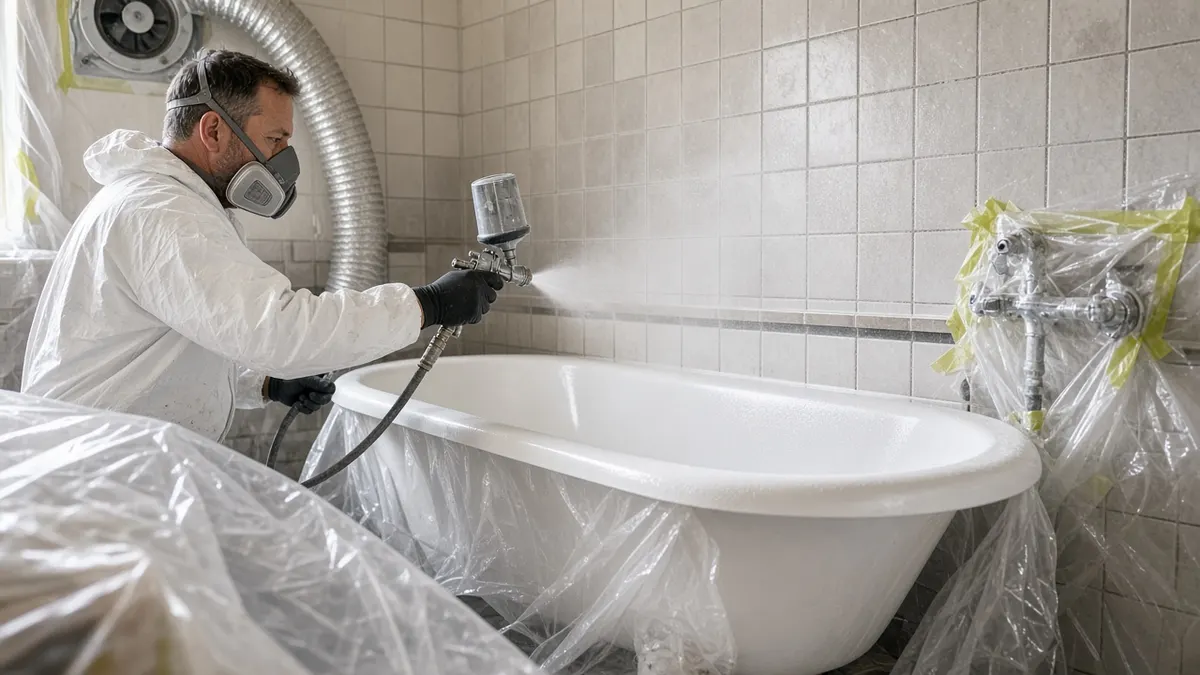
Resurfacing a standard built-in bath costs about $450 to $750 in Australia in 2026, and resurfacing a whole bathroom, meaning the bath, basin and all the wall and floor tiles, usually costs $1,500 to $4,500 including GST. That is a fraction of the $15,000-plus you would spend on a full renovation, which is why resurfacing is popular with landlords, people selling and anyone living with a pink, mint-green or beige bathroom from the 1970s or 80s.
The catch is that resurfacing is a coating. It changes the colour and covers wear, chips and stains, but it does not repair a leaking shower, failed waterproofing or a rotting floor. The prices below are indicative and assume surfaces in fair condition. Get at least three written quotes, and ask each resurfacer to look at the bathroom in person or from clear photos before they give you a firm number.
Typical resurfacing prices in 2026
Most resurfacers price per item, with a discount when you do several items in one visit because the setup, masking and extraction gear is the same. These are indicative ranges including GST for metro areas.
| Item | Indicative price | Notes |
|---|---|---|
| Standard built-in bath (1,500 to 1,675 mm) | $450 to $750 | Enamelled steel, cast iron or acrylic in fair condition |
| Spa bath | $650 to $1,000 | Jets masked or removed; larger surface |
| Freestanding or clawfoot bath | $700 to $1,300 | Price rises if the outside and feet are done too |
| Vanity basin | $200 to $400 | Cheaper when done with a bath |
| Shower base | $350 to $600 | Anti-slip additive in the final coat |
| Wall tiles | $40 to $80 per m² | Grout lines can be kept visible or coated over |
| Floor tiles | $50 to $90 per m² | Needs a slip-resistant finish; heavier wear |
| Laundry tub | $250 to $400 | Steel tubs coat well; plastic tubs are often cheaper to replace |
| Chip or crack repair | $80 to $300 | Per repair, depending on size and depth |
| Full bathroom package | $1,500 to $4,500 | Bath, basin, wall and floor tiles in a 4 to 7 m² room |
Expect a minimum call-out of roughly $300 to $450 if you only want one small item, such as a single basin. Most operators would rather book a bath plus a basin than a basin on its own, and they price accordingly.
What actually happens on the day
A professional resurfacing job is mostly preparation. Spraying the coating is quick; getting the surface ready to hold it is not. A typical bath and tile job looks like this:
- The resurfacer removes old silicone, soap scum and any loose grout, then deep cleans and degreases every surface.
- Glossy surfaces are etched or sanded so the primer can bond. On enamel this is often a mild acid etch; on acrylic and tiles it is usually mechanical sanding.
- Chips, cracks and drill holes are filled and sanded flush.
- Everything that is not being coated gets masked: tapware, the spout, walls, floor, vanity doors, the window.
- An extraction fan is set up to pull overspray and fumes out through the window or door.
- A bonding primer goes on, followed by two or three coats of a two-pack polyurethane or epoxy-based topcoat, sprayed with the room sealed.
- Masking comes off, and new silicone is applied once the coating has cured enough.
A bath on its own takes three to five hours. A full bathroom with tiles usually takes a full day, sometimes a day and a half if there are lots of repairs. Most coatings are touch-dry within a few hours, but you should not use the bath or shower for 24 to 48 hours. Your resurfacer will tell you the exact cure time for their product.
Resurfacing against replacing or renovating
The right choice depends on what is wrong with the bathroom. If it is purely cosmetic, resurfacing is hard to beat on price. If water is getting where it should not, it is the wrong tool.
| Option | Indicative cost (inc. GST) | Time | Best for |
|---|---|---|---|
| Resurface bath only | $450 to $750 | Half a day plus cure | Chipped, stained or dated colour bath in a sound bathroom |
| Replace built-in bath | $3,000 to $6,500 | 1 to 2 weeks | Cracked or rusted-through bath; involves plumbing, tiling and waterproofing |
| Resurface full bathroom | $1,500 to $4,500 | 1 to 2 days plus cure | Watertight room with a good layout and dated tiles |
| Regrout and reseal shower | $400 to $900 | 1 day | Cracked grout and failed silicone, no water damage behind |
| Full renovation | $15,000 to $45,000 | 3 to 5 weeks | Leaks, failed waterproofing, poor layout, rotten framing |
Replacing a built-in bath sounds simple, but the bath is set into the tiles and the membrane. Removing it breaks the waterproofing around the hob, so the job becomes plumbing, waterproofing and tiling. That is why a $500 resurface is so often the better answer for a bath that is sound but ugly. If you are leaning towards a full rebuild, our bathroom renovation cost guide shows the line items.
Prices around the country
Resurfacing is a small-crew trade, so travel and labour rates drive the difference between cities more than materials do. The coatings cost about the same everywhere.
| City | Standard bath | Full bathroom package |
|---|---|---|
| Sydney | $550 to $800 | $2,000 to $4,800 |
| Melbourne | $500 to $750 | $1,800 to $4,500 |
| Brisbane | $480 to $720 | $1,700 to $4,200 |
| Perth | $500 to $750 | $1,800 to $4,400 |
| Adelaide | $450 to $680 | $1,500 to $3,900 |
| Hobart | $450 to $700 | $1,500 to $4,000 |
| Canberra | $520 to $780 | $1,900 to $4,600 |
| Darwin | $550 to $850 | $2,000 to $5,000 |
In regional areas you may find a resurfacer who visits on set days each month. Booking into one of those runs can save a travel charge of $100 to $250.
Three sample jobs with real numbers
All amounts include GST and assume a metro operator.
Bath and basin in a Wollongong unit
A two-bedroom 1980s unit with a beige enamelled steel bath, a matching basin and white wall tiles in decent shape. The owner wants the bath and basin white before leasing it out.
| Item | Cost |
|---|---|
| Bath resurface | $580 |
| Basin resurface, combined-visit price | $260 |
| Two small chip repairs on the bath rim | $80 |
| Remove and replace silicone around bath and basin | $120 |
| Total | $1,040 |
Full mint-green bathroom in Elizabeth, Adelaide
A 1970s Housing Trust-style home with mint-green wall tiles to the ceiling, a matching bath with a shower over it, and a basin on a pedestal. The owners plan to sell within a year and want a neutral white room without the cost of a renovation.
| Item | Cost |
|---|---|
| Wall tiles, 18 m² at $55 per m² | $990 |
| Floor tiles, 4 m² at $70 per m² with anti-slip | $280 |
| Bath resurface | $520 |
| Basin resurface | $240 |
| Grout and silicone repairs | $180 |
| Filling old fixing holes and two cracked tiles | $150 |
| Total | $2,360 |
That is about one tenth of what a renovation of the same room would cost, and the job took a day and a half.
Ensuite shower and tiles in a Perth home
A 1990s ensuite with a tiled shower base, grubby grout and dated cream wall tiles. The owners noticed a damp patch on the hallway skirting and called a plumber first.
| Item | Cost |
|---|---|
| Licensed plumber to test for leaks (none found in the pipework) | $220 |
| Regrout and reseal shower recess | $650 |
| Shower base resurface with anti-slip | $480 |
| Wall tiles, 12 m² at $60 per m² | $720 |
| Vanity basin | $250 |
| Total | $2,320 |
The damp patch turned out to be failed silicone at the shower hob, which the regrout and reseal fixed. Had the plumber found water behind the tiles, coating over it would have been money wasted.
What moves the price up or down
Two bathrooms of the same size can get quotes $1,000 apart. These are the usual reasons.
- Surface condition. A bath with a few stains needs a clean and an etch. A bath with twenty chips, rust around the waste and an old DIY paint job that has to be stripped first can take twice as long.
- Previous coatings. If someone has already resurfaced the bath with a cheap kit, the old coating usually has to come off completely. Stripping adds $150 to $400 and sometimes more.
- Tile count and grout. Small mosaic tiles and lots of grout lines take longer to clean, repair and spray than large wall tiles. Some resurfacers charge more per m² for mosaics, and a few will not coat them at all.
- Colour. White and off-white are standard. Custom colours, speckled stone-look finishes or two-tone jobs cost extra because the operator has to mix and clean out the spray gear for each colour.
- Access and fumes. A small windowless ensuite is harder to ventilate. The operator may need ducting run to a door, which adds time.
- Travel. Outer suburbs and regional towns often attract a travel fee, and some operators set a minimum job value for distant areas.
Colour, finish and grout choices
Most people choose gloss white, which matches almost any new tapware and looks clean in listing photos. Satin and matte finishes are available from some operators but show water marks and soap scum more readily, and they tend to need more careful cleaning.
For tiles, you have two main options. The resurfacer can coat the whole wall in one colour, grout lines included, which gives a smooth, almost panel-like look. Or they can coat the tile faces and then re-colour the grout lines in a contrasting shade by hand, which takes longer and costs more but looks closer to new tiles. Ask to see both on a past job before deciding.
Stone-look and speckled finishes are popular for benchtops and vanity tops but can look dated quickly on walls. If you are resurfacing to sell, keep it plain.
A note for landlords and strata owners
Resurfacing suits rental properties well. It can be done between tenancies in a day or two, it costs less than a week of lost rent in many suburbs, and a fresh white bathroom photographs well for the next listing. Keep the invoice and warranty with the property records, since the work may be claimable as a repair or capital works deduction; ask your accountant which applies to your situation.
In strata buildings, check the by-laws before booking. Some owners corporations restrict spray work, require notice to neighbours or set work hours. The fumes can travel through shared exhaust ducts, so a resurfacer who has worked in apartment blocks before will know to seal and duct the room properly.
When resurfacing is the wrong call
Resurfacing is cosmetic. Skip it, or fix the underlying problem first, in these situations:
- Leaks or damp. Musty smells, bubbling paint on the other side of the wall, loose tiles or swollen skirting point to water escaping. A coating seals the face of the tile but not the substrate behind it. Get a licensed plumber to test first; our plumber cost guide covers leak detection prices.
- Drummy or loose tiles. Tap the tiles with a coin. A hollow sound means the adhesive has let go. Those tiles need re-fixing before any coating.
- Rust-through on a steel bath. Surface rust around the waste can be treated, but if the steel is perforated the bath needs replacing.
- Deep cracks in acrylic or fibreglass. Flexing cracks will telegraph through a new coating within months.
- A layout you hate. If the room does not work, a new colour will not change that.
Fumes, safety and the rules
Two-pack coatings used for resurfacing contain isocyanates or similar hardeners, which are strong respiratory sensitisers. A good operator wears a supplied-air or properly fitted respirator, sets up mechanical extraction and seals the room. You should still plan for everyone in the house, especially children, anyone with asthma and pets, to be out during spraying and for a few hours after. In a unit, tell the neighbours and the strata manager; fumes travel through shared ventilation.
Resurfacing on its own is not usually a licensed trade, but the rules can still catch the job. In Queensland, building work over $3,300 needs a QBCC licence, and in NSW residential building work over $5,000 needs a licensed contractor; a large resurfacing package with tile repairs can approach those figures. Check the current thresholds with the QBCC or NSW Fair Trading, or the regulator in your state.
Anything that involves the water supply or waste is plumbing work and must be done by a licensed plumber. That includes disconnecting or replacing tapware, removing a spout to coat behind it, changing a bath waste or fixing a leak. A resurfacer should mask around tapware, not pull it apart, unless they hold a plumbing licence.
Homes built before 1990 may have asbestos in wall sheeting behind tiles, in the floor underlay or in an old cistern. Resurfacing does not normally disturb these materials, but drilling, cutting or removing tiles can. If you are unsure, get a sample tested before any of that work starts.
Making the new finish last
A well-applied resurfacing coat lasts about 8 to 15 years. How you treat it decides which end of that range you get.
- Clean with a soft cloth and mild detergent. Abrasive creams, scourers and strong bleach dull and wear the coating.
- Do not leave rubber bath mats with suction cups in place. They trap water against the surface and can cause the coating to lift.
- Keep hair dye, nail polish remover and solvent cleaners well away from the bath.
- Fix dripping taps quickly. A constant drip in one spot wears the coating and leaves a stain.
- Run the exhaust fan during and after showers to reduce moisture on the tile coating.
Most resurfacers give a written warranty, often in the range of 3 to 10 years, against peeling and lifting caused by poor adhesion. It usually excludes damage from impacts, harsh chemicals and suction mats. Read the exclusions before you pay.
Checking the quote and the operator
A solid quote lists each item to be coated, the area of tiles in m², the coating system used (primer and topcoat), the number of coats, chip repairs, silicone replacement, cure time and the warranty in writing. It should also say whether grout lines will be kept visible or coated over.
Ask these questions before you book:
- How long have you been resurfacing, and can I see photos of jobs that are a few years old, not just freshly sprayed?
- What extraction and respiratory protection do you use?
- What exactly does the warranty cover, and is it in writing?
- Do you hold public liability insurance? Can I see the certificate?
- If the job is over the state licence threshold, what is your licence number?
Be wary of very cheap prices that skip etching or priming, cash-only deals and anyone who wants full payment upfront. A modest deposit is normal; paying the balance on completion is standard. You can compare local bath and basin resurfacers and ask each for a written quote on the same scope.
Ways to keep the bill down
Bundle items. A bath, basin and shower base done in one visit is cheaper than three separate bookings, because masking, setup and travel happen once.
Leave the floor if it is in good shape. Floor coatings take the most wear and cost more per m² than walls. A new set of floor tiles laid over a sound, flat floor is sometimes a better long-term choice; our tiler cost guide has current per-m² rates to compare.
Do the easy prep yourself. Clear the bathroom of everything, take down shower curtains, towel rails that unscrew easily and the mirror if it is not fixed in place, and clean the room thoroughly. Some operators knock a little off for a cleared, clean room. Replacing an old shower screen at the same time can also make the room look newly renovated; check shower screen installers near you for a separate quote.
How Yakka fits in
Resurfacing is specialist spray work, so you will want a dedicated resurfacer for the coating itself. Yakka Labour can help with the jobs around it: clearing out the bathroom and the hallway before the resurfacer arrives, removing an old shower screen or mirror, taking away rubbish and doing a thorough clean once the coating has cured.
Any plumbing, including moving or replacing tapware or fixing a leak found along the way, needs a licensed plumber. Yakka does not replace licensed trades, so book them separately and check their licence number with your state regulator.
Frequently asked questions
How much does it cost to resurface a bath in Australia?
Resurfacing a standard built-in bath costs about $450 to $750 in 2026, including GST. Spa baths are more, around $650 to $1,000, and freestanding or clawfoot baths run $700 to $1,300 depending on whether the outside is coated. Chip repairs add $80 to $300 each, and you can usually get a lower per-item price by doing the basin at the same visit.
How long does bath resurfacing last?
A professionally applied resurfacing coat usually lasts 8 to 15 years. Longevity depends on surface preparation and how the bath is treated. Avoid abrasive cleaners, suction-cup bath mats and solvents such as hair dye or nail polish remover. Fixing dripping taps and ventilating the room after showers also help the coating last longer.
Can you resurface bathroom tiles instead of replacing them?
Yes. Wall tiles can be resurfaced for roughly $40 to $80 per m², and floor tiles for $50 to $90 per m² with a slip-resistant finish. Tiles must be firmly fixed, and any leaks must be repaired first. Resurfacing changes the colour and finish but does not improve waterproofing, so it suits watertight bathrooms with dated tiles.
Is bath resurfacing safe?
It is safe when done properly. The two-pack coatings give off strong fumes while being sprayed, so a good operator uses mechanical extraction and a respirator and seals the room. Everyone in the house, including pets, should stay out during spraying and for a few hours after. Once cured, the coating is inert and safe for normal use.
How soon can I use the bath after resurfacing?
Most coatings need 24 to 48 hours before the bath or shower can be used. The surface is usually touch-dry within a few hours, but it continues to harden over several days. Your resurfacer will confirm the cure time for their product. Using it too early can leave marks or cause the coating to lift.
Do I need a licence to resurface a bathroom?
Resurfacing is not usually a licensed trade on its own, but larger jobs can fall under state building licence thresholds, such as $3,300 in Queensland and $5,000 in NSW for residential building work. Any work on tapware, wastes or water supply must be done by a licensed plumber. Check the current threshold with your state regulator.
Is it worth resurfacing a bathroom before selling?
Often, yes. A dated coloured bathroom can put buyers off, and resurfacing the bath, basin and tiles for $1,500 to $4,500 gives a clean, neutral look in a day or two. It is far cheaper than a renovation. It will not hide water damage from a building inspector, though, so fix any leaks first.
Official sources
Award rates, licences and safety rules change. Check the official source before you hire or take on a shift.
- Queensland Building and Construction Commission (QBCC)Contractor, plumbing and drainage licence search in Queensland
- NSW Fair TradingTrade licence checks for electricians, plumbers and builders in New South Wales
- Asbestos Safety and Eradication AgencyWhere asbestos is found in homes and how to deal with it safely