Exterior cost guide
How Much Does a Roof Replacement Cost in Australia? (2026)
Typical cost in Australia (2026, inc. GST)
$18,000 to $45,000 per job
full re-roof of a single-storey home with about 200 m² of roof
A full roof replacement on a typical Australian home costs about $18,000 to $45,000 in 2026, or roughly $85 to $250 per m². Metal-to-metal re-roofs sit at the low end, tile-to-tile and tile-to-Colorbond in the middle, and asbestos or terracotta jobs at the top. Storeys, scaffold, rotten battens, gutters and disposal decide where your house lands.
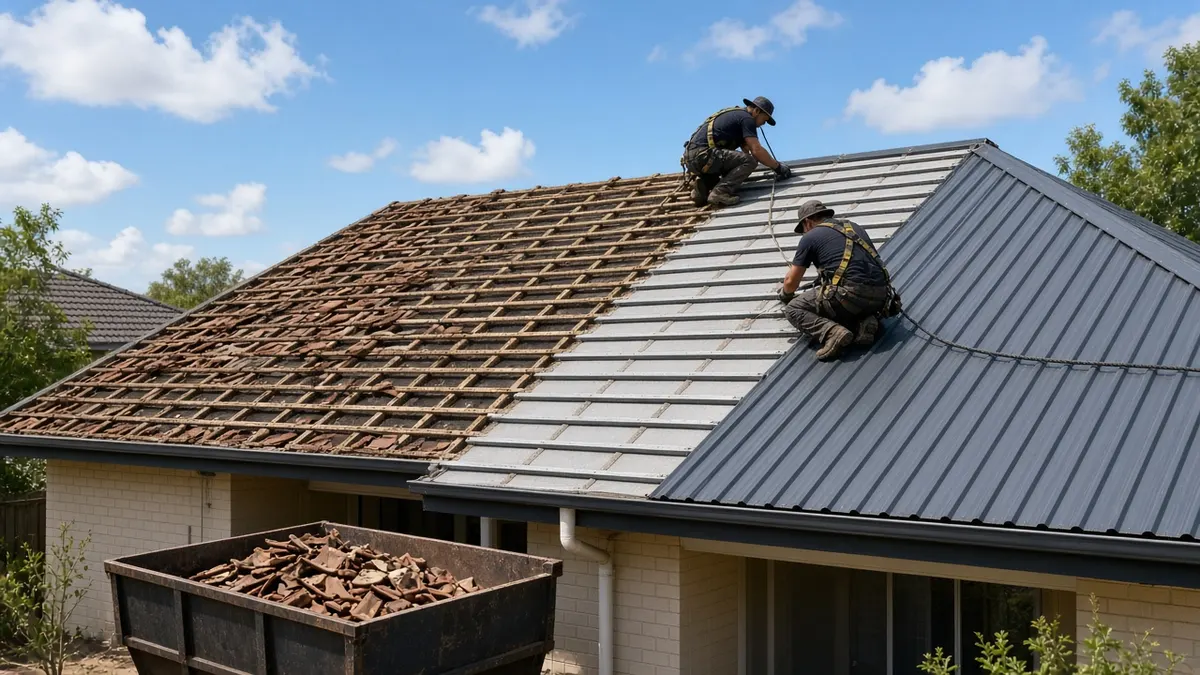
Replacing the roof on an average Australian house costs between $18,000 and $45,000 in 2026. That works out to about $85 to $250 per square metre once stripping, disposal, new battens, the new roof covering, flashings and safety equipment are all counted.
This guide is about a full re-roof: the old roof comes off completely and a new one goes on. If your roof only needs cleaning, repairs and a fresh coating, that is a restoration and costs a fraction of the price, covered in the roof restoration cost guide. If you have already decided on steel and want profile and colour details, read the Colorbond roofing cost guide.
Figures here are indicative, include GST and assume standard suburban access. Re-roofs vary a lot from house to house, so get at least three written quotes, ideally after each roofer has been up on the roof or into the roof space.
Re-roof prices by what comes off and what goes on
The two biggest decisions are what you are removing and what you are replacing it with. Removing old steel is quick and the scrap is worth a little. Removing tiles is heavy and slow. Removing asbestos is a licensed job with its own rules and tip fees.
| Old roof to new roof | Price per m² | Typical 200 m² home |
|---|---|---|
| Old metal to Colorbond | $85 to $140 | $17,000 to $28,000 |
| Concrete or terracotta tiles to Colorbond | $100 to $170 | $20,000 to $34,000 |
| Concrete tiles to new concrete tiles | $110 to $180 | $22,000 to $36,000 |
| Tiles to new terracotta tiles | $150 to $250 | $30,000 to $50,000 |
| Asbestos cement sheet to Colorbond | $140 to $250 | $28,000 to $50,000 |
| Slate re-roof (heritage) | $300 to $500 | $60,000 to $100,000 |
A two-storey house usually adds $3,000 to $8,000 for scaffold. New gutters and downpipes add another $3,000 to $6,000 on a typical home if they are not already in the quote.
Where the money goes on a re-roof
Here is roughly how a $28,000 tile-to-Colorbond re-roof on a 200 m² single-storey home breaks down. The split changes from job to job, but the pattern holds: materials are well under half the bill.
| Component | Share of total | Approximate cost |
|---|---|---|
| Strip-out labour | 10% to 12% | $2,800 to $3,400 |
| Waste removal and tip fees | 5% to 7% | $1,400 to $2,000 |
| Battens, sarking or blanket | 15% to 18% | $4,200 to $5,000 |
| Roof sheets, capping, flashings, fixings | 30% to 35% | $8,400 to $9,800 |
| Installation labour | 25% to 30% | $7,000 to $8,400 |
| Edge protection or scaffold | 6% to 8% | $1,700 to $2,200 |
That is why cheap quotes are rarely cheap on materials. They save on labour, by bringing a smaller crew or skipping steps such as replacing battens, or on safety, by leaving out edge protection. Ask each roofer to break their price down this way so you can see where the difference is.
Replace or restore: how to tell
Most tiled roofs do not need replacing. Concrete and terracotta tiles last for decades, and a restoration at $4,500 to $11,000 often buys another 15 to 20 years. Replacement makes sense when the roof covering itself is finished, not when it is just tired.
Signs you are looking at a replacement:
- Steel sheets with rust holes right through them, especially along laps, at gutters and around fixings. Surface rust alone can usually be treated.
- Concrete tiles that are soft, crumbling or snapping when walked on, which happens to some old tiles once the surface has worn away.
- Timber battens that are split, rotten or undersized, so tiles are slipping across large areas.
- A sagging roofline, which points to frame problems that need fixing with the covering off.
- Asbestos cement roofing that is weathered, cracked or damaged.
- Repeated leaks in different places despite repairs.
If only a few tiles are cracked and the ridge pointing is loose, that is repair or restoration work. A building inspection before you decide can save you from either overspending or patching a roof that is past it.
The extras nobody can see until the roof is off
A roofer can estimate the roof covering from the ground, and a good one will check the roof space. Some problems still only appear once the old roof is stripped, so a sensible quote lists rates for them in advance.
| Hidden item | Typical rate | How common |
|---|---|---|
| Replace rotten or split battens | $15 to $30 per linear metre | Very common on homes over 40 years old |
| Replace or sister a damaged rafter | $150 to $400 each | Occasional, more likely near old leaks |
| Replace rotten fascia board | $40 to $90 per linear metre | Common where gutters overflowed |
| Remove and refit solar panels (licensed electrician) | $1,000 to $3,000 per system | Any home with panels |
| Replace old insulation in roof space | $15 to $30 per m² | Optional, easy to do while open |
| Repair water-damaged ceilings | $300 to $1,500 per room | Where old leaks were left too long |
Old electrical cabling in the roof space is worth checking too. If an electrician spots brittle rubber-insulated wiring while the roof is open, it is cheaper to deal with it now than after the new roof and insulation go in.
Asbestos roofs: a separate budget
Corrugated asbestos cement roofing, often called fibro or by trade names such as Super Six, was common on Australian homes, sheds and garages until the mid-1980s. Asbestos was banned in Australia from the end of 2003. If your house was built before about 1990 and has grey corrugated sheeting, assume it contains asbestos until a lab test says otherwise.
Under WHS laws across Australia, removing more than 10 m² of non-friable asbestos must be done by a licensed removalist, and a whole roof is always well over that. Removal on a typical home roof costs about $40 to $70 per m² including disposal at a licensed facility and a clearance certificate, so roughly $6,000 to $14,000 on its own. The asbestos removal cost guide goes into how removalists price the work. Safe Work Australia's asbestos guidance explains the rules, and they apply to homeowners as well as trades.
Never let anyone pressure clean, sand, cut or walk carelessly on an asbestos roof. Water blasting asbestos cement is prohibited under WHS regulations because it spreads fibres across your yard and your neighbours' yards.
Picking the replacement material
A re-roof is the one chance in 40 or 50 years to change what is on top of your house. The choice usually comes down to the frame, the look and the long-term upkeep. For new-roof prices per m² across every common material, see the roofing cost guide.
The frame. Going from heavy to light is easy. Concrete tiles to steel takes weight off rafters that may have been carrying tiles for 50 years, and a roofer simply changes the batten spacing. Going the other way, from steel to tiles, is a different matter. A frame designed for a light roof may not be strong enough for tiles, so you would need an engineer to check it and possibly extra timber, which can add thousands. Few people do it.
The look. Some streets, estates and heritage areas expect tiles, and a steel roof can look out of place on a Federation or Spanish Mission home. Terracotta re-roofs on character homes cost more, but they suit the house and hold value. On a 1970s or 1980s brick veneer, steel rarely looks wrong.
Upkeep. A new tiled roof still has mortar or pointing at the ridges and hips, and a surface finish that weathers. A steel roof has screws and flashings to check, and that is about all. Over 30 years the maintenance gap adds up to several thousand dollars in favour of steel.
| Material | Weight on the frame | Main ongoing cost | Suits |
|---|---|---|---|
| Colorbond steel | Light | Gutter cleaning, occasional screw and flashing check | Most homes, low pitches, bushfire and cyclone areas with the right details |
| Concrete tiles | Heavy | Ridge repointing and recoating every 15 to 25 years | Homes built for tiles, estates that require them |
| Terracotta tiles | Heavy | Ridge repointing, colour does not fade | Character and heritage homes |
| Slate | Very heavy | Specialist repairs, very long life | Heritage homes already roofed in slate |
Living at home while the roof is replaced
Most families stay at home during a re-roof. It is noisy from about 7 am, and there is dust, especially when old tiles and battens come off and decades of grime drop into the roof space. Cover beds and furniture in rooms below the section being stripped, and take anything valuable out of the roof space and garage. Downlight holes and manholes let dust into rooms, so a cheap roll of plastic and some tape helps.
Keep children and pets away from the drop zone under the roof edge, and leave a clear path for the skip or truck. Tell your neighbours before work starts, as the crane truck or skip may block the street for a few hours on the first and last days.
Re-roof costs by state and city
| Location | Tile to Colorbond, per m² | Metal to metal, per m² | Notes |
|---|---|---|---|
| Sydney | $115 to $175 | $95 to $150 | Two-storey homes and tight lots push scaffold costs up |
| Melbourne | $105 to $165 | $90 to $140 | Steel roofing is licensed roof plumbing in Victoria |
| Brisbane | $100 to $160 | $85 to $135 | High-set homes need taller edge protection |
| Perth | $100 to $160 | $85 to $135 | Many tiled 1970s and 1980s homes reaching end of life |
| Adelaide | $95 to $150 | $80 to $125 | Lower labour rates |
| Hobart | $100 to $160 | $85 to $135 | Fewer crews, weather delays |
| Canberra | $110 to $170 | $90 to $145 | Check older homes against the ACT loose-fill asbestos register first |
| Darwin | $130 to $200 | $110 to $170 | Cyclone tie-downs, freight, wet season |
Three re-roofs, line by line
Concrete tiles to new concrete tiles, Morley, Western Australia
A 1980s single-storey brick and tile home, 220 m² of roof, hip and valley design. The owners wanted to keep the tiled look.
| Item | Cost |
|---|---|
| Strip old tiles and battens | $3,300 |
| Disposal of tiles and timber | $1,600 |
| New battens and sarking | $4,400 |
| Concrete tiles and fixings | $8,800 |
| Ridge and hip bedding with flexible pointing | $2,600 |
| Valley irons and flashings | $1,300 |
| Laying labour | $7,000 |
| Edge protection | $1,800 |
| Total including GST | $30,800 |
About $140 per m². Tile-to-tile costs more than tile-to-steel here because the frame and battens must suit tile loads and laying is slower.
Two-storey metal re-roof, Merewether, Newcastle
A two-storey home 2 km from the beach, 260 m² of rusted steel roof, a short box gutter at the rear, gutters replaced at the same time.
| Item | Cost |
|---|---|
| Scaffold, about four weeks | $5,500 |
| Remove old sheets and scrap | $2,600 |
| Batten repairs (allowance) | $1,200 |
| Coastal-grade sheets, blanket and fixings | $13,000 |
| Capping, flashings and box gutter section | $3,400 |
| New gutters and downpipes | $4,200 |
| Installation labour | $9,800 |
| Total including GST | $39,700 |
About $153 per m² all in, higher than the metal-to-metal range above because scaffold, gutters and the box gutter are included. Take out the scaffold and gutters and the roof itself is about $30,000, or $115 per m².
Old iron to Colorbond on a high-set Queenslander, Ipswich
A timber Queenslander on stumps, 180 m² of original galvanised iron, simple gable and verandah roofs.
| Item | Cost |
|---|---|
| Remove iron and scrap | $1,800 |
| Replace 40 lm of rotten battens | $900 |
| Colorbond corrugated, blanket and fixings | $8,600 |
| Capping and flashings | $1,500 |
| Installation labour | $6,400 |
| Scaffold and edge protection for high-set home | $3,000 |
| Total including GST | $22,200 |
About $123 per m². A QBCC-licensed contractor is required at this value, and Queensland home warranty cover applies to residential work above the QBCC threshold.
Approvals, contracts and home warranty insurance
A like-for-like re-roof normally does not need a development application. You may need council approval if you change the roof shape or height, add a dormer, or live in a heritage conservation area where a change from tiles to steel affects the streetscape. Call your council before you sign if your house is heritage-listed or in a heritage area.
A re-roof is large enough to bring in consumer protection rules in most states:
- NSW: a written contract is required for residential building work over $5,000, and home building compensation cover is required for work over $20,000. Deposits are capped at 10%. The NSW Fair Trading website has a licence check tool.
- Victoria: major domestic building contracts need a registered builder, and domestic building insurance is required above the current threshold. Steel roofing must be done by a licensed roof plumber, who issues a compliance certificate.
- Queensland: work over $3,300 needs a QBCC licence and is generally covered by the QBCC Home Warranty Scheme. Contract and deposit rules apply above set values.
- Other states and territories: check the current thresholds for licensing, contracts and warranty insurance with Building and Energy (WA), Consumer and Business Services (SA), CBOS (Tasmania), Access Canberra or the NT Building Practitioners Board.
Bushfire-prone land adds another layer. A new roof should meet the bushfire attack level for the site under AS 3959, which affects sarking, ember guards and gaps at the eaves and ridge.
What happens day by day
A typical single-storey re-roof with a two or three person crew runs about a working week:
- Day 1: edge protection or scaffold goes up, skip or truck arrives, and the crew starts stripping one side of the roof.
- Days 2 to 3: strip-out continues section by section. Battens and rafters are checked and repaired, sarking or blanket goes on, and new sheets or tiles are fixed on the stripped areas before the end of each day.
- Days 4 to 5: remaining sections are finished, hips, ridges and flashings go on, penetrations are sealed and gutters are fitted.
- Final day: clean-up, swarf removal on steel roofs, magnet sweep for nails in the yard, handover and paperwork.
Two-storey homes, asbestos removal and wet weather all stretch this out. Expect noise and dust inside, so move valuables out of the roof space and cover anything stored in the garage.
Insurance, storms and who pays
Home insurance generally covers sudden storm, hail or fallen-tree damage, and some policies will fund a full re-roof if the damage is widespread. Insurers do not pay for wear and tear, rust, or a roof that was already failing. If your roof was damaged in a storm, photograph everything, lodge the claim before arranging permanent work, and let the insurer's assessor see the damage. Temporary tarping to stop water getting in is normally fine and is usually claimable.
Be wary of door-knockers after a storm who offer to "deal with the insurance" for you in exchange for signing up on the spot. Use a licensed roofer you have checked yourself.
Comparing quotes properly
When three re-roof quotes land, line them up against these points:
- Same roof area in m², and the same material, grade, thickness or tile range.
- Batten replacement: included in full, included as an allowance, or extra per metre.
- Sarking or blanket type and R-value.
- Scaffold or edge protection included and for how long.
- Gutters, downpipes, fascia, solar removal and asbestos removal: in or out.
- Waste disposal and site clean-up.
- Licence number, insurance, home warranty certificate where required, and workmanship warranty length.
- Payment schedule tied to stages, with the deposit within your state's limit.
The cheapest quote is often missing one of these lines. The most expensive is not always the best either, so ask each roofer to explain their price.
Bringing the cost down sensibly
- Switch heavy tiles to steel if your frame and style suit it. It usually costs less than tile-to-tile and reduces long-term maintenance.
- Combine work while the scaffold is up: gutters, fascia, skylights, insulation and solar all cost less to do now than later.
- Keep sound gutters rather than replacing them by default.
- Book in the quieter months for your area. Outside storm season, crews are more flexible on price and start dates.
- Clear the site yourself before the crew arrives so you are not paying roofers to move cars, bikes and pot plants.
Where Yakka can lend a hand
Re-roofing generates a lot of heavy, unskilled work around the licensed part of the job. Through Yakka you can book labourers by the shift to clear the yard and garage before the crew arrives, carry old tiles or sheets to the skip, clean the roof space if you are adding new insulation, and do the final tidy-up once the scaffold is gone. Roofers are listed on the platform too, so you can find a roofer near you and arrange scaffolding or skip and truck hire for the old roof.
Labourers do not do licensed roofing, roof plumbing or asbestos removal. Keep a licensed roofer in charge of the roof, a licensed removalist on any asbestos, and check every licence yourself.
Frequently asked questions
How much does it cost to replace a roof per m2 in Australia?
Most full re-roofs cost $85 to $250 per m² in 2026. Old metal to new Colorbond is the cheapest at about $85 to $140 per m². Tiles to Colorbond costs about $100 to $170, tiles to new tiles about $110 to $180, and asbestos or terracotta jobs run higher. Scaffold for two-storey homes and new gutters are often extra.
How much does it cost to re-roof a 3 bedroom house?
A typical three-bedroom single-storey home has about 180 m² to 220 m² of roof. A full re-roof usually costs $18,000 to $35,000 for metal or tile-to-Colorbond jobs, and up to $45,000 or more for tile-to-tile, terracotta or asbestos roofs. Two-storey homes cost more because of scaffold and slower access.
Is it cheaper to restore or replace a roof?
Restoring is much cheaper, usually $4,500 to $11,000 for a single-storey home compared with $18,000 or more to replace. Restoration only makes sense if the roof covering is still sound. If steel is rusted through, tiles are crumbling, battens are rotten or there is asbestos, replacing the roof is usually the better long-term spend.
Does home insurance pay for a new roof?
Home insurance usually covers sudden damage from storms, hail or fallen trees, and may pay for a full replacement if the damage is extensive. It does not cover rust, worn-out tiles, poor maintenance or general age. Photograph the damage, lodge your claim quickly and let the assessor inspect before permanent repairs are done.
Do I need council approval to replace my roof?
A like-for-like roof replacement generally does not need council approval. You may need it if you change the roof shape, pitch or height, add dormers, or live in a heritage-listed home or heritage conservation area where changing from tiles to steel affects the streetscape. Check with your council before signing a contract.
How long does a roof replacement take?
Most single-storey re-roofs take four to eight working days for a crew of two or three. Two-storey homes, complex roof shapes, asbestos removal and rotten battens can add several days. Rain stops work, so allow extra time in wet months. A good crew strips and covers one section at a time so the house is never left open overnight.
How often should a roof be replaced in Australia?
Colorbond and other steel roofs commonly last 30 to 50 years. Concrete tiles can last 50 years or more, although ridge pointing and coatings need attention every 15 to 25 years. Terracotta and slate can last far longer. Replace when the covering itself fails, not because of age alone. Regular maintenance pushes replacement further out.
Official sources
Award rates, licences and safety rules change. Check the official source before you hire or take on a shift.
- Safe Work AustraliaNational work health and safety framework, including high-risk work licences
- Queensland Building and Construction Commission (QBCC)Contractor, plumbing and drainage licence search in Queensland
- Consumer and Business Services SALabour hire licensing in South Australia
- NSW Fair TradingTrade licence checks for electricians, plumbers and builders in New South Wales
- Asbestos Safety and Eradication AgencyWhere asbestos is found in homes and how to deal with it safely
- Consumer, Building and Occupational Services (Tasmania)Building, plumbing and electrical licensing in Tasmania