More cost guide
Smoke Alarm Installation Cost 2026: Australian Prices and State Rules
Typical cost in Australia (2026, inc. GST)
$80 to $350 per alarm
low end a 10-year lithium battery alarm fitted; high end a hardwired alarm in a new position installed by a licensed electrician
Smoke alarm installation in Australia costs about $80 to $150 per alarm for a 10-year lithium battery unit and $150 to $350 per alarm for a hardwired unit installed by a licensed electrician in 2026. Bringing a three-bedroom home up to an interconnected photoelectric standard typically costs $450 to $1,600. Alarm type, interconnection, new wiring, ceiling access and your state's rules drive the price.
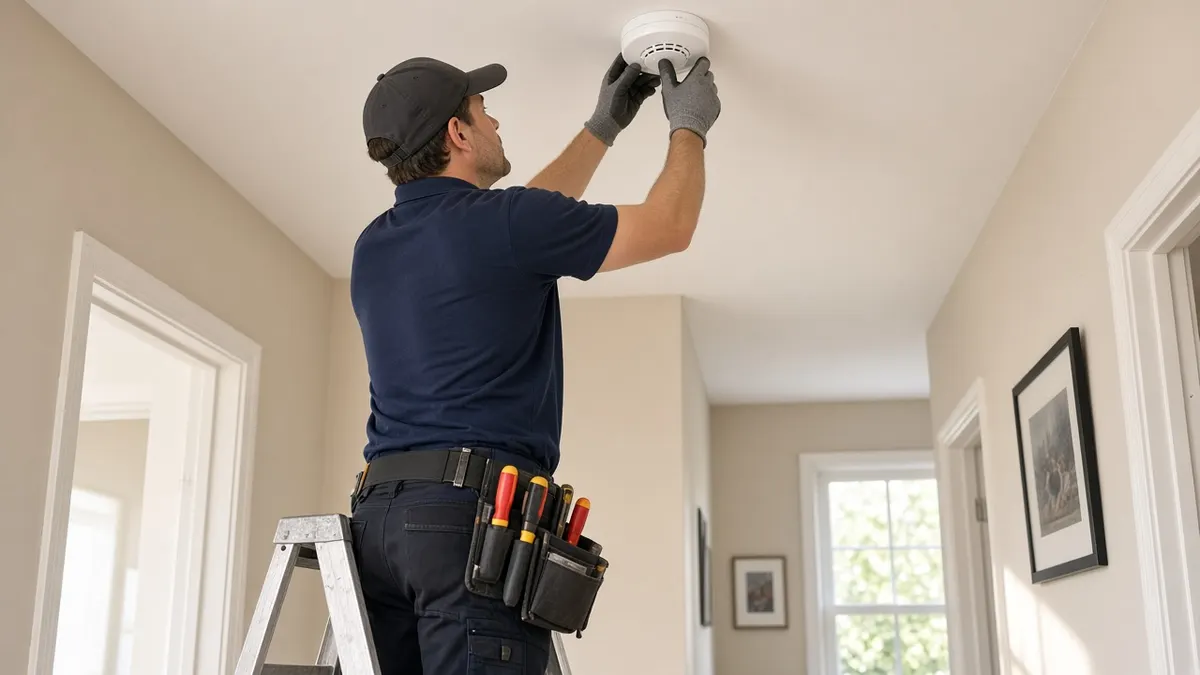
A smoke alarm costs roughly $80 to $150 per unit to install if it is a 10-year lithium battery model, and $150 to $350 per unit if it is hardwired by a licensed electrician, in 2026 prices. A whole-home upgrade to interconnected photoelectric alarms in a three-bedroom house usually lands between $450 and $1,600, depending on whether you choose hardwired or battery units and how many new positions need cable.
The rules matter as much as the price. Queensland is part-way through a phased change that requires interconnected photoelectric alarms in every home by 1 January 2027, and other states have their own requirements for new homes, rentals and sales. This guide covers alarm types and prices, whole-home totals, three costed examples, what each state requires as far as the rules are clear, and who is allowed to install what. Prices include GST and are indicative. Get at least three written quotes, and check the current rules with your state fire service or regulator.
Smoke alarm prices at a glance
| Job | Typical price per alarm (inc GST) | Who can install it |
|---|---|---|
| 10-year lithium photoelectric alarm, supplied and fitted | $80 to $150 | Anyone competent; no electrical licence needed |
| 10-year lithium alarm with wireless interconnection, fitted | $110 to $190 | No electrical licence needed for battery units |
| Hardwired alarm, like-for-like replacement | $120 to $220 | Licensed electrician |
| Hardwired alarm with wireless interconnect module, replacement | $150 to $260 | Licensed electrician |
| Hardwired alarm in a new position, new cable | $180 to $350 | Licensed electrician |
| Heat alarm for a kitchen or garage (hardwired) | $150 to $280 | Licensed electrician |
| Annual landlord compliance check, per property | $80 to $150 per year | Compliance company or electrician |
Most electricians also charge a call-out fee of $80 to $150, so one alarm on its own costs more per unit than five done together. Per-alarm figures in the table above assume several alarms on the same visit.
Battery, 10-year lithium or hardwired
Replaceable 9 volt battery alarms
The old style with a battery you change every year. Units cost $15 to $40, but most fire services now recommend against them because flat or removed batteries are a common reason alarms fail. Many states no longer accept them for rentals or new work.
Sealed 10-year lithium battery alarms
The battery is built in and lasts the life of the alarm, which is usually ten years. When it runs out, the whole unit is replaced. Units cost $30 to $70, or $60 to $120 with wireless interconnection. Because there is no fixed wiring, fitting one is not electrical work, and a handyman or the homeowner can screw it to the ceiling.
Hardwired 240 volt alarms
Connected to the home's lighting circuit with a backup battery inside. Units cost $50 to $120, or $90 to $180 with a wireless interconnect module. Installing, replacing or relocating them is fixed electrical work, so a licensed electrician must do it. Many states require hardwired alarms in newer homes, and in Queensland an existing hardwired alarm must be replaced with another hardwired alarm.
| Type | Unit cost | Lifespan | Main advantage | Main drawback |
|---|---|---|---|---|
| 9 volt replaceable battery | $15 to $40 | Up to 10 years, battery yearly | Cheap | Batteries go flat or get removed |
| 10-year sealed lithium | $30 to $70 | About 10 years | No wiring, no battery changes | Whole unit replaced when battery ends |
| 10-year lithium, wireless interconnected | $60 to $120 | About 10 years | All alarms sound together without new cable | Must stay within one brand's system |
| Hardwired 240 volt with backup | $50 to $120 | About 10 years | Mains power, required in many newer homes | Needs a licensed electrician |
| Hardwired with wireless interconnect | $90 to $180 | About 10 years | Mains power plus easy interconnection | Highest unit price |
Photoelectric or ionisation?
There are two main sensing types. Ionisation alarms react quickly to fast flaming fires but are slower to detect the smouldering, smoky fires that often start at night in furniture and bedding. They are also more prone to false alarms from cooking. Photoelectric alarms detect visible smoke particles and respond better to smouldering fires. Fire services across Australia recommend photoelectric alarms, and Queensland requires them under its new rules.
If your home still has ionisation alarms, often labelled with a radiation symbol, replacing them with photoelectric units is a sensible upgrade even if your state does not force it. Combined photoelectric and ionisation units exist but do not meet Queensland's requirement for alarms that do not contain an ionisation sensor.
Interconnection: wired or wireless
Interconnected alarms all sound together. If a fire starts in the lounge room at 2 am, the alarm in the bedroom at the other end of the house goes off too, instead of waiting for smoke to travel down the hallway. It is one of the most useful upgrades you can make.
There are two ways to do it. Hardwired interconnection runs an extra conductor between alarms through the ceiling, which works well in new builds and homes with easy roof space access. Wireless interconnection uses radio modules built into or added to each alarm, so the units talk to each other without new cable. In existing homes, wireless is usually cheaper and quicker, especially in two-storey houses, slab homes with no roof space and apartments. The trade-off is that you are tied to one manufacturer's system, so replacement alarms must be compatible.
Smoke alarm rules by state
Every state requires working smoke alarms in homes, but the details differ. What follows is limited to the points that are well established. Rules change, and the official guidance always takes priority over this summary.
Queensland
Queensland's rules are the strictest in the country. Under the phased requirements, smoke alarms in homes must be photoelectric, must not also contain an ionisation sensor, must be hardwired or powered by a non-removable 10-year battery, and must be interconnected with every other alarm in the home. They must be installed on every storey, in every bedroom, in hallways that connect bedrooms to the rest of the home, and if there are no bedrooms on a storey, in the most likely path of travel to the exit. The rules applied to new and substantially renovated homes first, then from 1 January 2022 to homes being sold or leased, and from 1 January 2027 they apply to all homes. If you are replacing an existing hardwired alarm, the new one must also be hardwired. The Queensland Fire Department smoke alarm page has the current requirements and placement diagrams.
With the 2027 deadline close, Queensland electricians are busy. If you own a home in Queensland that does not comply yet, book early rather than in December.
New South Wales
Since 2006, NSW has required at least one working smoke alarm on every level of a home. Landlords have specific duties under the residential tenancy laws to check, repair and replace alarms. Fire and Rescue NSW recommends photoelectric alarms that are interconnected. NSW Fair Trading publishes the landlord obligations.
Victoria
Victorian homes must have smoke alarms on every storey, and homes built after 1 August 1997 must have hardwired alarms. Rental providers have smoke alarm safety check duties under the rental minimum standards. Consumer Affairs Victoria explains what landlords must do, and Fire Rescue Victoria and the CFA publish placement advice.
Western Australia
WA requires compliant mains-powered smoke alarms to be installed before a home is sold, rented or hired, with limited situations where battery alarms are allowed. Alarms that are too old must be replaced. The exact requirements are administered through Building and Energy and local governments, and DFES publishes guidance.
South Australia, Tasmania, the ACT and the Northern Territory
These jurisdictions each set their own requirements for new homes, rentals and sales, including when hardwired alarms are needed. Check with the SA Metropolitan Fire Service or Country Fire Service, Tasmania Fire Service, ACT Fire and Rescue or Access Canberra, and NT Fire and Rescue Service before you buy alarms, sell or sign a lease.
Where alarms go, and where they should not
Placement decides whether an alarm wakes you in time. The general approach used by fire services is an alarm in every bedroom, in hallways outside sleeping areas, and on every level, including near the bottom of the stairs in a two-storey home. Living areas are worth covering too, because many night-time fires start in the lounge room.
Alarms work best on the ceiling, away from corners and the dead air space where wall meets ceiling. On a raked or cathedral ceiling, the installer follows the manufacturer's instructions and the relevant standard for distance from the apex. Avoid putting a smoke alarm right outside a bathroom, where steam sets it off, or directly beside a kitchen, where toast and frying cause false alarms that tempt people to pull the battery. In those spots, a heat alarm is often the better choice, and it can be interconnected with the smoke alarms so it still triggers the whole system. Keep alarms clear of ceiling fans, air conditioner outlets and supply vents, which can blow smoke away from the sensor.
Buying, selling and renovating
Smoke alarms often come up during a property transaction. In Queensland, homes being sold or leased already need to meet the new requirements, and sellers usually disclose smoke alarm compliance in the contract. In Western Australia, the mains-powered alarm rules apply before settlement for a sale. Elsewhere, a building and pest inspection may note old or missing alarms, which can become part of the negotiation.
If you are renovating, adding new rooms or substantially changing the layout, the new work usually has to meet the current building code requirements for smoke alarms, which in practice means hardwired, interconnected alarms in the right locations. Your builder or certifier will flag this, and it is cheaper to wire alarms while ceilings are open than to retrofit later. Ask your electrician to price the alarms into the renovation quote rather than adding them at the end.
Whole-home costs
These totals assume interconnected photoelectric alarms in every bedroom, hallway and storey, with the call-out included. The battery column uses wireless 10-year lithium units. The hardwired column uses hardwired units with wireless interconnect modules, with new cable where needed.
| Home | Typical alarms | 10-year battery, interconnected | Hardwired, interconnected |
|---|---|---|---|
| Two-bedroom unit | 3 | $300 to $550 | $550 to $1,000 |
| Three-bedroom single storey | 4 to 5 | $450 to $900 | $900 to $1,600 |
| Four-bedroom single storey | 5 to 6 | $550 to $1,100 | $1,100 to $1,900 |
| Four-bedroom two storey | 7 to 8 | $650 to $1,300 | $1,500 to $2,600 |
A mix is common and often makes sense. Existing hardwired positions are replaced with hardwired units, and new positions such as bedrooms get compatible 10-year lithium units that join the same wireless network. That keeps the price down while meeting rules like Queensland's, as long as every alarm is the right type and interconnected.
Three homes, costed
Queensland upgrade in a Logan lowset
A three-bedroom 1980s brick lowset with two old hardwired ionisation alarms in the hallway. The owners need five interconnected photoelectric alarms: one in each bedroom, the hallway, and one near the living area exit path. Two options were quoted.
| Item | All hardwired (inc GST) | Mixed hardwired and battery (inc GST) |
|---|---|---|
| Call-out fee | $100 | $100 |
| Labour at $110 per hour | $495 (4.5 hours) | $275 (2.5 hours) |
| Hardwired alarms with wireless interconnect at $110 | $550 (5 units) | $220 (2 units) |
| Compatible 10-year lithium interconnected alarms at $85 | None | $255 (3 units) |
| Cable and sundries | $60 | $20 |
| Total | $1,205 | $870 |
Both options meet the Queensland requirements as described above, provided the products are compliant and all five alarms are interconnected. The all-hardwired option costs more but avoids sealed batteries in the bedrooms running out in ten years.
Expired alarms in a Reservoir rental, Victoria
A 2000s two-bedroom unit with two hardwired alarms more than ten years old. The rental provider asks an electrician to replace them like for like with hardwired photoelectric units.
| Item | Cost (inc GST) |
|---|---|
| Call-out fee | $100 |
| Labour, 1 hour at $105 | $105 |
| 2 hardwired photoelectric alarms at $70 | $140 |
| Total | $345 (expect $300 to $450) |
Two-storey family home in Gungahlin, ACT
A four-bedroom two-storey home with three older hardwired alarms. The owners are not legally required to upgrade but choose to: seven hardwired photoelectric alarms with wireless interconnection, covering every bedroom, both hallways, the stair landing and the living area.
| Item | Cost (inc GST) |
|---|---|
| Call-out fee | $110 |
| Labour, 7 hours at $120 | $840 |
| 7 hardwired alarms with interconnect modules at $110 | $770 |
| Cable and sundries | $80 |
| Total | $1,800 (expect $1,600 to $2,400) |
Running new cable to the downstairs bedrooms in a two-storey home is the slow part, because there is a floor above rather than a roof space.
Who can install which alarms
Hardwired smoke alarms are fixed electrical work. Installing, replacing or moving them must be done by a licensed electrician in every state and territory, and you should receive the compliance paperwork your state requires. No homeowner or unlicensed handyman can legally connect one, even as a like-for-like swap on an existing plug-in base.
Battery-powered alarms, including sealed 10-year lithium units, are not connected to fixed wiring, so fitting one does not need an electrical licence. A competent handyman can install them, and so can a homeowner who is comfortable on a ladder. Our article on whether a handyman can do electrical work explains the boundary. The important caveat is the state rules: if your state or your situation requires hardwired alarms, a battery unit will not satisfy them. In Queensland, an existing hardwired alarm cannot be swapped for a battery unit.
Rentals and annual servicing
Landlords and rental providers carry most of the legal responsibility for smoke alarms in rented homes, and the duties are set by each state's tenancy laws. Common obligations include making sure alarms work at the start of a tenancy, testing or checking them at set intervals, replacing batteries and expired alarms, and fixing faults quickly when the tenant reports them. Tenants usually need to report problems and must not remove or disable alarms.
Many landlords pay a compliance company $80 to $150 a year per property to visit, test the alarms, replace any that have expired and produce a certificate for the property manager. That fee usually covers the visit only, and replacement alarms are charged on top. It is convenient for investors with several properties. With a single property, booking an electrician directly every year or two can cost about the same.
Lifespan, testing and maintenance
Smoke alarms do not last forever. Most manufacturers and fire services say to replace them every ten years, and the manufacture or expiry date is printed on the back or side of the unit. If you cannot find a date, the alarm is probably old enough to replace.
- Press the test button monthly so everyone in the house knows what the alarm sounds like.
- Vacuum around the vents every six months or so to clear dust and insects.
- Replace removable batteries yearly if you still have those older units.
- Never paint over an alarm or cover it during renovations without removing the dust cover afterwards.
- If an alarm chirps intermittently, it usually signals a low battery or the end of its life.
Keeping the cost reasonable
- Do all alarms on one visit. The call-out fee is a big part of a single-alarm job.
- Mix hardwired and 10-year battery units where the rules allow it, using one compatible wireless system.
- Combine with other electrical work. Smoke alarms are often added when a switchboard is upgraded or downlights are installed. See our guides to switchboard upgrades and downlight installation.
- Buy a recognised brand. Cheap alarms of uncertain origin may not meet the Australian standard, AS 3786, and may not interconnect reliably.
- Plan for 2027 in Queensland. Booking well before the deadline avoids the year-end rush.
What a good smoke alarm quote includes
- The exact alarm model, sensing type and power source for each position.
- A floor plan or room list showing where every alarm goes.
- Whether interconnection is wired or wireless, and that every alarm will be linked.
- Removal and disposal of old alarms.
- For hardwired work, the electrician's licence number and the compliance certificate.
- A statement of which state requirements the installation is designed to meet.
Be wary of quotes that do not name the alarm model, door-knockers selling alarms, or anyone claiming a battery unit can replace an existing hardwired alarm in Queensland.
Where Yakka can help
For hardwired alarms, use a licensed electrician. You can find an electrician through Yakka among the tradies listed on the platform, or see the electrician cost guide for typical hourly rates.
Battery-only alarms are a job a capable handyman can do, often alongside other small tasks like replacing door handles or hanging blinds. Yakka can connect you with a handyman for that kind of mixed list, but any hardwired alarm on the list stays with the electrician.
Frequently asked questions
How much does it cost to install a hardwired smoke alarm?
A hardwired smoke alarm usually costs $120 to $220 to replace like for like and $180 to $350 in a new position in 2026, installed by a licensed electrician when several alarms are done on the same visit. A single alarm job costs more per unit because of the $80 to $150 call-out fee. Wireless interconnect modules add to the unit price.
Do smoke alarms need to be interconnected in Queensland?
Yes. Under Queensland's phased rules, smoke alarms must be photoelectric, hardwired or powered by a 10-year non-removable battery, and interconnected with every other alarm. The rules already apply to new homes and homes sold or leased since 1 January 2022, and they apply to all homes from 1 January 2027. Check the Queensland Fire Department website for the current details.
Can I install my own smoke alarms?
You can fit battery-powered smoke alarms, including sealed 10-year lithium units, yourself because they are not connected to fixed wiring. Hardwired 240 volt alarms must be installed, replaced or moved by a licensed electrician in every state. Check your state's rules first, because some homes and situations require hardwired alarms and a battery unit will not comply.
How often should smoke alarms be replaced?
Most manufacturers and fire services recommend replacing smoke alarms every ten years. The manufacture or expiry date is printed on the unit. Sensors become less reliable with age, dust and insects. If you cannot find a date on an alarm, it is probably old enough to replace. Test alarms monthly in the meantime.
How many smoke alarms does a three-bedroom house need?
It depends on the layout and your state's rules. In Queensland, a single-storey three-bedroom home typically needs at least four or five interconnected alarms: one in each bedroom plus the hallway and any required exit path. Elsewhere the legal minimum can be lower, but fire services recommend alarms in bedrooms, hallways and living areas.
Who is responsible for smoke alarms in a rental property?
In most states the landlord or rental provider must install and maintain working smoke alarms, replace expired alarms and fix faults, while tenants must report problems and must not disable alarms. The exact duties, including testing intervals and battery replacement, are set by each state's tenancy laws, so check with your state consumer affairs or fair trading office.
Are photoelectric smoke alarms better than ionisation?
For most homes, yes. Photoelectric alarms respond better to smouldering fires, which produce a lot of smoke and are common at night, and they give fewer false alarms from cooking. Australian fire services recommend photoelectric alarms, and Queensland's rules require them. Ionisation alarms are often marked with a small radiation symbol on the unit.
Official sources
Award rates, licences and safety rules change. Check the official source before you hire or take on a shift.
- NSW Fair TradingTrade licence checks for electricians, plumbers and builders in New South Wales
- Access CanberraConstruction occupation licences and building approvals in the ACT
- Building and Energy (WA)Electrical, plumbing and building licensing in Western Australia