Outdoor cost guide
Swimming Pool Cost Australia 2026: Concrete vs Fibreglass vs Vinyl
Typical cost in Australia (2026, inc. GST)
$35,000 to $130,000 per pool
inground pool installed, vinyl liner to concrete, before fencing, paving and landscaping
An inground swimming pool in Australia costs about $35,000 to $65,000 for vinyl liner, $45,000 to $85,000 for fibreglass and $65,000 to $130,000 or more for concrete in 2026, including GST, before fencing, paving and landscaping. Those extras usually add $20,000 to $60,000. Pool size, site access, rock, design and finishes drive the final cost.
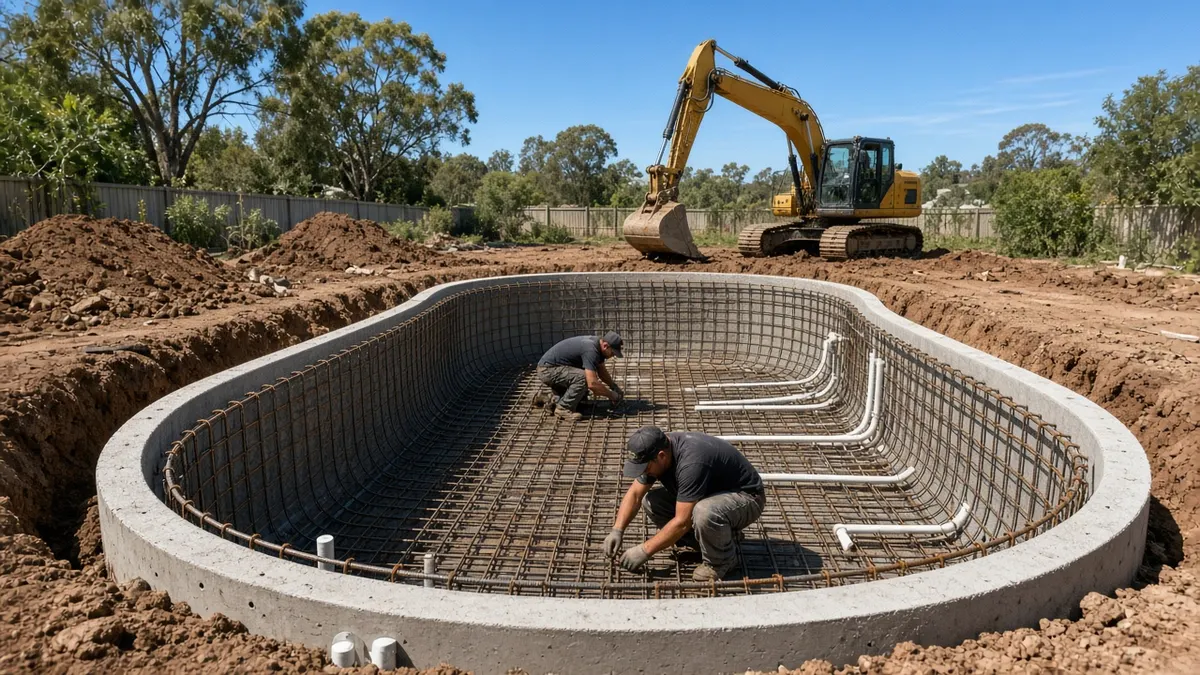
A new inground swimming pool in Australia costs roughly $35,000 to $130,000 in 2026, including GST, before you add fencing, paving and landscaping. Where you land in that range depends mostly on the type of pool. Vinyl liner pools are the cheapest to build, fibreglass sits in the middle, and concrete costs the most but can be built to almost any shape or size.
Once compliant fencing, paving, heating and some landscaping are included, most finished backyard pool projects cost $65,000 to $150,000. Luxury concrete pools with infinity edges, integrated spas and extensive stonework go well beyond that.
This guide compares the three main pool types, what each costs to build and to own, and what pushes the price up. All figures are indicative. Get at least three written quotes from licensed pool builders after a site visit, and make sure each quote covers the same scope.
The short version: three pool types side by side
| Concrete | Fibreglass | Vinyl liner | |
|---|---|---|---|
| Typical installed price | $65,000 to $130,000+ | $45,000 to $85,000 | $35,000 to $65,000 |
| Time on site | 8 to 16 weeks | 1 to 3 weeks | 2 to 4 weeks |
| Shape and size | Any shape, size or depth | Limited to manufacturer moulds; width capped by road transport | Flexible within panel systems |
| Surface | Pebble, render, glass bead or tiles | Smooth gelcoat | Soft vinyl membrane |
| Main ongoing cost | Resurfacing every 10 to 20 years; more chemicals | Low; gelcoat repair occasionally | Liner replacement every 7 to 12 years |
| Typical structural life | Several decades | 25 years or more | 25 years or more for walls and floor; liner much shorter |
| Best for | Custom designs, sloping or awkward sites, long-term owners | Families wanting a fast, low-maintenance pool | Tight budgets and simple rectangular pools |
Price ranges assume a standard backyard pool of about 6 to 10 metres long with reasonable access. Small plunge pools come in under these ranges, and large or complex pools go over them.
Concrete pools
Concrete pools are built on site. The hole is excavated, steel reinforcement is tied in place, plumbing is roughed in and then concrete is sprayed onto the steel to form the shell. After curing, the interior is finished with pebble, render, glass bead or tiles, and the coping goes on.
Because nothing is pre-made, a concrete pool can be any shape, size or depth. That suits sloping blocks, narrow lap pools, wet edges, built-in spas, swim-up benches and anything else a designer can draw. It is also the reason concrete costs more and takes longer. Each stage needs its own crew and inspections, and the shell needs time to cure.
| Concrete pool size | Typical installed price |
|---|---|
| Plunge pool, 4 to 5 m | $50,000 to $80,000 |
| Standard, 8 x 4 m | $70,000 to $110,000 |
| Large, 10 x 5 m | $90,000 to $140,000 |
| Lap pool, 12 to 15 m narrow | $85,000 to $140,000 |
| Custom with spa, wet edge or feature walls | $130,000 to $250,000+ |
The interior finish has a big effect on a concrete pool's price and life. Pebble is the common choice: hard-wearing, good at hiding minor marks and usually good for 15 to 20 years or more. Fully tiled interiors cost much more but last longer. When the surface eventually wears, resurfacing an average concrete pool costs roughly $12,000 to $25,000 in pebble; our pool renovation cost guide covers that in detail.
Concrete is slightly alkaline and porous, so concrete pools generally need more acid and chlorine than fibreglass to keep water balanced, and the surface gives algae more to grip.
Fibreglass pools
Fibreglass pools are made in a factory as one-piece shells, trucked to site and lowered into the hole by crane. Once approvals are through and the shell is ready, the on-site work is quick, often one to three weeks from excavation to coping.
The gelcoat surface is smooth and non-porous, which makes cleaning easier and keeps chemical use down. The main limits are design and size. You choose from the moulds a manufacturer makes, and the width is capped by what can legally and practically travel on a truck, generally a bit over 4 metres for residential models. Access for the crane also matters. If a crane cannot reach the backyard, fibreglass may not work.
Typical installed prices run from about $30,000 to $50,000 for plunge pools and $45,000 to $85,000 for standard 6 to 10 metre pools. Our fibreglass pool cost guide breaks the installation down line by line, with worked examples from Melbourne, Brisbane and Perth.
Vinyl liner pools
Vinyl liner pools use a frame of steel, aluminium or polymer wall panels, a floor of compacted sand or a cement mix, and a custom-fitted vinyl liner that holds the water. They are less common in Australia than concrete or fibreglass, but they are the cheapest way to get an inground pool, and the panel systems allow more size flexibility than fibreglass moulds.
The trade-off is the liner. It fades, wrinkles and can be punctured by sharp objects, dog claws or careless pool toys. Most liners need replacing every 7 to 12 years, at roughly $5,000 to $12,000 each time. Some buyers also see vinyl as less premium, which can matter if you sell.
Typical installed price for a standard vinyl liner pool is about $35,000 to $65,000. It is a sensible choice for a family on a tight budget who wants a simple rectangle and is happy to budget for a liner every decade.
Above-ground and semi-inground options
Above-ground pools are far cheaper. A quality steel or resin wall kit costs about $1,500 to $8,000, and professional installation on a level, prepared base adds $1,000 to $5,000. Decking around an above-ground pool can add several thousand dollars more. Some can be partly sunk into a slope as a semi-inground pool, which looks better but needs panels rated for it.
Do not assume an above-ground or inflatable pool escapes the rules. In most states any pool or spa that can hold more than 300 mm of water needs a compliant safety barrier, and many need registration or approval. Check with your council before buying.
Plunge pools, lap pools and spas
Pool shape and purpose change the sums as much as the material does.
Plunge pools of 4 to 5.5 metres suit small blocks, townhouses and people who mostly want to cool off rather than swim laps. They cost less than a full-size pool, but not proportionally less. Excavation setup, crane hire, equipment, approvals and fencing barely shrink, so a plunge pool often costs 60 to 75 percent of a standard pool rather than half. Heating is cheaper because there is less water to warm, which makes year-round use more realistic.
Lap pools are long and narrow, usually 10 to 15 metres by 2.5 to 3 metres. They fit down the side of a block and suit serious swimmers. Fibreglass lap shells exist up to a certain length; longer lap pools are usually concrete.
Spas can be built into a concrete pool, moulded into some fibreglass shells or bought as a standalone portable unit. A built-in spa typically adds $10,000 to $30,000 to a concrete pool once jets, blower, heating and plumbing are included. A quality standalone spa costs roughly $8,000 to $20,000 plus a slab, electrical work by a licensed electrician and a compliant barrier or lockable lid, depending on the state.
Matching the pool type to your backyard
A few questions narrow the choice quickly.
- Can a crane reach the backyard? If not, fibreglass is probably out and concrete or vinyl it is.
- Is the block steep, oddly shaped or tight? Concrete handles awkward sites best because the shell is built to fit.
- Do you want a specific size or a design feature? Wider than about 4 metres, deeper than standard, a wet edge or a built-in spa all point to concrete.
- Is speed important? Fibreglass is the fastest by a long way once approvals are through.
- Is the budget tight? Vinyl liner or a smaller fibreglass shell gets you swimming for the least money.
- How long will you stay? Short-term owners rarely get back the premium for a custom concrete pool.
Many families in suburban Australia land on a 7 to 8 metre fibreglass pool. It balances cost, speed and maintenance, and suits the typical flat block with side access. Concrete makes more sense once the site or the design gets complicated.
The extras that double the budget
The pool shell is often only half the cost of the finished project. Here are the extras most families add and what they typically cost.
| Extra | Typical cost |
|---|---|
| Pool fencing: aluminium | $150 to $250 per linear metre |
| Pool fencing: semi-frameless glass | $250 to $400 per linear metre |
| Pool fencing: frameless glass | $350 to $600 per linear metre |
| Paving around the pool | $120 to $300 per m², depending on material |
| Heat pump | $4,000 to $9,000 installed |
| Solar heating | $4,000 to $8,000 installed |
| Gas heater | $3,500 to $7,000 plus gas fitting |
| LED pool lights | $800 to $2,000 each, installed |
| Solar blanket and roller | $600 to $2,000 |
| Automatic pool cover | $10,000 to $25,000 |
| Robotic cleaner | $800 to $2,500 |
| Retaining walls on sloping sites | $5,000 to $30,000+ |
| Landscaping and garden beds | $3,000 to $20,000+ |
| Switchboard upgrade for pool equipment | $1,500 to $4,000 if needed |
Fencing alone often runs $5,000 to $20,000. The glass pool fencing cost guide covers the options in more detail.
Three finished projects, one of each type
These worked examples show realistic totals in 2026 including GST.
Concrete: 9 x 4 m pool in Baulkham Hills, NSW
A family home on a gently sloping block with sandstone a metre down. Pebble interior, frameless glass fencing and travertine paving.
| Item | Cost |
|---|---|
| Concrete pool construction, including excavation, steel, shell, pebble interior, waterline tiles, coping and standard equipment | $72,000 |
| Rock excavation surcharge | $6,000 |
| Heat pump | $6,500 |
| Frameless glass fencing, 30 linear metres at $450 | $13,500 |
| Travertine paving, 50 m² at $220 | $11,000 |
| Complying development certificate, engineering and survey | $4,500 |
| Landscaping and turf repair | $6,000 |
| Total | $119,500 |
Fibreglass: 7.5 m pool in Narre Warren, VIC
A flat block in Melbourne's south-east with good access. Aluminium fencing, concrete paving and a heat pump to stretch the season.
| Item | Cost |
|---|---|
| Fibreglass pool installed: shell, crane, excavation, filtration and coping | $56,000 |
| Building permit and engineering | $3,000 |
| Aluminium pool fence, 28 linear metres at $180 | $5,040 |
| Concrete paving, 30 m² at $140 | $4,200 |
| Heat pump | $6,000 |
| Solar blanket and roller | $900 |
| Total | $75,140 |
Vinyl liner: 8 x 4 m pool in Bendigo, VIC
A regional family home on a large flat block. Simple rectangle, budget fencing and pavers, no heating at first.
| Item | Cost |
|---|---|
| Excavation and spoil removal | $6,000 |
| Wall panels, floor, liner, filtration and installation | $34,000 |
| Electrical connection | $1,500 |
| Building permit | $2,500 |
| Aluminium pool fence, 30 linear metres at $170 | $5,100 |
| Concrete pavers, 35 m² at $120 | $4,200 |
| Total | $53,300 |
Add roughly $5,000 to $12,000 for a replacement liner somewhere around years 7 to 12.
What a pool costs over 20 years
The cheapest pool to build is not always the cheapest to own. This rough comparison uses a standard family pool and assumes similar fencing and paving for each type, so those are left out.
| 20-year cost (approximate) | Concrete | Fibreglass | Vinyl liner |
|---|---|---|---|
| Build | $85,000 | $60,000 | $45,000 |
| Resurfacing or liners | $15,000 (one resurface) | $0 to $10,000 (possible recoat) | $16,000 (two liners) |
| Chemicals and salt (20 years) | $10,000 to $16,000 | $6,000 to $12,000 | $6,000 to $12,000 |
| Electricity for pump (20 years) | $8,000 to $20,000 | $8,000 to $20,000 | $8,000 to $20,000 |
| Equipment replacement | $6,000 to $12,000 | $6,000 to $12,000 | $6,000 to $12,000 |
| Approximate total | $124,000 to $148,000 | $80,000 to $114,000 | $81,000 to $105,000 |
The figures are rough, but the pattern holds. Concrete costs more to own as well as to build, and the reason to choose it is design freedom rather than savings. Fibreglass and vinyl end up close over 20 years, with fibreglass usually the more durable and lower-hassle option.
Pool prices in each state
Typical installed price for a standard 8 by 4 metre pool, before fencing and paving.
| City | Concrete | Fibreglass | Local factors |
|---|---|---|---|
| Sydney | $80,000 to $130,000 | $55,000 to $85,000 | Sandstone rock, tight blocks, high spoil disposal costs |
| Melbourne | $75,000 to $120,000 | $52,000 to $80,000 | Reactive clay, building permit and barrier registration |
| Brisbane | $70,000 to $115,000 | $50,000 to $78,000 | Strong demand, sloping blocks and rock in hilly suburbs |
| Perth | $65,000 to $105,000 | $45,000 to $72,000 | Sandy soil makes excavation quicker and cheaper |
| Adelaide | $65,000 to $110,000 | $48,000 to $75,000 | Reactive clay, moderate labour costs |
| Canberra | $80,000 to $125,000 | $55,000 to $85,000 | Fewer builders, short season, heating almost a must |
| Hobart | $80,000 to $130,000 | $55,000 to $88,000 | Freight, rock and a cool climate |
| Darwin | $85,000 to $135,000 | $58,000 to $90,000 | Freight, wet season delays, high water tables |
What drives the price up
- Rock. Usually excluded from base quotes and charged per hour or per cubic metre. It can add a few thousand dollars or tens of thousands.
- Access. Narrow side access means smaller machines and more hand work. For fibreglass, it can mean a bigger crane lifting over the house.
- Slope. Sloping blocks need retaining walls, engineering and sometimes suspended slabs or raised pool walls.
- Size and depth. Bigger pools need more excavation, more materials, more water and more fencing and paving.
- Design features. Infinity or wet edges, integrated spas, water features, swim-outs and feature tiles all add cost, mostly to concrete pools.
- Soil and services. Reactive clay, high water tables, sewer lines and easements in the backyard can all add engineering or relocation costs.
- Season. Spring is the busiest time to sign. Builders are often more flexible on scheduling and price in autumn and winter.
Approvals, barriers and licensing
Every inground pool needs approval and a compliant safety barrier, and the barrier must pass inspection before the pool is filled or used. Pool barriers are built to AS 1926.1, and states add their own rules on registration, inspections and certificates.
- NSW: approval via development application or complying development certificate, and registration on the NSW Swimming Pool Register. Pool builders are licensed by NSW Fair Trading.
- Victoria: building permit, council registration and ongoing barrier compliance certificates. Builders must be registered with the Building and Plumbing Commission (BPC).
- Queensland: building approval through a certifier and listing on the pool safety register. The Queensland Government's pool safety page explains the rules, and the QBCC licenses pool builders.
- Western Australia: building permit, with barrier inspections by local government. See Building and Energy's rules for pools and spas.
- SA, Tasmania, ACT and NT: check with Consumer and Business Services (SA), CBOS (TAS), Access Canberra or the NT Building Practitioners Board, and your local council.
Pool equipment wiring must be done by a licensed electrician, gas heaters by a licensed gasfitter, and sewer or backwash connections by a licensed plumber. Pool contracts above your state's threshold usually need a written contract, a licensed builder and home warranty insurance, and deposits are capped by law in several states. Check the current limits with your state regulator before you pay anything.
Planning timeline
From first conversation to first swim, allow:
- Fibreglass: 2 to 4 months, of which 1 to 3 weeks is on site
- Vinyl liner: 2 to 4 months, of which 2 to 4 weeks is on site
- Concrete: 4 to 8 months, of which 8 to 16 weeks is on site
Approvals vary from a couple of weeks for a straightforward complying design to several months if a development application is needed. To swim by summer, start talking to builders in autumn or winter.
Running costs to budget for
Expect to spend roughly $1,000 to $2,500 a year running an unheated pool, covering electricity for the pump and chlorinator, chemicals, salt, water top-ups and minor repairs. Heating adds $500 to $1,500 a year with a heat pump, more with gas. Professional servicing, if you use it, costs $600 to $2,000 a year depending on how often the technician visits.
A variable-speed pump and a pool cover are the two upgrades that cut running costs most. A cover reduces evaporation, heat loss and leaf litter, and a variable-speed pump uses a fraction of the power of an old single-speed model.
Sensible ways to trim the budget
- Go a size smaller. Dropping from a 9 metre to a 7 metre pool reduces excavation, water, fencing and paving all at once.
- Keep the depth simple. A uniform 1.4 to 1.5 metre depth costs less to dig and fill, and is better for kids' games than a deep end.
- Use compliant boundary fences. Where your existing fences meet barrier rules, they can form part of the pool barrier and shorten the new fence.
- Stage the extras. Get the pool, barrier and essential paving done, then add lighting upgrades, landscaping and shade structures later. Run conduit and plumbing for future additions during the build.
- Clear the site yourself. Removing old garden beds, a shed or a clothesline before the builder arrives saves on their crew rates.
Never save on the barrier, the approvals or the licensed electrical work. Those are the parts that keep children safe and keep the pool legal.
Choosing a builder and checking the quote
Ask every builder for:
- Their licence number, which you can check with your state regulator
- An itemised quote with clear inclusions and exclusions
- The rock rate in writing, and how they will assess the ground
- Equipment brands and models, and the warranty on each
- Who handles approvals, engineering and the barrier inspection
- Home warranty insurance details where required
- A progress payment schedule tied to completed stages
- Addresses of recent pools you can look at
Be wary of "from" prices with no site visit, deposits above your state's limit, verbal promises about rock or access, and builders who can't show recent work.
Where Yakka helps
Pool construction, electrical, plumbing and barrier work belong with licensed trades. Yakka Labour does not build pools. It does connect you with labourers for the work around the edges: clearing the backyard before excavation, removing old sheds and garden beds, carrying pavers and soil, spreading mulch and turf and cleaning up once the builders finish.
You can browse pool builders, plunge pool specialists and pool fencing installers on the platform, and book general labourers by the shift for landscaping and clean-up.
Finishing the backyard
The area around the pool shapes how much you use it. Our paving cost guide compares concrete, pavers, porcelain and natural stone for pool surrounds. Plan paving, fencing and any shade structures with the pool rather than after it, so trenches for power and plumbing go in once and nothing new has to be dug up.
Frequently asked questions
How much does an inground pool cost in Australia?
An inground pool typically costs $35,000 to $65,000 for vinyl liner, $45,000 to $85,000 for fibreglass and $65,000 to $130,000 or more for concrete in 2026, before fencing, paving and landscaping. Adding those extras usually brings a finished project to between $65,000 and $150,000, with complex concrete designs costing more.
Which is cheaper, a concrete or fibreglass pool?
Fibreglass is usually cheaper to build and to own. A comparable fibreglass pool often costs $20,000 to $40,000 less to install than concrete, goes in faster and uses fewer chemicals. Concrete costs more but can be any shape, size or depth, which suits custom designs and difficult sites.
What is the cheapest type of inground pool?
Vinyl liner pools are generally the cheapest inground option, at about $35,000 to $65,000 installed. The catch is that liners need replacing every 7 to 12 years at roughly $5,000 to $12,000 each time. Over 20 years, the total cost of vinyl and fibreglass pools often ends up fairly close.
How much does it cost to run a pool per year?
An unheated backyard pool usually costs $1,000 to $2,500 a year to run, covering pump electricity, chemicals, salt, water top-ups and minor repairs. Heating adds about $500 to $1,500 a year with a heat pump. A variable-speed pump and a pool cover are the most effective ways to bring running costs down.
Do above-ground pools need a fence in Australia?
In most states, yes. Any pool or spa that can hold more than 300 mm of water generally needs a compliant safety barrier, and that includes many above-ground and inflatable pools. Some states also require registration or approval. Check with your council before buying or filling an above-ground pool.
How long does it take to build a pool?
A fibreglass pool usually takes one to three weeks on site and two to four months overall once approvals and delivery are included. Vinyl liner pools are similar. Concrete pools take longer, typically 8 to 16 weeks on site and four to eight months from the first quote to the first swim.
Does a pool add value to a house in Australia?
A well-kept pool can make a home more appealing in warm climates and family suburbs, but it rarely adds as much value as it costs to build. In cooler areas or on small blocks, some buyers see a pool as a maintenance cost. Build a pool because you will use it, and ask local agents if resale matters.
Official sources
Award rates, licences and safety rules change. Check the official source before you hire or take on a shift.
- Queensland Building and Construction Commission (QBCC)Contractor, plumbing and drainage licence search in Queensland
- Consumer and Business Services SALabour hire licensing in South Australia
- NSW Fair TradingTrade licence checks for electricians, plumbers and builders in New South Wales
- Building and Plumbing Commission (Victoria)Builder and plumber registration, domestic building insurance and licence checks in Victoria
- Consumer, Building and Occupational Services (Tasmania)Building, plumbing and electrical licensing in Tasmania
- Access CanberraConstruction occupation licences and building approvals in the ACT