Build & Renovate cost guide
How Much Does Exposed Aggregate Concrete Cost? (Australia 2026)
Typical cost in Australia (2026, inc. GST)
$110 to $200 per m²
new exposed aggregate slab including base, mesh, pour, wash-off and first seal
Exposed aggregate concrete costs about $110 to $160 per m² for a typical driveway or patio in Australia in 2026, including GST. Narrow paths and pool surrounds often cost $120 to $200 per m² because of extra edging and care, and honed exposed aggregate can reach $220 per m². The stone blend, site access, demolition and sealing are the main price drivers.
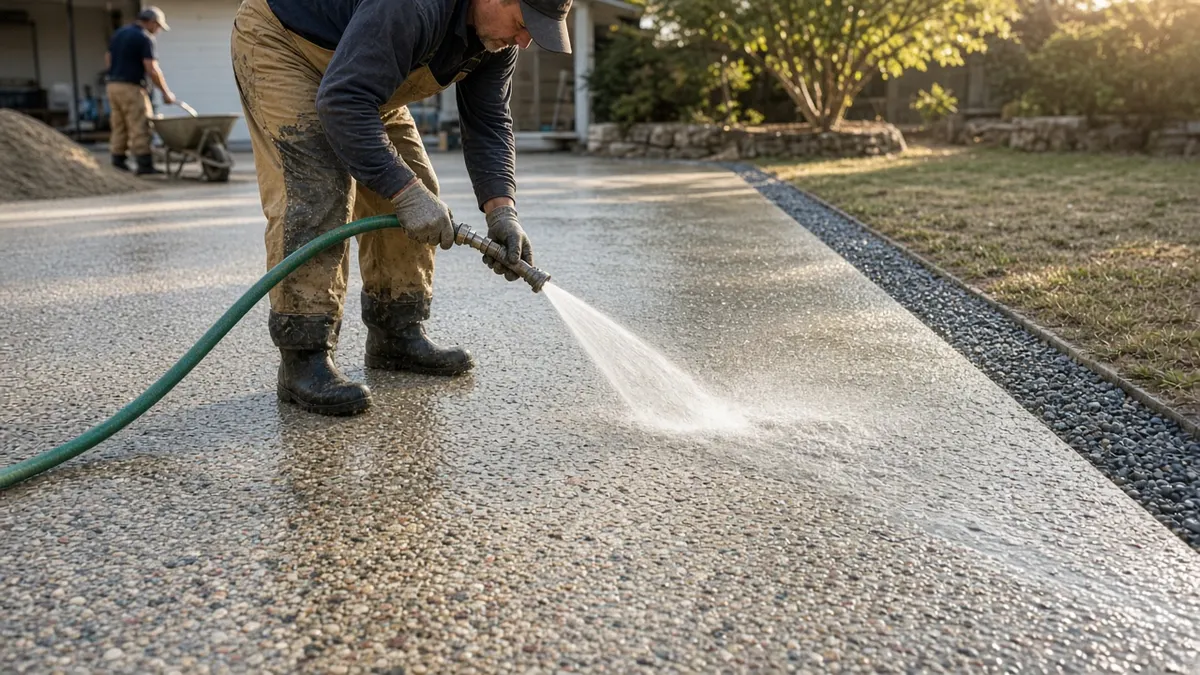
Exposed aggregate concrete costs about $110 to $160 per m² in Australia in 2026 for a standard driveway or patio, including GST. Paths, pool surrounds and premium stone blends push the price toward $200 per m², and a ground and honed exposed aggregate finish can go higher again.
It is the most popular decorative concrete in Australian suburbs because it hides dirt, gives good grip and suits most house styles. It also costs more than plain concrete for reasons that are easy to understand once you see how it is made. This guide covers prices by application, what the stone blend does to the bill, sealing and upkeep, and three priced examples. If you are mainly comparing driveway finishes, the concrete driveway cost guide lines up plain, coloured, stamped and exposed side by side. All prices are indicative. Get at least three written quotes.
Prices by application
| Job | Typical price per m² (incl. GST) | Why the rate differs |
|---|---|---|
| Driveway, 40 to 80 m² | $110 to $160 | Large, simple shapes and one pour keep the rate down. |
| Patio or alfresco slab | $115 to $165 | Often needs falls away from the house and work near doors and walls. |
| Garden paths and side paths | $120 to $180 | Lots of formwork per square metre, barrow access, small pours. |
| Pool surrounds | $130 to $200 | Careful work around coping, expansion joints, slip-resistant sealer. |
| Honed (ground) exposed aggregate | $140 to $220 | Extra grinding gives a smooth, flat stone face. |
| Acid wash and reseal of an existing surface | $10 to $20 | Maintenance every few years. |
| Strip old sealer and reseal | $18 to $30 | Needed when old sealer has peeled or turned white. |
Small jobs often hit a minimum charge of $1,800 to $2,500, because a crew, a concrete truck and often a pump are needed whether you are pouring 10 m² or 50 m².
How exposed aggregate is made, and why it costs more
Plain concrete is poured, levelled and finished in one visit. Exposed aggregate needs extra materials, extra steps and a return visit.
- Ordering a decorative mix. The concrete plant batches a mix with a chosen blend of pebbles or crushed stone. Decorative blends cost more per cubic metre than standard concrete, and the plant may add a small-load surcharge.
- Placing and finishing. The crew places, screeds and floats the concrete as usual, making sure stones sit evenly near the surface. On some jobs they scatter extra stone over the wet surface and press it in, called seeding.
- Applying a surface retarder. A chemical sprayed on the surface stops the top few millimetres of cement paste from setting while the rest of the slab hardens.
- Washing off. Usually the next morning, the crew scrubs and pressure washes the surface to remove the loose paste and reveal the stones. Timing matters. Too early and stones come loose; too late and the paste will not wash away evenly.
- Saw cutting joints. Control joints are cut within a day or so to stop random cracking.
- Acid washing and sealing. After the concrete has cured for a few weeks, the surface is cleaned with a diluted acid to remove cement haze, then sealed to bring out the colour of the stone.
Honed exposed aggregate skips the retarder. Instead, the hardened slab is ground with diamond tooling to cut through the stones and leave a flat, smooth face, a bit like a terrazzo look. It is popular around pools and in alfresco areas but needs a slip-resistant treatment where it will get wet.
What the stone blend does to the price
The aggregate is the part you look at every day, and it is also the most variable cost. Concrete plants in each city offer a range of blends, from local river gravel and crushed basalt or granite to premium coloured pebble and quartz mixes.
| Blend type | Look | Rough extra cost per m² at 100 mm thick |
|---|---|---|
| Standard local blend | Browns, greys and creams, natural river stone | Usually included in the base rate |
| Designer blend | Coloured pebbles, charcoal or sandy tones, consistent size | $5 to $12 |
| Premium blend | White quartz, black basalt, imported or specialty stone | $12 to $25 |
| Oxide colour in the paste | Darker or tinted background between stones | $8 to $20 |
Ask to see a real sample board or, better, a finished job using the same blend. Stone looks different wet, dry and sealed, and the colour of the cement paste between the stones changes the overall tone more than people expect. Blend names and availability vary between plants and regions, so a blend you saw in Sydney may not exist in Perth.
City by city
These are typical rates for a standard exposed aggregate slab of 40 to 80 m², and for smaller paths and patios where edging and access push the rate up.
| Location | Driveway-size slab per m² | Paths and small patios per m² |
|---|---|---|
| Sydney | $125 to $175 | $135 to $195 |
| Melbourne | $120 to $165 | $130 to $185 |
| Brisbane | $110 to $155 | $120 to $175 |
| Perth | $105 to $150 | $115 to $170 |
| Adelaide | $100 to $145 | $110 to $165 |
| Canberra | $120 to $165 | $130 to $185 |
| Hobart | $115 to $160 | $125 to $180 |
| Darwin | $130 to $185 | $140 to $200 |
| Regional | $100 to $155 | $110 to $175 |
Sydney and Darwin are dearest for different reasons: Sydney for labour and access, Darwin for freight on cement and stone and a short dry-season window. Regional prices swing widely depending on how far the nearest plant is from your site.
Three projects with line-item costs
Alfresco and side path in Chermside
A 30 m² alfresco slab off the back of a lowset home plus a 12 m² path down the side to the bins, 42 m² in total. Access was through a narrow side gate, so a pump was needed.
| Item | Cost |
|---|---|
| Excavation and spoil removal, 42 m² at $14 | $588 |
| Roadbase supply and compaction, 42 m² at $9 | $378 |
| Formwork and mesh, 42 m² at $16 | $672 |
| Exposed aggregate mix, 4.6 m³ at $370 | $1,702 |
| Line pump hire | $750 |
| Placing, retarder and wash-off, 42 m² at $36 | $1,512 |
| Saw cutting control joints | $250 |
| Acid wash and two coats of sealer, 42 m² at $9 | $378 |
| Subtotal (ex GST) | $6,230 |
| GST | $623 |
| Total | $6,853 (about $163 per m²) |
Pool surround in Baldivis
A 45 m² surround around an existing fibreglass pool, replacing tired brick pavers. Salt-resistant, slip-resistant sealer was specified because the pool is chlorinated with a salt system.
| Item | Cost |
|---|---|
| Lift old pavers, excavate and prepare base, 45 m² at $20 | $900 |
| Formwork around coping and mesh, 45 m² at $18 | $810 |
| Exposed aggregate mix, 5.0 m³ at $360 | $1,800 |
| Pump hire | $800 |
| Placing and wash-off with pool water protected, 45 m² at $40 | $1,800 |
| Saw cuts and expansion joint against coping | $400 |
| Anti-slip sealer, 45 m² at $10 | $450 |
| Subtotal (ex GST) | $6,960 |
| GST | $696 |
| Total | $7,656 (about $170 per m²) |
Any temporary removal of pool fencing during the work must be managed so the pool stays securely fenced. The rules sit with your state; in WA, Building and Energy and local councils oversee pool barriers.
Restoring a 15-year-old driveway in Modbury
A 50 m² exposed aggregate driveway that had gone dull and blotchy, with old sealer flaking in the wheel tracks.
| Item | Cost |
|---|---|
| Pressure clean, 50 m² at $4 | $200 |
| Mild acid wash for efflorescence, 50 m² at $3 | $150 |
| Strip failed sealer, 50 m² at $6 | $300 |
| Two coats of solvent-based acrylic sealer, 50 m² at $7 | $350 |
| Minor crack repair | $150 |
| Subtotal (ex GST) | $1,150 |
| GST | $115 |
| Total | $1,265 (about $25 per m²) |
Had the owners resealed every few years, the stripping step would not have been needed and the job would have been closer to $15 per m².
Things that move the quote
- Demolition. Breaking out old concrete, asphalt or pavers adds $35 to $70 per m² depending on thickness and access.
- Shape and edges. Curves, steps, narrow paths and work around pool coping all need more formwork and hand finishing.
- Access. No truck access means a pump, typically $600 to $1,000 for a residential pour, or barrowing, which is slow.
- Thickness and reinforcement. Paths may be 75 to 100 mm with lighter mesh, while driveways for heavy vehicles go to 125 or 150 mm.
- Falls and drainage. Patios must fall away from the house, and large areas may need grated drains connected to stormwater by a plumber.
- Weather. Hot, windy days make the wash-off timing harder. Crews may add retarder or bring an extra worker, and rain can wash out the surface before it sets.
- Sealer type. Solvent acrylics are cheap and give a wet look. Polyurethane or hybrid sealers last longer but cost more.
Sealing: the ongoing cost people forget
Exposed aggregate looks its best sealed. The sealer deepens the colour of the stones, makes oil and food spills easier to clean, and stops moss and grime settling in the texture. The catch is that most sealers are a maintenance item, not a once-off.
| Sealer | Look | Typical life on a driveway | Rough pro cost per m² to reapply |
|---|---|---|---|
| Solvent-based acrylic | Wet look, deepens colour | 2 to 3 years | $8 to $15 |
| Water-based acrylic | Lighter sheen, lower odour | 1 to 3 years | $8 to $14 |
| Penetrating (silane or siloxane) | Natural, no sheen | 3 to 5 years | $8 to $16 |
| Polyurethane or hybrid | Tough, satin or gloss | 4 to 7 years | $15 to $30 |
Two problems turn up again and again. White patches under the sealer, called blushing, usually come from moisture trapped when the sealer went on a damp slab. Peeling in wheel tracks comes from hot tyres or too thick a coat. Both mean stripping and resealing, so it pays to seal on dry, mild days with thin coats.
If you want to DIY the reseal, a good sealer costs roughly $3 to $6 per m² per coat in materials. You will need a pressure washer, a sprayer or roller and a dry forecast. Wear chemical-resistant gloves and eye protection for acid washing, and use a respirator with solvent-based products. Follow the product's safety data sheet.
Common faults and what causes them
- Patchy exposure. Some areas show lots of stone, others look like plain concrete. Usually uneven retarder or wash-off timing.
- Loose stones. Stones popping out after a few months point to over-washing or a weak surface. A few loose stones near edges are common; widespread loss is a defect.
- Cement haze. A grey film over the stones that the acid wash did not remove.
- Colour variation between pours. Two trucks of the same blend can look slightly different. Ask how the crew will manage this on large areas.
- Random cracks. Missing or late saw cuts, or a poor base.
Agree in writing what happens if these show up, and take photos at handover.
Licences, approvals and safety
Exposed aggregate is concreting, and concreting is residential building work once a job passes your state's dollar threshold. In NSW, work over $5,000 in labour and materials needs a licensed contractor and written contract; NSW Fair Trading has a free licence check. Queensland has a specific QBCC concreting licence class, and a licence is required for building work valued over $3,300. In Victoria, check registration and contract requirements with the Building and Plumbing Commission, and in other states and territories check the current threshold with the local building regulator.
A driveway crossover on council land needs council approval almost everywhere, and stormwater drains need a licensed plumber to connect. Patios attached to the house can affect termite management systems and weep holes, so keep the slab below the house's damp course and ask the concreter how they will protect existing termite barriers.
On the safety side, saw cutting and grinding concrete releases silica dust, which crews should control with water and proper respirators. Acid washing involves hydrochloric acid solutions, so keep kids and pets away and protect nearby plants and metal fittings.
Is exposed aggregate the right choice?
For most driveways and outdoor areas in Australia, it is a sound middle path. It costs roughly $30 to $50 more per m² than plain concrete, it hides stains, and it is grippy in the wet. The texture is less pleasant for bare feet than smooth finishes, so around pools many owners choose a finer stone or a honed finish.
Compared with pavers, it has no joints for weeds and ants and will not shift, but a damaged section is harder to patch invisibly. If you want a more formal look or easy repairs, read the paving cost guide. For pool projects, the pool renovation cost guide covers coping and surrounds as part of a bigger job.
How it stacks up against other decorative concrete
Exposed aggregate competes mostly with coloured, stencilled and stamped concrete. Each has a different maintenance profile, and the cheapest to install is not always the cheapest over 15 years.
| Finish | Install per m² (incl. GST) | Hides stains | Grip when wet | Upkeep |
|---|---|---|---|---|
| Plain broom | $75 to $120 | Poorly | Good | Low, optional sealing |
| Coloured through the mix | $90 to $135 | Fairly well | Good | Low, sealing helps colour |
| Exposed aggregate | $110 to $160 | Very well | Very good | Reseal every 2 to 3 years |
| Stencilled | $110 to $160 | Fairly well | Depends on sealer | Reseal every 2 to 3 years, pattern can wear |
| Stamped | $120 to $180 | Fairly well | Can be slippery if glossy | Reseal every 2 to 3 years |
| Honed aggregate | $140 to $220 | Well | Needs anti-slip treatment | Reseal or re-hone over time |
On a sloping driveway or anywhere that gets wet, standard exposed aggregate is hard to beat for grip. On a covered alfresco where you want a smoother surface for furniture and bare feet, a finer stone blend or a honed finish is often the better fit.
Ways to keep the price down
- Stick with a local standard blend. The cheapest blends at your nearest plant are often attractive, and premium stone can add $10 to $25 per m².
- Pour everything at once. Combining a path, patio and driveway into one pour spreads the cost of the crew, truck and pump. Coming back for a second small pour can cost nearly as much as the first.
- Keep shapes simple. Straight edges and fewer steps mean less formwork and hand finishing.
- Do the demolition and clear-out yourself. Lifting pavers, digging out turf and removing garden edging before the crew arrives can save hundreds of dollars, as long as you agree the scope with the concreter first.
- Avoid the busiest months. Spring and the run-up to Christmas are peak season for outdoor concreting. Late autumn and winter pours in milder climates can be easier to book, though cold slows curing in southern states.
- Look after the sealer. Regular resealing is cheaper than stripping and starting again.
Getting a quote you can compare
Give each concreter the same brief: area, thickness, intended use, preferred blend and whether old surfaces need removing. Then check each quote covers:
- Base depth and compaction, mesh type and concrete strength.
- Aggregate blend name, and whether a sample or past job can be seen.
- Control joint layout and how joints meet existing structures.
- Acid wash, sealer brand and number of coats.
- Pump, demolition, disposal and drains listed separately.
- Licence number and insurance, and a written warranty on workmanship.
Be wary of very low quotes that leave out the sealer or the base, crews who will not name the blend, and big cash deposits. To see what a concreter's time is worth, the concreter hourly rate guide lists typical labour rates.
How long the job takes
For a typical 40 to 60 m² area, expect one or two days of demolition and preparation, the pour on day two or three, wash-off the following morning, and saw cutting within a day of the pour. Acid washing and sealing usually happen two to four weeks later as a separate visit. Walk on it after a day, keep cars off for at least a week, and avoid parking on the sealer until it has fully cured.
Using Yakka for the heavy work
A lot of the cost before an exposed aggregate pour is plain hard work: lifting old pavers, digging out garden beds, barrowing spoil to a skip, moving pot plants and outdoor furniture, and hosing down afterwards. You can book workers on Yakka Labour for those parts of the job by the day, which keeps the concreter focused on the pour. The guide to how to hire a labourer for a day explains costs and how bookings work.
The concreting and finishing should go to an experienced crew who does exposed aggregate regularly. Compare local concreters on the platform, and if you plan to reseal yourself later, concrete protection material suppliers stock suitable sealers.
Frequently asked questions
How much does exposed aggregate concrete cost per m2?
In 2026, exposed aggregate concrete usually costs $110 to $160 per m² for a driveway or patio, including GST. Paths and pool surrounds often cost $120 to $200 per m² because of extra edging and care, and honed exposed aggregate can reach $220 per m². Demolition of old surfaces is extra.
Is exposed aggregate more expensive than pavers?
It is usually similar or slightly cheaper than mid-range pavers once base preparation is included. Concrete pavers laid on a proper base often cost $100 to $160 per m², and natural stone more. Exposed aggregate has no joints for weeds and ants, but pavers are easier to lift and repair in small sections.
How often does exposed aggregate need sealing?
Most exposed aggregate driveways need resealing every two to three years with an acrylic sealer, or every four to seven years with a polyurethane or hybrid product. Areas under cover last longer. Resealing before the old coat fails avoids the extra cost of stripping peeled or whitened sealer.
Is exposed aggregate slippery?
Standard exposed aggregate has good grip because the stones create a textured surface. It can become slippery if a thick, glossy sealer fills the texture, or if moss grows in shady areas. Around pools, ask for an anti-slip additive in the sealer or a finer stone, and keep the surface clean.
Can you put exposed aggregate over existing concrete?
Not in the usual way, since exposed aggregate is part of a full-depth pour. Over a sound slab, options include a thin bonded topping slab, which raises the level and needs careful detailing, or a decorative overlay that mimics the look. Cracked or sinking concrete should be removed and replaced instead.
How long does exposed aggregate last?
A well-built exposed aggregate slab lasts 30 to 50 years. The surface finish depends on maintenance, so regular cleaning and resealing keep it looking good. Most problems that shorten its life come from a poor base, missing control joints, tree roots or loads the slab was not designed to carry.
Why are stones coming loose from my exposed aggregate?
A few loose stones near edges and joints are common in the first months. Widespread loss usually means the surface was washed too early or too hard, or the paste was weak. Sealing helps lock stones in. If it keeps happening, contact the concreter while the workmanship warranty still applies.
Official sources
Award rates, licences and safety rules change. Check the official source before you hire or take on a shift.
- Queensland Building and Construction Commission (QBCC)Contractor, plumbing and drainage licence search in Queensland
- NSW Fair TradingTrade licence checks for electricians, plumbers and builders in New South Wales
- Building and Plumbing Commission (Victoria)Builder and plumber registration, domestic building insurance and licence checks in Victoria
- Building and Energy (WA)Electrical, plumbing and building licensing in Western Australia