Outdoor cost guide
Retaining Wall Cost per m2 in Australia (2026 Guide)
Typical cost in Australia (2026, inc. GST)
$250 to $1,000 per m²
per square metre of wall face, supply and install, walls under about 1.2 m on accessible sites
A retaining wall in Australia typically costs $250 to $1,000 per square metre of wall face installed in 2026, including GST. Treated pine sleepers sit at the low end, concrete sleepers and limestone blocks in the middle, and core-filled masonry, sandstone or poured concrete at the top. Height, soil, drainage, excavation and spoil removal, access, engineering and council approval drive the final cost.
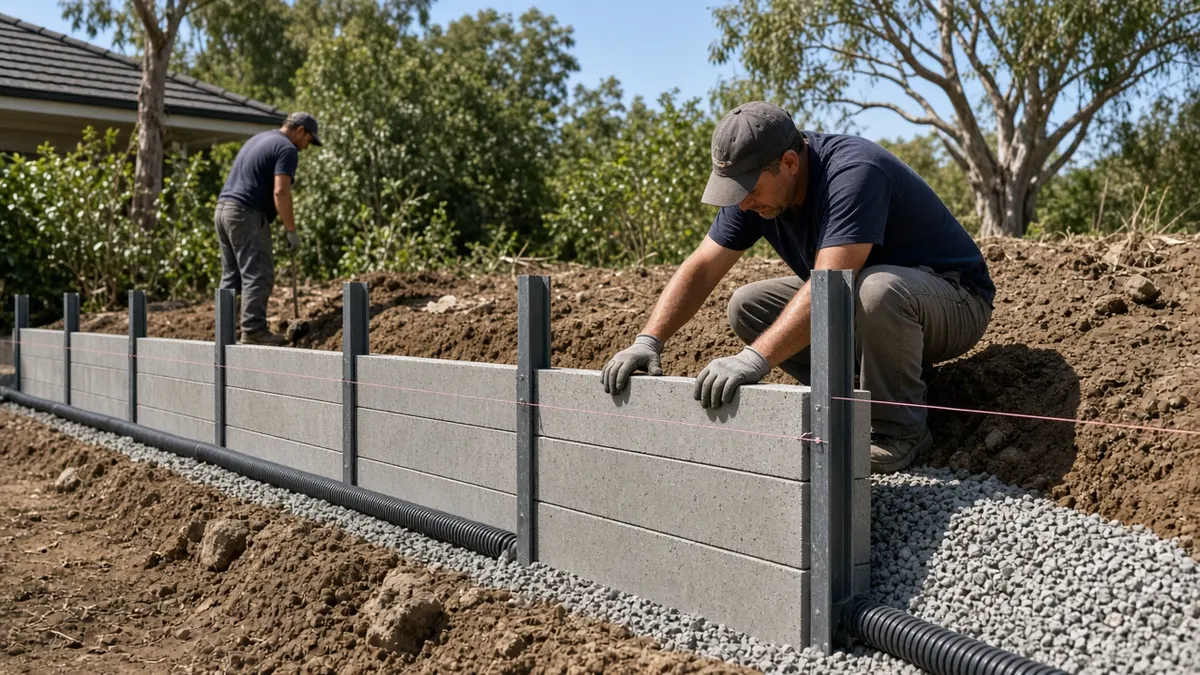
A retaining wall costs about $250 to $1,000 per square metre of wall face installed in 2026, GST included. A 10 m long, 600 mm high treated pine sleeper wall might come in around $2,500 to $3,500, while a 1.5 m engineered block wall along a sloping boundary can easily pass $20,000.
Retaining walls are priced by the square metre of face, which is length times exposed height. The part you see is only half the story, though. What sits behind and below the wall, including the footing, drainage, gravel backfill and the soil that has to be dug out and trucked away, is often where the money goes. This guide covers prices for each wall type, the hidden costs, approvals and engineering, and three costed examples. Treat all figures as indicative, and get at least three written quotes based on the same design.
Retaining wall prices by material
| Wall type | Installed per m² of face | Typical life | Good for |
|---|---|---|---|
| Treated pine sleepers, timber posts | $250 to $450 | 15 to 25 years | Low garden walls, budget jobs |
| Hardwood sleepers | $350 to $550 | 20 to 30 years | Low walls with a natural look |
| Concrete sleepers, galvanised steel posts | $350 to $650 | 40+ years | Boundary walls, most suburban jobs |
| Limestone blocks (mainly WA) | $350 to $700 | 50+ years | Perth and coastal WA sites |
| Interlocking segmental concrete blocks | $450 to $850 | 50+ years | Curves, terraces, taller walls with geogrid |
| Gabion baskets | $450 to $900 | 30 to 50 years | Drainage-heavy sites, modern look |
| Core-filled concrete block (Besser), reinforced | $550 to $1,000 | 50+ years | Taller structural walls, rendered finishes |
| Sandstone blocks | $600 to $1,200 | 50+ years | Feature walls, Sydney sandstone areas |
| Poured reinforced concrete | $700 to $1,400 | 50+ years | Heavy loads, basements, steep cuts |
| Rock or boulder wall | $300 to $700 | 50+ years | Rural and bush blocks with machine access |
Prices assume walls up to roughly 1 to 1.2 m on a site where a small excavator or bobcat can get in. Taller walls cost more per square metre, not just in total, because the footing gets bigger, the posts or blocks get heavier, and an engineer has to design it.
The costs behind the wall
Two quotes for the same length of wall can differ by thousands because one includes the groundwork and the other does not. Check each quote for these items.
Excavation and spoil
Cutting into a slope to create a flat area means digging out soil and getting rid of it. Machine excavation plus truck or skip disposal typically costs $60 to $150 per cubic metre, depending on access, soil type and tip fees. A 10 m wall cut 1 m into a slope can easily produce 10 to 15 m³ of spoil once you allow for the footing and backfill zone. Rock adds cost fast: a hydraulic hammer on a small excavator can turn a two-day dig into a week.
Drainage
Water is the main reason retaining walls fail. A wall that holds back wet soil carries far more pressure than one with good drainage. A proper job has a slotted ag pipe at the base wrapped in geofabric or laid in a sock, 300 mm or so of clean drainage gravel behind the wall, and an outlet to a stormwater point or a safe discharge area. Expect $40 to $100 per linear metre for drainage, and more if a plumber needs to connect it to the stormwater system.
Footings
Sleeper walls need posts set in concrete at a depth that matches the height of the wall, often similar to or greater than the exposed height. Block walls need a compacted base or a concrete strip footing. Masonry and poured walls need reinforced concrete footings designed by an engineer.
Access
If machines cannot get to the wall, everything is dug and carried by hand. That can double the labour cost, especially for heavy concrete sleepers, which weigh 60 to 90 kg each.
Demolition of an old wall
Removing a rotten sleeper wall or a failed block wall typically costs $50 to $150 per m² of face, more if the old wall was concrete.
Engineering and approval
Engineer's design for a residential retaining wall usually costs $800 to $3,000, and council or certifier approval can add $500 to $2,500 or more. The structural engineer cost guide explains what an engineer's design and inspection includes.
How prices vary by city
Local materials, soil and labour rates make a real difference. The table shows typical installed prices for a concrete sleeper wall with steel posts, under 1 m high, including standard drainage but excluding major excavation.
| City | Concrete sleeper wall per m² | Local factors |
|---|---|---|
| Sydney | $420 to $650 | Sandstone rock, steep blocks, high labour rates |
| Melbourne | $380 to $600 | Reactive clay needs deeper post footings |
| Brisbane | $380 to $620 | Hilly suburbs, heavy summer rain makes drainage critical |
| Perth | $350 to $560 | Sand digs easily; limestone blocks often cheaper |
| Adelaide | $350 to $560 | Clay in many suburbs, lower labour rates |
| Hobart | $400 to $640 | Dolerite rock and steep sites |
| Canberra | $400 to $630 | Higher labour rates, frost affects concrete timing |
| Darwin | $430 to $680 | Freight, wet season scheduling, tropical downpours |
The wall type that is cheapest also changes with the city. Limestone is often the value pick in Perth, sandstone can compete in parts of Sydney, and concrete sleepers are the most common choice almost everywhere else.
Labour rates for the trades involved
On an average retaining wall, labour and machine time make up 50% to 65% of the cost. Typical 2026 rates:
- Landscapers and wall builders: $60 to $95 per hour, though most quote a fixed price.
- Mini excavator or bobcat with operator: $110 to $180 per hour, often with a minimum of four hours plus float delivery.
- General labourers for digging, barrowing gravel and carrying sleepers: $45 to $70 per hour. Our landscaper hourly rate guide has more on trade rates.
- Structural engineer: usually a fixed fee for design and sometimes an inspection of footings.
- Plumber for stormwater connection: $100 to $150 per hour plus materials.
Three retaining walls, costed
Low sleeper wall in Baulkham Hills, NSW
A family wants to level a sloping backyard for a lawn. The plan is a 12 m treated pine sleeper wall, 800 mm high, on H4 timber posts, with ag drainage behind it. The bobcat can get in through the side gate.
| Item | Cost (incl. GST) |
|---|---|
| Sleeper wall, 12 m by 0.8 m (9.6 m² at $380 per m²) | $3,650 |
| Ag pipe, geofabric and drainage gravel, 12 m | $660 |
| Excavation, levelling and spoil removal | $1,100 |
| Total | $5,410 |
A wall this height in NSW may or may not need approval depending on how far it is from the boundary and whether it involves fill or cut. The exempt development rules are specific, so check the NSW Planning Portal or ask council before building.
Engineered concrete sleeper wall in Ashgrove, Brisbane
A steep block where the owners want a flat area for a pool. They need an 18 m wall, 1.2 m high, near the side boundary. The wall is over 1 m and close to a boundary fence, so it needs engineering and building approval.
| Item | Cost (incl. GST) |
|---|---|
| Concrete sleepers and galvanised H-posts, 18 m by 1.2 m (21.6 m² at $520 per m²) | $11,230 |
| Engineer's design | $1,400 |
| Certifier and approval fees | $1,500 |
| Drainage with stormwater connection | $1,600 |
| Excavation, rock breaking allowance and spoil removal | $3,200 |
| Total | $18,930 |
Groundwork, engineering and approval add about 70% on top of the wall itself here, which is common on steep Brisbane blocks. If the pool and wall are designed together, the pool builder may include the wall in their engineering.
Limestone block wall in Joondalup, Perth
A new home on a sandy block with a 1 m fall to the rear neighbour. The owner builds a 20 m limestone block wall, 1 m high, along the rear boundary before the Colorbond fence goes on top.
| Item | Cost (incl. GST) |
|---|---|
| Limestone blocks laid on a compacted base, 20 m² at $460 per m² | $9,200 |
| Sand removal, levelling and compaction | $900 |
| Drainage behind the wall | $800 |
| Total | $10,900 |
Perth's sand is easy to dig, which keeps groundwork down. Fences on top of retaining walls usually need the wall to be designed for the extra wind load on the fence posts, so tell the wall builder if a fence will go on top. The fencing cost guide covers the fence itself.
Approvals, engineers and licences
Every state and many councils set their own height limits for walls that can be built without approval, and the trigger often depends on the distance from the boundary and from buildings as well as height. As a rough guide:
- Low garden walls, often up to around 600 mm and set back from the boundary, are commonly allowed without approval, but conditions apply.
- Walls around 1 m and higher usually need approval and an engineer's design.
- Any wall supporting a load above it, such as a driveway, a house, a pool or another wall, needs engineering regardless of height.
- Walls on or near a boundary, in flood or landslip zones, or in heritage areas often need approval even when low.
In Queensland, walls over 1 m high, or close to a building or another wall, generally need building approval; confirm the current trigger with your certifier or the QBCC. In NSW, the exempt and complying development rules on the NSW planning website set out when a wall can be built without a development application. In Victoria, talk to your council or a registered building surveyor. In other states, ask the council first.
Licensing depends on the job value and state. In NSW, residential building work over $5,000 generally needs a licensed contractor through NSW Fair Trading. In Queensland most building work over $3,300 needs a QBCC licence. In Victoria, domestic building work above the registration threshold must be done by a builder registered with the Building and Plumbing Commission, which replaced the VBA in 2025; check the current threshold with them. Landscapers who build walls usually hold the relevant licence, but ask for the number and check it online.
Always lodge a free Before You Dig Australia enquiry before excavation. Retaining wall digs regularly expose water, sewer, gas and power lines.
Boundary walls and who pays
Retaining walls on a boundary are a common source of neighbour disputes. Dividing fence laws in most states deal with fences, not retaining walls, and the general principle is that the owner who changed the natural ground level, by cutting or filling, is responsible for retaining it. That often means a developer or a previous owner, which is not much help to you now.
If both neighbours benefit, for example where an old wall is failing and both yards are at risk, owners often agree to share the cost. Put any agreement in writing, including who owns and maintains the wall afterwards. If a wall is failing and threatening your property and you cannot agree, get legal advice early. A surveyor's report showing where the boundary runs is a good starting point.
Signs your existing wall needs work
- Leaning outward or bulging in the middle.
- Rotten or split sleepers, especially near the base, or posts that move when pushed.
- Cracks in block or masonry walls that are widening.
- Water seeping through the face, soggy ground at the base, or white salt deposits on masonry.
- Soil washing out from under or between sleepers.
- Fences on top of the wall starting to tilt.
A small lean on a low garden wall can often be fixed by replacing a few sleepers and adding drainage. A tall wall that is moving is a safety issue and needs an engineer to look at it before anyone digs near it. Never excavate at the base of a leaning wall to 'take the pressure off'.
Choosing the right wall for the job
Treated pine sleepers are the cheapest and easiest to build, but they are timber in contact with wet soil, so they do not last forever. Use them for low garden beds and terraces, not boundary walls you want to forget about.
Concrete sleepers with steel posts are the workhorse of suburban retaining. They are fast to build, last for decades, are available in plain, timber-look and stone-look finishes, and fit neatly under a Colorbond fence.
Segmental blocks handle curves well and can go taller with geogrid reinforcement layers in the backfill. They need room behind the wall for that geogrid, which matters on tight boundaries.
Masonry and poured concrete make sense for structural walls, walls supporting driveways or buildings, and rendered walls that match the house. They are the most expensive and need an engineer.
Sandstone and limestone look great and last a lifetime. They are best value where they are quarried locally: sandstone around Sydney, limestone around Perth.
Can you build a retaining wall yourself?
A low treated pine sleeper garden wall, up to a few courses high, is a reasonable DIY job. Materials cost roughly $100 to $180 per m² for sleepers, posts, concrete and drainage. The hard parts are digging deep enough post holes, getting posts plumb and in line, and doing the drainage properly instead of just backfilling with clay.
Anything over about 600 mm, on a boundary, near a building or supporting a load is a different matter. Mistakes can mean a wall that falls into your neighbour's yard, with liability to match. For those, use a licensed builder or landscaper working to an engineer's design. Many owners save by doing the labour-heavy parts themselves or with hired help: clearing plants, barrowing gravel, carrying sleepers and cleaning up.
Cutting the cost sensibly
- Terrace instead of one tall wall. Two 600 mm walls stepped back from each other can avoid the engineering and approval a single 1.2 m wall would need, and they look softer. Check with council, as stepped walls close together can still be treated as one.
- Reuse the spoil. If you need fill elsewhere on the block, spreading the excavated soil on site saves disposal fees.
- Plan with other work. If you are building a pool, driveway or extension, have the wall designed and built at the same time so the excavator only comes once. The paving cost guide is useful if the new level area will be paved.
- Do not skimp on drainage. It is a small part of the price and the main thing that keeps the wall standing.
What to expect on site
On a typical sleeper wall, day one is set-out and excavation. The builder marks the line, the excavator cuts the bank back and digs post holes, and spoil is loaded straight into a truck or skip. Posts are concreted in and left to firm up. Day two or three is sleepers, drainage pipe and gravel, then backfill and compaction behind the wall, with a final level and clean-up. Block walls follow a similar rhythm but start with a compacted base or strip footing.
Expect machinery noise, a muddy driveway if it rains, and possibly a skip on the street that needs a council permit. Move cars, outdoor furniture and pot plants out of the way, and tell neighbours if the work is near the boundary. If the excavator needs to come through a side gate, measure the gap: many mini excavators need around 1 m clear.
What the quote should include
A clear quote shows the length and exposed height of each wall, the material and product, post or footing specifications, drainage details and outlet, excavation volume and how spoil will be handled, backfill material, and who is responsible for engineering, approval and Before You Dig. It should state the builder's licence number where required, insurance and warranty. A price per square metre with no detail about drainage or footings is not something to sign.
Getting labour help through Yakka
Retaining walls are heavy work. Concrete sleepers, drainage gravel, wheelbarrows of spoil and the clean-up at the end take a lot of hands, and you do not need a licensed builder for all of it. Yakka connects you with workers by the shift to clear the site, dig by hand where machines cannot reach, carry materials and tidy up afterwards.
For the wall itself, you can find a retaining wall builder or book an excavation contractor. Structural walls, engineering and any work your state requires a licence for stay with licensed professionals.
Frequently asked questions
How much does a retaining wall cost per square metre?
Most retaining walls cost $250 to $1,000 per square metre of wall face installed in 2026, including GST. Treated pine sleepers start around $250, concrete sleepers with steel posts $350 to $650, segmental blocks $450 to $850, and core-filled masonry or sandstone $550 to $1,200. Excavation, drainage, engineering and approvals can add 30% to 70%.
What is the cheapest type of retaining wall?
Treated pine sleepers on timber posts are usually the cheapest at about $250 to $450 per m² installed, and you can build a low one yourself for $100 to $180 per m² in materials. They last 15 to 25 years. Concrete sleepers cost more upfront but last much longer, so they are often better value for boundary walls.
Do I need council approval for a retaining wall?
It depends on the height, distance from the boundary and buildings, and what the wall supports. Low garden walls, often up to around 600 mm and set back from boundaries, are commonly exempt, but conditions apply. Walls around 1 m or higher, on boundaries, or supporting driveways, buildings or pools usually need approval and engineering. Check with your council or certifier first.
When does a retaining wall need an engineer?
Generally when the wall is around 1 m or higher, when it supports a load such as a driveway, house, pool or another wall, or when it sits on difficult soil or a steep slope. Council or a certifier may also ask for engineering on lower boundary walls. An engineer's design for a house-scale wall usually costs $800 to $3,000.
Who pays for a retaining wall on a boundary?
Generally the owner who changed the natural ground level by cutting or filling is responsible for retaining it. Dividing fence laws mostly cover fences, not retaining walls. Neighbours often agree to share costs when both benefit, such as replacing a failing wall. Put any agreement in writing and get legal advice if a failing wall is in dispute.
How long does it take to build a retaining wall?
A low sleeper or block wall up to 15 m long usually takes two to four days, including excavation and drainage. Taller engineered walls with approvals take longer: allow several weeks for design and approval, then one to two weeks on site. Rock, wet weather and difficult access all add time.
How long do treated pine retaining walls last?
A well-built treated pine sleeper wall with H4 or higher treated timber and good drainage usually lasts 15 to 25 years. Poor drainage, wet clay soils and low-grade timber shorten that. Concrete sleepers with galvanised steel posts typically last 40 years or more, which is why they are popular for boundary walls.
Official sources
Award rates, licences and safety rules change. Check the official source before you hire or take on a shift.
- Queensland Building and Construction Commission (QBCC)Contractor, plumbing and drainage licence search in Queensland
- NSW Fair TradingTrade licence checks for electricians, plumbers and builders in New South Wales
- Building and Plumbing Commission (Victoria)Builder and plumber registration, domestic building insurance and licence checks in Victoria