Outdoor cost guide
Artificial Grass Cost in Australia: 2026 Prices per m²
Typical cost in Australia (2026, inc. GST)
$70 to $130 per m²
supply and install on a new compacted base, typical suburban backyard of 30-150 m²
Professionally installed artificial grass costs about $70 to $130 per m² in Australia in 2026, including GST. A 50 m² backyard usually lands between $3,800 and $6,500. The turf itself is only a third to a half of the bill. Excavation, a compacted crushed-rock base, edging, access and disposal of the old lawn make up the rest, and small areas cost more per m².
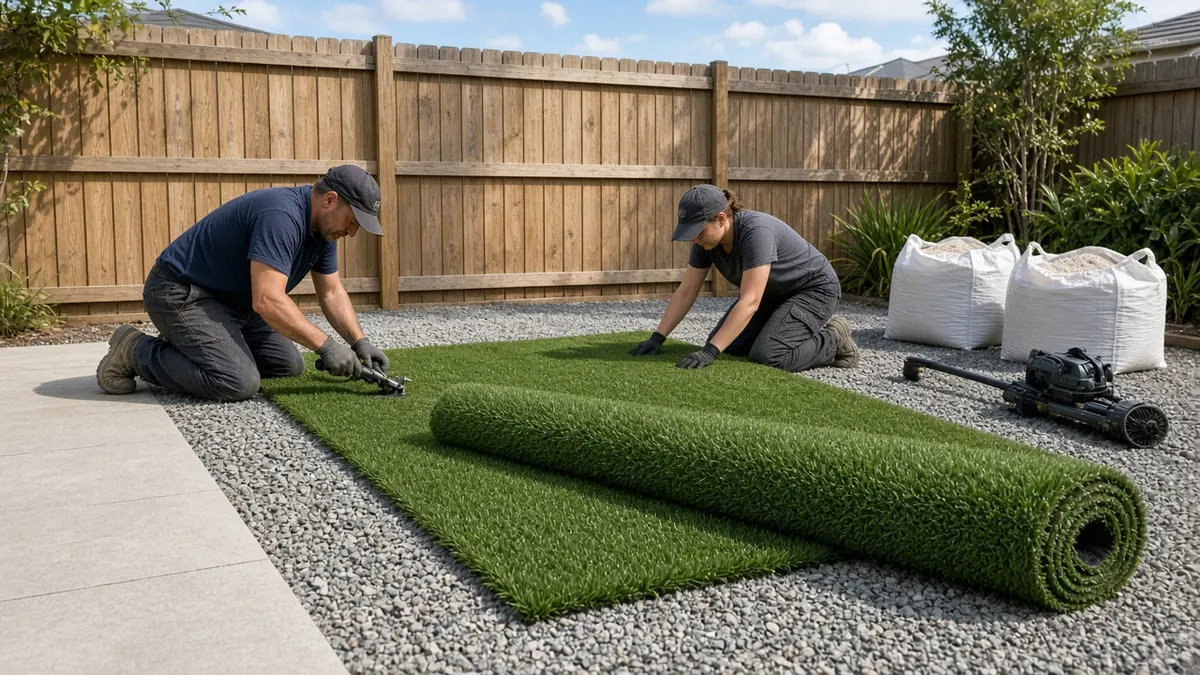
Artificial grass in Australia costs roughly $70 to $130 per square metre fully installed in 2026, including GST. Most suburban backyards between 40 and 80 m² end up somewhere between $3,500 and $8,000, with the final number set more by what is under the turf than by the turf you pick.
That last point surprises a lot of people. They walk into a showroom, see synthetic turf priced at $35 per m² and assume the job will cost about that. It won't. A proper install means digging out the old lawn, carting it away, laying and compacting a crushed-rock base, fixing edging and then laying, joining and infilling the turf. Skip any of those steps and the lawn ripples, holds puddles or grows weeds through the joins within a couple of years.
The figures below are indicative only. Prices move with your soil, access and location, so get at least three written quotes that spell out the base depth and materials before you commit.
Installed price by lawn size
Installers have fixed costs on every job: getting a crew and a bobcat or mini loader to site, a minimum tip load, cutting and joining time. On small areas those costs are spread over fewer square metres, so the rate per m² goes up. On big areas it comes down.
| Area | Typical installed cost | Approx. rate per m² | Usual time on site |
|---|---|---|---|
| Balcony or courtyard, 10-20 m² | $1,200 to $3,200 | $90 to $160 | Half a day to 1 day |
| Small backyard, 30-50 m² | $3,000 to $6,500 | $75 to $130 | 1 to 2 days |
| Medium backyard, 80-100 m² | $6,000 to $12,000 | $70 to $120 | 2 to 3 days |
| Large yard, 150-200 m² | $10,500 to $23,000 | $65 to $115 | 3 to 5 days |
| Over existing concrete or pavers | $55 to $95 per m² | $55 to $95 | Half a day to 2 days |
Laying over concrete is cheaper because there is no excavation or base work. You still pay for a foam shock pad or underlay, adhesive and labour, and you need the slab to drain properly. Turf glued to a flat slab with no fall turns into a sponge after rain.
Where the money goes on a typical job
Here is a rough breakdown of a standard soil-based install, per square metre. The ranges are wide because a flat, sandy Perth block and a sloping clay block in Sydney's Hills district are very different jobs.
| Item | Typical cost | What it covers |
|---|---|---|
| Remove old lawn and excavate 75-100 mm | $12 to $30 per m² | Turf cutter or loader, labour, loading, tip fees for soil and green waste |
| Crushed-rock or roadbase sub-base, 50-75 mm | $10 to $20 per m² | Supply, spreading, wetting and compacting with a plate compactor |
| Fine top layer (crusher dust or decomposed granite) | $4 to $10 per m² | 10-20 mm screeded layer that gives a smooth finish |
| Weed membrane, pegs, joining tape and glue | $4 to $8 per m² | Consumables that stop weeds and hold seams together |
| Synthetic turf (supply) | $25 to $65 per m² | Depends on pile height, density, yarn type and UV warranty |
| Infill (silica sand or zeolite) | $3 to $8 per m² | Weighs the turf down, keeps fibres upright, helps with pet odour |
| Laying, cutting and joining labour | $12 to $30 per m² | Rolling out, seaming, trimming around edges, brushing in infill |
| Edging | $20 to $60 per linear metre | Treated pine, steel, aluminium or a concrete mowing strip |
Add those up and you land around $75 to $170 per m² before economies of scale, which is why a well-quoted medium yard comes in near the middle of the headline range and why cut-price quotes usually skimp on the base.
Choosing the turf itself
Product quality matters, but not as much as the sales pitch suggests. A mid-range turf on a good base will outlast a premium product on a bad one. Here is what actually separates the cheap rolls from the expensive ones.
Pile height
Most residential turf is between 25 and 40 mm. Shorter pile (25-30 mm) suits high-traffic areas, kids and dogs because it springs back better and is easier to clean. Longer pile (35-40 mm) looks lusher from the back door but flattens in walkways unless it is dense and well infilled.
Density and stitch rate
Denser turf has more fibres per m², looks more natural and hides the backing. It also costs more and weighs more. Ask for the face weight or stitch count on the spec sheet and compare like with like.
Yarn and backing
Polyethylene yarn is soft and common. Nylon is tougher but harsher underfoot. Some products blend in a brown "thatch" fibre to mimic dead grass at the base, which looks more realistic. A perforated or fully permeable backing drains faster, which matters for pets and for heavy summer storms in Brisbane or Darwin.
UV rating and warranty
Australian sun destroys cheap imported turf. Look for products tested for Australian UV levels with a written fading warranty, typically 7 to 10 years on residential products. A warranty that only covers "manufacturing defects" is close to worthless for fading.
As a rule of thumb, budget turf runs $25 to $35 per m², mid-range $35 to $50 and premium $50 to $65 or more for supply only. For most family backyards, a dense 30-35 mm mid-range product is the sweet spot.
Three worked examples
These are realistic jobs priced at 2026 rates, including GST. Your quotes will differ, but they show how the line items stack up.
Example 1: 45 m² backyard in Blacktown, NSW
A three-bedroom brick veneer with a patchy kikuyu lawn, flat clay soil and 1.2 m side access. The owner wants a family-friendly 35 mm turf with timber edging along garden beds.
| Line item | Cost |
|---|---|
| Remove kikuyu, excavate 80 mm and dispose (45 m² x $18) | $810 |
| Roadbase plus crusher dust, compacted (45 m² x $15) | $675 |
| Weed mat, pegs, joining tape, glue | $200 |
| 35 mm mid-range turf, 50 m² ordered to allow for offcuts (x $38) | $1,900 |
| Treated pine edging, 20 linear metres (x $25) | $500 |
| Silica sand infill | $180 |
| Laying, joining and finishing labour | $1,100 |
| Total including GST | $5,365 (about $119 per m²) |
The kikuyu is the hidden risk here. It spreads by runners and will push up through joins unless the installer digs out the runners properly and uses a good weed membrane. Ask how they handle it.
Example 2: 12 m² apartment balcony in Richmond, VIC
Tiled balcony with a good fall to a floor waste, lift access only. The owner wants a soft surface for a dog and a couple of chairs.
| Line item | Cost |
|---|---|
| Foam drainage underlay (12 m² x $15) | $180 |
| Pet-friendly 30 mm turf with perforated backing, 14 m² (x $45) | $630 |
| Adhesive, tape, zeolite infill | $140 |
| Labour (minimum half-day charge) | $500 |
| Carrying materials through building, parking | $100 |
| Total including GST | $1,550 (about $129 per m²) |
Check your strata by-laws before ordering. Some buildings restrict balcony floor coverings because of waterproofing warranties, and the turf must not block the floor waste.
Example 3: 120 m² front and back yard in Logan, QLD
Lowset brick home with a gentle slope and a soggy corner that holds water after storms. Budget-conscious owner happy with a 30 mm entry-level product.
| Line item | Cost |
|---|---|
| Excavation and disposal (120 m² x $16) | $1,920 |
| Compacted crushed-rock base (120 m² x $14) | $1,680 |
| Ag pipe and gravel trench across the soggy corner, 15 m | $900 |
| 30 mm budget turf, 130 m² ordered (x $36) | $4,680 |
| Steel edging, 40 linear metres (x $25) | $1,000 |
| Membrane, consumables and infill | $600 |
| Laying and finishing labour | $2,000 |
| Total including GST | $12,780 (about $106 per m²) |
If the ag pipe needs to connect into the property's stormwater line rather than discharging to a gravel soak, that connection is plumbing or drainage work for a licensed plumber, so expect another few hundred dollars.
Prices around the country
Rates vary by city because labour costs, tip fees, soil types and freight differ. These are typical installed ranges for a standard backyard job.
| City or region | Typical installed rate | Why |
|---|---|---|
| Sydney | $80 to $140 per m² | High labour and tip fees, clay soils, tight access in older suburbs |
| Melbourne | $75 to $130 per m² | Reactive clay in the west and north often needs a deeper base |
| Brisbane | $70 to $125 per m² | Drainage work is common because of heavy summer storms |
| Perth | $65 to $120 per m² | Sandy soil drains well and is quick to excavate |
| Adelaide | $65 to $120 per m² | Competitive market, moderate labour rates |
| Canberra | $75 to $135 per m² | Smaller pool of installers, frost heave on poorly prepared bases |
| Hobart | $75 to $135 per m² | Freight on turf and fewer specialist installers |
| Darwin | $85 to $150 per m² | Freight, wet season scheduling, heat-rated products |
| Regional areas | Add 10% to 25% | Travel time, delivery and accommodation for the crew |
What pushes a quote up or down
- Access. If a mini loader can't get down the side of the house, every barrow of soil and rock goes by hand. That can add $10 to $25 per m² on a small yard.
- Soil and slope. Heavy clay, rock or a slope that needs levelling means more digging, more base material and sometimes a small retaining edge.
- Existing lawn. Couch and kikuyu need thorough removal. Some installers spray first and come back a week or two later, which adds a visit.
- Drainage. Low spots, downpipes that discharge onto the lawn and clay that holds water all need fixing before turf goes down.
- Edges and shapes. Curved garden beds, lots of trees and pavers to cut around add labour and offcut wastage. Wastage on fiddly shapes can reach 15%.
- Turf choice. Going from budget to premium turf can add $20 to $30 per m², or $1,000 to $1,500 on a 50 m² yard.
- Extras. Concrete mowing strips, garden bed rebuilds, irrigation capping and putting greens all add cost.
Synthetic or real turf: the 10-year sums
Real turf is far cheaper up front. Supplying and laying a quality couch or buffalo turf on prepared soil costs roughly $25 to $45 per m². The gap closes over time once you add mowing, water, fertiliser and the odd patch repair.
| Cost over 10 years, 50 m² backyard | Artificial grass | Real turf |
|---|---|---|
| Upfront install | $4,000 to $6,500 | $1,300 to $2,300 |
| Mowing (DIY fuel and servicing, or paid mowing) | $0 | $1,500 to $7,000 |
| Water, fertiliser, weed and grub treatments | $100 to $400 | $1,000 to $2,500 |
| Top-up infill, brushing, minor repairs | $300 to $800 | $200 to $600 (returfing patches) |
| Approximate 10-year total | $4,400 to $7,700 | $4,000 to $12,400 |
If you mow it yourself, real grass usually wins on cost. If you pay someone, the numbers favour synthetic within about 6 to 10 years. Our lawn mowing cost guide has per-visit prices if you want to run your own numbers.
Cost is not the only factor. Synthetic turf gets much hotter than real grass in full summer sun, it does not cool the yard the way living plants do, and it ends up in landfill when it wears out because recycling options are still limited. Real grass handles heavy wear badly in shade, which is exactly where synthetic turf earns its keep. The Australian Government's Your Home guide is a useful reference on designing outdoor spaces for shade and heat.
Doing it yourself
A handy owner can lay a small area. On a 20-30 m² yard, DIY can save $1,000 to $2,500, mostly in labour. The materials cost is similar either way, and you may pay more per m² for turf because trade installers get better pricing.
Expect to hire a turf cutter ($120 to $200 a day), a plate compactor ($80 to $150 a day) and possibly a skip or a trailer for the old lawn and soil. Excavated clay is heavy. A 50 m² area dug to 80 mm produces about 4 m³ of soil, which is several tonnes and more than a standard trailer should carry in one trip. See our skip bin hire cost guide for bin sizes and prices.
The steps that go wrong most often for DIYers are compaction (one pass is not enough), running the turf in different directions so the pile colour looks patchy, and seams that show because the edges were cut badly. If you are going DIY on anything bigger than a courtyard, consider paying a pro to do the base and laying the turf yourself, or the other way around.
Licences, approvals and rules
Laying synthetic turf in your own backyard does not normally need council approval. A few situations change that:
- Nature strips and verges. The strip between your boundary and the road usually belongs to council. Many councils restrict or ban synthetic turf there, so check before you lay anything.
- Strata properties. Balconies and common property fall under by-laws. Get written approval from the owners corporation or body corporate first.
- Drainage connections. Connecting new drains into stormwater is plumbing or drainage work in most states and needs a licensed plumber.
- Bigger landscaping jobs. If the job includes retaining walls, paving or other structural landscaping over your state's licensing threshold, the contractor may need a building licence. In NSW check with NSW Fair Trading, and in Queensland check the current threshold and licence classes with the QBCC.
Asbestos is rare in lawn jobs, but some older homes have fibro sheeting buried in yards from past renovations. If an installer digs up fragments of grey fibrous sheeting, stop work and get it tested.
Upkeep, lifespan and what wears it out
A decent residential turf on a good base lasts about 10 to 15 years. Heavy use from big dogs, kids' football games or constant shade and leaf litter can bring that down to 8 years or so.
Maintenance is light but not zero. Plan to:
- Blow or rake off leaves every week or two so they don't rot into the infill.
- Rinse pet areas regularly. Zeolite infill helps with odour, and a perforated backing helps urine drain.
- Power brush high-traffic areas against the grain a few times a year to lift flattened fibres.
- Top up infill every couple of years.
- Keep hot items off it. Barbecue coals, cigarette butts and even sunlight reflected from some low-E glass windows can melt the fibres.
Weeds can still grow in windblown dust and debris on top of the turf. A spot spray or quick pull a few times a year keeps on top of them.
Ways to spend less without a worse result
The base is the last place to save money. These are the savings that hold up over time:
- Do the removal yourself. Cutting out the old lawn and filling a skip before the installer arrives can knock $8 to $15 per m² off the quote. Confirm the depth and finish they want first.
- Pick mid-range turf. The jump from mid-range to premium is mostly about looks from close up. In a family yard, density and UV warranty matter more than the extra 5 mm of pile.
- Keep shapes simple. Straightening a wavy garden bed edge cuts labour and offcut waste.
- Book in the cooler months. Installers are busiest from late spring into summer. Autumn and winter bookings are often easier to get and sometimes cheaper, although wet weather can delay base work.
- Combine jobs. If paving or a path is planned, get one contractor to do the excavation for both at the same time.
How to compare installer quotes
Get at least three written quotes and compare them line by line. A good quote spells out:
- The exact turf product, its pile height and its UV warranty in writing.
- Excavation depth and what happens to the spoil.
- Base material type and depth, and how it will be compacted.
- Edging type and linear metres.
- Whether weed membrane and infill are included.
- Workmanship warranty, separate from the product warranty.
- Payment terms. A modest deposit is normal; be wary of anyone wanting most of the money before they start.
Red flags include quotes priced only per m² with no detail on the base, "we lay straight over your existing soil", cash-only pricing with no invoice, no public liability insurance and pressure to sign on the day.
Getting help with the labour
Much of an artificial grass job is plain hard work: cutting out old turf, barrowing soil to a skip, spreading and compacting rock. Yakka Labour lets you book labourers by the shift or job for that groundwork, which suits owners who want to lay the turf themselves or keep a specialist installer's time focused on the final layer.
You can also find lawn and turf specialists, landscapers and gardeners and rubbish removal help on the platform. For drainage connections into stormwater, use a licensed plumber.
Pairing turf with other outdoor work
Synthetic turf is often one part of a bigger backyard makeover. If you are also adding a patio or path, our paving cost guide covers prices per m² by material, and the decking cost guide covers timber and composite decks. Doing the paving and turf in the same project usually saves money because the excavation and base work can be done in one go with one machine hire.
Frequently asked questions
How much does artificial grass cost per m2 in Australia?
Installed artificial grass typically costs $70 to $130 per m² in 2026, including GST. Supply-only turf ranges from about $25 to $65 per m² depending on quality. Small areas such as balconies cost more per m² because of minimum charges, and large flat yards with good access come in toward the lower end.
Is artificial grass worth it?
It is worth it if you pay for mowing, have a shady or high-traffic area where real grass struggles, or want a low-maintenance yard. It is harder to justify if you mow yourself and have good sun, because real turf costs far less to install. Also weigh up the extra heat in summer and the disposal problem at the end of its life.
How long does artificial grass last in Australia?
A good-quality residential product on a properly prepared base usually lasts 10 to 15 years. Heavy use from dogs and children, poor drainage, lots of leaf litter or a cheap product without an Australian UV rating can shorten that to around 8 years. Regular brushing and infill top-ups help it last longer.
Can you lay artificial grass on dirt?
You should not lay it straight on soil. Soil moves, settles and holds water, so the turf ends up lumpy and weeds grow through. The standard method is to excavate 75 to 100 mm, lay and compact a crushed-rock base, add a fine top layer and weed membrane, then lay the turf. That base is where most of the installation cost goes.
How long does it take to install artificial grass?
Most backyards between 30 and 100 m² take one to three days. A balcony or concrete area can be done in half a day. Large yards, poor access, drainage work or rock in the soil can stretch it to four or five days. Wet weather delays base work because the rock cannot be compacted properly when the ground is saturated.
Is artificial grass good for dogs?
It can be, provided you pick a pet-friendly product with a perforated or fully permeable backing and use zeolite infill to control odour. Shorter, denser pile around 25 to 30 mm is easier to clean. You still need to pick up waste and hose urine areas regularly, especially in hot weather when smells build up quickly.
Do I need council approval for artificial grass?
Not usually for a private backyard. Approval is often needed if you want to lay it on the council nature strip or verge, and strata properties need owners corporation or body corporate consent for balconies or common areas. Check your council website and your strata by-laws before buying turf.
Official sources
Award rates, licences and safety rules change. Check the official source before you hire or take on a shift.
- Queensland Building and Construction Commission (QBCC)Contractor, plumbing and drainage licence search in Queensland
- NSW Fair TradingTrade licence checks for electricians, plumbers and builders in New South Wales
- Asbestos Safety and Eradication AgencyWhere asbestos is found in homes and how to deal with it safely