Exterior cost guide
Paving Cost Guide Australia 2026: Pavers, Stone and Labour
Typical cost in Australia (2026, inc. GST)
$90 to $280 per m²
supply and lay on a prepared sand and roadbase bed, concrete pavers to natural stone
Paving in Australia costs about $90 to $150 per m² for concrete pavers, $100 to $170 for clay pavers and $130 to $280 for natural stone such as sandstone, travertine or bluestone in 2026, supplied and laid, including GST. Porcelain pavers run $140 to $260. Excavation, removal of old surfaces, driveway-grade bases, pool coping and access push the total higher.
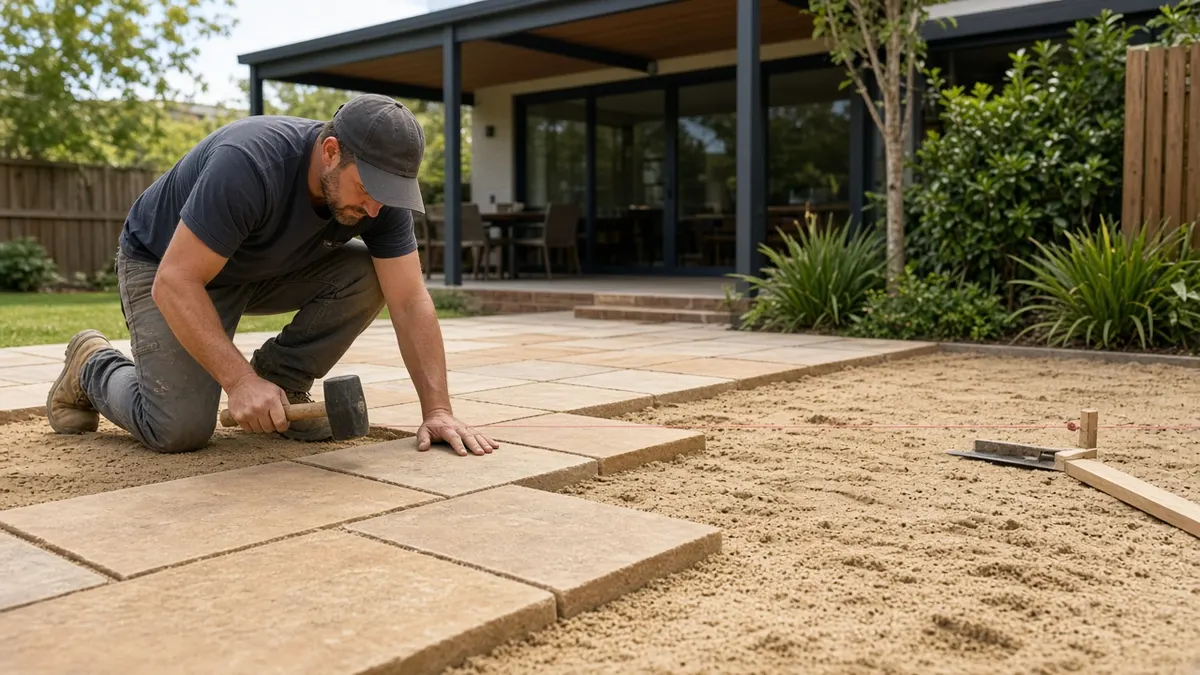
Paving costs about $90 to $280 per m² in Australia in 2026, supplied and laid, including GST. Concrete pavers on a sand bed sit at the cheap end, around $90 to $150 per m², while natural stone like bluestone or granite can reach $280 per m² before you add a concrete base or pool coping.
The paver you pick is only part of the price. Labour, the base underneath and how much digging and carting the site needs often add up to more than the pavers themselves. This guide covers costs by material, what goes into the base, prices for patios, driveways and pool surrounds, and three costed jobs. Figures are indicative, so get at least three written quotes. If you are deciding between pavers and a poured finish, the exposed aggregate concrete cost guide is the obvious comparison.
Paving prices by material
These are typical supply and lay rates for patios and paths on a sand and roadbase bed, with excavation and demolition priced separately.
| Paver type | Pavers only per m² | Supply and lay per m² (incl. GST) |
|---|---|---|
| Concrete pavers | $30 to $65 | $90 to $150 |
| Clay pavers | $40 to $90 | $100 to $170 |
| Permeable pavers | $45 to $85 | $110 to $180 |
| Limestone (common in Perth) | $50 to $110 | $120 to $220 |
| Sandstone | $60 to $130 | $130 to $220 |
| Travertine | $60 to $140 | $140 to $250 |
| Bluestone (basalt) | $80 to $160 | $160 to $280 |
| Granite | $80 to $160 | $150 to $280 |
| Porcelain outdoor pavers, 20 mm | $60 to $140 | $140 to $260 |
| Labour only, client supplies pavers | n/a | $45 to $90 |
Add $20 to $40 per m² for excavation and spoil removal on a grassed area, $15 to $35 per m² to lift old pavers, and $35 to $70 per m² to break out old concrete.
Why the base costs as much as the pavers
Pavers fail from the bottom up. Sunken patches, rocking pavers and wavy driveways nearly always come from a thin or poorly compacted base, not from the pavers themselves. A good quote spends real money below the surface.
Flexible paving: sand and roadbase
Most Australian patios and paths are laid this way. The installer digs out soil, lays and compacts crushed rock (roadbase or crusher dust) in layers, screeds 20 to 30 mm of bedding sand on top, lays the pavers, fixes an edge restraint, then compacts again and sweeps jointing sand in. For foot traffic, 75 to 100 mm of compacted roadbase is common. Driveways need more, often 150 to 200 mm, plus thicker pavers.
Rigid paving: mortar on a concrete slab
Thin natural stone, large-format tiles and pool surrounds are often laid on a mortar bed or adhesive over a concrete slab. It gives a very stable result and suits thin, brittle stone, but you pay for the slab as well, roughly $75 to $120 per m² extra, and it needs proper expansion joints and drainage.
Pedestal systems
Porcelain pavers on adjustable pedestals are used on balconies, rooftops and over waterproofing membranes, where water needs to drain underneath. Pedestals add cost but avoid adding heavy mortar beds to a structure.
Edges, joints and falls
Every flexible pavement needs a solid edge restraint, usually a concrete haunch or edging, or the pavers creep outward. Joints are filled with fine sand or polymeric sand, which sets firm and slows weeds and ants. The surface should fall away from the house, typically around 1 in 100 or more, toward a garden bed or drain.
Costs by area: patios, paths, driveways and pools
| Area | Typical size | Concrete pavers total | Natural stone total |
|---|---|---|---|
| Small courtyard | 15 m² | $1,900 to $3,000 | $2,500 to $4,800 |
| Backyard patio | 30 m² | $3,300 to $5,700 | $4,500 to $9,600 |
| Side path, 1 m wide | 15 m² | $1,800 to $3,000 | $2,500 to $4,800 |
| Driveway, heavier base and pavers | 50 m² | $6,500 to $12,000 | $10,000 to $17,500 |
| Pool surround, plus coping | 40 m² | $7,000 to $11,500 | $10,000 to $20,000 |
The totals include typical excavation for a grassed area but not demolition of old concrete. Stone driveways and many stone pool surrounds assume a concrete base slab. Small jobs tend to sit at the upper end because the paver still needs to bring a plate compactor, saw and materials.
Driveways
A paved driveway costs roughly $20 to $50 per m² more than a patio in the same paver. You need a deeper base, thicker pavers (often 60 to 80 mm), a pattern like herringbone that resists turning tyres, and stronger edge restraints. Clay and concrete pavers suit driveways well. Thin natural stone should be laid on a concrete slab if cars will drive on it. For poured alternatives, see the concrete driveway cost guide.
Pool surrounds
Pool paving adds coping, the edge pieces that sit on the pool wall, which usually cost $90 to $250 per linear metre supplied and laid. Choose a paver with good slip resistance when wet and that stays cool underfoot; pale travertine, sandstone and some porcelain pavers are popular for this reason. Ask for the slip rating tested to AS 4586, and look for a rating suited to wet barefoot areas. Salt pools can erode soft stone, so sealing matters.
Living with each material
Price is one filter. How a paver behaves in your climate and your yard over 20 years is another, and it is where people most often wish they had chosen differently.
Concrete pavers are the workhorse. They come in every colour and size, cost the least and are easy to replace. Cheaper ones can fade in strong sun and show efflorescence, a white bloom, in the first year. Through-coloured pavers hold their colour better than surface-coloured ones.
Clay pavers keep their colour for decades because it is fired in. They suit traditional brick homes and driveways, and the classic red and brown tones never really date. They are harder to cut neatly, which adds a little labour.
Sandstone is soft, warm-toned and stays relatively cool underfoot, which makes it popular around pools. It is porous and marks easily, so it needs sealing and can erode near salt pools if neglected.
Travertine is the other pool favourite: pale, cool and elegant. Tumbled or filled travertine is more slip resistant than polished. Holes in unfilled stone can collect dirt.
Bluestone is dense, hard wearing and very Melbourne. Dark stone gets hot in full summer sun, and sawn bluestone can be slippery when wet unless it has a textured finish.
Limestone is the classic Perth paving stone. It is soft and porous, so it needs sealing, but it suits the sandy local soils and coastal look.
Porcelain pavers resist stains, do not need sealing and come in timber, stone and concrete looks. They need a very flat base, careful cutting with the right tools and a rated slip-resistant finish outdoors.
Permeable pavers let rainwater soak through the joints into a special base. Some councils encourage them to reduce stormwater runoff, and they can help on sites with drainage problems.
Paving prices around the country
| Location | Concrete pavers per m² | Natural stone per m² | Notes |
|---|---|---|---|
| Sydney | $100 to $165 | $160 to $290 | High labour costs and tight access on older blocks. |
| Melbourne | $95 to $160 | $150 to $280 | Bluestone is local and popular. |
| Brisbane | $90 to $150 | $140 to $260 | Sloping blocks often need retaining and steps. |
| Perth | $80 to $135 | $120 to $240 | Sandy soil and lots of paving contractors keep prices keen. Limestone is common. |
| Adelaide | $85 to $140 | $130 to $250 | Reactive clay needs a good base. |
| Canberra | $95 to $160 | $150 to $280 | Frost-resistant pavers matter. |
| Hobart | $95 to $160 | $150 to $280 | Fewer contractors, rocky sites. |
| Darwin | $105 to $175 | $170 to $300 | Freight on pavers and stone, wet season. |
| Regional | $85 to $150 | $130 to $280 | Freight on stone, travel for the crew. |
Three paving jobs with full costings
Concrete paver patio in Rouse Hill, 30 m²
A grassed area behind a project home turned into an entertaining patio with 400 x 400 mm charcoal concrete pavers. Easy side access for a bobcat.
| Item | Cost |
|---|---|
| Excavate turf and soil, 30 m² at $12 | $360 |
| Supply and compact 100 mm roadbase, 30 m² at $14 | $420 |
| Bedding sand and screeding, 30 m² at $5 | $150 |
| Concrete pavers, 32 m² including cuts and waste at $45 | $1,440 |
| Laying labour including cuts, 30 m² at $50 | $1,500 |
| Concrete edge restraint, 22 linear metres at $15 | $330 |
| Jointing sand and final compaction, 30 m² at $4 | $120 |
| Spoil disposal | $350 |
| Subtotal (ex GST) | $4,670 |
| GST | $467 |
| Total | $5,137 |
Excluding excavation and disposal, the paving came to about $145 per m² including GST.
Bluestone pool surround in Doncaster, 40 m²
Old cracked brick pavers around a 1990s concrete pool replaced with sawn bluestone on a new concrete base, plus 28 linear metres of bullnose bluestone coping.
| Item | Cost |
|---|---|
| Lift old pavers and dispose, 40 m² at $25 | $1,000 |
| New 100 mm concrete base slab, 40 m² at $85 | $3,400 |
| Sawn bluestone pavers, 42 m² at $95 | $3,990 |
| Adhesive bed and laying, 40 m² at $85 | $3,400 |
| Bullnose bluestone coping, 28 linear metres at $110 supplied and laid | $3,080 |
| Penetrating sealer, 40 m² at $14 | $560 |
| Grout and expansion joints | $300 |
| Subtotal (ex GST) | $15,730 |
| GST | $1,573 |
| Total | $17,303 |
Leaving out demolition and coping, the stone and its concrete base cost about $320 per m² including GST. Rigid stone on a slab is a premium job, but around a pool it stays flat for decades.
Herringbone paved driveway in Ellenbrook, 50 m²
A gravel driveway replaced with 60 mm concrete pavers laid in herringbone on a deep roadbase. Perth's sandy soil made excavation straightforward.
| Item | Cost |
|---|---|
| Remove gravel and level, 50 m² at $10 | $500 |
| Supply and compact 150 mm roadbase, 50 m² at $20 | $1,000 |
| Bedding sand, 50 m² at $5 | $250 |
| 60 mm concrete pavers, 53 m² at $42 | $2,226 |
| Laying labour including herringbone cuts, 50 m² at $45 | $2,250 |
| Concrete edge restraint, 34 linear metres at $18 | $612 |
| Plate compaction and jointing sand, 50 m² at $4 | $200 |
| Subtotal (ex GST) | $7,038 |
| GST | $703.80 |
| Total | $7,741.80 (about $155 per m²) |
What makes one paving quote higher than another
- Paver size and pattern. Large-format pavers need a flatter base and two people to lift. Herringbone and other angled patterns mean more cuts than stretcher bond.
- Cuts and shapes. Curves, steps, around pool coping, drains and downpipes all mean more cutting.
- Access. If materials have to be barrowed through the house or down a narrow side path, labour goes up. Pallets of pavers are heavy.
- Site levels. Sloping yards need steps, retaining or a cut and fill. The retaining wall cost guide covers that side of things.
- Drainage. Grated drains and stormwater connections add materials and a licensed plumber.
- Demolition. Lifting old pavers is relatively quick; breaking out concrete is slower and generates more waste.
- Sealing. Natural stone and pool areas usually need sealing at $10 to $25 per m².
- Stone variability. Natural stone comes in grades. Cheaper grades have more colour variation, chips and thickness differences, which can add laying time.
Rules, licences and safe cutting
Paving is generally treated as residential building or landscaping work once a job passes your state's money threshold. In NSW, work over $5,000 in labour and materials needs a contractor licensed for that type of work and a written contract; landscapers and bricklayers often hold the relevant classes, and NSW Fair Trading lets you check a licence. In Queensland, ask which QBCC licence class the paver holds; a licence is required for building work valued over $3,300. In Victoria and the other states and territories, check the current threshold with the Building and Plumbing Commission, Building and Energy, Consumer and Business Services, CBOS, Access Canberra or the NT Building Practitioners Board.
Some paving touches other rules. Driveway crossovers on council land need a permit. Pool surrounds must not create climbable objects near the pool barrier, and any temporary fencing changes must keep the pool secure. Paving against the house must not cover weep holes or bridge the damp-proof course, and it should not hide the termite management system; ask your paver and pest inspector how they will keep the slab edge or barrier inspectable. Stormwater drains need a licensed plumber.
Cutting pavers and stone with a dry saw releases crystalline silica dust, which causes silicosis. Pavers and contractors should cut wet or with dust extraction and wear suitable respirators. Safe Work Australia's silica guidance sets out the controls. If you DIY, hire a wet saw rather than dry cutting with an angle grinder.
Doing it yourself
Paving is one of the more DIY-friendly outdoor jobs, especially a small patio or path with concrete pavers on a sand bed. Hire costs for a plate compactor are roughly $80 to $150 a day and a wet saw $80 to $150 a day. You will also need screed rails, a long level, a string line, a rubber mallet and a lot of energy, since a 30 m² patio involves moving several tonnes of roadbase, sand and pavers.
The common DIY mistakes are a base that is too thin or not compacted in layers, no edge restraint, no fall away from the house and pavers laid tight without joints. Get those right and a DIY patio can save you the labour portion, often $45 to $90 per m². Leave driveways, stone on slabs and pool surrounds to professionals unless you have done it before.
Upkeep, sealing and repairs
Paving is cheap to look after. Sweep, wash occasionally and pull the odd weed. A pressure clean every year or two lifts grime and moss, though aggressive cleaning blasts joint sand out, so it needs re-sanding afterwards. The pressure cleaning cost guide covers professional rates.
Sealing is optional for concrete pavers and usual for natural stone, porcelain grout lines and pool areas. A penetrating sealer lasts several years, and resealing typically costs $10 to $25 per m² if you pay for it.
The big advantage of pavers is repairs. A few sunken or cracked pavers can be lifted, the base topped up and the same pavers relaid, often for $50 to $90 per m² for the affected area. Keep a few spare pavers from the original batch, because colours change between production runs.
A paving quote checklist
- Paver name, size, thickness and colour, and the quantity allowed for waste.
- Base type and depth, bedding material and compaction method.
- Laying pattern and edge restraint type.
- Falls, drainage and any stormwater work, with the plumber identified.
- Excavation, demolition and disposal listed separately.
- Sealing, if included, with the product named.
- Licence number where required, public liability insurance and a workmanship warranty.
- A deposit within your state's legal limit and payment tied to progress.
Warning signs include no mention of the base depth, a quote that only lists the paver price, a promise to lay straight onto soil or sand with no roadbase, and big cash deposits.
How long paving takes
A 30 m² patio on an easy site usually takes two to four days: a day of excavation and base, then laying, cutting, edging and compaction. Driveways and stone on a concrete slab take longer, since the slab needs to cure before the stone goes down. Expect a pool surround to take one to two weeks including coping. You can walk on sand-bedded paving as soon as it is compacted and sanded, and drive on a paved driveway once the edge restraints have cured, usually within a few days.
Spending less on paving
- Choose a concrete paver that looks like stone. Modern concrete pavers cost a fraction of natural stone.
- Use standard sizes and a simple stretcher or stack bond pattern to reduce cuts.
- Buy pavers yourself from a supplier clearance or end-of-line range, then pay for labour only.
- Do the demolition and clearing yourself or with hired help.
- Pave in autumn or winter in the southern states when contractors are less busy.
- Keep the design rectangular. Curves look great and cost more in cuts and labour.
For a guide to what landscapers and paving crews charge for their time, see the landscaper hourly rate guide, and if you need a concrete base slab poured first, the concreter hourly rate guide covers concreting labour.
Where Yakka can take on the grunt work
Paving is heavy. Digging out turf, barrowing tonnes of roadbase and sand, carrying pallets of pavers to the back of the block, lifting old bricks and loading a skip all take strong backs rather than a trade licence. You can book workers for that side of the job on Yakka Labour, and our guide to how to hire a labourer for a day explains what it costs.
The laying itself, especially driveways, stone on slabs and pool surrounds, is best done by an experienced paver who knows base preparation and drainage. You can compare local paving contractors and ask each to quote the same paver, base and pattern so the numbers line up.
Frequently asked questions
How much does paving cost per m2 in Australia?
In 2026, supply and lay paving usually costs $90 to $150 per m² for concrete pavers, $100 to $170 for clay pavers and $130 to $280 for natural stone, including GST. Porcelain pavers run $140 to $260 per m². Excavation, removal of old surfaces, concrete bases and pool coping are extra.
How much does it cost to pave a 30m2 patio?
A 30 m² patio with concrete pavers on a sand and roadbase base typically costs $3,300 to $5,700 including GST, or $4,500 to $9,600 in natural stone. That allows for typical excavation on a grassed area. Expect more if old concrete must be broken out, access is tight or the yard slopes.
Is paving cheaper than concrete?
Plain concrete is usually cheaper than pavers, at about $75 to $120 per m² against $90 to $150 for concrete pavers. Decorative concrete such as exposed aggregate costs roughly the same as mid-range pavers. Pavers cost more upfront in labour but are easier to repair, while concrete has no joints for weeds.
Do I need a licence to lay pavers?
For DIY on your own home, generally no, as long as it does not involve plumbing or affect a pool barrier. Contractors need a licence once the job passes the state threshold, which in NSW is $5,000 in labour and materials. Queensland and other states have their own rules, so check with your regulator.
What is the best base for pavers?
For patios and paths, a compacted crushed rock base of about 75 to 100 mm with 20 to 30 mm of bedding sand is standard. Driveways need a deeper base, often 150 to 200 mm, and thicker pavers. Thin natural stone and large tiles are often laid on a mortar or adhesive bed over a concrete slab.
How long does paving last?
Well-laid concrete and clay pavers on a properly compacted base can last 25 to 50 years, and natural stone often longer. Problems usually come from a poor base, missing edge restraints, tree roots or loads the paving was not designed for. Individual pavers can be lifted and relaid when they sink or crack.
Should I seal my pavers?
Sealing is optional for concrete pavers but recommended for natural stone, pool surrounds and outdoor kitchens where food and oil spills happen. A penetrating sealer protects against stains and salt damage without making the surface slippery. Resealing every few years typically costs $10 to $25 per m² if you hire someone.
Official sources
Award rates, licences and safety rules change. Check the official source before you hire or take on a shift.
- Safe Work AustraliaNational work health and safety framework, including high-risk work licences
- Queensland Building and Construction Commission (QBCC)Contractor, plumbing and drainage licence search in Queensland
- Consumer and Business Services SALabour hire licensing in South Australia
- NSW Fair TradingTrade licence checks for electricians, plumbers and builders in New South Wales
- Building and Plumbing Commission (Victoria)Builder and plumber registration, domestic building insurance and licence checks in Victoria
- Consumer, Building and Occupational Services (Tasmania)Building, plumbing and electrical licensing in Tasmania