Outdoor cost guide
Driveway Gate Cost Australia 2026: Manual and Automatic
Typical cost in Australia (2026, inc. GST)
$1,500 to $10,000 per job
single driveway opening 3.5 to 5 m, manual gate (low) to automated sliding or swing gate (high)
A driveway gate in Australia costs about $1,500 to $6,000 installed for a manual swing or sliding gate in 2026, and $4,000 to $10,000 for an automated gate with motor, remotes and power, including GST. Custom timber or cantilever gates can pass $15,000. Gate width, material, swing or slide, motor type, distance to power, slope and accessories like intercoms set the price.
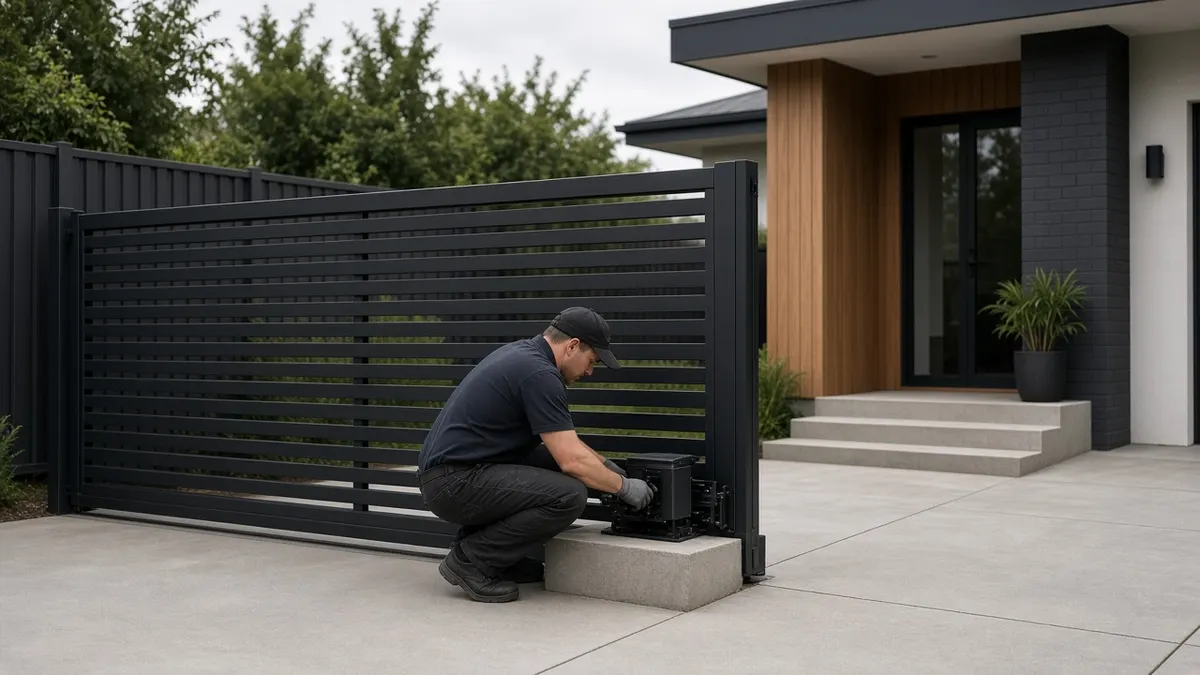
A driveway gate costs about $1,500 to $6,000 installed for a manual gate in 2026, and about $4,000 to $10,000 for an automated swing or sliding gate, GST included. The gate itself is often less than half the bill once you add posts, a track or hinges, the motor, remotes, power from the house and the electrician.
The spread is wide because a driveway gate can be anything from a plain pair of steel-framed mesh gates on a rural block to a 6 m automated aluminium slat slider with a video intercom. This guide breaks down the price of each gate type, the automation costs that catch people out, city pricing and three costed jobs. All figures are indicative, and you should get at least three written quotes covering the same gate, motor and electrical work.
Driveway gate prices by type
Prices below are for a single driveway opening of about 3.5 to 5 m, supplied and installed, on reasonably level ground with existing posts or fence to tie into.
| Gate type | Manual, installed | Automated, installed |
|---|---|---|
| Steel tubular or mesh swing pair | $1,500 to $3,000 | $3,800 to $6,500 |
| Colorbond infill swing pair | $1,200 to $2,800 | $3,800 to $6,500 |
| Aluminium slat swing pair | $2,500 to $5,000 | $4,800 to $8,500 |
| Aluminium slat sliding gate | $3,000 to $6,000 | $4,500 to $9,500 |
| Timber slat sliding or swing gate | $3,500 to $7,500 | $5,500 to $11,000 |
| Laser-cut or decorative steel | $4,000 to $9,000 | $6,000 to $13,000 |
| Cantilever sliding gate (no ground track) | $6,000 to $12,000 | $8,000 to $18,000 |
Aluminium has become the go-to material for suburban gates because it is light, does not rust, and lighter gates are easier on motors. Steel is stronger and cheaper for rural and industrial gates but needs galvanising and paint to survive. Timber looks the warmest but is heavy, moves with the weather and needs oiling, so timber gates are usually built on a steel frame.
Swing or sliding?
The choice often makes itself once you look at the driveway.
Sliding gates need a clear run of fence beside the opening at least as long as the gate, plus a bit more, for the gate to slide back along. They suit short driveways where swinging leaves would hit the car, and sloping driveways where a swing gate would scrape the ground. A ground track needs a concrete footing along its length and has to be kept clear of leaves and gravel. Cantilever gates avoid the track by hanging off rollers on posts, but cost much more.
Swing gates need clear space inside the boundary for each leaf to open, because most councils do not allow gates to swing out over the footpath or road reserve. They suit flat driveways with room to open, and are usually cheaper as manual gates. Automated swing gates need a motor for each leaf on a double gate, which can make them as dear as a slider.
Sloping driveways deserve extra thought. A gate that swings across a driveway rising away from the street will hit the concrete unless it is hung high, which leaves a gap under it, or fitted with rising hinges. A slider running across the slope may need a stepped or raked bottom rail. Raise this at the measure and quote stage, not on install day.
The automation bill
Automation is where quotes vary the most. These are the components and typical prices on top of the gate itself:
| Component | Typical cost (incl. GST) |
|---|---|
| Sliding gate motor kit, supplied and fitted | $1,200 to $3,000 |
| Swing gate motors, double gate (arm type) | $1,500 to $3,800 |
| Underground swing gate motors | $3,000 to $6,000 |
| Solar power kit instead of mains | $1,500 to $3,500 |
| Electrician for power to the gate | $500 to $1,800 depending on distance |
| Concrete footing and track for a slider | $400 to $1,500 |
| Safety beams (photo-electric) | $150 to $400 |
| Keypad | $150 to $400 |
| Audio or video intercom | $400 to $2,500 |
| Smartphone app control module | $200 to $500 |
| Battery backup | $150 to $400 |
| Extra remotes | $50 to $120 each |
The motor needs to be sized to the gate's weight and length. A heavy timber slider on a cheap motor will strain, overheat and wear out early. Ask the installer to state the gate's estimated weight and the motor's rated capacity on the quote.
Power is the other big variable. If there is already a power point or a sub-circuit near the gate, the electrician might take an hour or two. If the gate is 30 m from the switchboard across a garden and a concrete driveway, there is trenching, conduit, possibly cutting concrete, and a lot more labour. Solar kits avoid that but suit lighter gates with moderate daily use better than heavy gates opened twenty times a day. The electrician cost guide has more on call-out fees and hourly rates.
Prices around the country
Typical installed price for an automated 4.5 m aluminium slat sliding gate with two remotes, safety beams and power run from the house within 15 m:
| City | Typical total (incl. GST) | Notes |
|---|---|---|
| Sydney | $6,500 to $10,000 | Highest labour and electrician rates, steep driveways common |
| Melbourne | $6,000 to $9,500 | Strong competition among gate and fence companies |
| Brisbane | $5,800 to $9,000 | Many sloping blocks, wind ratings in exposed suburbs |
| Perth | $5,500 to $8,800 | Sandy ground, easy footings; limestone walls often involved |
| Adelaide | $5,500 to $8,500 | Lower labour rates |
| Hobart | $6,000 to $9,500 | Steep sites, fewer specialist installers |
| Canberra | $6,200 to $9,800 | Higher labour rates |
| Darwin | $6,800 to $10,500 | Freight, cyclone-rated posts and fixings, harsh conditions for motors |
Regional and rural properties often pay less for the gate itself but more for power, because the gate is a long way from the house. Solar is more common there for that reason.
Three driveway gate jobs, broken down
Automated aluminium slider in Kellyville, NSW
A double-storey house on a 500 m² block with a short, flat driveway and a new rendered front fence. The owners want a 4.8 m black aluminium slat sliding gate to match the fence battens, automated, with a video intercom at the pedestrian entry. The switchboard is in the garage about 10 m away.
- Aluminium slat sliding gate, 4.8 m, powder coated: $3,800
- Concrete footing and ground track: $700
- Sliding gate motor kit with two remotes and safety beams: $1,900
- Electrician, new circuit and power to the gate: $750
- Video intercom with handset in the house: $1,100
- Total: $8,250
Most of the cost beyond the gate itself is automation and electrical work, which is typical. Without the intercom, the job would land around $7,150.
Manual steel swing gates on acreage near Ipswich
A five-acre block needs a 4 m wide opening for a horse float. The owner wants a pair of galvanised steel tube and mesh gates on new steel posts, manual, with a drop bolt and chain latch.
- Pair of 2 m galvanised mesh gates: $1,050
- Two heavy-duty galvanised posts, concreted: $550
- Hinges, drop bolt and latch hardware: $180
- Labour: $650
- Total: $2,430
Solar automation could be added later for about $2,500 to $3,500, which is cheaper than running mains power 120 m from the house.
Custom timber swing gates in Brighton, Melbourne
A period home with a brick front fence and piers. The owners want a pair of spotted gum slat swing gates on a hidden steel frame, automated with underground motors so nothing shows, plus a keypad and battery backup. Each leaf is 1.8 m wide and 1.6 m high.
- Custom spotted gum gates on a steel frame, finished: $6,800
- Underground swing motors and control board: $4,200
- Keypad, battery backup and four remotes: $750
- Electrician, power to the piers including trench: $1,300
- Labourer to dig the motor boxes and trench: $500
- Total: $13,550
Underground motors cost more and need good drainage, because the boxes sit below the driveway surface. If the area is likely to hold water, an arm motor fixed to the gate and pier is the more reliable choice.
Council rules and safety
Front fences and gates are visible from the street, so councils pay attention. Common rules include height limits for front fences and gates, a requirement that gates do not open over the footpath or road reserve, and design controls in heritage areas. A new driveway crossing or a change to the kerb usually needs separate council approval. Check with your council before ordering a custom gate, especially if it is taller than about 1.2 to 1.5 m or in a heritage overlay.
Automated gates are heavy moving machines, and children, pets and visitors get hurt by them every year. A safe installation includes:
- Safety beams so the gate stops or reverses if something is in the way.
- Correctly adjusted force sensing so the motor stops when it meets resistance.
- Mesh or guards over gaps where hands could be crushed, particularly where a sliding gate passes a post or a swing gate hinges near a pier.
- A manual release so the gate can be opened in a power failure.
- Clear instructions on how to use the release and keep remotes out of reach of young children.
Ask your installer what safety features are included and get them to demonstrate the gate stopping on an obstruction before they leave.
Who needs to be licensed
The 240 V side of a gate installation must be done by a licensed electrician in every state and territory. That includes a new circuit from the switchboard, a power point at the gate and any hard-wired connection. Regulators include Energy Safe Victoria, the Electrical Safety Office in Queensland and NSW Fair Trading, and they take unlicensed electrical work seriously. A handyman or labourer can dig a trench, but the electrician lays and connects the cable and certifies the work.
Gate motors typically run on low voltage from a transformer, and gate installers commonly connect the motor, beams and accessories. Whether any of that low voltage work needs a licence depends on the state and the setup, so check with your installer and electrician. The gate and its posts may fall under building licensing if the job value is above your state's threshold, such as $5,000 in NSW for residential building work and $3,300 in Queensland. Ask for licence numbers, and see our article on whether a handyman can do electrical work for where the line sits.
Matching pedestrian gates
Most people want a pedestrian gate beside the driveway gate in the same material. A matching manual pedestrian gate usually adds $600 to $1,500 installed in aluminium or steel, and more in custom timber. Adding an electric strike or magnetic lock so it can be released from the intercom adds roughly $400 to $900 plus the electrician's time. If the pedestrian gate is the main way visitors reach the front door, think about lighting and a level path at the same time, since trenching for both at once is cheaper than coming back.
What happens on installation day
A typical automated sliding gate install runs over two or three visits. First, the footing for the track and any new posts are dug and poured, and the electrician either runs power at the same time or comes in separately to lay conduit before the concrete goes in. Once the concrete has cured enough, usually a few days, the installer returns to fit the track, hang the gate, mount the motor and set the limits and force. Swing gates follow a similar pattern, with posts or pier brackets set first.
On the final visit, ask the installer to walk you through the remotes, the manual release, the safety beams and how to reset the gate after a power cut. Test it yourself while they are still there. Keep the driveway clear for the day, and expect the gate to be out of action while the concrete cures.
Security, insurance and resale
An automated gate is a real deterrent to opportunistic theft from cars and front yards, and it keeps dogs and children in. It is not a fortress, though: most suburban gates can be climbed. Some insurers ask about security features, so it is worth mentioning a locked gate when you renew home and contents cover, but do not expect a big discount.
For resale, a well-made gate that matches the front fence lifts street appeal, particularly on family homes where buyers value a secure yard. A cheap, noisy or broken gate does the opposite. If you might sell within a few years, a quality mid-range gate and motor is a safer bet than a high-end custom design that suits only your taste.
Running costs and lifespan
A well-installed gate frame lasts 20 years or more. Motors typically last 8 to 15 years depending on use, quality and exposure, and backup batteries need replacing every three to five years at about $80 to $200 each. Remotes get lost and cost $50 to $120 to replace and program.
An annual service, usually $150 to $300, checks the track, rollers, hinges, limit settings, safety beams and force settings. Sliding gate tracks need sweeping regularly, because a pebble in the track can stop the gate or wear out the wheels. Coastal properties should rinse motors and hardware occasionally. Electricity use is small: a gate motor mostly sits on standby, and running costs are usually only a few dollars a month.
Can you install one yourself?
A manual swing gate kit is a realistic DIY project if you can concrete posts plumb and hang a gate square. Kits for steel or aluminium gates are sold by fencing suppliers. Sliding gates are harder because the track must be dead level and straight, or the gate will run uphill or jump off.
DIY automation kits are sold too, but the power supply still has to be installed by a licensed electrician, and setting force and safety correctly matters. Many owners buy and hang the gate themselves, then have a gate specialist fit and set up the motor, and an electrician supply power. That split can save $1,000 or more.
Where to save, and where not to
- Combine with the fence. If you are replacing the front fence, get the gate quoted by the same contractor. See the fencing cost guide and the Colorbond fencing cost guide for matching options.
- Plan power early. If you are pouring a new driveway, lay a conduit to the gate position before the concrete goes down. It costs very little and saves cutting concrete later. The concrete driveway cost guide covers the driveway itself.
- Skip the extras you will not use. A video intercom is great if you get lots of deliveries. If you do not, a keypad and remotes may be enough.
- Do not undersize the motor. Saving $300 on a motor that cannot cope with the gate's weight is a false economy.
- Do not skip safety beams. They are cheap and they prevent injuries and damage to cars.
What a proper quote includes
Look for the gate size, material, finish and colour, frame and infill details, swing direction or slide direction, post or pier details, and footing or track specification. For automation, the quote should name the motor brand and model, its rated gate weight, the number of remotes, safety beams, battery backup and any accessories. It should be clear whether the electrician's work is included or separate, who gets any approval needed, and how long the warranty is on the gate, motor and workmanship.
Red flags include a quote with no motor model, no mention of safety beams, a request for a large deposit before any materials are ordered, and an installer who suggests their non-electrician staff can wire it into the house.
Help from Yakka on gate projects
Gate jobs often involve heavy, unskilled work before the specialists arrive: digging out an old gate and posts, breaking up concrete footings, digging a trench for the electrician's conduit, clearing garden beds from the gate's swing or slide path, and carting away rubbish. Yakka connects you with workers by the shift for that part of the job.
For the gate and motor, you can find a gate installer near you, and for power, find a licensed electrician. Yakka workers do not replace either of them.
Frequently asked questions
How much does an automatic driveway gate cost in Australia?
An automated driveway gate typically costs $4,000 to $10,000 installed in 2026, including the gate, motor, two remotes, safety beams and power from the house. Custom timber gates, underground motors, cantilever sliders and video intercoms can push it past $13,000. Electrical work over long distances also adds cost. Get three written quotes for the same specification.
Is a sliding or swing gate cheaper?
For manual gates, a swing pair is usually cheaper than a slider because there is no track or footing. Once automated, the cost is often similar, because a double swing gate needs two motors and a slider needs one motor plus a track. Sliding gates suit short or sloping driveways; swing gates need room inside the boundary to open.
How much does a gate motor cost to install?
A sliding gate motor kit typically costs $1,200 to $3,000 supplied and fitted, and arm-style motors for a double swing gate $1,500 to $3,800. Underground swing motors run $3,000 to $6,000. Add $500 to $1,800 for an electrician to bring power to the gate, or $1,500 to $3,500 for a solar kit.
Do I need an electrician to install an electric gate?
Yes, for the mains power side. Any new circuit, power point or hard-wired 240 V connection must be done by a licensed electrician in every state. Gate installers usually connect the low voltage motor, beams and accessories. A labourer or handyman can dig the trench, but the electrician must lay, connect and certify the cable.
Do I need council approval for a driveway gate?
Often not for a standard gate within front fence height limits, but it depends on your council. Gates usually must not open over the footpath or road reserve, front fences and gates often have height limits, and heritage areas have design controls. A new driveway crossing needs separate approval. Check with council before ordering a custom gate.
How long do automatic gate motors last?
Most gate motors last 8 to 15 years depending on quality, how often the gate is used, its weight and exposure to weather. Backup batteries need replacing every three to five years. An annual service at $150 to $300, keeping the track clean and matching the motor to the gate's weight all help a motor last longer.
Can I automate my existing driveway gate?
Usually, if the gate is solid, hangs or slides freely and is not too heavy for a standard motor. A gate that drags, sags or binds has to be fixed first, because a motor will not cope. Expect $2,000 to $5,000 to automate an existing gate, including the motor, remotes, safety beams and power, depending on the gate type and distance to power.
Official sources
Award rates, licences and safety rules change. Check the official source before you hire or take on a shift.
- Workplace Health and Safety QueenslandHigh-risk work licences and the Electrical Safety Office in Queensland
- NSW Fair TradingTrade licence checks for electricians, plumbers and builders in New South Wales
- Energy Safe VictoriaElectrician licensing in Victoria