Outdoor cost guide
How Much Does Timber Fencing Cost in Australia? (2026)
Typical cost in Australia (2026, inc. GST)
$90 to $450 per linear metre
1.8 m timber fence installed, from treated pine paling (low) to hardwood slat screen (high)
Timber fencing costs about $90 to $150 per linear metre installed for a 1.8 m treated pine paling fence in 2026, $130 to $220 for hardwood lapped and capped, and $250 to $450 for horizontal slat screens in hardwood or merbau. Prices include GST. Post type, timber species, ground conditions, slope, removal of the old fence and gates drive the final figure.
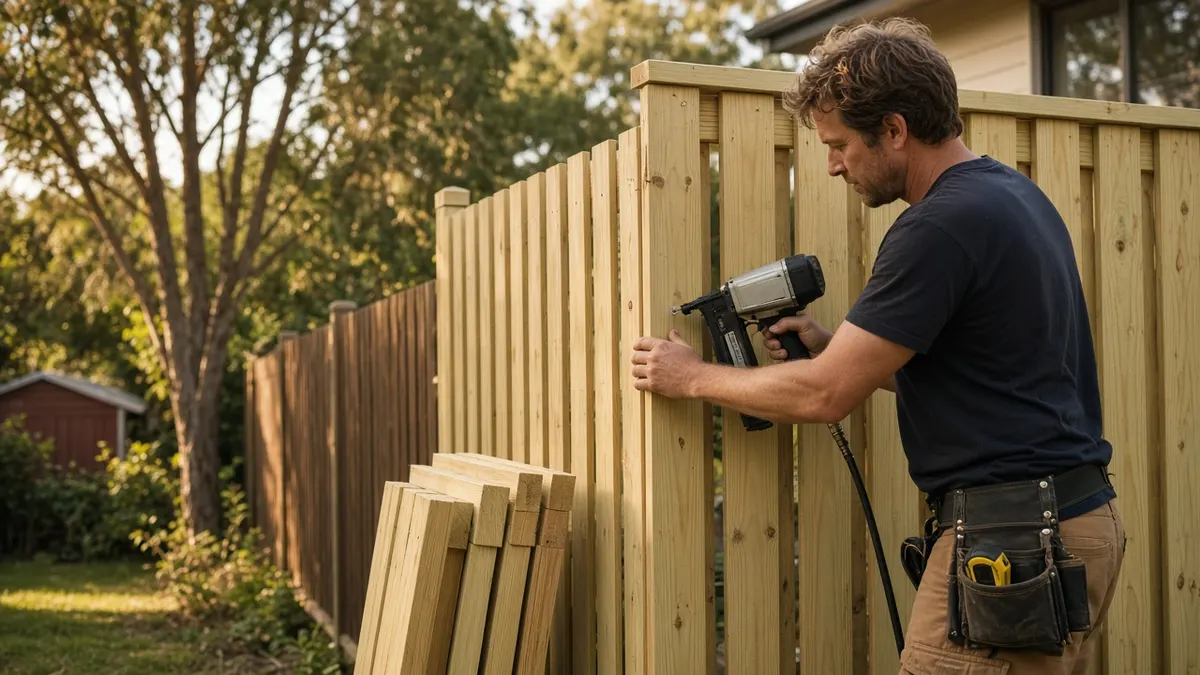
A basic 1.8 m treated pine paling fence costs about $90 to $150 per linear metre installed in 2026, GST included. Hardwood lapped and capped sits around $130 to $220 per metre, and a horizontal slat screen in spotted gum, blackbutt or merbau runs $250 to $450 per metre. For a 30 m back fence that means anything from about $2,700 to well over $10,000 depending on the style.
Timber is the fence most Australians grew up with, and it still makes sense in plenty of situations. It suits sloping blocks, it can be repaired one paling at a time, and a good slat screen is about the best-looking fence you can put on a front boundary. The trade-off is maintenance. Below are prices by style, what the different timbers and posts mean for lifespan, three costed jobs, and what upkeep really costs over 20 years. All figures are indicative, so get at least three written quotes for the same specification.
Timber fence styles and installed prices
| Style | Height | Installed per linear metre | Typical life |
|---|---|---|---|
| Treated pine paling, butted | 1.8 m | $90 to $150 | 15 to 20 years |
| Treated pine paling, lapped and capped | 1.8 m | $115 to $180 | 15 to 20 years |
| Hardwood paling, lapped and capped | 1.8 m | $130 to $220 | 20 to 25 years |
| Cypress pine paling | 1.8 m | $120 to $200 | 20 to 25 years |
| Paling with steel posts | 1.8 m | $120 to $200 | Palings 15 to 25 years; posts much longer |
| Treated pine picket, painted | 0.9 to 1.2 m | $150 to $260 | 15 to 20 years with repainting |
| Horizontal slat screen, treated pine | 1.8 m | $200 to $320 | 15 to 20 years |
| Horizontal slat screen, hardwood or merbau | 1.8 m | $250 to $450 | 20 to 25 years with oiling |
| Rural post and rail, treated pine | 1.2 m | $45 to $100 | 20+ years |
Butted palings sit edge to edge. As they dry and shrink, gaps open up between them, so privacy drops over the first year or two. Lapped palings overlap by 20 to 30 mm, which keeps the fence closed as the timber moves. A capping rail along the top shelters the end grain from rain and gives a neater finish. Lapped and capped costs more because it takes more palings per metre and an extra rail, but it is the better fence.
Pine, hardwood or something else
Treated pine
Radiata or slash pine treated with preservative is the cheapest and most common fencing timber. Treatment levels are rated by hazard class. Palings and rails that stay above ground need at least H3. Posts set in the ground need H4 or higher, and H5 is used where posts sit in wet ground or carry more load. Ask your fencer what grade the posts are, because cheap H3 posts set in concrete are a common reason a fence leans after eight or ten years.
Australian hardwoods
Spotted gum, blackbutt, ironbark and other eucalypts are harder, heavier and longer lasting than pine. They cost more and weather to a silver grey if left untreated. Hardwood paling fences are common in Victoria, and hardwood slat screens are now popular everywhere for front fences and courtyard walls. Some hardwoods are naturally more durable in the ground than others, so posts are often a different species or steel.
Cypress pine
White cypress is a native softwood with natural resistance to termites. It is widely used for fencing in Queensland and northern NSW. It has a distinctive knotty look and a scent that fades over time.
Merbau and imported timbers
Merbau is a dense reddish timber used for slat screens and decks. It looks great oiled but bleeds tannin when new, which can stain concrete or render below it for the first few months of rain. It is imported, so ask for certified timber from a responsibly managed source if that matters to you.
Steel posts with timber infill
A good compromise for long life is galvanised steel posts with timber rails and palings. Steel posts do not rot or get eaten by termites, so when the palings eventually need replacing, the frame is still sound. It adds roughly $15 to $40 per metre over an all-timber fence.
What makes a timber fence quote go up
- Removing the old fence. Typically $15 to $40 per metre including tip fees. Old fibro fences must go out with a licensed asbestos removalist.
- Slope. Timber can follow the ground more easily than steel sheets, but a raked fence takes longer to cut and fit. Stepped fences need plinths or sleepers to close the gaps underneath, about $20 to $60 per metre.
- Rock and roots. Rock drilling for post holes adds $20 to $50 per hole. Big tree roots along the boundary can force posts to move off their ideal spacing.
- Height. A 2.1 m fence needs longer posts and more timber, adds 15% to 25% to the price and may need council approval.
- Finish. Painting or staining at installation adds $15 to $40 per metre per side, depending on whether it is sprayed or brushed and how many coats.
- Gates. A timber pedestrian gate on a proper frame costs about $450 to $1,200 installed. Driveway gates in timber are heavy and need strong posts and hinges.
- Access. Carrying every post, bag of concrete and bundle of palings through the house or down a narrow side path takes hours.
Three timber fence jobs, costed
Hardwood lapped and capped dividing fence in Geelong
A 35 m side boundary between two brick veneer houses in Belmont. The old pine fence is leaning and grey. Both owners agree on 1.8 m hardwood palings, lapped and capped, on H4 treated pine posts, with a plinth along the bottom.
| Item | Cost (incl. GST) |
|---|---|
| Posts, rails, palings, capping and plinth boards, 35 m | $3,150 |
| Concrete, nails and fixings | $350 |
| Labour, two fencers over two days | $2,800 |
| Remove and dispose of old fence | $900 |
| Total | $7,200 |
The new fence is $6,300, or $180 per metre, with removal on top. Under Victoria's Fences Act each owner would usually pay $3,600 if they both agree this is the fence they want. If one neighbour had only wanted plain butted pine, they could argue they should only pay half of that cheaper fence.
Merbau slat front screen in Newcastle
A renovated cottage in Merewether wants a 12 m front fence: 1.5 m high horizontal merbau slats, 65 mm boards with 10 mm gaps, on galvanised steel posts set into a low rendered plinth that is already there. The quote includes oiling and a matching pedestrian gate.
| Item | Cost (incl. GST) |
|---|---|
| Merbau slats, steel posts and stainless fixings, 12 m | $2,700 |
| Labour, carpenter for about two and a half days | $1,900 |
| Two coats of decking oil | $350 |
| Slat pedestrian gate, frame, hinges and latch | $950 |
| Total | $5,900 |
The fence alone is $4,950, or about $413 per metre, which is normal for hardwood slats with stainless screws and tight gaps. Front fences are not shared with a neighbour, so the owner pays it all. Stainless screws cost more but stop black stains spreading from each fixing.
Cypress paling with steel posts in Toowoomba
A 40 m rear boundary on a large block with an old termite-damaged pine fence. The owner chooses cypress palings on galvanised steel posts to avoid the same problem again.
| Item | Cost (incl. GST) |
|---|---|
| Steel posts, cypress rails and palings, 40 m | $3,400 |
| Concrete and fixings | $350 |
| Labour | $2,450 |
| Remove old fence and dispose | $800 |
| Total | $7,000 |
That is $6,200 for the fence, or $155 per metre. With good termite management around the house, this fence should outlast the original by a long way.
Regional price differences
Timber fencing tends to be cheapest where there is a local supply of fencing timber and plenty of competition: regional Victoria, south-east Queensland and parts of NSW. Sydney and Canberra usually price at the top of each range because of labour costs. Perth uses less timber fencing than the eastern states, with Colorbond and limestone more common, so you may find fewer specialists and slightly higher prices for hardwood. Hobart has good access to local hardwood but steep blocks and dolerite rock add labour. Darwin and far north Queensland are tough on timber because of termites, humidity and cyclone requirements, and steel is the more common choice there.
The real cost of maintaining a timber fence
This is where timber and steel part ways. A timber fence that is left alone will go grey, crack and eventually rot at the base. That may be fine for a back fence nobody looks at. For a fence you want to keep looking good, budget for regular oiling or staining.
| Task | How often | Typical cost (30 m fence, one side) |
|---|---|---|
| Stain or oil, DIY | Every 2 to 4 years | $150 to $350 in materials |
| Stain or oil, professional | Every 2 to 4 years | $500 to $1,100 |
| Replace split or loose palings | As needed | $10 to $20 per paling plus labour |
| Replace a rotten post | As needed | $150 to $350 per post |
| Re-hang or repair a sagging gate | Every few years | $120 to $350 |
Over 20 years, regular professional staining on a 30 m fence can add up to several thousand dollars, which is more than the upfront difference between timber and steel. That does not make timber a bad choice. It just means the cheaper upfront price is not the whole story. The Colorbond fencing cost guide runs the same numbers for steel, and the overall fencing cost guide compares every material, including the dividing fence rules in each state.
A few habits extend a timber fence's life: keep soil, mulch and garden beds off the palings, trim plants so the fence can dry after rain, point sprinklers away from it, and fix a loose paling before it starts to flap and split.
Repair or replace?
Plenty of old timber fences get replaced when a repair would do. If the posts are solid and only a few palings are split or missing, a fencer or handyman can replace palings and re-nail loose rails for a few hundred dollars. A sagging gate often just needs a new hinge, a diagonal brace or a post re-set.
The test is the posts. Push firmly on the fence at each post. If several posts move at ground level, or you can push a screwdriver into the timber just below the soil line, the posts have rotted and the fence is on borrowed time. Replacing two or three posts can make sense at roughly $150 to $350 each. Once you are looking at a third or more of the posts, a full replacement usually costs less over the next decade than patching.
One middle option is to keep the existing palings and rails but swap timber posts for steel posts bolted alongside the old ones. It is a common fix in Melbourne and Adelaide, where clay soils move and push posts out of line, and it can buy a fence another five to ten years for a fraction of the replacement cost.
Termites and timber fences
Termites love a timber fence because it gives them a direct, hidden path from the soil to the next timber structure, which might be your house, deck or pergola. Treated pine resists them, but treatment wears off cut ends and old posts lose protection over time. Cypress resists them naturally. Steel posts remove the problem at ground level.
If you have had termites before, or live in Queensland, northern NSW, Darwin or anywhere else with high termite pressure, steel posts with timber infill are worth the extra $15 to $40 per metre. Keep the bottom of the palings clear of soil and mulch so you can see any mud tubes, and include the fence in your regular pest inspection.
Sharing a timber fence with your neighbour
Under every state's dividing fence law, neighbours share the cost of a sufficient fence between two private properties. A plain 1.8 m treated pine paling fence is often the benchmark for 'sufficient' in suburban areas, which matters if you want something better. If you want hardwood lapped and capped or a slat screen and your neighbour is happy with butted pine, you may only be able to ask them for half the cost of the pine fence, not half of yours.
Sort out details beforehand: which yard gets the smooth paling face and which gets the posts and rails (there is no universal rule, so agree it upfront), who stains which side, and access to both yards on the day. Get the agreement in writing, even if it is just an email with the quote attached.
Council, licensing and safety
Most councils allow side and rear timber fences up to about 1.8 m without approval, and lower front fences, but heritage overlays, bushfire-prone land and corner blocks can change that. In bushfire-prone areas, timber fences close to the house can carry fire to the building, and planning guidelines in some states favour non-combustible fences near dwellings. Check with your council before choosing timber in a mapped bushfire area.
Licensing applies to the contractor, and thresholds differ by state. In NSW, residential building work over $5,000 generally needs a licensed contractor; check the details with NSW Fair Trading. In Queensland the threshold for most building work is $3,300 and the regulator is the QBCC. In Victoria the Building and Plumbing Commission, which replaced the VBA in 2025, sets the registration rules. Ask for the licence number and check it online before you pay a deposit.
Safety basics for any fence job: lodge a free Before You Dig Australia enquiry before digging post holes, treat any old fibro fence as asbestos and leave it to a licensed removalist, and wear a mask and gloves when cutting treated pine, since the sawdust is an irritant.
Doing it yourself
A paling fence is one of the more achievable DIY building jobs, especially on flat ground with no rock. Materials for a 1.8 m treated pine paling fence cost roughly $45 to $80 per metre, so doing it yourself can halve the bill. The skills that matter are setting a straight string line, keeping posts plumb and at an even height, and getting paling spacing even along the run. A nail gun and a hired auger save a lot of time.
Slat screens are harder. Every board is on show, the gaps have to be dead even, and hardwood needs pre-drilling. Most people who DIY a paling fence still pay a carpenter for a front slat screen. If you need one, our guide to carpenter hourly rates explains what to expect to pay.
Ways to save on a timber fence
- Choose lapped pine over hardwood for back boundaries that nobody sees, and save hardwood or slats for the street front.
- Use steel posts so that the next fence is just new palings, not a full rebuild.
- Stain it yourself. Wait a few weeks for new treated pine to dry out, then apply a penetrating stain. Our list of wood care product suppliers is a starting point.
- Share with your neighbour by serving the right notice before work starts.
- Do the demolition and clearing yourself or with hired help, and leave the line clear for the fencer.
What a good quote spells out
A timber fence quote should name the timber species and treatment grade for posts, rails and palings, the post size and spacing, footing depth, paling style (butted or lapped), capping, plinth, height and total length. It should say who removes the old fence, whether tip fees are included, and how slope and rock are handled. Look for the contractor's ABN, licence number where your state needs one, public liability insurance and a workmanship warranty. Be wary of a quote that just says 'timber fence 30 m' with a price and nothing else.
Booking help through Yakka
On most timber fence jobs, a big slice of the time goes into work that does not need a fencer: ripping off old palings, digging out rotten posts and their concrete, clearing ivy and shrubs from the boundary, stacking and carting the old timber. Yakka lets you book workers by the shift for exactly that, which can trim the fencer's quote or make a DIY build much faster.
When you are ready for the install, you can find a fencer near you. Licensed work, such as asbestos removal or anything over your state's licensing threshold, still needs the appropriate licence holder.
Frequently asked questions
How much does a timber fence cost per metre?
In 2026 a 1.8 m treated pine paling fence costs about $90 to $150 per metre installed, lapped and capped hardwood around $130 to $220, and horizontal slat screens $200 to $450 depending on the timber. These prices include GST but usually exclude removal of the old fence, plinths and gates. Compare at least three written quotes.
Is a timber fence cheaper than Colorbond?
A treated pine paling fence is usually $20 to $40 per metre cheaper to install than Colorbond. Hardwood and slat fences often cost more than Colorbond. Over 20 years timber usually costs more once staining, paling and post repairs are included, while Colorbond needs little more than an occasional wash.
How long does a treated pine fence last?
A well-built treated pine paling fence typically lasts 15 to 20 years. Posts rated H4 or H5 for in-ground use, a capping rail, regular staining and keeping soil off the palings all help. Cheap posts, soil against the fence and constant sprinkler spray shorten its life. Steel posts can make the frame last much longer.
What is the difference between butted and lapped and capped palings?
Butted palings sit edge to edge, so gaps open as the timber dries and shrinks. Lapped palings overlap by 20 to 30 mm, so the fence stays closed. A capping rail runs along the top to shed rain from the end grain and give a tidier finish. Lapped and capped costs more but gives better privacy and lasts longer.
Should I stain a new treated pine fence?
Yes, if you want it to keep its colour and resist cracking. Wait a few weeks for new treated pine to dry out, then apply a penetrating exterior stain or oil, and repeat every two to four years. Left unstained, pine goes grey and splits faster. Professional staining costs about $15 to $40 per metre per side.
Can I build a timber fence myself?
A paling fence on flat ground is a realistic DIY job, and materials cost roughly $45 to $80 per metre for treated pine. You need a straight string line, plumb posts and even paling spacing. Get a free Before You Dig Australia enquiry first, serve a dividing fence notice if you want your neighbour to contribute, and never touch an old fibro fence yourself.
Is timber fencing allowed in bushfire areas?
It depends on the council and the bushfire attack level for your site. Timber fences close to a house can carry fire to the building, so planning guidelines in some states favour non-combustible fences near dwellings in bushfire-prone areas. Check with your council or a bushfire consultant before choosing timber on mapped bushfire land.
Official sources
Award rates, licences and safety rules change. Check the official source before you hire or take on a shift.
- Queensland Building and Construction Commission (QBCC)Contractor, plumbing and drainage licence search in Queensland
- NSW Fair TradingTrade licence checks for electricians, plumbers and builders in New South Wales
- Building and Plumbing Commission (Victoria)Builder and plumber registration, domestic building insurance and licence checks in Victoria
- Asbestos Safety and Eradication AgencyWhere asbestos is found in homes and how to deal with it safely