More cost guide
How Much Does a Power Point Cost to Install in Australia? (2026)
Typical cost in Australia (2026, inc. GST)
$120 to $350 per power point
one double power point including the call-out fee; additional points on the same visit cost less
Getting one double power point installed by a licensed electrician in Australia costs about $120 to $200 to replace an existing outlet and $200 to $350 for a new one in 2026, including the call-out fee. Each extra outlet on the same visit costs much less. Wall type, how the cable reaches the spot, circuit capacity and outdoor or USB fittings drive the price.
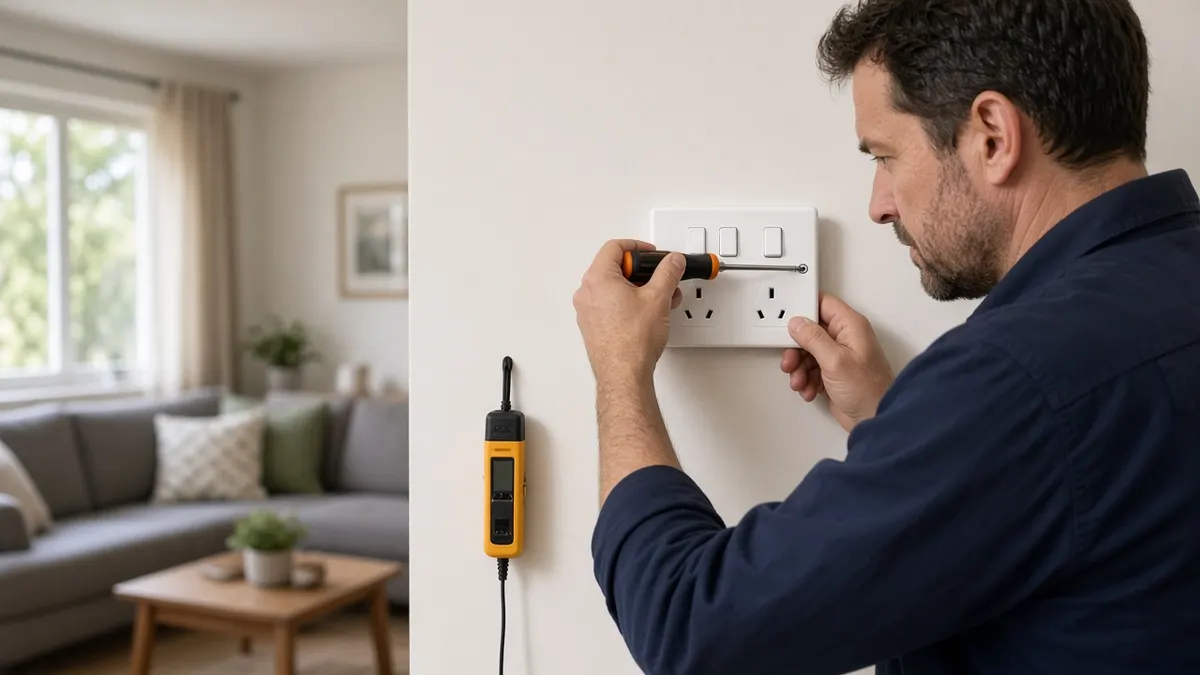
A single double power point costs about $120 to $200 to replace and $200 to $350 to install in a new spot in 2026, once you include the electrician's call-out fee. Extra outlets on the same visit are far cheaper, often $40 to $80 each for straight replacements and $120 to $220 each for new points, because the call-out and setup are already paid for.
That is why the smartest way to buy power points is in batches. This guide covers prices for the common types, what makes one wall cheaper than another, special locations like kitchens and outdoor areas, three costed jobs and the licensing rules. Electricians often call a power point a GPO, short for general purpose outlet, so you will see that on quotes. All prices include GST and are indicative. Get at least three written quotes before you commit.
Power point prices in 2026
The first column is what you would pay if that was the only job on the visit. The second is roughly what each additional one adds when the electrician is already there.
| Job | One point, including call-out | Each extra on the same visit |
|---|---|---|
| Replace a double power point, same spot | $120 to $200 | $40 to $80 |
| Replace with a USB-A and USB-C double outlet | $150 to $250 | $70 to $120 |
| New double point, plasterboard wall, cable from roof space | $200 to $350 | $120 to $220 |
| New double point in a brick or rendered wall | $280 to $450 | $180 to $300 |
| Convert a single to a double outlet | $120 to $200 | $40 to $90 |
| Kitchen benchtop double point, new cable | $220 to $380 | $130 to $240 |
| Outdoor weatherproof double point | $250 to $450 | $180 to $320 |
| Dedicated circuit with outlet for an appliance | $400 to $900 | Quoted separately |
| 15 amp outlet for a workshop or heavy appliance | $450 to $900 | Quoted separately |
| Floor box or pop-up bench outlet | $350 to $800 | $250 to $600 |
| Move an existing point along the same wall | $180 to $350 | $120 to $250 |
Moving a power point is often priced like a new one, because the electrician has to run new cable to the new spot and then blank off or remove the old one. It also leaves a hole in the wall that needs patching.
The four things that set the price
Replacement or brand new
Replacing a power point in the same spot is quick. The electrician isolates the circuit, removes the old outlet, connects the new one and tests it. Ten minutes for a straightforward swap, a bit longer if the old wiring is tired. A new point needs cable run from an existing circuit or the switchboard, a hole cut in the wall, a mounting bracket and testing, which is more like 45 minutes to an hour and a half.
Where the cable comes from
In most single-storey homes, cable drops down inside the wall cavity from the roof space. That is the easy path. If the point is on a ground floor below another storey, the cable may have to come up from underneath or along from another outlet, which can mean cutting access holes. In slab homes with no roof access above the wall, surface-mounted conduit or skirting duct may be the only practical option without serious wall damage.
What the wall is made of
Hollow plasterboard walls are the cheapest to work in. Solid double brick walls have no cavity, so the electrician has to chase a channel into the brick or render for the cable, then someone has to patch it. Walls with noggins (horizontal timber braces) in the way take longer to fish cable through. Tiled splashbacks need careful cutting to avoid cracking tiles.
Whether the circuit can take it
A power circuit can only carry so much load. If the circuit you want to extend already runs a fridge, a microwave and a kettle, the electrician may recommend a new circuit instead. If the switchboard has no safety switch protecting the power circuits, adding new outlets is a good time to fix that. Under the current wiring rules, AS/NZS 3000, new circuits in homes generally need RCD protection. Our switchboard upgrade cost guide explains what that work involves when the old board cannot take more.
What the outlets themselves cost
The part is a small share of the bill. Here is a rough idea of what electricians pay or charge for common outlet types.
| Outlet type | Typical part price | Notes |
|---|---|---|
| Standard double power point, white | $10 to $25 | Basic builder range |
| Designer double power point (slim, black, brushed) | $30 to $90 | Premium ranges cost more per plate |
| Double power point with USB-A and USB-C | $40 to $90 | Check the charging output suits your devices |
| Outdoor weatherproof double | $40 to $90 | Rated for outdoor use with a cover |
| 15 amp single outlet | $20 to $45 | Larger earth pin, needs a suitable circuit |
| Smart Wi-Fi power point | $60 to $150 | App control and energy monitoring on some models |
| Pop-up bench outlet | $150 to $450 | Needs cabinetry cut-out and careful sealing |
USB outlets are convenient, but they do not suit everyone. A good USB-C charger plugged into a normal point does the same job and can be replaced when standards change. If you want USB outlets, put them by the bed and the kitchen bench rather than in every room.
Kitchens, bathrooms, garages and outdoor areas
Kitchens
Kitchens are the room most people underestimate. A modern kitchen easily needs four to six double outlets along the benches plus dedicated circuits for the oven, cooktop and sometimes the dishwasher or a built-in microwave. Benchtop points near the sink must sit in the right position relative to the tap and basin. Adding them during a renovation, before the splashback goes on, is far cheaper than retrofitting through tiles or glass.
Bathrooms and laundries
The wiring rules define zones around baths, showers and basins where outlets cannot go or need specific protection. In a small bathroom that can rule out the spot you want for a hair dryer. The electrician will tell you what is allowed. Laundry points for a washing machine and dryer are simple, but a dryer on the same circuit as a heater can trip things in winter.
Garages and workshops
Garages often have one lonely point by the roller door. Adding a run of outlets along a bench, a 15 amp outlet for a compressor or welder, or a dedicated circuit for a second fridge is common. Concrete block or brick garage walls usually mean surface conduit, which is cheaper than chasing and perfectly acceptable in a garage.
Outdoors
Outdoor points need weatherproof fittings and must be protected by a safety switch. For a point on a post or a shed away from the house, the cable has to run underground in conduit at the depth the wiring rules require, so trenching becomes part of the cost. A point on the house wall under an alfresco is much simpler. If you plan an outdoor kitchen, a spa or a pool pump, ask for a separate circuit rather than adding to an existing one.
Electric vehicles
A standard power point can trickle charge an EV slowly, but most owners end up wanting a dedicated wall charger on its own circuit. That is a different job, typically $1,800 to $3,500 with the charger, and it may need a switchboard upgrade. The electrician cost guide lists it alongside other larger jobs.
When a dedicated circuit makes more sense
A dedicated circuit is a new cable run from the switchboard to one appliance or one outlet, protected by its own circuit breaker or RCBO. It costs more than tapping into an existing circuit, typically $400 to $900 depending on the distance from the board and the cable size, but it stops nuisance tripping and keeps heavy loads away from the outlets you use every day.
Appliances that usually get their own circuit include wall ovens, induction and electric cooktops, split system air conditioners, pool pumps and heaters, spa heaters, large workshop tools and EV chargers. A split system usually needs its own circuit and isolator, which our air conditioning installation guide includes in its pricing. If the switchboard is full, uses old ceramic fuses or has no room for another breaker, the dedicated circuit may trigger a board upgrade, so ask about that before you choose an appliance that needs a big supply.
Older homes, rentals and apartments
In homes wired before the 1970s, adding an outlet can uncover problems. Old rubber-insulated cable crumbles when it is moved, some circuits have no earth, and two-pin outlets may still be in service in back rooms. An electrician cannot safely extend a circuit like that, so a single new outlet can turn into replacing a section of wiring. Budget a contingency of 20 to 30 percent on any power point job in a house that has never been rewired.
Tenants should not organise electrical work without the landlord's written approval, and the landlord or agent is responsible for arranging repairs to faulty outlets. In apartments, work inside your own unit is usually your responsibility, but cabling through common property walls, risers or ceilings may need strata approval. Concrete walls and ceilings in apartment buildings also limit where new outlets can go without surface conduit, so ask the building manager about any rules before booking.
Prices by city
| City | Replace one double point | New double point, plasterboard | Main reason for the difference |
|---|---|---|---|
| Sydney | $130 to $210 | $220 to $380 | Higher hourly rates and travel |
| Melbourne | $120 to $200 | $200 to $360 | Older housing stock, more brick walls |
| Brisbane | $120 to $190 | $200 to $340 | Timber homes are often easier to cable |
| Perth | $125 to $210 | $220 to $380 | Double brick is common, so chasing adds cost |
| Adelaide | $110 to $180 | $190 to $320 | Lower labour rates |
| Hobart | $115 to $190 | $200 to $340 | Fewer electricians, longer waits |
| Canberra | $130 to $210 | $220 to $370 | High local wages |
| Darwin | $140 to $230 | $240 to $400 | Small trade pool and freight |
Perth deserves a special mention. A large share of older Perth homes are double brick, which has no wall cavity. Every new point in an internal or external brick wall means chasing, so Perth quotes for new outlets can run 20 to 30 percent higher than a Brisbane quote for the same number of points.
Three jobs, broken down
Ten USB upgrades in a Belconnen house, ACT
A 1970s three-bedroom ex-government home. The owner wants ten tired double outlets replaced with USB-A and USB-C doubles in the same positions. The wiring is in reasonable shape.
| Item | Cost (inc GST) |
|---|---|
| Call-out fee | $110 |
| Labour, 2.5 hours at $120 | $300 |
| 10 USB double outlets at $45 | $450 |
| Testing and compliance paperwork | Included |
| Total | $860 (expect $750 to $1,100) |
About $86 per outlet, in line with the extra-point rate in the table above.
Home office in a Geelong brick veneer, Victoria
A single-storey brick veneer with plasterboard internal walls and an easy roof space. The spare room becomes an office with three new double points and one data point for a wired internet connection.
| Item | Cost (inc GST) |
|---|---|
| Call-out fee | $100 |
| Labour, 4 hours at $105 | $420 |
| 3 double power points, cable and brackets | $120 |
| Data point, cable and wall plate | $60 |
| Total | $700 (expect $600 to $900) |
Alfresco power in a Joondalup home, WA
A double brick home with a tiled roof. The owners want two outdoor weatherproof double points under the alfresco on a new circuit with its own RCBO, with the cable run in conduit down the external brick wall rather than chased in.
| Item | Cost (inc GST) |
|---|---|
| Call-out fee | $110 |
| Labour, 5 hours at $115 | $575 |
| 2 weatherproof double outlets | $140 |
| Cable, conduit, RCBO and fixings | $220 |
| Total | $1,045 (expect $900 to $1,400) |
Is it legal to replace a power point yourself?
No. Replacing, adding or moving a power point is fixed electrical work, and it must be done by a licensed electrician in every Australian state and territory. That includes swapping a cracked outlet for an identical one. The penalties for unlicensed electrical work are significant, insurers can refuse claims connected to it, and a badly connected outlet can sit quietly for years before it causes a fire or electrocutes someone. Hardware stores sell the parts, but buying them does not make it legal to install them.
The regulators who license electricians are NSW Fair Trading, Energy Safe Victoria, the Electrical Safety Office in Queensland, which sits within WorkSafe Queensland, Building and Energy in WA, Consumer and Business Services in SA, CBOS in Tasmania, Access Canberra and the NT Electrical Workers and Contractors Licensing Board. Your electrician should give you the compliance certificate your state requires once the work is tested.
A handyman cannot do it either, even if they have done it for years. Our article on whether a handyman can do electrical work explains the rules state by state.
Power boards and double adaptors are not a fix
The most common reason people call about new power points is a room full of power boards. A power board is fine for a TV, a set-top box and a lamp. It is a poor long-term answer for a heater, a kettle, an air fryer or a space heater, and daisy-chaining boards together is a real fire risk. If you are running several high-draw appliances off one outlet, the cost of two new points is small next to the risk.
Signs that it is time for more outlets, or a check of the ones you have, include outlets that feel warm, plugs that fall out because the contacts are loose, scorch marks on the plate, a burning smell and a safety switch that trips when certain appliances run together. Any of those is worth a call to an electrician now.
Ways to spend less
- Make a list for the whole house. The call-out fee is the biggest cost on a one-outlet job. Spread it across six or eight points and the price per point drops sharply.
- Add points during renovations. At rough-in, with walls open, a new point costs a fraction of retrofitting after plastering and painting.
- Pick the position carefully. A point on an internal plasterboard wall below a roof space is the cheapest place to put one. Ask the electrician whether a slightly different spot avoids chasing brick.
- Accept surface conduit in garages and sheds. It is cheaper than chasing and easy to change later.
- Stick with a standard range unless the room is a showpiece. Designer plates can triple the parts cost.
- Group other small electrical jobs such as a light fitting or a smoke alarm into the same visit.
Checking a power point quote
For anything more than a single replacement, get a written quote that lists:
- The number and type of outlets, including the brand range if appearance matters to you.
- Whether each point is a replacement, a new point off an existing circuit, or on a new circuit.
- Any switchboard work, such as a new RCBO or safety switch.
- Whether chasing, patching or painting is included. It usually is not.
- The electrician and contractor licence numbers.
- Confirmation that testing and the compliance certificate are included.
Be cautious of anyone who will not provide a licence number, wants cash with no invoice, or says the paperwork is optional. A quote far below the others often skips the circuit capacity check or the safety switch.
Getting help around the electrical work
Yakka Labour lists electricians, so you can find a licensed electrician near you for the outlets themselves. Only a licensed electrician can do that part.
The work around it is where general help pays off. Moving a heavy bookcase, entertainment unit or desk away from the wall before the electrician arrives saves billable minutes. Afterwards, a handyman can patch the hole where an old point was removed and touch up the paint. For larger patches after brick chasing, see the plaster repair cost guide.
What happens on the day
The electrician will isolate the power circuit they are working on, so expect some outlets to be off for part of the visit. Lights usually stay on because they are on a separate circuit. Replacements take minutes each. New points in plasterboard take 45 to 90 minutes each, and the first one usually takes longest while the electrician works out the cable route.
Expect a little plaster dust around new points and some mess if brick has been chased. Before leaving, the electrician should test every outlet, check that the safety switch trips correctly and give you the compliance paperwork. Keep it with your house records, because buyers and insurers sometimes ask for it.
Frequently asked questions
How much does it cost to add a power point in Australia?
Adding one new double power point in a plasterboard wall typically costs $200 to $350 in 2026, including the electrician's call-out fee. Each extra new point on the same visit adds roughly $120 to $220. Brick walls, outdoor locations and points that need a new circuit cost more, sometimes $400 to $900 for a dedicated appliance circuit.
Can I replace a power point myself in Australia?
No. Replacing a power point is fixed electrical work, and it must be done by a licensed electrician in every Australian state and territory, even for an identical like-for-like swap. Unlicensed electrical work is illegal, can void insurance and can cause fires or electric shock. Plug-in devices such as timers and power boards do not need an electrician.
How much does it cost to move a power point?
Moving a power point usually costs $180 to $350 for one point, about the same as installing a new one. The electrician runs cable to the new position and removes or blanks off the old outlet. Patching and painting the old hole is normally extra, and moving points in brick walls costs more because the cable has to be chased in.
Are USB power points worth it?
They are handy beside beds, on kitchen benches and in home offices, and they add about $30 to $70 per outlet over a standard double point. The downside is that charging standards change, and a built-in USB port cannot be upgraded as easily as a plug-in charger. Most people are happy with a few USB outlets rather than every point in the house.
How long does it take to install a power point?
A like-for-like replacement takes 10 to 20 minutes. A new double point in a plasterboard wall with roof access above usually takes 45 to 90 minutes, depending on the cable route. Points in brick walls, outdoor points and new circuits take longer, and a batch of six to eight new outlets is usually a full day.
Do outdoor power points need to be weatherproof?
Yes. Outdoor outlets must use fittings rated for outdoor use, usually with a hinged cover, and must be protected by a safety switch. If the point is away from the house on a post, shed or garden wall, the cable has to run underground in conduit, which adds trenching and labour to the cost.
Do I need a new circuit for more power points?
Not always. Many extra points can run off an existing power circuit if it has capacity. An electrician may recommend a new circuit for heavy loads such as an oven, a heater, a workshop or an outdoor kitchen, or if the existing circuit is old or already heavily loaded. A new circuit usually adds $300 to $700.
Official sources
Award rates, licences and safety rules change. Check the official source before you hire or take on a shift.
- Workplace Health and Safety QueenslandHigh-risk work licences and the Electrical Safety Office in Queensland
- Consumer and Business Services SALabour hire licensing in South Australia
- NSW Fair TradingTrade licence checks for electricians, plumbers and builders in New South Wales
- Consumer, Building and Occupational Services (Tasmania)Building, plumbing and electrical licensing in Tasmania
- Access CanberraConstruction occupation licences and building approvals in the ACT
- Energy Safe VictoriaElectrician licensing in Victoria