Interior cost guide
Floor Tiling Cost Australia 2026: Prices by Room and Tile
Typical cost in Australia (2026, inc. GST)
$90 to $250 per m²
supplied and laid, standard porcelain to natural stone, before screeding or waterproofing
Floor tiling in Australia usually costs $90 to $250 per m² supplied and laid in 2026, made up of roughly $50 to $120 per m² labour plus the tiles. Standard 600 x 600 porcelain sits at the lower end. Large format, natural stone, herringbone and outdoor tiles cost more. Removing old tiles, screeding, waterproofing wet areas and small-room minimum charges can add significantly to the total.
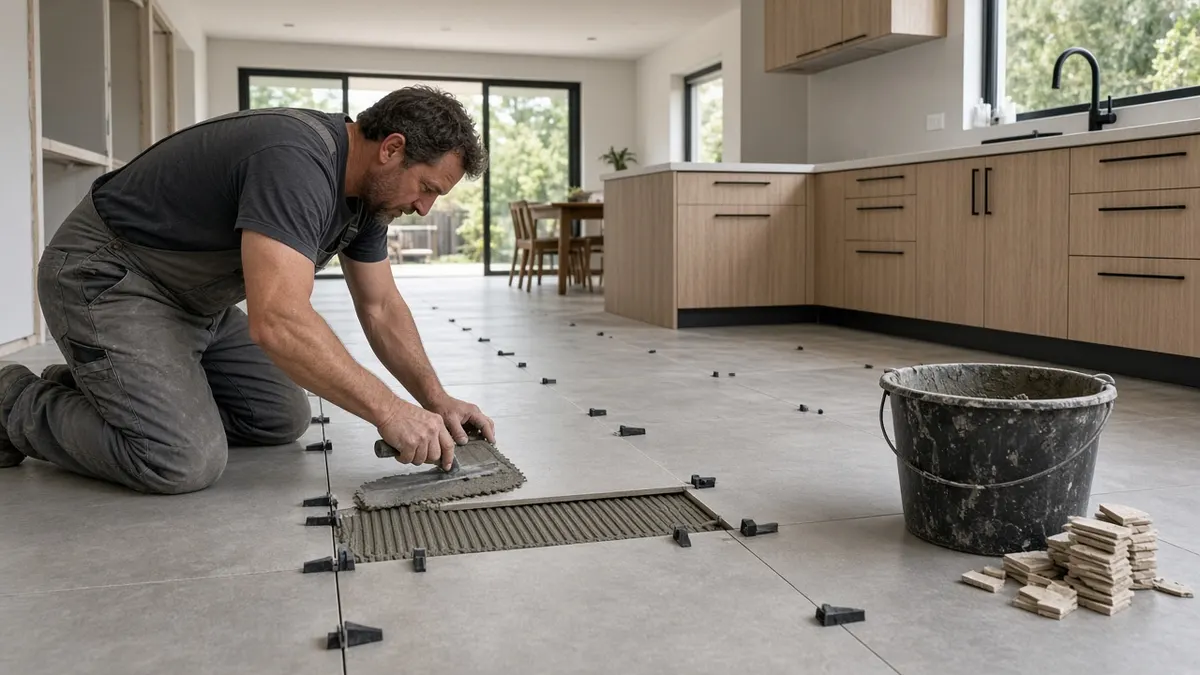
Tiling a floor in Australia costs between $90 and $250 per m² for most homes in 2026, counting the tiles, adhesive, grout and labour. A small bathroom floor might come to $1,200, while tiling 50 m² of open-plan living in large format porcelain can pass $10,000 once the slab is prepared.
Every price here includes GST and is indicative only. Tile prices vary enormously, and the condition of the floor underneath is the wild card in any quote. Get at least three written quotes from licensed tilers, and make sure each one is pricing the same tile and the same preparation.
Floor tiling cost by room
Room size matters, but so does what the room needs. Wet areas need waterproofing and falls to the drain. Living areas need a flat slab and expansion joints. Outdoor areas need slip-resistant tiles and exterior adhesives. The ranges below include tiles, materials and labour for a typical mid-range porcelain floor.
| Room | Typical floor area | Supplied and laid |
|---|---|---|
| Ensuite floor | 3 to 4 m² | $900 to $2,800 |
| Main bathroom floor | 4 to 6 m² | $1,200 to $3,500 |
| Laundry | 4 to 6 m² | $900 to $2,500 |
| Entry and hallway | 8 to 12 m² | $1,100 to $3,000 |
| Kitchen | 12 to 18 m² | $1,800 to $4,500 |
| Open-plan kitchen, dining and living | 40 to 60 m² | $4,500 to $13,000 |
| Alfresco or patio | 20 to 30 m² | $3,000 to $8,500 |
| Whole ground floor of a house | 100 to 150 m² | $11,000 to $32,000 |
The upper end for bathrooms and ensuites covers jobs where old tiles and screed come out and the floor is re-waterproofed. Small rooms cost more per m² because most tilers charge a minimum for a day or half-day, and wet areas involve more cutting around toilets, floor wastes and shower hobs.
Tile type changes the price more than anything
Two floors of the same size can differ in price by thousands of dollars because of the tile alone. Bigger and heavier tiles also take longer to lay well, so labour climbs with tile cost.
| Tile type | Tile cost per m² | Laying labour per m² | Typical installed per m² |
|---|---|---|---|
| Glazed ceramic | $20 to $45 | $50 to $80 | $80 to $135 |
| Standard porcelain, up to 600 x 600 | $30 to $80 | $55 to $90 | $95 to $180 |
| Large format porcelain, 1200 x 600 and up | $45 to $120 | $75 to $120 | $130 to $250 |
| Natural stone (travertine, limestone, marble) | $70 to $250 | $80 to $140 | $160 to $400 |
| Herringbone, chevron or mosaic | $50 to $200 | $100 to $180 | $160 to $390 |
| Encaustic or cement-look patterned | $80 to $200 | $80 to $130 | $170 to $340 |
| 20 mm outdoor porcelain | $60 to $130 | $70 to $120 | $140 to $260 |
The installed column includes roughly $10 to $15 per m² for adhesive, grout, levelling clips and trims. Natural stone also needs sealing, which adds $10 to $25 per m² at installation and a reseal every few years. Allow 10 percent extra tile for cuts and breakages on a straight lay and 15 percent or more for diagonal, herringbone or rooms with lots of angles.
Porcelain is the default for most Australian floors now. It is dense, absorbs very little water and suits wet areas, kitchens and outdoor spaces when you pick the right slip rating. Ceramic is cheaper and fine for low-traffic indoor rooms, but it chips more easily. Natural stone looks beautiful and ages well, but it is softer, needs sealing and marks with acids such as lemon juice and some cleaners.
The hidden costs under the tile
Quotes that look cheap often leave out preparation. A tile floor will only be as flat and as solid as what sits beneath it, so most of the surprises happen here.
- Removing old tiles: $25 to $50 per m², more if they are bedded on a thick mortar bed. Add disposal.
- Grinding and levelling a slab: $25 to $60 per m². Large format tiles in particular need a very flat substrate.
- Sand and cement screed: $35 to $70 per m², usually to build falls to a floor waste or to raise a floor to meet another.
- Waterproofing a wet area floor: $40 to $80 per m², with most bathrooms costing $600 to $1,500 for the floor and upturns.
- Fibre cement sheeting over timber floors: $40 to $70 per m² installed, to give tiles a stiff, stable base.
- Uncoupling or crack-isolation membrane: $25 to $45 per m² where a slab has cracks or movement.
- Tile skirting: $25 to $45 per linear metre supplied and fixed.
- Electric underfloor heating mats: $90 to $180 per m² for the mat, plus a licensed electrician to connect it.
Timber-framed floors are a particular trap. Tiles need a floor that does not flex. Many older suspended floors need extra noggings or thicker sheeting before they can take tiles, and some cannot take heavy stone at all without an engineer's input. If the budget is tight and the floor is timber, a floating floor may be a better fit.
What each room needs
Bathrooms, ensuites and laundries
Wet area floors are the most technical tiling most homeowners will pay for. The floor needs a membrane that meets AS 3740, the standard for waterproofing domestic wet areas, and the National Construction Code sets out which parts of the room must be waterproofed. The floor also needs falls so water runs to the waste rather than pooling. A tiler who only lays tiles may subcontract the waterproofing, and in NSW waterproofing is its own licence category.
Retiling a bathroom floor without touching the walls is possible but fiddly. The new floor must meet the existing wall tiles neatly, the membrane must turn up the walls behind them, and the toilet and floor waste have to be reset by a plumber. Often it makes more sense to treat the room as part of a bathroom renovation.
Kitchens
Kitchen floors take heavy traffic, dropped pans and water near the sink and dishwasher. A matt or lightly textured porcelain is the practical choice. Talk to your kitchen installer about sequence: tiling the whole floor before the cabinets go in costs more in tiles but makes future changes easier, while tiling up to the cabinets saves material.
Living areas and hallways
Large format tiles look great in open-plan spaces, with fewer grout lines and a calmer look. They are also less forgiving. Any dip or hump in the slab causes lippage, where one tile edge sits higher than the next and catches the light and your toes. A good tiler will check the slab with a long straight edge and price levelling before starting. Large areas need movement joints, normally at perimeters and at regular intervals across the floor, so ask where they will go and what colour the sealant will be.
Outdoor areas
Outdoor tiles need a slip rating suited to wet conditions. Australian Standard AS 4586 classifies slip resistance, and for outdoor living areas that get wet most tilers recommend a P4 or P5 rated tile. The slab needs a fall away from the house, and the adhesive and grout must be rated for exterior use and sun exposure. Many people choose 20 mm porcelain pavers for alfresco areas because they are strong and can also be laid on pedestals or sand and cement. Tiled balconies over living space need a proper membrane system and are not a job to cut corners on.
Tiling labour across Australia
Laying labour is the part of the bill that changes most from city to city. The figures below are typical labour-only rates for laying standard porcelain on a prepared floor. For a fuller breakdown of labour rates by tile and job type, see our blog post on tiler rates per m² in Australia.
| City or area | Labour per m², standard porcelain | Notes |
|---|---|---|
| Sydney | $65 to $100 | Highest rates, parking and access add time |
| Melbourne | $60 to $95 | Many period homes with timber floors that need sheeting first |
| Brisbane | $55 to $85 | Lots of outdoor tiling and alfresco work |
| Perth | $60 to $90 | Busy trade market keeps rates firm |
| Adelaide | $50 to $80 | Lower average labour rates |
| Hobart | $55 to $85 | Smaller pool of tilers, book ahead |
| Canberra | $60 to $95 | Rates close to Sydney |
| Darwin | $70 to $110 | Freight on tiles and materials, heat affects working times |
| Regional | $50 to $90 | Cheaper rates, but travel time may be charged |
Three worked examples
Each example is realistic for the area and uses rates inside the ranges above. All totals include GST.
Main bathroom floor in a Penrith brick veneer, 5 m²
A 1990s three-bedroom home. The bathroom floor tiles were cracked and drummy, so they came out along with the old screed. The walls were kept.
| Line item | Cost |
|---|---|
| Remove and dispose of old floor tiles and screed | $450 |
| New screed with falls to the floor waste | $400 |
| Waterproofing floor and upturns | $750 |
| 600 x 600 porcelain, 6 m² at $55 | $330 |
| Adhesive, grout and trims | $150 |
| Tiling labour (small-room minimum) | $900 |
| Plumber to reset toilet and floor waste | $450 |
| Total (incl GST of about $312) | $3,430 |
The tiles themselves are less than a tenth of the cost. That pattern is normal for small wet areas.
Kitchen and family room in Gungahlin, Canberra, 38 m²
A 2000s slab-on-ground home. The owners replaced carpet and vinyl with 1200 x 600 matt porcelain and tile skirting.
| Line item | Cost |
|---|---|
| Remove carpet and vinyl, 38 m² at $8 | $304 |
| Grind and level slab, 38 m² at $25 | $950 |
| Large format porcelain, 42 m² at $65 | $2,730 |
| Adhesive, grout and levelling clips, 38 m² at $12 | $456 |
| Laying labour, 38 m² at $90 | $3,420 |
| Tile skirting, 26 linear metres at $35 | $910 |
| Movement joints and trims | $200 |
| Total (incl GST of about $815) | $8,970 |
About $236 per m², which is typical once large format tiles, slab preparation and skirting are counted.
Alfresco in Baldivis, Perth, 24 m²
An existing covered concrete slab with a good fall away from the house. The owners chose 20 mm outdoor porcelain with a P5 slip rating.
| Line item | Cost |
|---|---|
| Clean, repair and prime slab | $250 |
| 20 mm porcelain, 26 m² at $75 | $1,950 |
| Exterior flexible adhesive and grout, 24 m² at $15 | $360 |
| Laying labour, 24 m² at $85 | $2,040 |
| Step edge, 6 linear metres at $60 | $360 |
| Grout sealing | $150 |
| Total (incl GST of about $465) | $5,110 |
Roughly $213 per m². Without the step edge and slab repairs, a similar job would sit closer to $190 per m².
Licences, waterproofing rules and safety
Tiling is licensed trade work in several states once the job passes a dollar threshold. In NSW, a contractor licence is needed for residential wall and floor tiling valued at more than $5,000 in labour and materials including GST, and the NSW Government tiling licence page explains what the category covers. In Queensland, the QBCC requires a licence for building work valued over $3,300, as set out on its page about when you need a licence. In Victoria, domestic building work over $10,000 generally needs registration with the Building and Plumbing Commission. In WA, SA, Tasmania, the ACT and the NT, check the current requirements with Building and Energy, Consumer and Business Services, CBOS, Access Canberra or the NT Building Practitioners Board.
Waterproofing deserves its own check. Ask who is applying the membrane, whether they hold the right licence in your state, and whether you get a written certificate for the membrane. A failed shower floor leads to rotten framing, mould and a full bathroom rebuild, so this is the line item to protect.
Cutting porcelain, stone and concrete creates respirable crystalline silica dust. Tilers should cut wet or with dust extraction and wear proper respiratory protection, and you should keep children and pets away from the cutting area. In homes built before 1990, old vinyl, its backing and fibre cement sheets under bathroom floors can contain asbestos, so test before demolition.
Timeframes and what happens on site
On a prepared slab, one tiler typically lays 10 to 20 m² of standard porcelain a day, and less with large format, stone or patterned layouts. Grouting usually happens the next day once the adhesive has set. A kitchen floor might take two days. An open-plan area of 50 m² can take four to six days for a single tiler, fewer with a two-person crew.
Wet areas take longer than their size suggests because each stage has to cure. A typical bathroom floor runs something like this: strip-out on day one, screed on day two, a few days of drying, waterproofing applied in coats with drying time between them, then tiling and grouting. A week from start to finish is common, and that is before any wall work.
Expect noise from the wet saw, a slurry mess near the cutting station and restricted access to the room until the grout has cured. Most tilers ask you to stay off newly laid tiles for at least 24 hours. Heavy furniture and appliances should wait a few days.
Layout and pattern choices that change the labour bill
A straight lay with tiles lined up in a grid is the quickest and cheapest layout. A brick-bond or third-offset pattern adds a little time. Diagonal layouts add more cuts at every wall. Herringbone and chevron can double the laying time, because every edge tile is cut and the pattern has to be set out perfectly from the centre of the room.
With rectangular porcelain tiles longer than 600 mm, many manufacturers advise against a half offset because slight bowing in the tile shows as lippage. A third offset is the usual answer. Ask your tiler to show you the set-out before they start, including where the cut tiles will land at doorways, which are the edges people see first.
Doing part of the job yourself
Laying floor tiles well is harder than it looks on video. Spreading adhesive to full coverage, keeping lines straight across a large room and avoiding lippage with big tiles all take practice. Mistakes are permanent and expensive to fix, so most owners are better off paying for the laying.
The jobs owners can take on are the ones that do not affect the finished surface: clearing the room, removing carpet, lifting old floating floors, carting debris and cleaning up afterwards. Removing old tiles is possible with a hired demolition hammer, but it is heavy, noisy work. Do not touch waterproofing in a wet area unless you hold the right licence and know the standard.
Ongoing costs and how long a tiled floor lasts
A well-laid porcelain floor can easily last 30 years or more, and outlive several kitchens. Grout is the weak point. Cement grout stains over time and may need a deep clean, a regrout or a grout sealer every few years. Epoxy grout costs more up front, roughly $10 to $25 per m² extra, but resists stains and suits kitchens and laundries well.
Natural stone needs resealing every one to five years depending on the stone and traffic. Cracked tiles can usually be cut out and replaced individually if you keep spares from the same batch, since later batches can differ slightly in colour. Tiled floors are cold underfoot in southern winters, which is why some owners add underfloor heating in bathrooms.
How to get a tiling quote you can trust
- Ask for the tile, adhesive and grout to be named in writing, along with the area and waste allowance.
- Check whether removal, disposal, levelling, screeding and waterproofing are included or excluded.
- Ask how the tiler checks flatness and what happens if the slab needs more work than expected.
- Confirm where movement joints will go on large floors and outdoor areas.
- Ask for the licence number if the job is over your state's threshold, and check it on the regulator's register.
- Ask for proof of public liability insurance.
- Be wary of cash-only pricing and large deposits. NSW caps deposits on residential building work at 10 percent, and Victoria at 10 percent for contracts under $20,000 and 5 percent above that.
To compare local tradespeople, browse our directory of tilers near you. If you want help understanding what a tiler charges for whole jobs and by the day, our guide to hiring a tiler covers that side.
Ways to save without a worse result
- Pick a standard size porcelain in a mid-range price. Laying costs less than with large format or herringbone.
- Lay tiles straight rather than diagonally to reduce cuts and waste.
- Keep existing tiles where they are sound and the height allows, and tile over them only on your tiler's advice.
- Do the strip-out and clean-up with labour help rather than at tiler rates.
- Order all tiles at once from a single batch and keep a box of spares.
- Book during the quieter months. Tilers are often busiest before Christmas and in spring.
Where Yakka fits on a tiling job
Yakka Labour connects homeowners with local workers for the labour-heavy parts of a renovation. On a tiling project that means clearing furniture, lifting carpet and old floating floors, breaking out and barrowing old tiles, carrying heavy boxes of porcelain from the driveway, and cleaning up dust and offcuts at the end. Paying a labourer for those hours usually costs less than paying a tiler to do them.
You can also find tilers listed on Yakka for the laying itself. For waterproofing and anything involving plumbing, use appropriately licensed trades and ask for their licence numbers before work starts.
Frequently asked questions
How much does it cost to tile a floor per m2?
Most floors cost $90 to $250 per m² supplied and laid in 2026, including tiles, adhesive, grout and labour. Labour alone is usually $50 to $120 per m² depending on tile size and city. Large format tiles, natural stone and patterns such as herringbone push the price higher, as do removal of old tiles, screeding and waterproofing.
How much does it cost to tile a small bathroom floor?
A 4 to 6 m² bathroom floor usually costs $1,200 to $3,500. The lower end covers laying new tiles over a sound, already waterproofed floor. The upper end includes removing old tiles and screed, new falls, a new waterproofing membrane and a plumber to reset the toilet and floor waste. Minimum charges make small rooms dear per m².
Is it cheaper to tile or lay a floating floor?
A floating floor is usually cheaper, at around $45 to $160 per m² installed compared with $90 to $250 for tiles. Tiles last longer, handle water better and suit wet areas and outdoor spaces. Floating floors are warmer underfoot, quicker to install and kinder to timber subfloors that would need stiffening before tiling.
Can you tile over existing floor tiles?
Sometimes. The old tiles must be firmly bonded, flat and clean, and the extra height must work with doors, other floor levels and appliances. A primer or special adhesive is normally needed. Tiling over tiles is not suitable in most wet areas because the waterproofing underneath cannot be checked or renewed.
Do I need a licensed tiler in NSW?
In NSW, a contractor licence is required for residential wall and floor tiling work valued at more than $5,000 in labour and materials including GST. Waterproofing is a separate licence category. Smaller jobs do not need a licence, but it is still sensible to hire someone with the right qualifications and insurance.
How many extra tiles should I order for a floor?
Order about 10 percent more than the measured area for a straight lay in a simple room, and 15 to 20 percent for diagonal, herringbone or rooms with many corners. Keep at least a box of spares from the same batch after the job, because replacement tiles bought years later often differ slightly in colour or size.
What slip rating do I need for outdoor tiles?
Outdoor areas that get wet should have tiles with a higher slip resistance classification under AS 4586. Many tilers recommend P4 or P5 for alfresco areas, pool surrounds and external steps. Ask the supplier for the test certificate, because tiles that look textured are not always rated for wet outdoor use.
Official sources
Award rates, licences and safety rules change. Check the official source before you hire or take on a shift.
- Queensland Building and Construction Commission (QBCC)Contractor, plumbing and drainage licence search in Queensland
- Consumer and Business Services SALabour hire licensing in South Australia
- Building and Plumbing Commission (Victoria)Builder and plumber registration, domestic building insurance and licence checks in Victoria
- Asbestos Safety and Eradication AgencyWhere asbestos is found in homes and how to deal with it safely
- Consumer, Building and Occupational Services (Tasmania)Building, plumbing and electrical licensing in Tasmania
- Access CanberraConstruction occupation licences and building approvals in the ACT