More cost guide
Ceiling Fan Installation Cost in Australia: 2026 Price Guide
Typical cost in Australia (2026, inc. GST)
$150 to $550 per fan
installation labour by a licensed electrician; the fan itself is extra
Ceiling fan installation by a licensed electrician in Australia typically costs $150 to $300 per fan at an existing light point and $300 to $550 for a new position with fresh cable and a wall control in 2026. The fan itself adds $80 to over $1,000. High or raked ceilings, bracing, roof access, switching choices and outdoor locations drive the labour price.
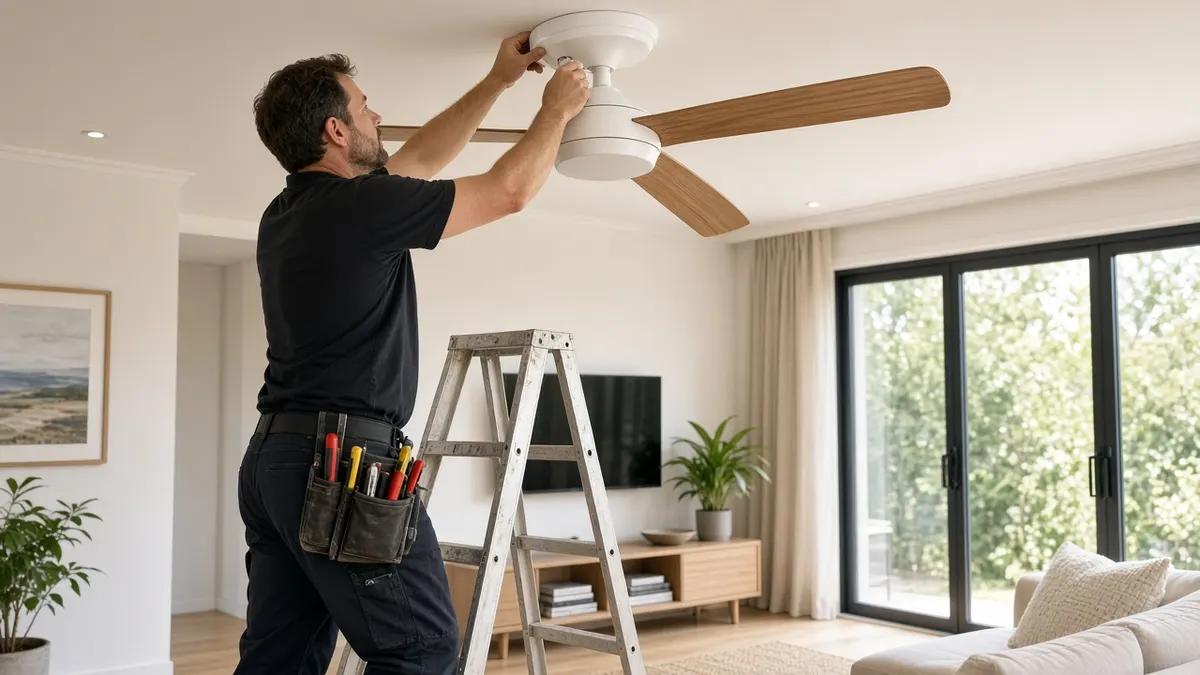
Having a ceiling fan installed costs about $150 to $300 per fan in labour if it goes where a light is already wired, and $300 to $550 if the electrician has to run new cable to a new position and add a wall control. The fan is extra: $80 to $200 for a basic AC model, $250 to $500 for a good DC fan, and more for designer or large outdoor fans.
Fans are one of the cheapest ways to make an Australian summer bearable, and they cost cents a night to run. The installation price varies more than most people expect, though, because a fan is heavier than a light, moves, and needs solid fixing to the ceiling structure. This guide covers installation prices, fan prices, the factors that change the labour, outdoor fans, running costs and three costed examples. Prices include GST and are indicative. Get at least three written quotes.
Installation prices for ceiling fans
| Job | Typical labour price per fan (inc GST) | Notes |
|---|---|---|
| Replace an existing ceiling fan, like for like | $120 to $250 | Old fan removed, new fan fitted to existing bracket or a new one |
| Fan at an existing light point, remote control | $150 to $300 | Uses the existing switch and cable; remote controls speed and light |
| Fan at an existing light point, new wall control | $250 to $400 | Extra cable to the switch for separate fan and light control |
| Fan in a new position with new cable and switch | $300 to $550 | Cable run from the lighting circuit, new switch plate |
| High or raked ceiling, longer drop rod | Add $100 to $300 | Taller ladders or a mobile platform, slower fitting |
| Bracing between joists | Add $50 to $150 | When the fan position falls between ceiling joists |
| Outdoor fan under a patio or alfresco | $250 to $500 | Weatherproof controls and suitable cable protection |
A call-out fee of $80 to $150 is often built into these figures for a single fan, so the per-fan price drops when several are installed on the same visit. Four fans in one house might cost $700 to $1,100 in labour rather than four times the single-fan price.
What the fan itself costs
| Type | Typical price | Running cost | Good for |
|---|---|---|---|
| Basic AC motor fan, no light | $80 to $200 | Moderate | Rentals, spare rooms, budget installs |
| AC fan with light | $150 to $350 | Moderate | Bedrooms where a single fitting replaces the light |
| DC motor fan with remote | $250 to $500 | Low | Most bedrooms and living areas |
| DC fan with LED light and remote | $300 to $650 | Low | Main bedrooms and living rooms |
| Designer or large span DC fan | $500 to $1,200 or more | Low | Open-plan living, high ceilings |
| Outdoor-rated fan | $250 to $900 | Low to moderate | Alfresco areas, verandahs, coastal homes |
| Smart fan with app or voice control | $350 to $900 | Low | Homes with an existing smart system |
DC motor fans cost more up front but are quieter, have more speed settings, often include a reverse function for winter, and use a fraction of the electricity of an AC fan. For a bedroom where the fan runs all night for months, DC is usually the better buy. Blade span matters too: a 1,200 mm (48 inch) fan suits a typical bedroom of about 10 to 12 m², while a living room of 20 m² or more usually needs a 1,320 mm (52 inch) fan or larger.
Light point, new position or replacement
Swapping a light for a fan
The cheapest installation. Most bedrooms have a ceiling light in the middle of the room, which is also the best spot for a fan. The electrician removes the light, fixes a fan bracket to the ceiling structure, mounts the fan and connects it to the existing cable. If the fan has a remote, the existing light switch becomes a power switch for the fan and its light, and the remote does the rest.
Separate switching at the wall
Some people prefer a wall control with separate fan speed and light switching, especially for parents who do not want to hunt for a remote at 3 am. That needs an extra conductor between the ceiling and the switch, which means more time in the roof space and a new switch mechanism. It typically adds $100 to $150 compared with a remote-only setup.
A brand new position
If you want a fan where there is no light, or a second fan in a long living room, the electrician runs new cable from the lighting circuit and adds a switch. In a single-storey home with good roof access, that is straightforward. Downstairs in a two-storey home it can mean cutting into the ceiling to fish cable, then patching.
Replacing an old fan
Swapping a tired fan for a new one is usually quick, but the electrician should check the old bracket and fixing rather than hanging a new fan off an old hook. Many fans sold now come with their own bracket designs, and the old one may not suit.
Ceiling height, roof space and bracing
High and raked ceilings
Standard Australian ceilings are around 2.4 m, with many newer homes at 2.55 m or 2.7 m. A fan on a 2.4 m ceiling usually sits close to the ceiling on a short rod. On ceilings of 3 m or more, a longer drop rod brings the blades down to a useful height, and the electrician may need a taller ladder, a second person or a mobile platform. Raked ceilings need an angled mount kit, and some fan designs cannot be fitted to steep rakes.
Bracing
A fan must be fixed securely to the ceiling structure, not just the plasterboard. If the light point sits between joists or trusses, the electrician adds a timber brace between the framing and fixes the bracket to that. It is quick in a roomy roof space and slower in a tight one. Never let anyone hang a fan from plasterboard alone.
Roof type
A high-pitched tiled roof gives the electrician room to work above the ceiling. A low-pitched metal roof, a skillion roof or a flat roof with no cavity can make bracing and cable runs difficult, sometimes requiring the work to be done from below with surface-mounted cable or a new access hole.
Ceiling material
Plasterboard is easy. VJ timber boards look good with a fan but need careful drilling. Old fibrous plaster can crack around new fixings. Some older ceilings, eaves and verandah linings contain asbestos and must not be drilled until tested.
Clearances, bunk beds and rooms with low ceilings
Fan blades need to sit high enough that nobody can reach them. The generally accepted minimum is about 2.1 m from the floor to the blades, and your electrician will confirm what the fan's instructions and the relevant standard require. On a standard 2.4 m ceiling, that leaves little room for a long drop rod, so a close-mounted or low-profile fan is often the answer.
Be careful in kids' rooms. A fan above a bunk bed or a loft bed can put the blades within reach of a child sitting up on the top bunk, even if the clearance from the floor is fine. Move the bed, pick a different position, or choose a bladeless or enclosed design. The same goes for mezzanines, stair landings and rooms where people lift long objects like curtain rods. In rooms with ceilings lower than 2.4 m, such as some converted garages and older cottages, a ceiling fan may simply not be suitable, and a wall-mounted fan or a split system may make more sense.
In apartments, check strata by-laws before installing a fan in a concrete ceiling. Fixing into the slab may need approval, and the cable route will be limited.
Remote, wall control or smart
The switching choice affects both price and daily use. A remote is the cheapest option at a light point and gives full speed and light control, but remotes go missing and batteries go flat. A wall-mounted controller supplied with many DC fans gives the same control from a fixed point, often with no extra cable if it communicates by radio with the fan. A traditional wired wall control with a separate fan speed switch and light switch is the most foolproof, but it needs extra cable and a wider wall plate. Smart fans and smart switches can be scheduled and controlled by phone or voice assistant, which suits some households and annoys others when the app changes. Ask the electrician which options suit the fan you have chosen before they arrive, because some fans only work with their own controllers.
Outdoor and coastal fans
Fans under a pergola, alfresco roof or verandah need an outdoor rating. Damp-rated fans suit covered areas protected from direct rain. Fully exposed positions need a wet-rated model. Near the coast, look for marine-grade or stainless hardware and blades that will not warp in humidity, because salt air destroys cheap fans quickly in places like the Gold Coast, Darwin or the northern beaches of Perth.
Outdoor installations usually cost more than indoor ones because the cable may need to run through a tight eave or along a beam in conduit, controls must suit outdoor use, and patio roofs are often insulated sandwich panels or bare metal with no cavity. If the patio is a newer addition with no lighting circuit, a new circuit may be needed, which our electrician cost guide prices separately. Check that the patio structure can carry a fan, as some lightweight pergola roofs are not designed for a moving load.
Prices by city
| City | Fan at existing light point (labour) | New position (labour) | Local factor |
|---|---|---|---|
| Sydney | $170 to $320 | $330 to $580 | Higher hourly rates and travel |
| Melbourne | $160 to $300 | $310 to $550 | Lower demand outside summer, easier booking |
| Brisbane | $150 to $290 | $300 to $530 | High demand, hot roof spaces in summer |
| Perth | $160 to $310 | $320 to $560 | Long hot summers keep electricians busy |
| Adelaide | $150 to $280 | $290 to $500 | Lower labour rates |
| Hobart | $150 to $290 | $300 to $520 | Lower demand, but fewer electricians |
| Canberra | $170 to $320 | $330 to $570 | Reverse-mode fans popular for winter |
| Darwin | $180 to $340 | $350 to $600 | Year-round demand and outdoor installs |
In the tropics, fans are not a summer extra. They run most of the year, so Darwin and north Queensland electricians install a lot of them and tend to price competitively for multiple fans, even with higher base rates.
Three installations, costed
Four bedroom fans in Carindale, Brisbane
A lowset brick home with a tiled roof. The owners bought four DC fans with LED lights and remotes ($350 each, $1,400 in total) and want them fitted at the existing bedroom light points. Two positions need bracing.
| Item | Cost (inc GST) |
|---|---|
| Call-out fee | $100 |
| Labour, 5 hours at $110 | $550 |
| Timber bracing for 2 positions | $80 |
| Connectors and sundries | $40 |
| Installation total | $770 (about $193 per fan) |
| Fans supplied by owner | $1,400 |
| All-in total | $2,170 (expect $1,900 to $2,600) |
One new living room fan in Werribee, Victoria
A single-storey brick veneer with no ceiling light in the middle of the family room. The electrician supplies a basic 1,320 mm AC fan, runs new cable from the lighting circuit and fits a wall switch.
| Item | Cost (inc GST) |
|---|---|
| Call-out fee | $90 |
| Labour, 2.5 hours at $100 | $250 |
| AC ceiling fan | $180 |
| Cable, switch and bracket | $60 |
| Total | $580 (expect $500 to $750) |
Two alfresco fans in Nightcliff, Darwin
A raised home with a covered rear deck. The owners want two wet-rated DC fans with marine-grade hardware and a weatherproof wall control, wired off the existing outdoor lighting circuit with cable in conduit along the beams.
| Item | Cost (inc GST) |
|---|---|
| Call-out fee | $130 |
| Labour, 4 hours at $135 | $540 |
| 2 outdoor wet-rated DC fans at $450 | $900 |
| Conduit, cable and weatherproof controls | $120 |
| Total | $1,690 (expect $1,500 to $2,100) |
Running costs compared with air conditioning
A DC ceiling fan uses roughly 5 to 35 W depending on speed, and an AC fan about 50 to 80 W. Run a DC fan at 30 W for eight hours a night over 150 summer nights and it uses about 36 kWh. At a rough electricity price of 33 cents per kWh, that is around $12 for the whole summer. An AC fan doing the same work might cost $25 to $30.
A split system cooling a bedroom draws far more, often several hundred watts to over a kilowatt while running. Fans do not lower the air temperature, but the breeze makes a room feel several degrees cooler, and many households find they can set the air conditioner a few degrees higher or turn it off earlier with a fan running. The best setup in hot climates is usually both: fans for most nights and the air conditioner for the worst heat. If you are weighing that up, our air conditioning installation cost guide covers the other half of the equation, and the Energy Rating website explains running costs for appliances.
Licences: who can install a ceiling fan
Installing a ceiling fan is fixed electrical work. It must be done by a licensed electrician in every Australian state and territory, including when the fan goes onto an existing light point using the same cable. A homeowner cannot legally do it, and neither can an unlicensed handyman, however simple the instructions in the box look. Many fan warranties also require installation by a licensed electrician, so a DIY or unlicensed install can void the warranty as well as being illegal.
Electricians are licensed by NSW Fair Trading, Energy Safe Victoria, the Electrical Safety Office in Queensland, Building and Energy in WA, Consumer and Business Services in SA, CBOS in Tasmania, Access Canberra and the NT Electrical Workers and Contractors Licensing Board. Ask for the licence number and check it on the state register. Our article on whether a handyman can do electrical work explains exactly where the legal line sits.
How to keep the price down
- Use existing light points wherever the position works. It is the single biggest saving.
- Install several fans in one visit. The call-out is paid once and the electrician is already set up in the roof space.
- Choose a remote or radio wall controller instead of a wired wall control if you are happy with it, to avoid extra cable runs.
- Have the fan on site and unpacked. Checking parts before the electrician arrives avoids paying for a second visit if something is missing.
- Combine with other ceiling jobs. If you are adding downlights at the same time, see our downlight installation guide and book both together.
- Book in winter or early spring. Electricians are much busier once the first hot week hits.
Checking a ceiling fan quote
- Whether the price includes supplying the fan or installation only.
- Which positions use existing light points and which need new cable.
- The switching method for each fan: remote, radio wall controller or wired wall control.
- Bracing, drop rods, angled mounts and any platform hire for high ceilings.
- Removal and disposal of old light fittings or fans.
- The electrician's licence number and the compliance certificate.
Be careful with very cheap per-fan prices that exclude bracing or assume every position is easy, and with anyone who suggests hanging a fan off plasterboard or an old light hook.
How Yakka can help
The installation is a job for a licensed electrician, and you can find a local electrician through Yakka among the tradies on the platform. Fans are also widely available from lighting suppliers if you want to choose your own before booking the install.
A general worker can help with the parts that need no licence: clearing furniture from bedrooms, carrying flat-packed fans and ladders up stairs, taking boxes and old fittings to the tip, and cleaning up dust afterwards. Nobody booked for general labour should touch the wiring or the fan connection.
Timeframes, upkeep and lifespan
An electrician can usually fit a fan at an existing light point in 45 minutes to an hour and a half, including assembly, bracing and testing. A new position with new cable and a wall control takes two to three hours. Large fans with several blades, high ceilings and outdoor installs take longer. The lighting circuit will be off while the work is done.
A good DC fan should run for ten years or more with minimal care. Wipe the blades every month or two in summer, because built-up dust makes the fan less effective and can cause wobble. If a fan starts to wobble, check the blade screws and use the balancing kit supplied with it. A fan that keeps wobbling after balancing, or makes a grinding noise, should be checked by an electrician, because a loose bracket is a safety issue. In winter, switching a fan to reverse at low speed pushes warm air down from the ceiling, which helps in rooms with high ceilings.
Frequently asked questions
How much does it cost to install a ceiling fan in Australia?
Installation labour by a licensed electrician typically costs $150 to $300 per fan at an existing light point and $300 to $550 for a new position with new cable and a wall switch in 2026. The fan is extra, from about $80 for a basic AC model to $500 or more for a quality DC fan with a light and remote.
Can I install a ceiling fan myself?
No. Installing a ceiling fan is fixed electrical work, and it must be done by a licensed electrician in every Australian state and territory, even if it replaces a light on the same cable. Unlicensed work is illegal, can void the fan's warranty and your insurance, and a poorly fixed fan can fall. You can assemble and unpack the fan before the electrician arrives.
Is a DC ceiling fan worth the extra cost?
For fans that run for long periods, usually yes. DC fans are quieter, have more speed settings and use far less electricity than AC fans, often 5 to 35 W compared with 50 to 80 W. The extra purchase price of $100 to $250 pays back slowly through power savings, but most people choose DC for the quietness and control.
Can a ceiling fan go where a light is?
Usually, yes. The middle of the room is the ideal fan position, and existing light points are often there. The electrician fixes a fan bracket to the ceiling structure, adding bracing if needed, and connects the fan to the existing cable. A remote then controls speed and light, or extra cable can be run for separate wall switching.
How long does it take to install a ceiling fan?
A fan at an existing light point usually takes 45 minutes to an hour and a half, including assembly, bracing and testing. A new position with new cable and a switch takes about two to three hours. High ceilings, outdoor fans and two-storey homes take longer, and several fans on one visit can fill most of a day.
What size ceiling fan do I need?
As a rough guide, a 1,200 mm (48 inch) fan suits a bedroom of around 10 to 12 m², and a 1,320 mm (52 inch) fan or larger suits living areas of about 20 m² or more. Very large open-plan spaces may need two fans. Ceiling height also matters, because blades should sit at a safe height above the floor.
Do outdoor ceiling fans need special installation?
Yes. Outdoor fans must be rated for damp or wet locations depending on exposure, and controls and cable runs need to suit outdoor conditions. Patio roofs often have no cavity, so cable may run in conduit along beams. Coastal homes should use fans with marine-grade or stainless hardware. A licensed electrician must install them.
Official sources
Award rates, licences and safety rules change. Check the official source before you hire or take on a shift.
- Workplace Health and Safety QueenslandHigh-risk work licences and the Electrical Safety Office in Queensland
- Consumer and Business Services SALabour hire licensing in South Australia
- NSW Fair TradingTrade licence checks for electricians, plumbers and builders in New South Wales
- Asbestos Safety and Eradication AgencyWhere asbestos is found in homes and how to deal with it safely
- Consumer, Building and Occupational Services (Tasmania)Building, plumbing and electrical licensing in Tasmania
- Access CanberraConstruction occupation licences and building approvals in the ACT