Interior cost guide
Polished Concrete Floor Cost in Australia: 2026 Price Guide
Typical cost in Australia (2026, inc. GST)
$55 to $160 per m²
interior grind and seal to full aggregate polish, 50-150 m² of living area
Most Australian homeowners pay $55 to $90 per m² for a grind and seal concrete floor and $85 to $160 per m² for a mechanically polished one in 2026, including GST. The biggest price drivers are whether the slab is new or old, how much stone you want exposed, what has to come off the slab first (tiles, carpet glue), crack repairs and minimum job charges on small areas.
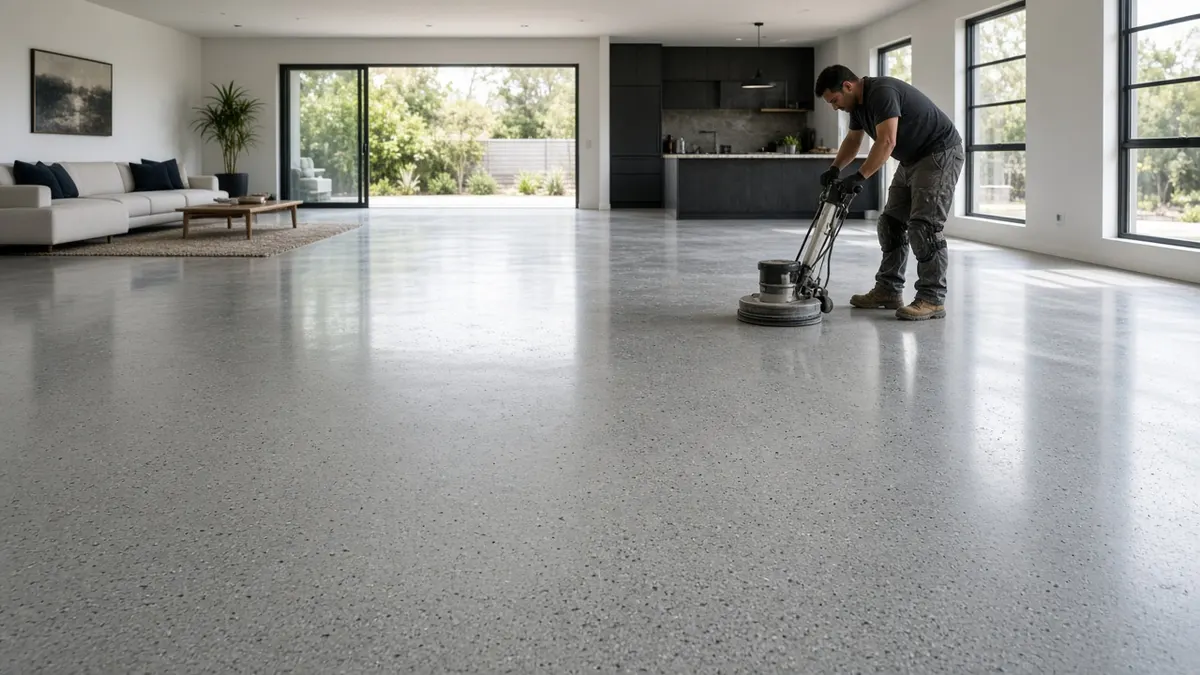
A polished or ground concrete floor inside an Australian home costs about $55 to $160 per m² in 2026, including GST. A simple grind and seal on a sound slab sits at the bottom of that range, while a full aggregate polish on an old slab that needs tiles lifted and cracks filled sits at the top.
That spread is wide because "concrete flooring" covers several different finishes and two very different starting points: a fresh slab on a new build, or a slab that has spent forty years under carpet. This guide is about interior floors you live on. If you are pricing a garage coating, see the epoxy flooring cost guide, and if you need the slab itself poured, the concrete slab cost guide covers that. All figures here are indicative. Get at least three written quotes from local contractors before you commit.
Price per m² by finish
Contractors in Australia tend to sell four or five finish levels. The names vary between businesses, so always ask what grit the floor finishes at and what sealer goes on top.
| Finish | What it looks like | Typical price per m² (incl. GST) |
|---|---|---|
| Grind and seal | Light grind to open the surface, then two or three coats of topical sealer. Satin or gloss sheen. | $55 to $90 |
| Honed concrete | Ground to around 200 to 400 grit with a penetrating or topical sealer. Matte, low glare, good for wet edges. | $70 to $110 |
| Mechanically polished, cream or salt and pepper | Little or fine aggregate showing, densified and polished to 800 grit or higher. Natural reflective sheen. | $85 to $130 |
| Mechanically polished, full aggregate exposure | Deeper grind so the larger stones show through, then polished. The most labour and diamond tooling. | $100 to $160 |
| Concrete overlay or microtopping | A thin cement-based layer trowelled over a poor slab or old tiles to get a concrete look. | $90 to $180 |
| Minimum job charge | Covers machine mobilisation, tooling and set-up on small areas. | $1,500 to $2,500 |
Expect the higher end in inner-city homes with tight access, apartments where everything goes up in a lift, and jobs under about 40 m², where set-up time is spread over fewer square metres.
New slab or old slab: the fork that sets your budget
The single biggest question a contractor will ask is whether the floor is going into a home that is still being built or one you already live in. The answer changes the price, the look and how predictable the result is.
Polishing a new slab
On a new build, polished concrete is cheapest and best when it is planned before the pour. The builder can order a 32 MPa mix with a chosen aggregate, ask the concreter for a flat, steel-trowelled finish, and keep plumbing and trench cuts out of the living areas. The polisher usually does an early grind before the frame goes up or once the roof is on, then the floor is covered with protection board until the final polish near handover.
Done this way, a salt and pepper finish often lands around $70 to $120 per m². The catch is site discipline. Plasterers, painters and sparkies all walk on that slab. Paint drips, plaster, diesel from a scissor lift and rust from a dropped bundle of steel can all stain it permanently, so make floor protection a line item in your building contract rather than an afterthought.
Revealing a slab that has been covered for years
Under old carpet or tiles is a lucky dip. You may find a beautiful floor, or you may find patched trenches where plumbing was moved, levelling compound, old paint, cracks, a change in colour where an extension was added, and screw holes from tack strips. None of these disappear with polishing. A good contractor will grind a small test patch before quoting a full polish, and many will steer you to grind and seal or a honed finish because it hides more.
Removal adds to the bill. Carpet and underlay are cheap to lift, perhaps $5 to $10 per m² plus disposal, but the glue and tack strip need grinding off. Ceramic tiles are a bigger job at roughly $25 to $50 per m² to remove, plus a skip bin and extra grinding to take the old adhesive bed down. Homes built before 1990 can have asbestos in vinyl tiles, sheet vinyl backing and some adhesives. Get any suspect material tested before anyone grinds it, and use a licensed removalist if it comes back positive; the asbestos removal cost guide has typical prices.
What each finish involves on the day
Understanding the process makes quotes much easier to compare, because the price is really a function of how many grinding passes the crew makes and how much hand work there is around the edges.
- Preparation. Furniture out, skirting protected or removed, old coverings lifted and the floor scraped back.
- Coarse grind. A planetary grinder with metal-bond diamonds takes the surface down. The deeper this goes, the more stone is exposed and the more it costs.
- Filling. Pinholes, cracks and joints are filled with a grout or epoxy mixed with the floor's own dust so the repair blends in as well as it can.
- Densifying. A lithium or sodium silicate densifier hardens the surface so it takes a polish and resists dusting.
- Honing and polishing. Resin diamonds run from about 50 or 100 grit through to 800, 1500 or 3000 grit for a high shine. Each step is a full pass over the room.
- Edges. A hand grinder does the strip along walls, under cabinetry kickboards and in doorways. Lots of small rooms means lots of edge work.
- Sealing. Polished floors get a penetrating guard. Grind and seal floors get two or three coats of a topical urethane or epoxy sealer.
Slip resistance matters near entries, laundries and any area that may get wet. Sealed concrete can be slippery when wet. Ask the contractor what slip rating the finished floor achieves when tested to AS 4586, and consider a honed finish or an anti-slip additive in the sealer for those zones.
Concrete floor prices by city
Labour rates, travel time and how many polishing contractors work in an area all show up in the price. These ranges are for a mechanically polished salt and pepper finish on a sound slab of 60 to 120 m².
| Location | Typical price per m² (incl. GST) | Why it differs |
|---|---|---|
| Sydney | $95 to $140 | Highest labour costs, slow access in inner suburbs and apartments. |
| Melbourne | $90 to $135 | Strong polished concrete market, lots of new estate work on the fringe. |
| Brisbane | $85 to $125 | Many lowset homes with slab floors, plenty of competition. |
| Perth | $85 to $125 | Mostly slab-on-ground housing, which keeps contractors busy year round. |
| Adelaide | $80 to $120 | Slightly lower labour rates. |
| Canberra | $90 to $135 | Smaller pool of contractors, higher wages. |
| Hobart | $90 to $135 | Fewer specialists, so travel and scheduling cost more. |
| Darwin | $100 to $150 | Small market, freight on tooling and sealers, wet-season scheduling. |
| Regional towns | $85 to $140 | Labour can be cheaper, but travel and accommodation are often added. |
Three jobs, costed line by line
These are realistic examples built from typical 2026 rates. Your quotes will differ, but the structure of the bill should look familiar.
New build in Werribee, 140 m² salt and pepper polish
A single-storey four-bedroom home where the owners chose polished concrete for the living, kitchen and hallway areas, with carpet in the bedrooms. The polish was planned before the pour.
| Item | Cost |
|---|---|
| Grinding, densifying and polishing to 800 grit, 140 m² at $70 | $9,800 |
| Penetrating guard sealer, 140 m² at $8 | $1,120 |
| Edge work around kitchen island and joinery | $600 |
| Pinhole and crack filling allowance | $450 |
| Protection board and tape until handover | $700 |
| Subtotal (ex GST) | $12,670 |
| GST | $1,267 |
| Total | $13,937 (about $100 per m²) |
1980s lowset in Carindale, 75 m² grind and seal after tile removal
The owners wanted to lose the beige ceramic tiles in the open-plan kitchen and living area. The adhesive was tested first and came back clear.
| Item | Cost |
|---|---|
| Tile removal and bagging, 75 m² at $30 | $2,250 |
| 6 m³ skip bin | $550 |
| Grinding off old adhesive bed, 75 m² at $15 | $1,125 |
| Crack repair and patching where a wall was removed | $800 |
| Grind and seal, two coats urethane, 75 m² at $60 | $4,500 |
| Subtotal (ex GST) | $9,225 |
| GST | $922.50 |
| Total | $10,147.50 (about $135 per m²) |
The finish itself worked out at about $66 per m² including GST. Lifting the tiles and getting the slab back to a clean surface cost almost as much as the floor. That is normal for renovations, and it is the part of the job where you can save money by organising some of the labour yourself.
Garage converted to a studio in Marrickville, 28 m² honed
A small job shows how minimum charges work. The crew still has to bring the same grinder, vacuum and tooling as they would for a whole house.
| Item | Cost |
|---|---|
| Honing to 400 grit with topical sealer, 28 m² at $85 | $2,380 |
| Mobilisation and set-up | $350 |
| Crack filling and oil stain treatment | $250 |
| Subtotal (ex GST) | $2,980 |
| GST | $298 |
| Total | $3,278 (about $117 per m²) |
Old garage slabs often have oil stains that never fully come out. A honed finish with a coloured or tinted sealer, or an overlay, can be a better choice than a high polish that highlights every mark.
What pushes a quote up or down
- Slab condition. Cracks, patches, curling at joints and old trenches all need filling and extra passes. A floor that is out of level by more than a few millimetres can need heavy grinding.
- Aggregate exposure. Each step deeper into the slab costs more in diamonds and hours. Full exposure on an old slab can also reveal uneven stone distribution.
- Area and layout. One large open room is faster than five small rooms with doorways, cupboards and a hallway.
- Access. Ground-floor homes with driveway access are easiest. Apartments, upstairs rooms and narrow terraces mean smaller machines and more time.
- Power. Big grinders often run on three-phase power. Without it, the crew uses smaller single-phase machines or brings a generator, which adds time or cost.
- What comes off first. Tiles, vinyl, carpet glue, paint and self-levelling compound all add removal and grinding time.
- Sealer choice. A penetrating guard is cheaper to maintain. A thick two-pack urethane gives more sheen and stain resistance but needs recoating down the track.
- Moving furniture and joinery. Most contractors want an empty room. Working around a kitchen that stays in place means more hand work at the kickboards.
- Dust control. Proper wet grinding or dust extraction with an H-class vacuum costs a little more and is worth every dollar in an occupied home.
Licences, dust and the paperwork
Grinding and sealing a floor is not one of the trades that needs a specialist licence in most states, but the job still sits inside building law once it passes your state's money threshold. In NSW, residential building work worth more than $5,000 in labour and materials needs a licensed contractor and a written contract, and NSW Fair Trading lets you check a licence online. In Queensland, the QBCC requires a licence for most building work valued over $3,300. In Victoria, check registration and contract rules with the Building and Plumbing Commission. For WA, SA, Tasmania, the ACT and the NT, check the current threshold with Building and Energy, Consumer and Business Services, CBOS, Access Canberra or the NT Building Practitioners Board.
Anything that touches services needs the right trade. Hydronic underfloor heating pipes in a new slab need a plumber, and electric in-slab heating needs a licensed electrician. Asbestos removal above the small DIY limits needs a licensed removalist.
Dust is the hidden safety issue. Concrete contains crystalline silica, and dry grinding releases fine dust that causes silicosis. Contractors have WHS duties to control it with water, on-tool extraction and the right respirators. Safe Work Australia's silica guidance explains what controls should be in place. If a crew turns up with a dry angle grinder and no vacuum, stop the job.
How concrete compares with other hard floors
Polished concrete is often chosen on looks, but it is worth weighing up against the alternatives for the same room. These are broad installed ranges.
| Floor | Rough installed cost per m² | Good for | Watch out for |
|---|---|---|---|
| Grind and seal concrete | $55 to $90 | Budget renovations, rental properties | Topical sealer wears in traffic lanes |
| Polished concrete | $85 to $160 | New builds, open-plan living | Hard and cold underfoot, cracks show |
| Epoxy coating | $60 to $170 | Garages, workshops, some commercial | Can look industrial in living areas |
| Porcelain floor tiles | $90 to $200 including tiles | Wet areas, consistent look | Grout lines, tile cost varies widely |
| Floating timber-look floor | $50 to $120 | Quick upgrades over an existing floor | Hollow sound, not for wet areas |
If tiles are on your shortlist, the floor tiling cost guide breaks down tile and labour prices in more detail.
Living with it: upkeep, comfort and lifespan
A mechanically polished floor is about as low maintenance as flooring gets. Sweep or dust mop, and wash with a pH-neutral cleaner. Avoid vinegar, bleach and citrus cleaners, which etch the surface over time. Expect a professional burnish or light re-polish every few years in heavy traffic areas, often $15 to $30 per m².
Grind and seal floors need more care. The topical sealer is the wearing surface, so it scratches and dulls in walkways. Plan on a recoat every three to five years for a busy family home, typically $20 to $40 per m² including a light sand.
Comfort is the trade-off people talk about after they move in. Concrete is hard on dropped glasses and tired legs, and it is cold in a Hobart or Canberra winter unless the slab gets winter sun or has underfloor heating. In a well-designed home with north-facing glazing, the slab's thermal mass soaks up winter sun and helps keep the place cool in summer. Rugs help with comfort and echo. In apartments, check your strata by-laws and acoustic requirements before replacing carpet with a hard floor.
A well-made concrete floor lasts as long as the house. Cracks can appear as the building settles. They can be filled, but they rarely vanish, so it helps to see them as part of the material.
Questions to ask before you sign
Concrete polishing quotes vary a lot in what they include. A good written quote should cover:
- The finish name and the final grit, the level of aggregate exposure and the sealer brand or type.
- Whether removal of existing coverings, adhesive grinding, crack filling and edge work are included or extra.
- Dust control method and who cleans up afterwards.
- How long the floor must be kept free of furniture and foot traffic.
- Payment schedule, with a deposit that stays within your state's legal limit.
- Licence number where the job is over your state threshold, plus public liability insurance details.
- Photos or addresses of recent jobs on similar slabs, especially old slabs if yours is one.
Red flags include cash-only pricing, a large upfront deposit, a quote with no breakdown, refusal to do a test patch on an old slab, and a promise that cracks will disappear.
For a sense of what the labour in a quote is worth, the concreter hourly rate guide lists typical hourly and per m² labour rates around the country.
Timeline from empty room to finished floor
A grind and seal on 60 to 80 m² usually takes two to three days, including curing time between sealer coats. A full mechanical polish on 100 to 150 m² is more like three to five days on site. Add a day or two at the start if tiles need lifting.
Most sealers allow light foot traffic within 24 hours, but furniture should stay off for two to seven days depending on the product. Do not lay rugs for at least a week on a topical sealer, since a rug can trap solvent and mark the finish. On new builds, the polish is split into two visits weeks or months apart, so schedule both in the building program early.
Cutting the cost without cutting corners
- Choose a finish that suits the slab. Salt and pepper or honed costs less than full exposure and hides old patches better.
- Group rooms so the crew polishes one continuous area instead of returning for a second visit.
- Do the removal and clean-out yourself or with hired help, so the specialist only bills for grinding.
- Book in cooler months if you can. Sealers are easier to apply when the slab is not baking, and some contractors are less busy outside the pre-Christmas rush.
- On a new build, put the polish in the contract from day one rather than adding it as a variation later.
Where Yakka fits in a concrete floor job
Much of the cost of revealing an old slab is labour that does not need a polishing specialist. Pulling up carpet and tack strip, chipping off tiles, bagging rubble, loading a skip, carrying furniture out to the garage and cleaning up the dust afterwards are all jobs you can book a worker for on Yakka Labour by the shift. Our guide on how to hire a labourer for a day explains how that works.
The grinding, polishing and sealing should still go to an experienced concrete polisher with the right machines and dust control. You can browse floor coating contractors and concrete resurfacing specialists to compare quotes, and use a licensed asbestos removalist for anything that tests positive.
Frequently asked questions
How much does polished concrete cost per m2 in Australia?
In 2026, a mechanically polished concrete floor usually costs $85 to $160 per m² including GST. Salt and pepper finishes on a new slab are often at the lower end, while full aggregate exposure on an old slab sits at the top. Small jobs are often charged a minimum of $1,500 to $2,500 because the crew needs the same machines regardless of area.
Is grind and seal cheaper than polished concrete?
Yes. Grind and seal usually costs $55 to $90 per m² because the crew makes fewer grinding passes and relies on a topical sealer for the sheen. The trade-off is maintenance. The sealer wears in walkways and needs recoating every few years, while a mechanically polished floor mainly needs cleaning and the occasional burnish.
Can you polish an old concrete slab under carpet or tiles?
Usually, yes, but the result is less predictable than on a new slab. Old slabs can have patches, cracks, plumbing trenches and glue residue that remain visible after polishing. Ask for a test patch first. Many owners of older homes choose grind and seal or a honed finish, which hide more imperfections and cost less.
Is polished concrete flooring worth it?
It is good value on a new build where the polish is planned before the pour, since you avoid buying a separate floor covering. It lasts as long as the house and is easy to clean. It is less suited to people who want a soft, warm floor, or to old slabs with heavy patching, where tiles or timber-look flooring may look better for similar money.
How long does it take to polish a concrete floor?
A typical house job of 80 to 150 m² takes three to five days on site for a full mechanical polish, and two to three days for a grind and seal. Allow extra time for tile removal or adhesive grinding. Furniture should usually stay off the floor for two to seven days after sealing, depending on the product used.
Does polished concrete crack?
Concrete cracks as it shrinks and as the house settles, so hairline cracks are common and are not normally a structural issue. Polishing does not cause cracks, but it can make existing ones easier to see. Contractors fill them with a colour-matched filler. If cracks are wide, growing or uneven, get a builder or structural engineer to look at the slab first.
Do I need a licensed contractor to polish concrete floors in NSW?
In NSW, residential building work worth more than $5,000 including labour and materials needs a licensed contractor and a written contract. Most whole-house polishing jobs exceed that. Check the contractor's licence on the NSW Fair Trading website and ask for proof of public liability insurance before work starts.
Official sources
Award rates, licences and safety rules change. Check the official source before you hire or take on a shift.
- Safe Work AustraliaNational work health and safety framework, including high-risk work licences
- Queensland Building and Construction Commission (QBCC)Contractor, plumbing and drainage licence search in Queensland
- Consumer and Business Services SALabour hire licensing in South Australia
- NSW Fair TradingTrade licence checks for electricians, plumbers and builders in New South Wales
- Building and Plumbing Commission (Victoria)Builder and plumber registration, domestic building insurance and licence checks in Victoria
- Asbestos Safety and Eradication AgencyWhere asbestos is found in homes and how to deal with it safely