Exterior cost guide
How Much Does Pressure Cleaning Cost? Australian Prices 2026
Typical cost in Australia (2026, inc. GST)
$3 to $8 per m²
driveways, paths and patios in concrete or pavers, standard condition
Professional pressure cleaning costs about $3 to $8 per square metre for driveways, paths and patios, so a double driveway of around 65 m² usually costs $250 to $450. A single-storey house soft wash is $400 to $900, and two storeys $700 to $1,400. Surface type, stains such as oil and rust, access, minimum charges and whether you add sealing drive the final price.
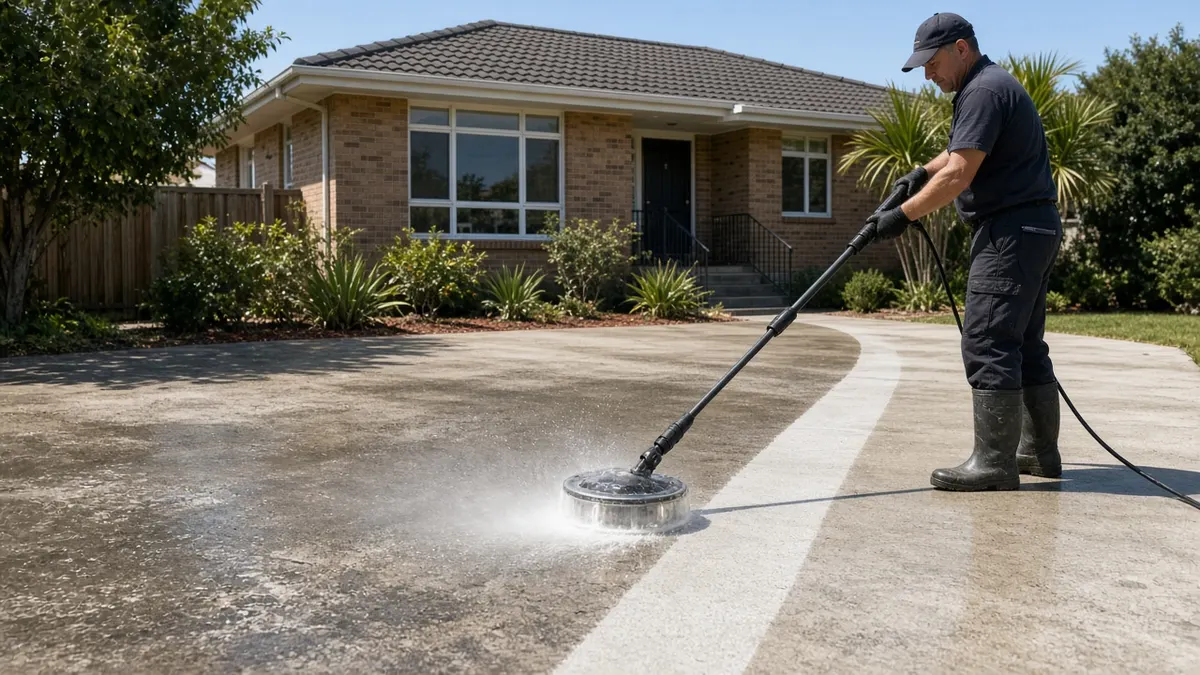
Pressure cleaning costs most Australian households $3 to $8 per square metre, which puts a typical double driveway at $250 to $450 and a full clean of the driveway, paths and back patio at $450 to $850. Washing the outside of a house is priced differently, usually $400 to $900 for a single-storey home and $700 to $1,400 for two storeys.
It is one of the few exterior jobs where the before and after photos are dramatic for not much money. It is also a job where cheap and careless can do real damage: etched concrete, striped pavers, furred timber and water forced behind cladding. The prices below are indicative for 2026 and include GST. Get at least three written quotes, and make sure each one covers the same areas and finish.
Rates per square metre by surface
Most operators price flat surfaces by the square metre, with a minimum charge of about $150 to $250 per visit. Measure your areas roughly before calling and you will spot an inflated quote quickly.
| Surface | Typical rate (incl. GST) | Notes |
|---|---|---|
| Plain concrete driveway or path | $3 to $6 per m² | Fastest surface to clean with a rotary surface cleaner |
| Exposed aggregate concrete | $4 to $7 per m² | Needs care so the stones are not loosened |
| Coloured or stencilled concrete | $5 to $9 per m² | Often has a sealer that is easy to damage |
| Clay or concrete pavers | $4 to $8 per m² | Joint sand washes out; re-sanding is extra |
| Tiled patio or pool surround | $4 to $8 per m² | Grout lines need lower pressure |
| Timber deck | $5 to $10 per m² | Low pressure and a cleaner to avoid furring the timber |
| Brick, render or cladding walls (soft wash) | $4 to $9 per m² | Usually quoted per house rather than per m² |
| Colorbond or timber fence | $3 to $6 per m² of fence face | Often priced per linear metre of fence |
Hourly rates also exist, mostly for small or mixed jobs. Expect about $70 to $130 per hour for an operator with a commercial machine, hot water unit or surface cleaner, and closer to the lower end for a general cleaner with a domestic machine. For context on general cleaning rates, see our guide to cleaner hourly rates in Australia.
Common pressure cleaning jobs and what they cost
| Job | Typical size | Typical price |
|---|---|---|
| Single driveway | 30 to 40 m² | $180 to $320 |
| Double driveway | 55 to 70 m² | $250 to $450 |
| Driveway, front path and rear patio | 100 to 130 m² | $450 to $850 |
| Timber deck clean, ready for oiling | 25 to 35 m² | $180 to $320 |
| Pool surround | 35 to 50 m² | $200 to $380 |
| House soft wash, single-storey | Walls, eaves and fascia | $400 to $900 |
| House soft wash, two-storey | Walls, eaves and fascia | $700 to $1,400 |
| Driveway clean and seal | 60 m² | $900 to $1,900 |
Roof cleaning is a separate job with its own safety requirements and pricing. Our roof cleaning cost guide covers tile and metal roofs.
Pressure washing and soft washing are different jobs
People use the terms loosely, but a good operator will choose between them depending on the surface.
Pressure washing uses high-pressure water, usually 2,500 to 4,000 psi, often through a spinning surface cleaner that keeps the nozzle a fixed height off the ground. It suits hard horizontal surfaces such as concrete and pavers. Hot water units cut through oil and grease faster, which is why they cost more to hire.
Soft washing uses low pressure, closer to a garden hose, and a cleaning solution that kills mould, algae and lichen. It is the right method for render, painted walls, weatherboards, eaves and most roofs, because high pressure can blow water behind cladding, strip paint and chip render. A house wash quote should be for soft washing. If someone plans to blast your painted weatherboards at full pressure, find someone else.
Timber decks sit in between. They need a deck cleaner, a low setting, a wide fan tip and the nozzle kept moving with the grain. Too much pressure lifts the soft summer growth of the timber and leaves a furry surface that has to be sanded before oiling.
What makes one quote higher than another
Area and condition
Size is the main factor, but condition is close behind. A driveway cleaned every two years takes one pass. A south-facing path that has been green and slimy for a decade may need a pre-treatment, a slow first pass and a second clean.
Stain type
General grime, mould and moss come off with water and a cleaner. Oil drips, rust marks from garden furniture or bore water, tyre marks, leaf tannin and efflorescence (the white powder on new pavers and brickwork) need specific chemicals and extra time. Expect $50 to $150 extra for oil stain treatment on a driveway, and be realistic: old oil that has soaked deep into plain concrete often fades rather than disappears.
Water and power
Most operators use your outside tap. Very low water pressure, or no tap near the work area, slows things down. Some carry their own water tank for this reason.
Wastewater capture
Dirty water with detergent, oil or paint flakes should not run into the stormwater system. On commercial jobs and some residential ones, operators use vacuum recovery equipment or bunding to collect it, which adds cost. Cheaper quotes sometimes skip this.
Height and access
Ground-level slabs are quick. Two-storey walls, steep driveways, narrow side passages and multi-level decks take longer, and anything above a single storey may need ladders, extension wands or a hired lift.
Add-ons
Re-sanding paver joints, sealing, deck oiling and gutter face cleaning are all extras. They often make sense to do in the same visit because the surface is already clean and dry access is set up.
Prices in each capital city
The table is for a double plain-concrete driveway of about 65 m², including a typical minimum charge.
| City | Double driveway | Local factors |
|---|---|---|
| Sydney | $280 to $480 | Higher labour rates, traffic, parking |
| Melbourne | $260 to $450 | Mould and moss on shaded paths in cooler months |
| Brisbane | $250 to $430 | Fast mould regrowth in humid summers |
| Perth | $250 to $420 | Bore water rust stains are a common add-on |
| Adelaide | $230 to $400 | Lower labour costs |
| Hobart | $240 to $420 | Moss and lichen, fewer operators |
| Canberra | $260 to $460 | Seasonal demand before spring and summer sales |
| Darwin | $280 to $500 | Heavy wet season mould, heat limits working hours |
| Regional | $220 to $450 plus travel | Fewer operators, travel fees common |
Water restrictions can also affect timing. During drought, some water utilities limit hosing of hard surfaces, sometimes with exemptions for commercial cleaners using high-pressure, low-volume equipment. Check your local water authority if restrictions are in place.
Worked examples
All three examples include GST.
Exposed aggregate driveway and paths in Blacktown, NSW
A double driveway of 60 m², a 15 m² front path and a 25 m² rear patio, last cleaned three years ago, with two oil drip patches where the ute parks.
| Item | Cost |
|---|---|
| Driveway, 60 m² at $4.50 per m² | $270 |
| Path and patio, 40 m² at $4.50 per m² | $180 |
| Oil stain pre-treatment, two patches | $90 |
| Total | $540 |
| GST included | about $49 |
Rendered single-storey house in Mandurah, WA
A coastal home with about 180 m² of painted render, eaves and fascia, black mould on the shady south side and salt haze on the windows.
| Item | Cost |
|---|---|
| Soft wash of walls, eaves and fascia | $650 |
| Mould treatment on south and east walls | $70 |
| Rinse of window frames and gutter faces | $80 |
| Total | $800 |
| GST included | about $73 |
Paver pool surround in Mermaid Waters, QLD
A 50 m² concrete paver pool surround, grey with algae, joints partly washed out. Owner wants it sealed to slow regrowth.
| Item | Cost |
|---|---|
| Pressure clean, 50 m² at $6 per m² | $300 |
| Re-sand joints with polymeric sand | $250 |
| Two coats of penetrating sealer, 50 m² at $18 per m² | $900 |
| Total | $1,450 |
| GST included | about $132 |
The third job shows how sealing changes the numbers. The clean was $300; the full clean, re-sand and seal was nearly five times that. Whether that is worth it depends on how long you plan to stay and how quickly the surface gets dirty again.
Is sealing worth paying for?
Sealing after a clean costs roughly $12 to $25 per m² on top of the cleaning, depending on the sealer and the number of coats. There are two broad types.
- Penetrating sealers soak into concrete and pavers without changing the look much. They repel water and oil, slow mould growth and usually last five years or more. They suit pool surrounds and natural-look pavers.
- Film-forming acrylic sealers sit on top, give a wet look or satin sheen and deepen colour. They wear faster on driveways, typically needing a recoat every two to four years, and can become slippery around pools unless an anti-slip additive is used.
Sealing is good value on coloured or stencilled concrete, new pavers, pool areas and driveways where oil is a constant problem. On a plain grey driveway, a clean every couple of years usually costs less over time than sealing and resealing. If your concrete is cracked or failing, cleaning will not hide it; our concrete driveway cost guide and paving cost guide explain replacement prices.
Doing it yourself
Pressure cleaning is one of the more DIY-friendly exterior jobs, with a few caveats. Your options:
- Buy an electric unit: $150 to $600 for a domestic machine. Fine for outdoor furniture, bins and a small patio, slow on a big driveway.
- Hire a petrol machine: about $70 to $150 a day for a 3,000 to 4,000 psi unit, plus $30 to $60 for a rotary surface cleaner attachment, which makes a huge difference on concrete.
- Chemicals: $30 to $80 for a mould and algae treatment, more for oil and rust removers.
The common DIY mistakes are holding the nozzle too close, which etches concrete and leaves stripes; using a zero-degree tip; blasting grout out of tiles and sand out of paver joints; furring timber decks; and spraying water up under weatherboards, window seals and roof flashings. High-pressure water can also cause injection injuries if it hits skin at close range, so wear enclosed shoes and never point the wand at anyone.
For a plain driveway and a patio, hiring a machine for a Saturday is good value. For render, painted surfaces, coloured concrete or anything above ground level, an experienced operator is usually worth the money.
Rules on wastewater, asbestos and licences
No Australian state requires a trade licence for pressure cleaning. That does not make it unregulated.
Stormwater. Stormwater drains run straight to creeks, rivers and the ocean without treatment. Letting dirty wash water with detergents, oil, paint flakes or chemicals into the gutter or a stormwater drain can breach environmental protection laws in every state. Professional operators should know the rules and direct wastewater to lawn or garden areas where suitable, or collect it. The NSW Environment Protection Authority and its counterparts in other states publish guidance for cleaning businesses.
Asbestos. Many homes built before 1990 have asbestos cement sheeting in eaves, walls, fences or roofs. Work health and safety laws prohibit using high-pressure water spray on asbestos-containing materials, because it breaks the surface and spreads fibres across your property and your neighbours'. If you have an old fibro fence, shed or roof, do not let anyone pressure clean it. Safe Work Australia explains the risks on its asbestos information page.
Insurance. A professional should carry public liability insurance in case of damage, such as water through a window seal, a chipped render corner or stripped paint. Ask for the certificate.
How often and when to book
Every one to three years is typical for driveways and paths, more often for shady, damp areas and pool surrounds where slip risk matters. Houses benefit from a soft wash every two to three years, especially in coastal and humid climates where mould grows fast.
Spring is the busy season, when people prepare for summer entertaining or a house sale. Late autumn and winter in the southern states are quieter and sometimes cheaper. Before selling, a clean of driveway, paths and house exterior is one of the cheapest ways to improve street appeal in listing photos.
If you plan to repaint, a soft wash two or three days beforehand is standard preparation, and many painters include it in their quote. Check our house painting cost guide to see how that fits into a repaint budget.
Strata, rentals and small commercial jobs
Pressure cleaning for a strata block, a shopfront or a rental turnover is priced a little differently. Strata committees usually want a fixed price for common areas such as car park ramps, bin rooms, stairwells and pathways, often on a recurring schedule every six or twelve months. Expect $3 to $6 per m² for large open concrete areas, with the per-metre rate dropping as the area grows, and separate pricing for bin room sanitising, which takes time and stronger chemicals.
Basement car parks bring extra requirements: wastewater recovery so oily water does not go down the stormwater pits, traffic management around residents' cars, and sometimes after-hours work. These can add 20 to 50 percent to the base rate. For shopfronts and footpaths, check with your council whether footpath cleaning needs a permit and what time of day it can be done.
Landlords and agents often book a driveway and path clean as part of a vacate or pre-lease tidy-up. It is quick, cheap and shows up well in listing photos. If the tenant's car has left oil stains, the cost of treatment is usually a fair claim against the bond when it goes beyond normal wear, but check the condition report first.
On the day
A standard double driveway takes one operator about an hour to an hour and a half, including setup and rinse-down. A full driveway, paths and patio job runs two to four hours. A house soft wash usually takes half a day for a single-storey home and most of a day for two storeys.
Before they arrive, move cars, bins, pot plants, outdoor furniture and doormats off the areas being cleaned. Close windows and doors on the side being washed, and check that outdoor power points have covers. Bring pets inside. Tell the operator about any loose pavers, cracked render, recently painted surfaces, fish ponds or sensitive garden beds so they can protect them or adjust the chemicals.
Expect some noise from the petrol engine and a wet surface for an hour or two afterwards. If sealing is part of the job, keep cars off the driveway for at least 24 to 48 hours, or longer if the product label says so. Foot traffic is usually fine after a few hours.
Keeping the cost down
- Do it all in one visit. The minimum charge and travel are the expensive part of a small job. Adding paths, the patio and the bins area to a driveway clean often costs less per square metre than booking each separately.
- Share with a neighbour. Two driveways side by side on the same morning can save each household a chunk of the call-out.
- Treat stains early. Wipe up fresh oil drips with kitty litter or a degreaser before they soak in. Old stains cost more and rarely disappear completely.
- Improve drainage and sunlight. Trimming shrubs that shade a path, or fixing a downpipe that dumps water onto a patio, reduces the mould that keeps coming back.
- Skip sealing on plain concrete unless oil or mould is a constant problem. Spend the money on a clean every two years instead.
Comparing quotes
A written quote for pressure cleaning should say:
- Every area included, with approximate square metres
- Method for each surface: pressure, soft wash or low-pressure deck clean
- Stain treatments included, and what results to expect on old oil or rust
- Whether sealing or re-sanding is included, and the product used
- How wastewater will be managed
- Total price including GST, and any minimum charge
- ABN and public liability insurance
Be wary of door-knockers with a trailer rig offering a cut price today, quotes that promise to remove every stain completely, and anyone who wants to pressure blast render, roofs or fibro at full pressure. A job like this should be paid on completion, not upfront.
Hiring help through Yakka
Pressure cleaning is the kind of hands-on job Yakka Labour is built for. You can hire a worker with their own commercial pressure cleaner for driveways, paths and patios, or book a labourer for a few hours to move furniture, sweep and clear the area so the cleaning goes faster. Browse pressure cleaners near you and check equipment, reviews and rates before you book.
For roof washing, high walls or anything involving fibro, choose someone with the right safety gear and experience, and confirm insurance before they start.
Frequently asked questions
How much does pressure cleaning cost per m2?
Professional pressure cleaning costs about $3 to $8 per square metre in Australia. Plain concrete sits at the low end, while exposed aggregate, coloured concrete, pavers and timber decks cost more because they need lower pressure or more care. Most operators also have a minimum charge of around $150 to $250, so small areas cost more per square metre.
How much does it cost to pressure clean a driveway?
A single driveway of 30 to 40 m² usually costs $180 to $320, and a double driveway of 55 to 70 m² costs $250 to $450. Oil stain treatment adds roughly $50 to $150. If you add a sealer, expect a total of $900 to $1,900 for a 60 m² double driveway, depending on the sealer type and number of coats.
How much does it cost to wash the outside of a house?
A soft wash of the exterior walls, eaves and fascia costs about $400 to $900 for a single-storey home and $700 to $1,400 for two storeys. Heavy mould, coastal salt build-up, difficult access and add-ons such as window frames and gutter faces push the price up. Soft washing uses low pressure to avoid damaging paint and render.
Can you pressure clean a fibro or asbestos roof?
No. Work health and safety laws prohibit using high-pressure water on asbestos-containing materials, because it damages the surface and spreads fibres. If your home was built before 1990 and has fibro roofing, eaves, walls or fencing, assume it may contain asbestos unless it has been tested, and get advice from a licensed asbestos assessor or removalist.
Is it worth hiring a pressure washer instead of paying someone?
For a plain concrete driveway and patio, hiring a petrol machine and surface cleaner for about $100 to $210 a day is good value if you are comfortable with the equipment. For render, painted walls, coloured concrete, decks or anything above ground level, a professional is usually worth it because mistakes can strip paint, etch concrete or fur timber.
How often should I pressure clean my driveway?
Every one to three years suits most driveways. Shaded, damp or south-facing areas and pool surrounds can need yearly cleaning to control mould and slip risk. Sealing after a clean slows regrowth and staining, which can stretch the time between cleans, but the sealer itself needs recoating every few years depending on the product.
Official sources
Award rates, licences and safety rules change. Check the official source before you hire or take on a shift.
- Safe Work AustraliaNational work health and safety framework, including high-risk work licences
- Asbestos Safety and Eradication AgencyWhere asbestos is found in homes and how to deal with it safely