Exterior cost guide
Roof Cleaning Cost in Australia: What to Pay in 2026
Typical cost in Australia (2026, inc. GST)
$500 to $1,400 per job
single-storey home, 150-200 m² roof, pressure clean or soft wash
A professional roof clean costs about $500 to $1,400 for a typical single-storey Australian home in 2026, or roughly $3 to $7 per m². Soft washing with a moss and lichen treatment costs a little more, and two-storey roofs cost 30% to 60% more. Roof size, pitch, storeys, how much growth there is and add-ons such as gutters set the price.
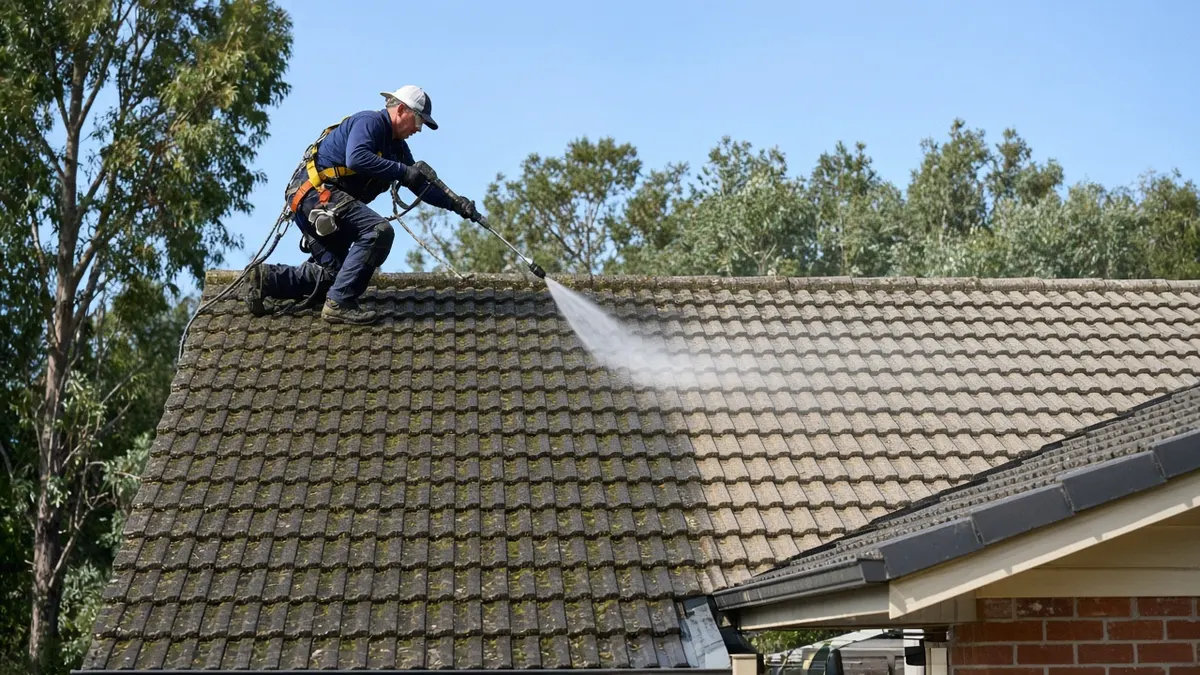
Cleaning a roof in Australia costs $500 to $1,400 for most single-storey homes in 2026. Priced by area, that is about $3 to $7 per square metre for a pressure clean or soft wash, with a minimum charge of around $300 to $450 for small roofs.
This guide covers cleaning on its own: washing off dirt, moss, lichen, mould and leaf stains without any coating. It is the cheapest roof job there is, and for a lot of homes it is all the roof needs. If you are cleaning because you plan to paint, the roof painting cost guide covers the full job, since painters include the clean in their price. If the clean turns up cracked tiles and failing ridge pointing, the roof restoration guide explains the next step.
Prices below are indicative and include GST. Get at least three written quotes, and make sure each covers the same method, the same add-ons and the same safety setup.
Roof cleaning prices by size
| Roof area | Typical home | Single-storey | Two-storey |
|---|---|---|---|
| Up to 100 m² | Cottage, townhouse, granny flat | $350 to $700 | $550 to $1,000 |
| 100 to 150 m² | Two or three-bedroom home | $450 to $1,000 | $700 to $1,500 |
| 150 to 200 m² | Three or four-bedroom home | $600 to $1,400 | $900 to $2,000 |
| 200 to 280 m² | Larger family home | $850 to $1,900 | $1,300 to $2,800 |
Two-storey roofs cost more because of extra fall protection, longer hose runs and slower work. Steep roofs and houses with tight side access sit at the top of each range. A roof covered in thick moss on a shady block takes far longer than a dusty roof on an open site.
Cleaning methods and what each costs
There is more than one way to clean a roof, and the right method depends on the roof material and what is growing on it.
| Method | Price per m² | Best for | Watch out for |
|---|---|---|---|
| High-pressure clean | $3 to $6 | Concrete tiles with heavy dirt and moss, prep for painting | Can strip worn tile surfaces and force water under laps |
| Soft wash (low pressure with cleaning solution) | $4 to $8 | Colorbond, terracotta, painted roofs, delicate tiles | Chemical run-off must be managed around gardens and drains |
| Treatment spray only (biocide left to work) | $2 to $4 | Light lichen and mould, maintenance between cleans | Takes weeks to months to show results as rain rinses the growth |
| Hand clean and brush | $5 to $10 | Small areas, heritage slate, around skylights and solar | Slow, labour-heavy |
High-pressure cleaning gives the most dramatic before and after, which is why it is the standard first step before a roof paint. On its own, though, it can be harsh on older concrete tiles whose surface has worn away. A good cleaner adjusts pressure and nozzle to the roof, rather than blasting everything at full power.
Soft washing has become the go-to for steel and painted roofs. A low-pressure spray applies a cleaning solution that kills moss, mould and lichen, and a gentle rinse removes the loosened growth. Because the roots are killed, regrowth is usually slower than after a pressure clean alone.
Cleaning different roof types
Concrete tiles are the most common roofs cleaned in Australia. They grow moss and lichen readily once the surface coating wears, especially on south-facing planes and under trees. A pressure clean works well if the tiles are sound. If the surface is already crumbly, a soft wash is safer.
Terracotta holds up well to cleaning, but very old tiles can be brittle and crack underfoot. Experienced cleaners walk on the lower edges of the tiles where they are supported. Glazed terracotta usually needs only a gentle wash.
Colorbond and other steel should be cleaned with low pressure and a non-abrasive, steel-safe cleaner. High pressure and harsh chemicals can damage the paint finish. In coastal areas, a regular rinse of areas that rain does not reach is part of normal maintenance for steel roofing.
Slate is cleaned by hand or with very low pressure by someone who knows slate. Pressure can lift or break slates.
Asbestos cement roofs are a hard no for pressure cleaning. Using high-pressure water spray on asbestos-containing material is prohibited under WHS regulations because it releases fibres and spreads contaminated slurry around your property and your neighbours'. Safe Work Australia's asbestos guidance covers the rules. If your home was built before about 1990 and has corrugated grey sheeting, have it tested before anyone touches it.
Add-ons that are worth bundling
Once a cleaner is on the roof with ladders, harnesses and water, small extras cost far less than booking them separately.
| Add-on | Typical extra cost | Notes |
|---|---|---|
| Gutter clean, single-storey | $150 to $300 | Recommended after any roof clean, as debris washes into gutters |
| Gutter clean, two-storey | $250 to $450 | Often done from the roof rather than ladders |
| Downpipe flush | $20 to $50 each | Clears blockages from washed-down grit |
| Solar panel clean | $8 to $15 per panel | Soft brush and purified water, no pressure |
| Moss and lichen treatment after the clean | $150 to $400 | Slows regrowth |
| Replace a few cracked tiles | $20 to $40 per tile | Only if the cleaner is a roofer or has matching tiles |
| Skylight dome wash | $30 to $80 each | Gentle hand clean, never pressure |
The gutter clean is the one to insist on. A roof clean sends a surprising amount of moss, grit and tile granules into the gutters, and leaving it there causes overflows in the next storm. The gutter cleaning cost guide covers gutter work on its own.
Roof cleaning prices by city
| City | Per m² | Typical 180 m² single-storey | Why |
|---|---|---|---|
| Sydney | $3.50 to $7.50 | $650 to $1,350 | Higher labour costs, lots of shaded leafy suburbs |
| Melbourne | $3.50 to $7.00 | $630 to $1,260 | Moss and lichen grow fast in damp eastern suburbs |
| Brisbane | $3.00 to $6.50 | $540 to $1,170 | Mould and black staining common in humid months |
| Perth | $3.00 to $6.50 | $540 to $1,170 | Dust and leaf stains more than moss |
| Adelaide | $3.00 to $6.00 | $540 to $1,080 | Lower labour costs |
| Hobart | $3.50 to $7.00 | $630 to $1,260 | Heavy lichen growth, fewer operators |
| Canberra | $3.50 to $7.00 | $630 to $1,260 | Seasonal, little work in frosty months |
| Darwin | $4.00 to $8.00 | $720 to $1,440 | Heavy mould after the wet season |
Regional areas are often similar to the nearest capital, though some operators add a travel fee if you are more than 30 to 50 km out.
Three roof cleans, priced out
Mossy concrete tiles in Croydon, Victoria
A single-storey 1980s home, 190 m² of concrete tiles, heavy moss on the south side under two big eucalypts.
| Item | Cost |
|---|---|
| Pressure clean, 190 m² at $4.50 | $855 |
| Moss and lichen treatment | $240 |
| Gutter clean | $190 |
| Replace four cracked tiles found during the clean | $120 |
| Total including GST | $1,405 |
Trimming back the overhanging branches would make the next clean cheaper and the moss slower to return.
Soft wash on a two-storey Colorbond roof, Sunshine Coast
A two-storey coastal home with 220 m² of steel roof, black mould streaks, salt build-up and a 20-panel solar system.
| Item | Cost |
|---|---|
| Soft wash, 220 m² at $5 | $1,100 |
| Two-storey gutter clean | $320 |
| Solar panel clean, 20 panels at $12 | $240 |
| Total including GST | $1,660 |
About $7.50 per m² all in, with the solar and gutters included.
Small cottage in Hobart
A weatherboard cottage with 110 m² of concrete tiles and patchy lichen.
| Item | Cost |
|---|---|
| Pressure clean (minimum charge applies) | $550 |
| Gutter clean | $180 |
| Total including GST | $730 |
At 110 m² this is $5 per m² for the clean, higher than the area alone would suggest because of the minimum charge.
Hourly rates behind a cleaning quote
Most roof cleaners quote a fixed price per job. If you are booking someone by the hour for a smaller clean or the ground work around it, these are typical 2026 rates:
| Who | Hourly rate | Notes |
|---|---|---|
| Specialist roof cleaner (with pressure unit) | $70 to $110 | Equipment and fall protection included |
| Pressure cleaning operator (ground level) | $60 to $95 | Driveways, paths, walls, decks |
| General cleaner or handyperson | $45 to $75 | Gutters from a ladder, windows, clean-up |
| Labourer | $45 to $65 | Moving furniture, green waste, covering gardens |
Stains a clean will not shift
Cleaning removes growth and grime, but some marks are part of the roof itself. Set your expectations before the job:
- Faded or patchy colour. If the original surface colour of concrete tiles has worn away, a clean shows the bare grey concrete underneath. Only a coating brings the colour back.
- Rust staining on steel. Orange marks from swarf, screws or rusting laps need rust treatment, not washing.
- Lichen ghosts. Lichen leaves pale rings on tiles even after it is dead and removed. They usually fade over months but may never fully disappear.
- White salt deposits on terracotta. Efflorescence comes from salts in the tile or mortar. It can be reduced but tends to return.
- Peeling paint from an old roof coating. Pressure cleaning will lift more of it. That roof needs a recoat, not repeated cleans.
Why bother cleaning a roof?
Growth on a roof does real damage over time. Moss acts like a sponge, holding water against the tiles and lifting them slightly so wind-driven rain can get underneath. Lichen roots into the surface of concrete tiles and slowly breaks it down. Debris washes off the roof into gutters and downpipes, where it causes overflows that can rot fascias and push water into the eaves.
A clean also tells you what condition the roof is in. Once the moss is off, cracked tiles, loose ridge caps and rusted valleys are easy to spot. For many owners the clean is the first step in deciding between doing nothing more, a coat of paint, or a restoration.
Solar owners have an extra reason. Dirty panels produce less power, and bird droppings or leaf build-up on one panel can affect output across a string. A combined roof and panel clean every couple of years keeps output closer to what it should be.
How often to clean a roof
There is no fixed schedule. As a guide:
- Open sites with little shade: every four to six years, or only when it looks dirty.
- Leafy, shaded blocks: every two to three years, as moss and lichen return faster.
- Humid coastal areas: every two to three years for mould, plus a rinse for steel roofs near the beach.
- Before painting or a restoration: always, as part of that job.
A biocide treatment after a clean can stretch the interval. Trimming trees and keeping gutters clear makes the biggest difference of all.
The easiest check is from the street with a pair of binoculars or a phone camera on zoom. Green or grey patches spreading across tiles, black streaks running down from the ridge, or gutters with plants growing in them all mean the roof is due. A roof that simply looks a bit dull is not urgent. Spend the money when there is growth to remove, not on a calendar.
Doing it yourself
A petrol pressure cleaner capable of roof work hires for about $100 to $150 a day, and roof cleaning treatments cost $50 to $150 for enough to do a house. On paper, DIY looks like it saves most of the bill. In practice it is risky:
- Wet roofs are slippery, and moss makes them slipperier. Falls from single-storey roofs cause serious injuries every year.
- Pointing the wand the wrong way drives water up under tiles and into the ceiling.
- Too much pressure strips worn tiles, and walking in the wrong spots cracks them.
- Chemical run-off can kill garden plants and must not go into stormwater drains, which flow to creeks and the ocean.
If you do go ahead, use a harness and anchor, never work alone, keep off the roof in wind or after rain, and test the roof for asbestos first on any older home. For most people on a two-storey or steep roof, the professional price is worth paying.
Licences, insurance and safety
Roof cleaning is not a licensed trade in most states, so anyone can offer it. That makes checking the business more important, not less:
- Ask for a current public liability insurance certificate. A cleaner who cracks tiles or floods a ceiling needs to be insured for it.
- Ask how they protect against falls. Roof work with a risk of falling more than 2 metres needs proper controls under WHS laws, and Safe Work Australia's working at heights guidance explains what that means.
- Ask what cleaning products they use and how they handle run-off near gardens, ponds and drains.
- If any repairs are offered, check whether they need a licence in your state. In Queensland, building work over $3,300 needs a QBCC licence, and in NSW residential building work over the current threshold needs a NSW Fair Trading licence.
Quote checklist and red flags
A good roof cleaning quote says:
- The roof area or a clear description of the house.
- The method: high pressure, soft wash, or both, and the products used.
- Whether gutters, downpipes, solar panels and skylights are included.
- What happens if broken tiles are found, and whether they are photographed.
- Clean-up of paths, walls and windows afterwards.
Be cautious of door-knockers who say your roof is "about to fail" and offer a same-day clean and paint. Also be wary of a cleaner who finds a dozen urgent problems mid-job and wants extra cash to fix them before they come down. Ask for photos, finish the clean as agreed, and get separate quotes for any repairs.
What to expect on the day
A single-storey clean usually takes three to six hours, and a two-storey clean most of a day. The crew will need access to an outdoor tap, though many bring their own water supply. Expect noise from a petrol pressure unit, and plenty of spray and grit coming off the roof edge, so move cars, outdoor furniture and washing away from the house. Close windows and doors. Soft washing is quieter, but the cleaning solution can mark some plants, so ask the crew to wet down or cover sensitive garden beds first.
The roof looks clean straight away after a pressure clean. After a soft wash or treatment spray, some staining can take a few weeks of rain to fade fully as the dead growth breaks down.
Doing the rest of the outside at the same time
Roof cleaning makes a mess of everything below it. Grit, moss and dirty water run down walls, collect on paths and splash onto windows. That makes it a sensible day to book the other outdoor cleaning jobs too: driveway, paths, patio, walls and windows. Many roof cleaners also do ground-level pressure cleaning and will discount a combined job because the equipment is already set up. The pressure cleaning cost guide covers driveways, paths and walls.
The order matters. Roof first, then gutters, then walls and windows, then paths and driveway last. Doing it the other way round means cleaning the ground twice.
Maintenance, warranties and insurance
Keeping the roof clean is part of keeping it in good condition, and that has a paperwork side. Steel roofing manufacturers generally set maintenance conditions for their warranties, such as washing areas not reached by rain, particularly near the coast. Coating warranties after a roof paint often expect the roof to be kept reasonably clean as well.
Home insurers usually cover sudden storm damage, not damage caused by poor maintenance. If a leak is traced to gutters blocked by years of moss and debris, a claim may be harder to win. Keeping invoices for roof and gutter cleaning is a simple way to show the house has been looked after.
Keeping the bill down
- Trim trees off the roof before the clean, or have it done at the same time.
- Bundle gutters, downpipes and solar panels into one visit.
- Ask neighbours if they want their roof done the same day. Some operators discount when they do several houses in a street.
- Book outside the busiest spring period if you are flexible.
- Do not over-clean. A roof that only has light dust does not need a full pressure wash every year.
Booking help through Yakka
Roof cleaning has plenty of work at ground level, and Yakka is a practical way to find people for it. You can book a cleaner, handyperson or labourer by the hour to clear and wash down gutters from a ladder, move outdoor furniture and pot plants, cover garden beds, and wash down paths, walls and windows after the roof is done. Browse pressure cleaners and gutter cleaners listed on the platform, or see the cleaner hourly rate guide for typical rates.
Whoever goes on the roof should be insured and set up for working at height. For anything beyond cleaning, such as tile replacement or ridge repairs, use a roofer who holds any licence your state requires.
Frequently asked questions
How much does roof cleaning cost per m2 in Australia?
Roof cleaning usually costs about $3 to $7 per m² in 2026. High-pressure cleaning of concrete tiles sits around $3 to $6 per m², while soft washing with a cleaning solution is about $4 to $8 per m². Small roofs often attract a minimum charge of $300 to $450, and two-storey roofs cost more.
Is it worth getting your roof cleaned?
Usually, yes, if moss, lichen or mould is building up. Moss holds water against tiles and can lift them, lichen slowly breaks down concrete tile surfaces, and debris blocks gutters. A clean also reveals cracked tiles and loose ridge capping early, when they are cheap to fix. If your roof only has light dust, there is no need to clean it often.
Does pressure cleaning damage roof tiles?
It can if it is done badly. Too much pressure strips the surface from older concrete tiles, aiming the spray upward forces water under the tiles, and careless walking cracks them. An experienced cleaner adjusts pressure for the roof and walks on supported areas. For worn tiles, steel and painted roofs, a low-pressure soft wash is usually the safer choice.
How often should I clean my roof?
Most homes need a roof clean every two to six years. Shady, leafy blocks and humid coastal areas sit at the more frequent end because moss and mould return quickly. Open, sunny sites can go much longer. A moss treatment after cleaning and regular tree trimming both stretch the time between cleans, and keeping gutters clear helps too.
Can you pressure clean an asbestos roof?
No. Using high-pressure water spray on asbestos-containing materials is prohibited under WHS regulations across Australia, because it releases fibres and spreads contaminated slurry. If your home was built before about 1990 and has grey corrugated roof sheeting, have a sample tested before any cleaning. Your state WHS regulator can explain what treatment options are allowed.
How long does a roof clean take?
A single-storey roof clean usually takes three to six hours, depending on size and how much moss there is. Two-storey roofs often take most of a day. Adding gutters, downpipes and solar panels adds an hour or two. After a soft wash or treatment spray, some staining can take a few weeks of rain to fade completely.
Should I clean my roof before painting it?
Yes, and any professional roof painter will include it. Paint will not bond properly to moss, dirt or loose surface material, so the roof is pressure cleaned and left to dry before a sealer and top coats go on. If you are planning to paint within a few months, get the clean done as part of the painting quote rather than separately.
Official sources
Award rates, licences and safety rules change. Check the official source before you hire or take on a shift.
- Safe Work AustraliaNational work health and safety framework, including high-risk work licences
- Queensland Building and Construction Commission (QBCC)Contractor, plumbing and drainage licence search in Queensland
- NSW Fair TradingTrade licence checks for electricians, plumbers and builders in New South Wales
- Asbestos Safety and Eradication AgencyWhere asbestos is found in homes and how to deal with it safely