Outdoor cost guide
Decking Cost in Australia 2026: Timber and Composite per m2
Typical cost in Australia (2026, inc. GST)
$300 to $850 per m²
ground-level or low deck, supply and install including subframe and boards, before stairs and balustrades
A new deck costs about $300 to $850 per square metre installed in Australia in 2026, including GST. Ground-level treated pine sits at the bottom, merbau and spotted gum in the middle to upper range, and composite at the top. High-set decks, stairs, balustrades, a steel subframe, difficult ground and council approval can push the total cost well above $1,000 per m².
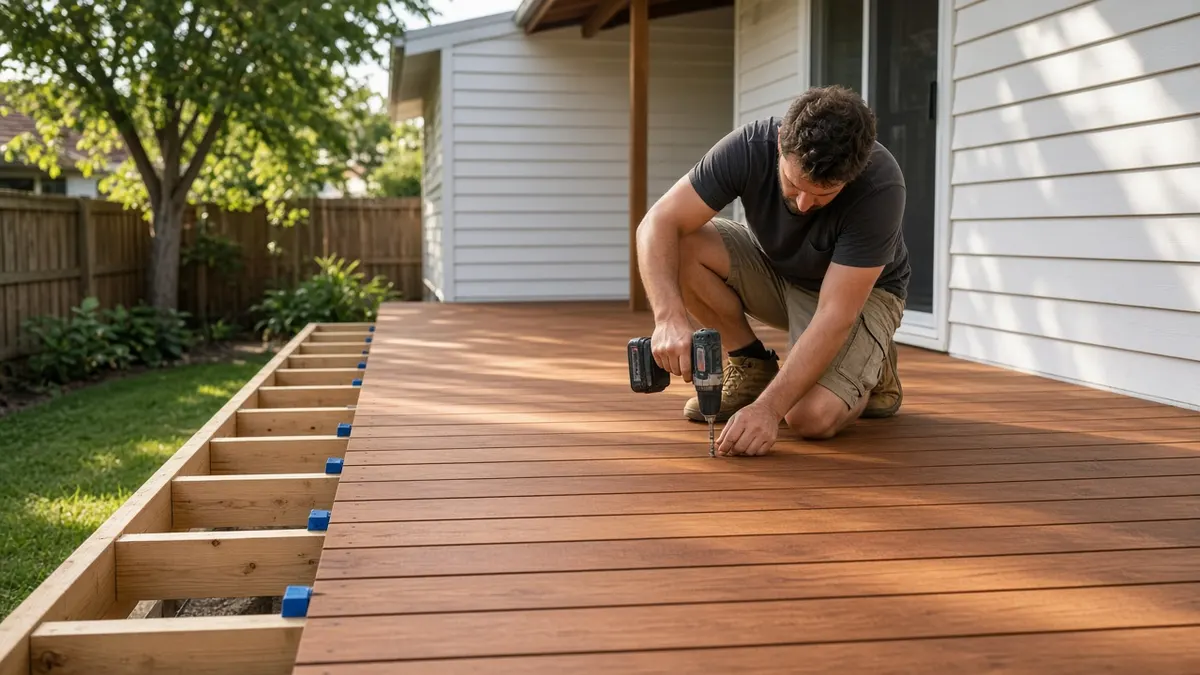
A new deck costs about $300 to $850 per square metre installed in Australia in 2026, GST included. A typical 20 m² low deck off the back of a house therefore lands somewhere between $6,000 and $17,000, and a high-set deck with stairs and a glass balustrade can easily double that.
Decks are priced by area, but the board you walk on is only one part. The subframe of posts, bearers and joists, the footings, the height off the ground and the edges (stairs, balustrades, fascia boards) carry just as much of the cost. This guide breaks it down by material and by height, works through three Australian examples, and covers approvals, bushfire and termite rules, and upkeep. Treat every figure as indicative and get at least three written quotes for the same design and materials.
Deck prices by board material
Installed prices for a low deck, up to about 600 mm off the ground, on reasonable ground with easy access. Prices include the subframe, footings, boards, fixings and a basic finish.
| Decking material | Installed per m² | Expected life | Upkeep |
|---|---|---|---|
| Treated pine | $300 to $500 | 15 to 20 years | Oil or stain every 12 to 18 months |
| Merbau | $450 to $700 | 20 to 30 years | Oil yearly; bleeds tannin when new |
| Spotted gum or blackbutt | $500 to $800 | 25 to 30 years | Oil every 12 to 18 months |
| Ironbark or other premium hardwood | $550 to $850 | 25 to 30+ years | Oil every 12 to 18 months |
| Composite, standard range | $500 to $850 | 20 to 25 years | Wash a few times a year |
| Composite, premium capped boards | $650 to $1,000 | 25 years or more | Wash a few times a year |
Treated pine is the budget choice and fine for a low deck that will be oiled regularly. Merbau is the classic Australian deck board: rich red, stable, and easy to get. Spotted gum and blackbutt are local hardwoods with good durability and better bushfire ratings for some sites. Composite boards cost more upfront but do not need oiling, do not splinter and do not rot, which makes them attractive for pool surrounds and rentals. Some composites get hot in direct summer sun, so check the product's heat performance if the deck faces north or west.
Board width, grade and colour
Within each timber, the board you pick still moves the price. Narrow 70 to 90 mm boards look traditional and move less with the weather, but take more screws and more labour per square metre. Wider 120 to 140 mm boards lay faster and suit modern houses, though they are more prone to cupping if they are not pre-oiled on all sides and given good ventilation underneath.
Hardwood is sold in grades. Select or premium grade has fewer knots, gum veins and colour variation, and costs noticeably more. Standard or feature grade has more character and is often 15% to 25% cheaper. For an outdoor deck that will weather to grey anyway, feature grade is often the smarter buy. Composite boards come in colour ranges from grey to dark brown, and lighter colours stay cooler underfoot in summer.
Height, stairs and balustrades
Height is the single biggest multiplier after the board choice. A deck that sits 300 mm off the ground needs short posts or stumps and no balustrade. A deck 2.5 m off the ground on a sloping block needs engineered posts, bracing, stairs and a full balustrade, plus probably council or certifier approval.
| Deck height or extra | Typical cost (incl. GST) |
|---|---|
| Low deck, under 600 mm | Base rate per m² |
| Medium height, 600 mm to 1 m | Add 10% to 25% to the base rate |
| High-set deck, over 1 m | Add 30% to 60% to the base rate |
| Timber balustrade | $250 to $450 per linear metre |
| Stainless wire balustrade | $350 to $600 per linear metre |
| Frameless or semi-frameless glass balustrade | $400 to $800 per linear metre |
| Timber stairs, two to four steps | $600 to $1,800 |
| Full flight of stairs to a high-set deck | $2,500 to $6,000 |
| Galvanised steel subframe instead of timber | Add $50 to $120 per m² |
| Remove and dispose of old deck | $30 to $70 per m² |
Under the National Construction Code, a balustrade is generally needed wherever it is possible to fall more than 1 m from the deck to the surface below. It must be at least 1 m high above the deck surface, and openings must not let a 125 mm sphere pass through. Higher decks have further rules about climbable elements. Your builder or certifier will design to these, but they explain why a deck that sits just over 1 m above the lawn suddenly costs a lot more than one just under it.
Where the money goes on a typical deck
For a low hardwood deck, the split is usually around 45% to 55% materials and the rest labour. Rough proportions:
- Footings and posts or stumps: 10% to 15%.
- Bearers and joists: 15% to 20%.
- Decking boards and fixings: 30% to 40%.
- Labour for building and finishing: 35% to 45%.
Carpenters and deck builders typically charge $70 to $110 per hour, though nearly all quote a fixed price. A two-person crew usually builds a straightforward 20 m² low deck in four to six working days, plus oiling time. Our carpenter hourly rate guide has more on trade rates in each state.
Hidden fixings, which clip boards down from the side so no screw heads show, add roughly $30 to $60 per m² in materials and labour. Pre-oiling every board on all four sides before laying, which helps hardwood resist cupping, adds labour but extends the deck's life.
Three decks, costed
Ground-level merbau deck in Blacktown, NSW
A 24 m² deck off the family room of a single-storey brick veneer, about 350 mm off the ground, with one long step down to the lawn. Clay soil, flat site, good access down the side of the house.
| Item | Cost (incl. GST) |
|---|---|
| Footings, H4 posts and treated pine subframe | $3,100 |
| Merbau 140 mm boards and stainless screws, 24 m² | $4,900 |
| Labour to build, two carpenters | $4,700 |
| Full-length step | $650 |
| Two coats of decking oil | $600 |
| Total | $13,950 |
The deck without the step comes to $13,300, or about $554 per m², the middle of the merbau range. A deck this low and this size is often exempt development in NSW if it meets the setback and other conditions, but check before building.
High-set spotted gum deck in Bardon, Brisbane
A Queenslander on a steep block wants a 30 m² deck off the kitchen, about 2.4 m above the ground at the far edge. Spotted gum boards on a galvanised steel subframe, glass balustrade on three sides (14 m) and a flight of stairs down to the yard. It needs engineering and building approval.
| Item | Cost (incl. GST) |
|---|---|
| Engineered footings, steel posts and subframe | $9,800 |
| Spotted gum boards, fixings and fascia, 30 m² | $6,600 |
| Labour to build | $7,400 |
| Glass balustrade, 14 m at $560 per metre | $7,840 |
| Timber stairs with handrail | $3,600 |
| Engineer, certifier and approval fees | $2,400 |
| Total | $37,640 |
The deck platform alone comes to $23,800, or about $793 per m², which reflects the steel subframe and height. With balustrade, stairs and approvals the whole project is around $1,250 per m², which is normal for high-set decks on sloping Brisbane blocks.
Composite replacement deck in Reservoir, Melbourne
An old 18 m² treated pine deck has rotted. The subframe is also past saving. The owners replace it with a mid-range composite deck at the same height, about 500 mm, with hidden fixings.
| Item | Cost (incl. GST) |
|---|---|
| Demolish old deck and dispose | $900 |
| New footings and treated pine subframe | $2,700 |
| Composite boards, hidden clips and fascia, 18 m² | $5,900 |
| Labour to build | $3,900 |
| Total | $13,400 |
The new deck is $12,500, or about $694 per m². In Victoria, a deck more than 800 mm above the ground generally needs a building permit, so staying at the original height keeps this job simpler. Confirm with your council or a registered building surveyor.
Deck costs across Australia
Labour rates and timber freight both affect price. Sydney and Canberra usually sit at the top of each range. Melbourne and Brisbane are slightly below, with plenty of deck builders competing for work. Perth and Adelaide tend to be a little cheaper on labour. Hobart has access to local hardwoods but steep sites push labour up. Darwin and far north Queensland pay more for freight and need termite-resistant, cyclone-appropriate construction, so prices run 10% to 20% higher. In regional areas, labour is often cheaper but builders may charge travel, and specialty composites may need to be freighted in.
Approvals, bushfire and termites
Council and certifier approval
Small, low decks are often exempt from approval, but the rules depend on the state and the site. Common triggers for approval include height off the ground, total floor area, distance to boundaries, whether the deck is roofed or attached to the house, and heritage or bushfire overlays. In NSW, the exempt development rules on the NSW planning website set limits on area, height and setbacks. In Victoria, decks more than 800 mm above ground generally need a building permit. In Queensland, ask a private certifier, and check builder licensing on the QBCC website.
Licensing
Decks are structural building work. In NSW, residential building work over $5,000 generally needs a licensed contractor through NSW Fair Trading. In Queensland most building work over $3,300 needs a QBCC licence. In Victoria, domestic building work above the registration threshold must be done by a builder registered with the Building and Plumbing Commission, which replaced the VBA in 2025. Ask for the licence number and check it online.
Bushfire-prone land
In mapped bushfire areas, the deck has to suit the site's bushfire attack level (BAL) under the Australian Standard for building in bushfire-prone areas, AS 3959. Higher BAL ratings limit which timbers and composites you can use, and may require non-combustible subframes or enclosed undersides. Some dense hardwoods and some composite products are rated for higher levels. Ask for evidence that the product suits your BAL rating.
Termites
Subframe timber should be treated to the right hazard level: H3 for above-ground framing and H4 or higher for posts in the ground. Many builders now set timber posts on galvanised stirrups above concrete footings, or use steel posts, so termites cannot get a hidden path into the deck. Keep the area under the deck ventilated and clear, and include it in your regular pest inspection.
Ongoing costs and how long a deck lasts
Timber decks need regular oiling. In full sun, once a year is common, and every 18 months in shade. Doing it yourself costs roughly $150 to $400 in oil for a 20 m² deck. A professional clean and oil typically costs $15 to $35 per m², and a full sand and re-oil of a grey, weathered deck $35 to $60 per m². You can find decking oil suppliers through our directory.
Composite decks skip the oil, but they still need a wash a few times a year to stop dirt, leaves and mould building up, especially in shaded or damp areas. A pressure washer on a low setting with a wide fan works for both timber and composite; see the pressure cleaning cost guide if you would rather pay someone.
Watch for soft boards near the house wall, loose or popped screws, cupped boards and rot in the joists where water pools. Catching a problem early usually means replacing a few boards rather than the whole deck. A deck that is well built and maintained adds usable living space, and a tired, rotting deck is one of the first things buyers notice at an inspection.
Deck or paving?
On flat ground, a paved or concrete area is usually cheaper than a deck of the same size and needs almost no upkeep. A deck wins when the ground slopes away from the house, when you want the outdoor floor level with the indoor floor, or when you want something softer and cooler underfoot than stone. On a sloping block, the cost of retaining walls and fill to create a flat area for paving can easily exceed the price of a deck built over the slope.
Many homes end up with both: a deck at floor level off the living area, stepping down to paving or lawn. If you are weighing it up, price the deck and the paved option with the same edges, steps and drainage included, so you are comparing like with like.
Building a deck yourself
A low, freestanding treated pine or merbau deck is one of the more popular DIY building projects. Materials for a low deck typically cost $150 to $350 per m² depending on the board, so DIY can save several thousand dollars. You need a good saw, a drop saw, an impact driver, a string line and a lot of patience getting the subframe level and square. Most problems with DIY decks start with footings that are too shallow or joists spaced too widely for the board.
High-set decks, decks attached to the house, and anything that needs approval are a different matter. The ledger fixed to the house has to be properly flashed to stop water getting into the wall, and the structure has to be designed for the loads. Licensing rules apply to anyone you pay, and approval rules apply to owners too. For those decks, hire a licensed builder.
How to keep the price down
- Keep it low. A deck under 1 m avoids balustrades and often approvals. On a flat block, a 400 mm deck costs much less than one built up to floor level of a high-set house.
- Use standard board lengths. Design the deck size around 5.4 m or 6 m boards to cut waste.
- Choose treated pine for the subframe and spend the money on the boards you see.
- Skip hidden fixings if you do not mind screw heads. Neat lines of stainless screws look fine.
- Oil it yourself once the builder has finished.
- Book in winter. Deck builders are flat out from spring to Christmas.
If you are also planning shade over the deck, quote both together. The pergola cost guide covers attached and freestanding options, and a deck and pergola built by the same crew often costs less than two separate jobs. If you are comparing a deck with a paved area, the paving cost guide gives per m² prices for pavers.
What happens during the build
Most deck builds follow the same order. First the site is cleared and set out with string lines, and the footing holes are dug and concreted. If approval was needed, a certifier or engineer may inspect the footings before anything else goes on. Next come the posts or stirrups, then bearers and joists, checked for level and spacing. Boards go on last, followed by fascia, stairs, balustrade and finish.
Expect power tools, a drop saw set up in the yard and a pile of offcuts for most of the week. If the deck attaches to the house, the builder fixes a ledger board to the wall and flashes it so rain cannot track into the brickwork or cladding. Ask to see the flashing before the boards cover it, because it is the detail that most often causes problems later. Hardwood decks may need a few weeks to weather before oiling, so the finish might be a separate visit.
Checking a deck quote
A useful deck quote spells out the size and height, footing type and depth, post, bearer and joist sizes and spacing, timber grades and treatment levels, board species and width, fixing method, stairs, balustrade type and height, finish, and who handles approval. It should list the builder's licence number, insurance and warranty, and a payment schedule that matches stages of work. A big upfront deposit, no mention of approvals for a high deck, or a quote that does not specify subframe sizes are reasons to keep looking.
Labour help from Yakka
Before the carpenter starts, there is often an old deck to rip up, pavers to lift, a garden bed to dig out or a slope to level by hand. After they finish, someone has to cart the offcuts and give the deck its first oil. Yakka connects you with workers by the shift for that kind of labour, which keeps the builder's hours focused on the structure.
For the build itself, you can find a deck builder near you. The structural work, and anything that needs a licence or approval in your state, stays with a licensed builder or carpenter.
Frequently asked questions
How much does a deck cost per square metre in Australia?
In 2026 a low deck typically costs $300 to $500 per m² in treated pine, $450 to $700 in merbau, $500 to $800 in spotted gum or blackbutt, and $500 to $850 for standard composite, including GST. High-set decks, stairs, balustrades and approvals add significantly. These are indicative figures, so compare three written quotes for the same design.
How much does a 20 m2 deck cost?
A 20 m² low deck typically costs $6,000 to $10,000 in treated pine, $9,000 to $14,000 in merbau and $10,000 to $17,000 in hardwood or composite, including GST. Add stairs, balustrades if the deck is over 1 m high, removal of an old deck and any approval fees. Difficult ground or access will also add cost.
Is composite decking worth the extra cost?
Often, if you dislike maintenance. Composite costs more upfront but does not need oiling, does not splinter and does not rot, which saves several hundred dollars a year in upkeep compared with timber. It suits pool surrounds, rentals and busy households. Some products get hot in full sun, and the look is less natural than real hardwood.
Do I need council approval to build a deck?
Small low decks are often exempt, but it depends on your state and site. Triggers for approval include height off the ground, floor area, distance to boundaries, a roof over the deck, and heritage or bushfire overlays. In Victoria, decks more than 800 mm above ground generally need a building permit. Check with your council or a certifier before building.
How long does it take to build a deck?
A straightforward 20 m² low deck usually takes a two-person crew four to six working days, plus a day or two for oiling. High-set decks with stairs, balustrades and engineering take two to four weeks on site, and approvals can add several weeks before work starts. Wet weather and timber supply delays also affect timing.
When does a deck need a balustrade?
Under the National Construction Code, a balustrade is generally required where a person could fall more than 1 m from the deck to the surface below. It must be at least 1 m high above the deck, and gaps must not allow a 125 mm sphere through. Higher decks have extra rules about climbable elements, so your builder should design to the code.
How often should I oil a timber deck?
Most timber decks in full sun need oiling about once a year, and every 18 months in shaded spots. Signs it is due include water no longer beading on the surface and boards turning grey. A professional clean and oil costs about $15 to $35 per m², or you can do it yourself for a few hundred dollars in materials.
Official sources
Award rates, licences and safety rules change. Check the official source before you hire or take on a shift.
- Queensland Building and Construction Commission (QBCC)Contractor, plumbing and drainage licence search in Queensland
- NSW Fair TradingTrade licence checks for electricians, plumbers and builders in New South Wales
- Building and Plumbing Commission (Victoria)Builder and plumber registration, domestic building insurance and licence checks in Victoria