More cost guide
Skip Bin Hire Cost in 2026: Australian Prices by Size and Waste
Typical cost in Australia (2026, inc. GST)
$250 to $1,200 per hire
2 to 12 m³ skip, general waste, metro area, standard hire period
Skip bin hire usually costs $250 to $380 for a 2 m³ mini skip, $350 to $520 for a 4 m³ skip, $450 to $700 for a 6 m³ skip and $650 to $1,200 for 10 to 12 m³. The price depends on the bin size, the type of waste (general, green, heavy or clean fill), landfill levies in your state, the hire period and whether a council permit is needed.
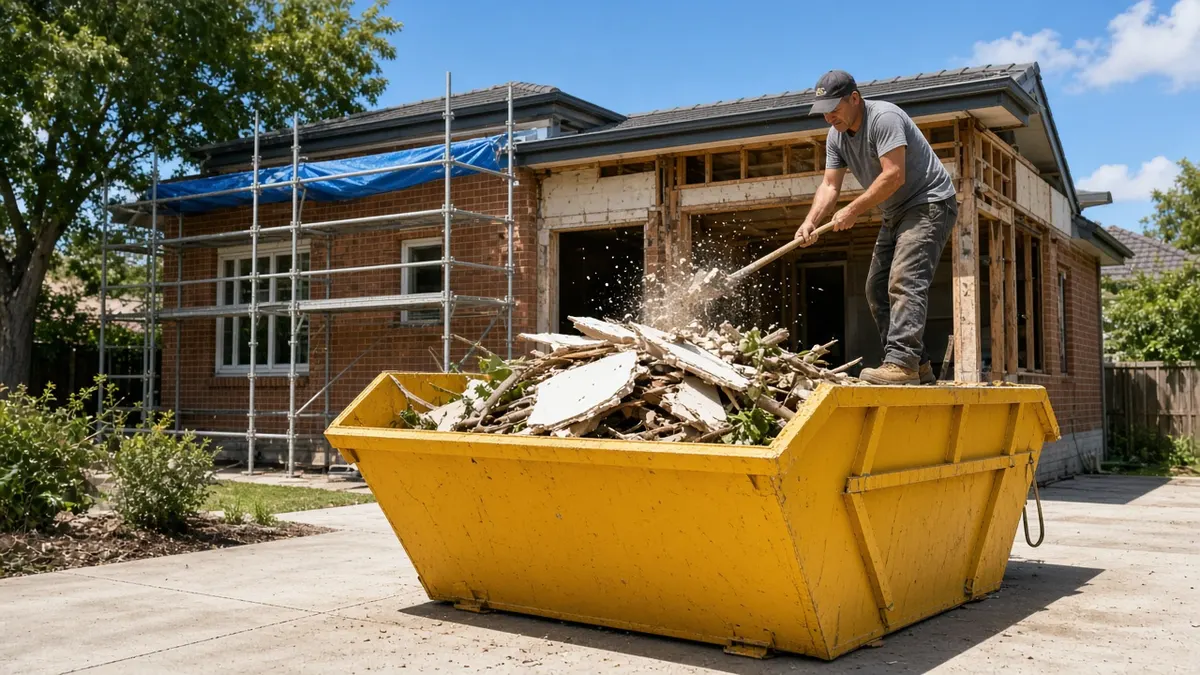
Skip bin hire in Australia costs roughly $250 to $1,200 for most household jobs. A 2 m³ mini skip for a small clean-out sits at the bottom of that range, a 6 m³ skip for a kitchen renovation or garage clear-out typically costs $450 to $700, and a large 10 to 12 m³ bin for a whole-house clean-out or small demolition job can run past $1,000.
The biggest factors are size, the type of waste and where you live. Landfill levies differ a lot between states, so the same bin can cost noticeably more in Sydney than in Adelaide or Hobart. The figures below are indicative 2026 prices in AUD including GST for metro areas. Skip companies change prices often, so get at least three written quotes and check exactly what each one includes.
Skip bin prices by size
Skip sizes are quoted in cubic metres (m³). As a reference point, a level load in a standard 6x4 box trailer is roughly 1 to 1.5 m³.
| Skip size | Good for | General waste price (inc. GST) |
|---|---|---|
| 2 m³ mini skip | Small clean-out, single room, a few bags and bits of furniture | $250 to $380 |
| 3 m³ | Small bathroom strip-out, garden tidy-up | $300 to $450 |
| 4 m³ | Bathroom renovation, garage clean-out | $350 to $520 |
| 6 m³ | Kitchen renovation, large garden job, moving house | $450 to $700 |
| 8 m³ | Multi-room renovation, big household clear-out | $550 to $850 |
| 10 m³ | Whole-house clean-out, shed or pergola demolition | $650 to $1,050 |
| 12 m³ | Large renovation or strip-out | $750 to $1,200 |
| 15 m³ and larger | Builders, big demolition jobs (often hook-lift bins) | $900 to $1,600+ |
Per cubic metre, bigger skips are usually better value. A 6 m³ skip often costs only $100 to $180 more than a 4 m³ skip, so if you are unsure, going up one size is usually cheaper than ordering a second bin later.
What you put in it changes the price
Skip companies price by waste type because it decides where the load goes and what it costs them to dispose of it. Heavy materials like concrete and soil cost more to transport and are often limited to smaller bins because of truck weight limits.
| Waste type | What it includes | Price compared with general waste |
|---|---|---|
| General household | Furniture, boxes, toys, household junk, light timber | Baseline |
| Green waste | Branches, leaves, lawn clippings, small stumps | Often 10 to 25 percent cheaper |
| Mixed heavy or building | Bricks, tiles, plaster, timber, concrete mixed with general waste | Often 10 to 30 percent dearer, smaller sizes only |
| Clean fill (soil, sand) | Soil or sand with no rubbish or vegetation | Can be cheaper, but strict rules on contamination |
| Concrete and bricks only | Clean masonry rubble, no soil or rubbish | Often cheaper because it is recycled |
Be honest when you book. If you order a green waste skip and fill it with old furniture, or a clean fill bin and throw in plastic, you will be charged the difference, plus a contamination fee in some cases. Separating heavy rubble from light rubbish into two bins can be cheaper than one large mixed bin on a renovation.
Price differences around Australia
For a 6 m³ skip of general household waste on a driveway for about a week, expect roughly:
| City or area | 6 m³ general waste | Why it differs |
|---|---|---|
| Sydney | $550 to $800 | High NSW waste levy in the metro area, traffic and distance to tips |
| Melbourne | $480 to $720 | Victorian landfill levy, competitive market |
| Brisbane | $450 to $680 | Queensland waste levy, plenty of operators |
| Perth | $450 to $680 | WA landfill levy in the metro area, long travel distances |
| Adelaide | $420 to $640 | Lower labour costs, solid recycling network |
| Hobart | $420 to $650 | Smaller market, fewer bins available at short notice |
| Canberra | $480 to $720 | Limited disposal sites and higher labour costs |
| Darwin | $500 to $780 | Small market and fewer operators |
| Regional areas | $400 to $750 | Lower levies in many areas, but delivery distance adds cost |
Waste levies are set by state governments and charged per tonne at landfill, and they are the main reason Sydney skip prices sit at the top of the table. The NSW Environment Protection Authority sets the levy in NSW, and other states publish theirs through their environment agencies. Levy rates usually rise each year, so expect skip prices to drift up over time too.
Extra fees that catch people out
- Council permit. If the skip goes on the road, nature strip or footpath, most councils require a permit. Fees vary widely, commonly from about $50 to $200 or more per week, and some inner-city councils charge more or restrict placement. Some skip companies arrange it for you and pass on the cost. If the bin fits on your driveway, you usually do not need one.
- Extended hire. Standard hire periods are often three to seven days. Extra days usually cost $10 to $30 each.
- Overweight bins. Each bin has a weight limit. Heavy loads that go over it are charged per tonne at the tip, which can add a few hundred dollars to a mixed heavy bin.
- Overfilling. Waste must sit level with the top of the bin so it can be legally transported. Drivers can refuse to collect an overloaded skip or ask you to remove material, and some charge a return fee.
- Special items. Mattresses, tyres and some appliances are often accepted with a surcharge of about $20 to $60 each, because they need separate handling.
- Wasted trip. If the truck cannot deliver or collect because of a blocked driveway, parked cars or low power lines, expect a fee.
What cannot go in a skip
Every company has its own list, but these items are almost always banned from standard skips:
- Asbestos in any form, including fibro sheeting, old vinyl tiles with asbestos backing and lagging.
- Paint, solvents, oils, pool chemicals and pesticides.
- Gas bottles, fire extinguishers and fuel containers.
- Car and household batteries.
- E-waste such as TVs and computers in many areas.
- Food waste, medical waste and anything liquid.
Asbestos deserves a stronger warning. Putting asbestos in a general skip is illegal, can contaminate the whole load and the tip, and the fines and clean-up costs fall on whoever hired the bin. If your home was built before 1990 and you are renovating, have suspect materials tested first. Our asbestos removal cost guide explains testing, licensed removal and the special disposal rules.
Types of skip and why the shape matters
Most residential skips are one of three styles, and the style affects where the bin can go and how easy it is to load.
- Standard marrel skips. The classic tapered bin lifted on chains by a skip truck, usually from 2 to about 10 m³. They fit on most driveways and are the default for household jobs.
- Walk-in skips. These have a door at one end, so you can wheel a barrow straight in rather than lifting everything over the side. They cost a little more but save a lot of effort on renovation jobs with heavy rubble, and they are worth asking for if you are loading tiles, soil or bricks.
- Hook-lift bins. Large, long bins from about 10 m³ up to 30 m³, rolled on and off a hook truck. They suit builders and big demolition jobs but need a long, straight run of firm ground and much more space than a marrel skip.
Some companies also offer low-sided skips for heavy waste. They hold less volume, which keeps the weight under the truck's limit when you are loading concrete or soil.
From booking to pick-up
Most skip companies can deliver within one to two business days in metro areas, sometimes the same day if you call early. Weekends and the end of school holidays are busy, and in December bins can be booked out for a week or more, so plan ahead for a renovation.
When you book, the company will ask for the size, waste type, address, where the bin should be placed and how long you need it. Drivers usually deliver in a morning or afternoon window rather than a fixed time. You do not normally need to be home if the spot is clearly marked and the driveway is clear. Leave the car on the street, open the gate, and put down boards where the bin will sit.
When you are done, ring or book online for collection. The driver checks the load is level, not overweight and free of banned items before lifting it. If something is wrong, such as a gas bottle sitting on top or waste piled above the rim, they may leave the bin until it is fixed, which can cost a return fee.
Where the rubbish ends up
Many skip operators take loads to a sorting facility rather than straight to landfill. There, metals are pulled out for recycling, clean concrete and bricks are crushed for road base, timber may be chipped, and green waste is turned into mulch and compost. The rest goes to landfill, where the state levy is charged by the tonne.
That is why separated loads are often cheaper. A skip of pure concrete or clean green waste costs the operator less to process than a mixed load that needs sorting, and some of that saving is passed on. It is also why honest booking matters: a single contaminated load can cost the company a lot more at the gate, and they will charge it back to you.
Choosing the right size
Most people underestimate how much rubbish a job makes, because loose waste takes up far more room than the same items in place. A rough guide for common jobs:
- Single room clear-out: 2 to 3 m³.
- Bathroom strip-out: 3 to 4 m³ of mixed heavy waste. Tiles, render and a cast iron bath are heavy, so check the weight limit.
- Kitchen renovation: 4 to 6 m³. Cabinets are bulky but light.
- Garage or shed clean-out: 4 to 8 m³ depending on how much has built up.
- Moving house or deceased estate clean-out: 6 to 12 m³ for a full house.
- Garden makeover: 4 to 8 m³ of green waste, with soil in a separate bin.
- Removing an internal wall or small shed: 4 to 8 m³. See the internal wall removal cost guide for the demolition side.
Break down furniture, flatten boxes and fill gaps with smaller items. A carefully packed skip can hold a third more than one filled by throwing things in from the door.
Sample jobs and what they cost
Bathroom strip-out in Parramatta, NSW
A small bathroom in a 1970s unit block is being renovated. The old tiles, render, vanity, bath and plasterboard go into a 4 m³ mixed heavy skip on the owner's car space. The asbestos inspection found none.
| Line item | Cost (inc. GST) |
|---|---|
| 4 m³ mixed heavy skip, seven days | $480 |
| Labour to carry waste down two flights and load, one worker for about 3 hours | $180 |
| Council permit | Not needed, on private property |
| Total | $660 |
Garage and backyard clear-out in Reservoir, VIC
A family clears out ten years of garage junk, two old mattresses and a broken trampoline before selling. The driveway is narrow, so the skip goes on the street.
| Line item | Cost (inc. GST) |
|---|---|
| 6 m³ general waste skip | $560 |
| Council road occupancy permit, one week | $90 |
| Two mattresses | $70 |
| Two extra hire days | $40 |
| Total | $760 |
Backyard makeover in Joondalup, WA
Old shrubs, a dead tree already cut into lengths and a lot of excavated sandy soil from a new garden bed. The owner orders two bins to keep the waste streams separate.
| Line item | Cost (inc. GST) |
|---|---|
| 8 m³ green waste skip | $560 |
| 4 m³ clean fill skip for sand | $390 |
| Labour to load both bins, two workers for about 4 hours each | $440 |
| Total | $1,390 |
A single 12 m³ mixed bin would have cost more, and the sand would likely have pushed it over its weight limit. For the tree itself, the tree removal cost guide covers felling and stump grinding.
Skip bin or another option
A skip is not always the cheapest way to get rid of rubbish. Here is how the main options compare.
- Skip bags. Heavy-duty bulk bags that hold about 1 to 3 m³ cost roughly $150 to $400 including collection by a crane truck. They suit tight sites and slow jobs, because you can fill them over weeks before booking collection. They often have stricter weight limits than skips.
- Trailer and the tip. Hiring a box trailer for $50 to $100 a day and paying tip fees per load works for small, light jobs if you have a tow bar. Tip fees per trailer load vary by council and waste type, and your time and fuel add up quickly over several trips.
- Rubbish removal service. A crew with a truck loads everything for you and charges by volume. It often works out cheaper than a skip plus labour for jobs under about 4 m³, and it means no permit and no bin sitting on the street. You can find rubbish removal workers on Yakka for this kind of job.
- Council hard waste collection. Many councils offer free or low-cost kerbside collections once or twice a year, or on booking. It is the cheapest option for furniture and household items if you can wait.
As a rule of thumb, a skip makes most sense when you are producing waste over several days, such as a renovation, or when there is more than about 4 m³ of it.
Placement, access and safety
Skip trucks need space. Allow roughly 3 metres of width for the truck to reverse in, plenty of room to lower the bin, and clearance from overhead power lines, trees and gutters. Tell the company about steep driveways, narrow lanes or low carports when you book.
Put timber boards or old sheets of ply under the skip's runners if it is going on pavers, a thin concrete driveway or a coloured or exposed aggregate surface. A loaded skip is heavy, and driveway repairs cost a lot more than a couple of boards. Bins on the street usually need reflective markings or lights at night, which the skip company or the council permit conditions will spell out.
On the loading side, watch your back with heavy materials, wear gloves and sturdy boots, and do not climb into the skip to stamp waste down. Broken glass, nails and old tiles cause plenty of injuries during home clean-ups.
How to pay less for a skip
- Book the right size once. A second delivery costs more than going up a size.
- Separate heavy waste. Clean concrete, bricks and soil are often cheaper to dispose of separately.
- Use your driveway. It avoids a council permit and is usually safer.
- Have the labour ready. Load the bin over a day or two rather than paying for extra hire days while it sits half full.
- Sell or donate first. Working furniture, timber and building materials can go to buy and swap groups, charities or reuse centres before they take up paid space in a bin.
- Avoid surcharges. Take mattresses, tyres and e-waste to council drop-off days if they offer them free.
Before you book: a quote checklist
Confirm these points in writing with the skip company:
- Bin size in m³ and the waste type it is priced for.
- Hire period, the daily rate for extra days, and delivery and collection windows.
- Weight limit and the charge per tonne over it.
- Surcharges for mattresses, tyres and other special items.
- Whether the company arranges any council permit, and the cost.
- What happens if the truck cannot access the site.
- Whether the price includes GST.
Be wary of prices that look much cheaper than the rest, as they often have short hire periods, low weight limits or big extras. Check the company has an ABN and that the bin it delivers matches the size you ordered.
Loading and clean-up help from Yakka
The skip company only drops off and collects the bin. Filling it is up to you, and on a renovation or clean-out that can be a full day of carrying. Yakka workers can do that loading for you, booked by the hour or the day, or handle the whole job as rubbish removal with their own ute or trailer so you skip the bin altogether. Our guide to hiring a labourer for a day explains how that works.
You can also compare skip and truck hire providers listed on the platform. For bigger jobs, like a full bathroom strip-out before the trades arrive, a worker can handle demolition prep, loading and the final sweep so your bin goes out once and full. The bathroom renovation cost guide covers the rest of that budget.
Frequently asked questions
How much does a 6 cubic metre skip bin cost?
A 6 m³ skip of general household waste usually costs $450 to $700 in most capital cities, and $550 to $800 in Sydney where waste levies are highest. Green waste is often a little cheaper and mixed heavy building waste a little dearer. Council permits, extra hire days, mattresses and overweight charges can add to the base price.
What size skip bin do I need for a bathroom renovation?
Most bathroom strip-outs fill a 3 to 4 m³ skip. Tiles, render, plaster and an old bath are heavy, so book a mixed heavy or building waste bin and check the weight limit. A large ensuite plus a laundry, or a bathroom with a cast iron bath and thick mortar bed, may need a 6 m³ bin.
Do I need a council permit for a skip bin?
If the skip goes on your driveway or private land, you usually do not need a permit. If it goes on the road, nature strip or footpath, most councils require one, commonly costing about $50 to $200 or more per week. Some skip companies arrange the permit for you. Check your council's rules before booking, especially in inner-city areas.
Can I put asbestos in a skip bin?
No. Asbestos cannot go in a standard skip bin. It must be removed and disposed of under strict rules, usually by a licensed asbestos removalist, and taken to a facility licensed to accept it. Putting asbestos in a general skip is illegal, can contaminate the whole load and can leave the hirer with fines and clean-up costs.
Is a skip bin cheaper than rubbish removal?
For small jobs under about 4 m³, a rubbish removal service that loads and takes everything in one visit is often similar in price or cheaper than a skip plus your own labour. For renovations that create waste over several days, or for large clean-outs, a skip is usually better value. Compare quotes for both on the same volume.
How long can I keep a skip bin?
Standard hire periods are usually three to seven days, depending on the company and the bin size. Most companies let you extend for about $10 to $30 per extra day, subject to availability. If the bin is on the street, your council permit also sets a time limit, so extending the hire may mean extending the permit too.
What happens if my skip bin is overweight?
Each bin has a weight limit. If the load is heavier, the company charges for the excess, usually per tonne at the tip rate, which can add a few hundred dollars. Very overloaded bins may be refused for collection until some material is removed. Heavy waste like soil, concrete and tiles is the usual cause, so ask about limits when booking.
Official sources
Award rates, licences and safety rules change. Check the official source before you hire or take on a shift.
- Asbestos Safety and Eradication AgencyWhere asbestos is found in homes and how to deal with it safely