Interior cost guide
Electrician Cost in Australia: 2026 Hourly Rates and Job Prices
Typical cost in Australia (2026, inc. GST)
$90 to $150 per hour
licensed electrician, metro area, business hours, plus a call-out fee of $80 to $150
A licensed electrician in Australia typically charges $90 to $150 an hour in 2026, plus a call-out fee of $80 to $150. Small jobs such as replacing a power point or light fitting usually cost $150 to $400 in total. The price moves with your city, roof and wall access, the age of the wiring, after-hours timing and whether parts are included.
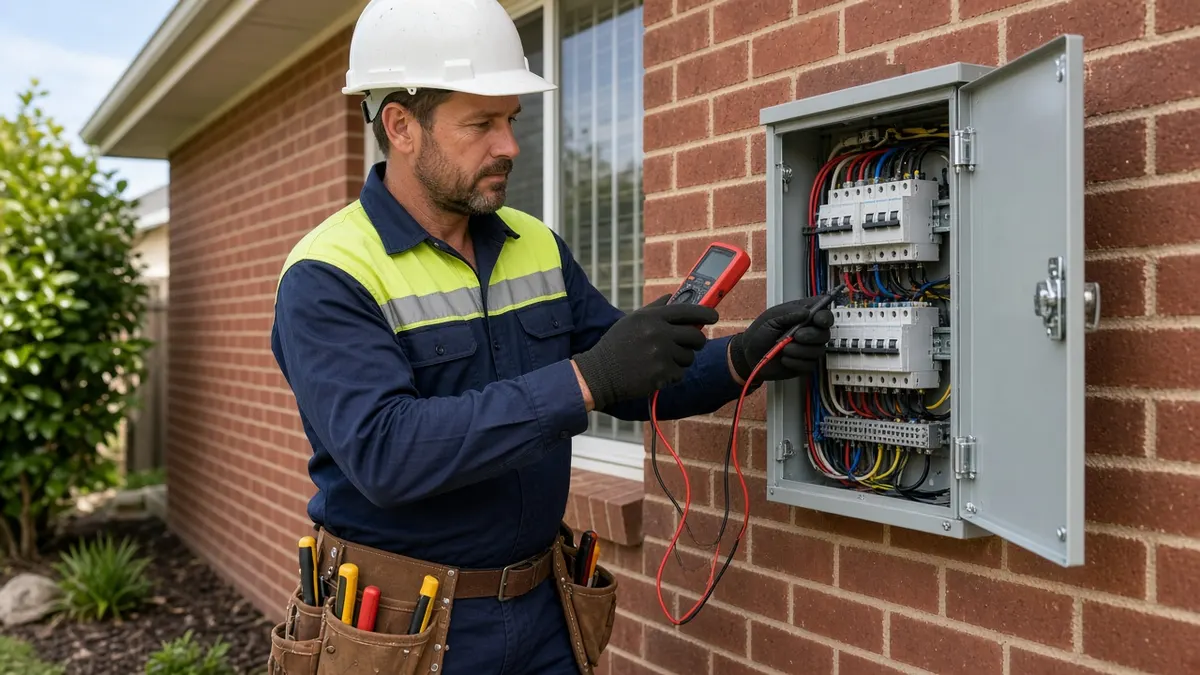
Most licensed electricians in Australia charge between $90 and $150 an hour in 2026, plus a call-out fee of $80 to $150 that sometimes covers the first half hour on site. Small jobs like swapping a power point or fitting a new light usually come to $150 to $400 all up, while a switchboard upgrade or a partial rewire runs into the thousands.
Those figures move a lot depending on where you live, when you need the work done and how hard the wiring is to reach. This guide gives realistic 2026 ranges for the jobs people book most often, three costed examples, and the licensing rules in each state. All prices include GST and are indicative only. Get at least three written quotes and compare exactly what each one includes before you sign anything.
How electricians price their work
There are three common pricing models, and plenty of sparkies mix them on the same job.
- Call-out fee plus an hourly rate. You pay a flat fee for the electrician to turn up, then an hourly rate billed in 15 or 30 minute blocks. Some fold the first 30 or 60 minutes into the call-out fee, others charge it on top. Ask which before they arrive.
- Fixed price per item. Common for repeatable work: a set price per downlight, per double power point or per smoke alarm. It is easier to compare between quotes, but the price usually assumes a single-storey home with clear roof space.
- Quoted job price. For switchboards, rewires, kitchen and bathroom renovations and new circuits, expect a written quote after a site visit. A few electricians charge for the quoting visit and credit it back if you go ahead.
| Charge | Typical 2026 range (inc GST) | What it covers |
|---|---|---|
| Call-out fee | $80 to $150 | Travel and the first 0 to 60 minutes, depending on the business |
| Hourly rate, business hours | $90 to $150 | Licensed electrician, billed in 15 or 30 minute blocks |
| Apprentice or second worker | $50 to $80 per hour | Cable pulling, roof space work, two-storey jobs |
| After hours and weekends | $140 to $220 per hour | Often charged at time and a half or double time |
| Emergency call-out | $150 to $350 | Nights, Sundays and public holidays, before labour |
| Fault finding | $150 to $450 | Depends entirely on how long the fault takes to trace |
| Day rate | $750 to $1,100 | Eight hours for one licensed electrician, parts extra |
On a bigger job that will clearly take a full day or more, ask whether the electrician will quote a day rate instead of hours. It tends to work out slightly cheaper and removes the temptation to watch the clock.
Prices for the jobs people book most
These are installed prices for a standard single-storey house with reasonable roof space access. They include labour and standard-grade parts unless the row says otherwise.
| Job | Typical installed price (inc GST) |
|---|---|
| Replace a single or double power point in the same spot | $80 to $150 |
| Add a new double power point off an existing circuit | $150 to $300 |
| New dedicated circuit (oven, split system, EV charger) | $350 to $900 |
| Replace a light fitting you have supplied | $80 to $160 |
| New LED downlight in a new position | $90 to $180 each |
| Ceiling fan on an existing light point (labour only) | $150 to $300 |
| Hardwired smoke alarm, like-for-like replacement | $120 to $220 each |
| Add a safety switch (RCD) to an existing board | $250 to $600 |
| Outdoor weatherproof double power point | $200 to $450 |
| Oven or cooktop connection, like for like | $120 to $300 |
| Data or TV point | $120 to $250 |
| Switchboard upgrade, typical house | $1,500 to $4,000 |
| EV charger (7 kW single-phase), charger plus installation | $1,800 to $3,500 |
| Full rewire, three-bedroom house | $8,000 to $18,000 |
Per-item prices look tidy on paper, but they assume no surprises. If the electrician opens a wall plate and finds brittle old rubber-insulated cable, or the board has no room for another circuit, the price changes on the spot. A good electrician will stop and tell you before spending your money. Our guides to downlight installation costs, adding or replacing power points and switchboard upgrade prices go into each of those jobs in more depth.
Electrician rates by city
Hourly rates follow local wages, travel times and how busy the trade is. These are typical business-hours ranges for a licensed electrician in 2026.
| City | Hourly rate | Call-out fee | Why it sits there |
|---|---|---|---|
| Sydney | $100 to $160 | $90 to $160 | High overheads, tolls, parking and long travel between jobs |
| Melbourne | $95 to $150 | $80 to $150 | Competitive market, lots of older inner-suburb wiring |
| Brisbane | $90 to $145 | $80 to $140 | Steady demand from smoke alarm upgrades and new builds |
| Perth | $95 to $155 | $90 to $150 | Resources work pulls electricians away from domestic jobs |
| Adelaide | $85 to $135 | $75 to $130 | Lower overheads and shorter travel times |
| Hobart | $85 to $140 | $80 to $140 | Smaller pool of electricians, so waits can be longer |
| Canberra | $100 to $155 | $90 to $150 | High local wages and a busy commercial sector |
| Darwin | $105 to $170 | $100 to $180 | Freight costs, a small trade pool and wet-season demand |
| Regional towns | $85 to $150 | Plus travel | Travel is often charged per kilometre or as a flat fee |
In regional areas the hourly rate can be lower than the city, but travel eats the saving. If the nearest electrician is an hour away, a $100 call-out can become $200 or more once travel is added. Grouping several small jobs into one visit makes the biggest difference in the bush.
Why two quotes for the same job can differ by hundreds
Getting to the wiring
Access is the biggest hidden cost. A single-storey brick veneer with a high-pitched tiled roof is easy: the electrician pops through the manhole and has room to move. A low-pitched metal roof, a flat roof with no cavity, a two-storey home where the upstairs ceiling sits above the downstairs walls, or solid double brick walls all add hours. Running cable through a concrete slab or under a raised timber floor with little clearance is slow work too.
The age of the wiring
Homes wired before about the 1970s can still have rubber-insulated cable, ceramic rewireable fuses and circuits without an earth. Any new work connected to old wiring has to be safe and compliant, so an electrician may refuse to extend a circuit that is falling apart. That is when a $200 power point job turns into a conversation about a switchboard upgrade or a rewire. Many older meter boards also have backing panels that contain asbestos, which changes how the board can be worked on. Our asbestos removal cost guide explains what that involves.
Parts and who supplies them
A builder-grade LED downlight costs $15 to $30, while a premium dimmable fitting with a long warranty can be $60 to $120. Supplying your own fittings can save money, but many electricians will not warrant parts they did not buy, and some add a small handling charge.
Making good afterwards
Electricians cut holes. Moving a power point, recessing a new switch or chasing cable into a rendered wall leaves damage that someone has to patch and paint. Most electrical quotes exclude this, so budget for a plasterer or handyman separately.
Timing
Summer is busy because of split system installs and storm damage. The run-up to Christmas is busy because everyone wants jobs finished before the break. Booking a non-urgent job in late autumn or winter can mean faster scheduling and a little more room to negotiate.
Three real jobs, costed line by line
These examples use mid-range rates. Your quotes will differ, but the structure shows where the money goes.
Downlight swap and two new power points in Penrith, NSW
A single-storey 1990s brick veneer with a tiled roof. The owner wants six old halogen downlights replaced with LEDs and two new double power points in the lounge room, both off an existing circuit.
| Item | Cost (inc GST) |
|---|---|
| Call-out fee | $100 |
| Labour, 3.5 hours at $110 | $385 |
| 6 LED downlights at $30 | $180 |
| 2 double power points, cable and fixings | $70 |
| Testing and compliance certificate | Included |
| Total | $735 (expect $650 to $900) |
Kitchen renovation electrical in Brunswick, Victoria
An inner-Melbourne weatherboard getting a new kitchen. The work covers a dedicated circuit for a wall oven, a heavier circuit for an induction cooktop, four double power points, six downlights and a rangehood point. It needs two visits: rough-in before the plasterer and fit-off after the cabinets go in.
| Item | Cost (inc GST) |
|---|---|
| Licensed electrician, 14 hours at $105 | $1,470 |
| Apprentice, 8 hours at $65 | $520 |
| Cable, power points, downlights, circuit breakers | $750 |
| Extra RCBO and board work for the cooktop circuit | $180 |
| Testing and Certificate of Electrical Safety | Included in labour |
| Total | $2,920 (expect $2,700 to $3,600) |
If the old switchboard has no room or no safety switches, add $1,500 to $3,000 for an upgrade. That is common in houses of this age.
Saturday night fault in a Brisbane Queenslander
The safety switch keeps tripping and half the house is dark. The electrician traces the fault to water inside an old outdoor light fitting and replaces it.
| Item | Cost (inc GST) |
|---|---|
| Emergency call-out | $220 |
| Labour, 1.5 hours at $180 after hours | $270 |
| Weatherproof outdoor light fitting | $90 |
| Total | $580 (expect $450 to $750) |
The same job on a Tuesday morning would have cost about $300. If the fault is not dangerous and you can safely leave the affected circuit off, waiting until business hours saves real money.
Licences and compliance paperwork in each state
All fixed electrical work in Australia must be done by a licensed electrician working for a licensed electrical contractor. That includes replacing a power point or light switch, moving a light, adding a circuit and anything inside the switchboard. Homeowners cannot legally do it themselves in any state, and unlicensed work can void your home insurance as well as put lives at risk. The rules on who issues licences and what paperwork you receive vary:
- New South Wales: electricians are licensed by NSW Fair Trading. After most work you should receive a Certificate of Compliance for Electrical Work (CCEW).
- Victoria: Energy Safe Victoria licenses electricians and contractors. Prescribed work needs a Certificate of Electrical Safety.
- Queensland: the Electrical Safety Office handles licensing. Your contractor should give you a certificate of testing and compliance.
- Western Australia: Building and Energy licenses electrical workers and contractors, and you should receive an Electrical Safety Certificate for completed work.
- South Australia: Consumer and Business Services licenses electrical contractors, and a certificate of compliance should be issued.
- Tasmania: CBOS (Consumer, Building and Occupational Services) is the regulator.
- ACT: Access Canberra licenses electricians.
- Northern Territory: the Electrical Workers and Contractors Licensing Board handles licensing.
Every state has a public licence register. Type the licence number from the quote into it before work starts. It takes two minutes and tells you whether the licence is current and what class of work it covers. Paperwork names and processes do change, so confirm the current requirement with your state regulator if a certificate matters to you, for example when selling a house or claiming on insurance.
Jobs a handyman can do, and the ones they cannot
A lot of people ask a handyman to swap a light fitting or move a power point because it seems small. It is still electrical work, and an unlicensed handyman cannot legally do it anywhere in Australia. Our article on whether a handyman can do electrical work covers the detail, including the restricted licences some appliance installers hold for disconnecting and reconnecting specific equipment. Those restricted licences do not cover new wiring or circuits.
What a handyman can do is the non-electrical work around an electrical job: patching plaster after a power point moves, painting, hanging artwork once a light is in, assembling furniture, mounting a TV bracket on a wall where the electrician has already installed the power and data points, and fitting battery-only devices like plug-in timers.
Small warning signs that get expensive if ignored
Plenty of big electrical bills start as a minor annoyance that sat for a year. A power point that feels warm, a switch that buzzes or sparks, lights that flicker when the kettle goes on, or a safety switch that trips for no obvious reason are all worth a $150 to $300 visit now rather than an emergency call later. A burning smell near the switchboard or a scorched power point is a stop-everything moment: turn off the main switch if it is safe to do so and call an electrician straight away.
If you have just bought an older home, a general electrical safety inspection costs around $200 to $400 for a typical house and gives you a written picture of the wiring, the board and the smoke alarms. It is a useful budgeting tool before you renovate, because it tells you whether the switchboard or wiring needs work before you spend money on new lights and power points. Landlords in some states have periodic electrical safety check obligations, so check the current rules with your state consumer affairs or tenancy body.
Cutting the bill without cutting corners
- Batch small jobs. One visit for six small tasks costs far less than six visits, because you pay the call-out fee once. Keep a running list of niggles and book them together.
- Decide on fittings before the electrician arrives. Standing around while you choose between two pendant lights costs about $2 a minute.
- Clear the way. Empty the cupboard under the manhole, move furniture away from walls where power points are going, and make sure the switchboard is easy to reach.
- Plan renovation wiring early. Adding power points and data while walls are open at the rough-in stage is cheap. Adding them after the plasterer has finished is not.
- Ask for a fixed price on repeat items. For ten downlights or eight smoke alarms, a per-item price takes the uncertainty out of the hourly rate.
- Do not skimp on the board. If an electrician recommends safety switches on every circuit, that advice comes from the current wiring rules and real risk, not an upsell.
Reading an electrical quote properly
A solid written quote for electrical work should include:
- The business name, ABN, electrical contractor licence number and the electrician's licence number.
- A clear scope listing every item, with quantities and fitting models where relevant.
- Whether the price is fixed or an estimate, and the hourly rate that applies to any variations.
- What is excluded, especially patching, painting, asbestos, roof access problems and switchboard upgrades.
- Confirmation that testing and the compliance certificate are included.
- Payment terms and the warranty on labour and parts.
- Proof of public liability insurance, if you ask for it.
Walk away if the electrician will not give a licence number, wants cash only with no invoice, asks for a large upfront deposit on a small job, or tells you a compliance certificate is not needed. Prices far below the other quotes usually mean something has been left out. Our guide to finding trusted tradies has more on checking a business before you hire.
Where Yakka fits on an electrical job
Yakka Labour lets you book electricians who list on the platform, and it is also useful for the labour around electrical work. You can find a licensed electrician near you for the wiring itself, then book a general worker for the jobs that do not need a licence: clearing out a cluttered roof space before the sparky climbs in, shifting heavy furniture, removing old light fittings and packaging, or cleaning up after a renovation.
Once the electrician has finished, a local handyman can patch holes and paint over the spots where power points moved. Yakka does not replace a licensed electrician, and any worker you book through the platform for general labour must not touch fixed wiring.
What to expect on the day
For a small job, the electrician usually turns up in a ute or van, asks where the switchboard is and turns off the relevant circuits. Expect the power to be off for part of the visit, so charge your phone and do not book it for the afternoon you need to work from home. Fridges and freezers are fine for an hour or two if you keep the doors shut.
When the work is done, the electrician tests the circuits, checks the safety switches trip correctly and fills out the compliance paperwork. Keep a copy with your house records. Insurers, buyers and future electricians may ask for it. For renovation work, expect two or more visits spread over weeks as the other trades move through. A switchboard upgrade usually takes half a day to a full day, and your energy distributor may need to be booked for disconnection and reconnection, which can add a wait of days or weeks depending on the area.
Frequently asked questions
How much does an electrician charge per hour in Australia?
Most licensed electricians charge $90 to $150 an hour during business hours in 2026, with Sydney, Canberra, Perth and Darwin at the higher end. Expect a separate call-out fee of $80 to $150. After-hours and weekend rates are commonly $140 to $220 an hour, and emergency call-outs can cost $150 to $350 before any labour is added.
Is it normal for an electrician to charge a call-out fee?
Yes. Almost every electrician charges a call-out or service fee to cover travel and setting up. Some include the first 30 or 60 minutes of labour in that fee, others do not. Ask on the phone exactly what the fee covers so you can compare businesses fairly, and group several small jobs into one visit to pay it only once.
Do I need a licensed electrician to replace a power point?
Yes. Replacing a power point or light switch is fixed electrical work, and it must be done by a licensed electrician in every Australian state and territory. That applies even if you are replacing it in the same spot with an identical part. Unlicensed work is illegal, can cause fires or electric shock, and may affect your home insurance.
How much does it cost to rewire a house in Australia?
A full rewire of a three-bedroom house typically costs $8,000 to $18,000 in 2026. The range depends on roof and underfloor access, whether walls are plaster or brick, how many points you want, and whether a switchboard upgrade is included. Two-storey homes and homes with little roof space sit at the top of the range or above it.
Are electricians more expensive on weekends?
Usually, yes. Weekend and after-hours work is often charged at time and a half or double time, which puts rates around $140 to $220 an hour. Emergency call-outs on Sundays and public holidays cost the most. If the problem is not dangerous and you can safely leave a circuit off, waiting for a weekday booking can halve the bill.
Can I buy my own light fittings and have an electrician install them?
Many electricians will install fittings you supply, as long as they are approved for sale in Australia and suit the job. Check the product carries the regulatory compliance mark. Be aware that most electricians will not warrant parts they did not supply, and some add a small handling charge. Cheap imported fittings without Australian approval may be refused.
How do I check if an electrician is licensed?
Ask for the licence number and the electrical contractor licence number, then enter them into your state regulator's online register. In NSW that is NSW Fair Trading, in Victoria Energy Safe Victoria, and in Western Australia Building and Energy. The register shows whether the licence is current and what type of work it covers.
Official sources
Award rates, licences and safety rules change. Check the official source before you hire or take on a shift.
- Workplace Health and Safety QueenslandHigh-risk work licences and the Electrical Safety Office in Queensland
- Consumer and Business Services SALabour hire licensing in South Australia
- NSW Fair TradingTrade licence checks for electricians, plumbers and builders in New South Wales
- Asbestos Safety and Eradication AgencyWhere asbestos is found in homes and how to deal with it safely
- Consumer, Building and Occupational Services (Tasmania)Building, plumbing and electrical licensing in Tasmania
- Access CanberraConstruction occupation licences and building approvals in the ACT