More cost guide
Toilet Replacement Cost Australia (2026): Suites and Labour
Typical cost in Australia (2026, inc. GST)
$500 to $1,700 per job
like-for-like toilet suite replacement, suite and licensed plumber's labour included
Replacing a toilet in Australia costs about $500 to $1,700 in 2026 for a like-for-like swap, including a new suite and a licensed plumber's labour of $250 to $500. Back-to-wall suites usually land between $900 and $2,000 installed, and converting to a wall-hung toilet with an in-wall cistern costs $3,000 to $7,000 because the wall has to be opened, framed and retiled.
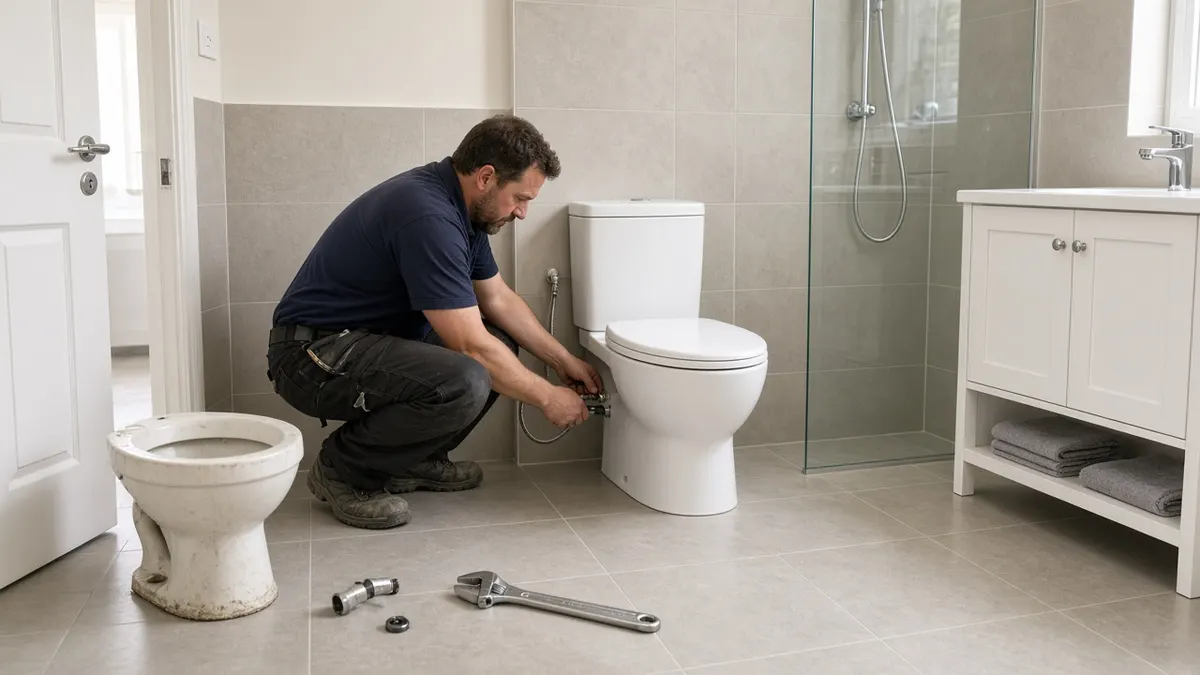
Replacing a toilet in Australia costs roughly $500 to $1,700 in 2026 when you swap like for like, with the new suite and a licensed plumber's labour both included. The labour part is usually $250 to $500; the rest is the toilet you choose. Moving to a back-to-wall suite pushes the total to about $900 to $2,000, and converting to a wall-hung toilet with a cistern hidden in the wall is a small renovation that typically costs $3,000 to $7,000.
Installing a toilet is plumbing work, so in every state and territory it must be done by a licensed plumber. That includes disconnecting the old one. The prices in this guide include GST and are indicative only; your final cost depends on the suite, the condition of the pipes and floor, and whether the new toilet lines up with your existing waste. Get at least three written quotes, and give each plumber the model number of the suite you want so they can check it fits.
Toilet replacement costs in brief
| Type of job | Suite price | Installed total (inc. GST) |
|---|---|---|
| Basic close-coupled, like-for-like | $200 to $450 | $500 to $950 |
| Mid-range close-coupled or wall-faced | $450 to $1,200 | $800 to $1,700 |
| Back-to-wall suite | $600 to $1,500 | $900 to $2,000 |
| Wall-hung pan with in-wall cistern, retrofit | $900 to $2,500 | $3,000 to $7,000 |
| Smart toilet with integrated bidet | $1,500 to $5,000+ | $2,200 to $6,500+ |
| Bidet seat added to existing toilet | $300 to $1,500 | $450 to $2,000, plus a power point if needed |
The jump between a back-to-wall suite and a wall-hung toilet surprises people. Both look similar once installed, but a back-to-wall suite still sits on the floor with its cistern visible or boxed in, while a wall-hung toilet needs a steel frame inside the wall cavity to carry the weight. That means opening the wall, framing, plumbing changes and retiling.
Labour against the cost of the toilet
For a straight swap, a plumber will typically spend one and a half to three hours on site. They isolate the water, disconnect and remove the old suite, clean up the floor and waste, fit a new pan connector, fix the new pan to the floor, assemble and connect the cistern, test for leaks and seal around the base. Most charge a fixed price for this, usually $250 to $500 in capital cities, and $50 to $120 extra to take the old toilet away.
Labour climbs when things are not straightforward. An old pan set in mortar has to be broken out carefully without cracking the floor tiles or damaging the waste pipe. A corroded stop tap may need replacing. A new suite with a different footprint may leave untiled floor showing. Each of these is common in houses built before the 1990s, and each adds time.
On a wall-hung conversion the toilet itself is a smaller share of the bill. Most of the money goes on the plumber's time relocating the waste and water supply, a carpenter or builder framing the opening, sheeting, tiling and making good. Our plumber cost guide covers hourly rates if you are pricing a bigger job by the hour.
Types of toilet and what you get for the money
Close-coupled
The standard Australian toilet: a pan on the floor with the cistern sitting directly on top. Close-coupled suites are the cheapest to buy and install and the easiest to service, because everything is accessible. Most budget and mid-range suites at the big hardware chains and plumbing suppliers are close-coupled.
Wall-faced and back-to-wall
The pan sits flush against the wall with the waste connection hidden inside the pan shroud, so there are no exposed pipes to clean around. Wall-faced suites usually still have a visible cistern on top; back-to-wall pans are often paired with a concealed cistern or a separate cistern. They look cleaner and are easier to clean, but they are less forgiving of set-out differences and cost more.
Wall-hung
The pan hangs off the wall with no contact with the floor, and the cistern sits inside the wall on a steel frame, flushed with a button panel. The floor underneath is easy to mop, and the room feels larger. The trade-off is cost and access: if the cistern valve fails, the plumber works through the button opening, which is fine for most repairs but fiddly. Choose a frame and cistern brand that local plumbers know and can get parts for.
Smart toilets and bidet seats
Integrated smart toilets combine the pan, seat, bidet wash, dryer and sometimes heated seats and auto-flush. A bidet seat is the budget version: it bolts onto most existing pans and connects to the water supply with a T-piece. Both need power for the heated and electronic features. A new power point near the toilet must be installed by a licensed electrician, and in a wet area it must be positioned to meet the wiring rules.
Set-out: the measurement that sets the price
Set-out is the distance from the finished wall behind the toilet to the centre of the waste pipe in the floor (for an S-trap toilet), or the height of the waste coming out of the wall (for a P-trap toilet). Every toilet suite lists the set-out range it accepts in its specification sheet.
If your existing set-out falls inside the new suite's range, the swap is simple. If it does not, the plumber has three options: an offset pan connector (cheap, but not every suite allows one), relocating the waste (expensive, especially on a concrete slab) or choosing a different suite. Measuring before you buy saves money. Take the measurement from the wall, not the skirting board, and note whether the waste goes into the floor or the wall.
Also check the water inlet position. Some suites need the supply at the side, some at the back, and an inlet in the wrong spot means extra pipework. A short phone call to your plumber with the suite model number usually sorts this out before you pay for anything. You can compare models at toilet suppliers near you and ask for the spec sheets.
Installed prices around Australia
Labour rates and travel make up most of the difference between cities. The suites themselves cost much the same nationally, though freight adds a little in Darwin and some regional areas.
| Location | Plumber labour, like-for-like | Installed with mid-range suite |
|---|---|---|
| Sydney | $300 to $550 | $900 to $1,800 |
| Melbourne | $280 to $500 | $850 to $1,700 |
| Brisbane | $260 to $480 | $800 to $1,650 |
| Perth | $280 to $500 | $850 to $1,700 |
| Adelaide | $240 to $450 | $750 to $1,600 |
| Hobart | $250 to $460 | $780 to $1,620 |
| Canberra | $300 to $530 | $880 to $1,750 |
| Darwin | $320 to $560 | $950 to $1,850 |
Three worked examples
All amounts include GST.
Like-for-like swap in a Blacktown brick veneer
A 1980s three-bedroom home with a cracked close-coupled suite. The floor waste lines up with the new suite's set-out range.
| Item | Cost |
|---|---|
| Mid-range close-coupled suite | $450 |
| Plumber labour, fixed price | $380 |
| New braided hose and isolating valve | $60 |
| New pan connector | $25 |
| Removal and disposal of old suite | $60 |
| Total | $975 |
Back-to-wall upgrade in a Belconnen ensuite
A 1990s Canberra home. The owners wanted a cleaner look. The new suite needed an offset connector, and the smaller footprint left a strip of untiled floor that needed patching.
| Item | Cost |
|---|---|
| Back-to-wall suite with concealed-style cistern | $950 |
| Plumber labour including offset connector | $550 |
| Floor tile patch by a tiler | $250 |
| Removal and disposal | $60 |
| Total | $1,810 |
Wall-hung conversion in a Northcote brick veneer
A Melbourne toilet room with a timber stud internal wall. The owners wanted a wall-hung pan with an in-wall cistern. The wall had to be opened, framed, re-sheeted and retiled.
| Item | Cost |
|---|---|
| Plumber: relocate waste and supply, install in-wall frame and cistern, fit pan | $1,600 |
| Carpenter: open wall, framing and noggins | $600 |
| Sheeting and patching | $400 |
| Wall tiling, about 4 m², tiles and labour | $900 |
| Wall-hung pan, in-wall cistern frame and flush button | $1,450 |
| Rubbish removal | $100 |
| Total | $5,050 |
If the wall had been tiled with a tile you can no longer buy, the owners would have faced retiling the whole wall, which is how these jobs drift towards the top of the range. Our tiler cost guide shows what that costs per m².
Extra costs that turn up on the day
- Mortar-set pans. Older pans were often bedded in cement mortar. Breaking them out without damaging the floor adds time.
- Damaged flange or waste. If the old waste pipe is cracked or the connection is perished, it needs repair before the new pan goes in, which can add $150 to $500.
- Floor tiles. A new pan with a smaller or different-shaped base may expose untiled or discoloured floor. Patching costs $150 to $600, depending on whether matching tiles exist.
- Stop tap and isolating valve. A seized or corroded valve should be replaced while the water is off, typically $50 to $150.
- Uneven floor. Out-of-level floors need packing or levelling so the pan sits firmly.
- Asbestos. Some older cisterns, especially black composite cisterns from the mid-twentieth century, and fibre cement wall sheeting behind toilets may contain asbestos. Do not break or drill them. Have a sample tested and, if positive, use a licensed removalist. Our asbestos removal cost guide has typical prices.
- Power for bidets. A new GPO near the toilet costs roughly $200 to $450 from a licensed electrician, depending on cable run.
Water use and WELS ratings
Every toilet sold in Australia must carry a WELS (Water Efficiency Labelling and Standards) label showing its star rating and how much water it uses per flush. You can compare models on the Water Rating website, which is run by the Australian Government.
Most new dual-flush suites use around 4.5 litres for a full flush and 3 litres for a half flush. Older single-flush cisterns can use 11 litres or more per flush, and early dual-flush models used more than today's suites. For a household of four, replacing a very old toilet can cut water use noticeably, which matters more in areas with high water charges or on tank water.
A higher star rating does not always mean a better toilet. Rimless pans with a good flushing design clean well on low volumes; some cheaper low-flow pans do not, and people end up double flushing. Read the flush performance details as well as the star rating.
Licensing: a plumber's job every time
Disconnecting, installing and connecting a toilet to the water supply and sewer is plumbing work in every state and territory. It must be done by a licensed plumber, and in some states the plumber must lodge a compliance certificate for the work. A handyman cannot legally install a toilet, even a simple like-for-like swap, and an insurer may refuse a claim for water damage caused by unlicensed work. Our guide on whether a handyman can do plumbing explains the state rules in plain terms.
Licensing is handled by NSW Fair Trading, the Building and Plumbing Commission in Victoria, the QBCC in Queensland, Building and Energy in WA, Consumer and Business Services in SA, CBOS in Tasmania, Access Canberra and the NT Plumbers and Drainers Licensing Board. You can look up a plumber's licence on the public register of each. In Queensland, the QBCC licence search takes a few seconds.
For a wall-hung conversion, the building side (opening walls, framing, sheeting and tiling) may also need a licensed builder or carpenter if the value passes your state's threshold, such as $3,300 in Queensland. Check the current threshold with your regulator.
Comfort height and accessible toilets
Standard pans put the seat at roughly knee height for an average adult, which is fine for most people but hard work for older users or anyone recovering from hip or knee surgery. Comfort-height or raised pans lift the seat by several centimetres and cost about the same as a mid-range suite, often $500 to $1,200. They are a simple, low-cost change if you are planning to stay in the house as you age.
A fully accessible toilet is a bigger job. It usually involves a specific pan height and set-out, grab rails fixed into solid backing, enough circulation space beside the pan and sometimes a wider door. Grab rails must be fixed into framing or noggins that can take a person's full weight, so on a plasterboard wall the wall may need opening. If you are building to a particular accessibility standard for funding or a care plan, ask an occupational therapist to specify the layout before you buy anything, and have a builder or carpenter install the backing.
Choosing a suite that lasts
Most toilet problems come from the cistern, not the pan. When comparing suites, look at the brand of the internal valves and how easy it is to buy replacement parts. A cheap suite from an unknown brand can be impossible to repair in five years, and you end up replacing the whole thing. Mainstream brands stocked by plumbing suppliers usually have parts available for many years.
Rimless pans have no hidden rim channel, so there is nowhere for grime to build up out of sight. They are easier to clean and now available at most price points. Soft-close, quick-release seats are worth the small extra cost too: you can lift the seat off to clean the hinges, and the lid does not slam.
Check the warranty. Ceramic pans often carry long warranties, sometimes ten years or more, while the cistern mechanism and seat are covered for a shorter period. Keep the receipt and the model number with your house documents.
Repair or replace?
Plenty of toilets get replaced when a $200 repair would do. A running cistern is usually a worn inlet valve or outlet seal, and a plumber can fix it for $150 to $350. A wobbly pan may only need new fixing screws and a fresh seal. A cracked seat costs $40 to $300 and takes ten minutes to change yourself.
Replace the suite when the pan or cistern is cracked, when parts are no longer available for an old cistern, when the toilet blocks frequently because of poor pan design, or when you are already renovating. If the toilet is part of a wider bathroom update, look at our bathroom renovation cost guide before deciding; replacing the toilet in the middle of a renovation costs little extra.
What to ask before you book
- Is the price fixed, and does it include removing and disposing of the old suite?
- Have you checked that my set-out and inlet position suit the model I have chosen?
- What happens if the waste or stop tap needs repair? What would that cost?
- Will you supply a compliance certificate if one is required in my state?
- What warranty do you give on labour?
- What is your licence number?
A cash-only price, no licence number on the quote or a plumber who refuses to look at the suite specification before quoting are all reasons to keep looking. You can compare licensed plumbers near you and ask each for a fixed price on the same model.
How long it takes
A like-for-like swap usually takes one and a half to three hours. Allow a little longer for a back-to-wall suite or a pan that is set in mortar. The silicone around the base should be left to cure for the time on the tube, often 24 hours, before you mop around it, though the toilet can be used straight away.
A wall-hung conversion takes two to five days, because the plumber, carpenter and tiler each need a turn and tile adhesive and grout need time to set. If you only have one toilet, plan for a portable toilet hire or a stay elsewhere during that time.
How Yakka can help
Toilet installation is licensed plumbing work, so Yakka Labour does not do it. Where a Yakka worker can help is around the job: carrying a heavy boxed suite up stairs, clearing a cluttered toilet room or laundry, and taking the old suite and packaging to the tip once the plumber has disconnected it.
On a wall-hung conversion or a wider bathroom job, a labourer can also handle rubbish removal and the clean-up between trades. The plumbing, any electrical work for a bidet seat and any building work over your state's threshold need licensed trades, so book them separately and check their licence numbers first.
Frequently asked questions
How much does a plumber charge to replace a toilet?
Most licensed plumbers charge $250 to $500 in labour to replace a toilet like for like in 2026, including GST. Removing and disposing of the old suite usually adds $50 to $120. Labour costs more if the old pan is set in mortar, the waste pipe needs repair or the new suite needs an offset connector to fit the existing set-out.
Can I replace a toilet myself in Australia?
No. Disconnecting and installing a toilet is plumbing work, and in every Australian state and territory it must be done by a licensed plumber. You can buy the suite yourself and change the toilet seat, but the connection to the water supply and sewer must be done by a licensed plumber. Unlicensed work can void home insurance.
How much does a wall-hung toilet cost to install?
Converting an existing floor-mounted toilet to a wall-hung pan with an in-wall cistern usually costs $3,000 to $7,000 in total. The pan, frame and button cost $900 to $2,500, and the rest is plumbing, framing, sheeting and retiling. Installing a wall-hung toilet during a full bathroom renovation costs much less extra, since the wall is already open.
What is a toilet set-out?
The set-out is the distance from the finished wall to the centre of the floor waste for an S-trap toilet, or the height of the wall waste for a P-trap toilet. Every suite lists the set-out range it accepts. Measuring yours before you buy prevents costly surprises such as moving the waste or returning the suite.
How long does it take to replace a toilet?
A licensed plumber can usually replace a toilet like for like in one and a half to three hours. Jobs with mortar-set pans, corroded stop taps or tile patching take longer. Wall-hung conversions take two to five days because several trades are involved and tile adhesive and grout need time to set.
How often should a toilet be replaced?
A good-quality ceramic pan can last for decades. Cisterns and their internal valves wear out sooner, but parts are usually replaceable. Replace the suite if the pan or cistern is cracked, parts are no longer available, it blocks often or you want a more water-efficient model. Otherwise, a repair is usually cheaper.
Are dual flush toilets worth it?
Yes, and nearly every toilet sold in Australia now has a dual flush. A typical modern suite uses about 4.5 litres for a full flush and 3 litres for a half flush, compared with 11 litres or more for some old single-flush cisterns. Check the WELS star rating and flush performance before you buy.
Official sources
Award rates, licences and safety rules change. Check the official source before you hire or take on a shift.
- Queensland Building and Construction Commission (QBCC)Contractor, plumbing and drainage licence search in Queensland
- Consumer and Business Services SALabour hire licensing in South Australia
- NSW Fair TradingTrade licence checks for electricians, plumbers and builders in New South Wales
- Building and Plumbing Commission (Victoria)Builder and plumber registration, domestic building insurance and licence checks in Victoria
- Asbestos Safety and Eradication AgencyWhere asbestos is found in homes and how to deal with it safely
- Consumer, Building and Occupational Services (Tasmania)Building, plumbing and electrical licensing in Tasmania