Interior cost guide
Floating Floor Cost in Australia: 2026 Prices per m²
Typical cost in Australia (2026, inc. GST)
$45 to $160 per m²
supply and install, laminate to engineered timber, before major subfloor repairs
A floating floor typically costs $45 to $160 per m² supplied and installed in Australia in 2026. Laminate sits at the bottom ($45 to $90), hybrid in the middle ($60 to $120) and engineered timber at the top ($90 to $180). Floor levelling, removing old tiles or carpet, acoustic underlay for strata and new skirting can add $15 to $60 per m² on top.
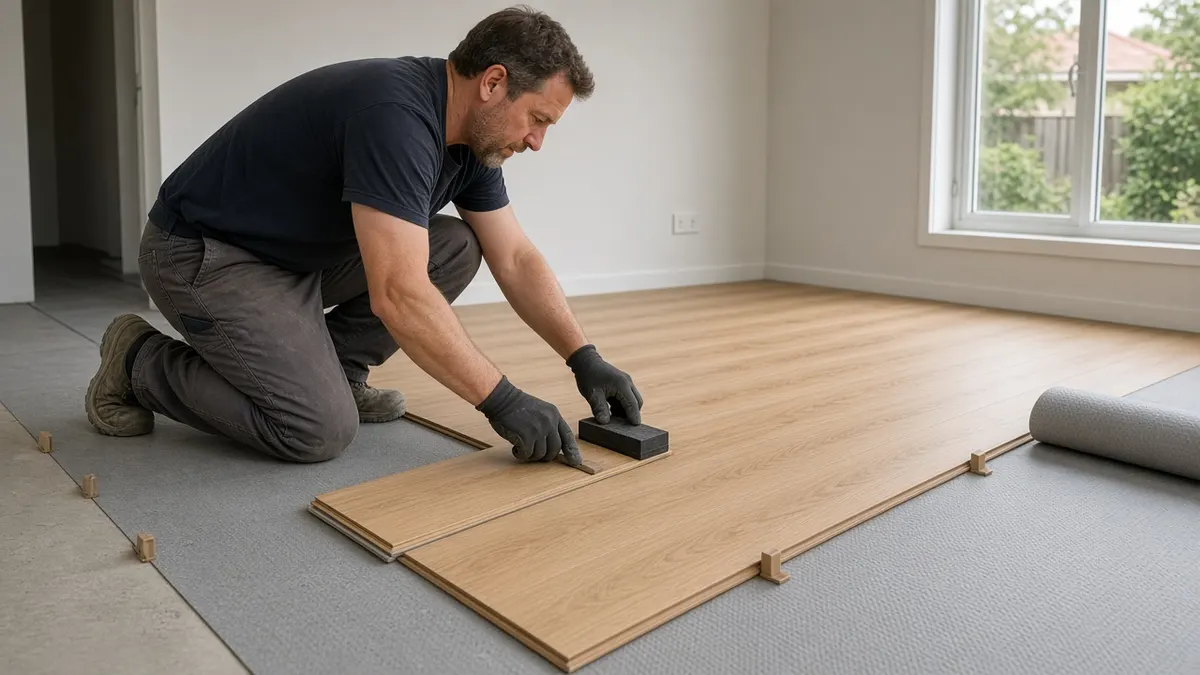
A floating floor costs most Australian homeowners between $45 and $160 per m² supplied and installed in 2026, so a 60 m² living area usually lands somewhere between $3,500 and $9,500. Where you fall in that range depends mainly on the material you pick and how much work the existing floor needs before the first plank goes down.
The figures below are indicative, include GST and assume a standard suburban home with reasonable access. Flooring prices move with the dollar and with freight, so treat this as a budgeting tool and get at least three written quotes before you commit.
Floating floor prices per m² by material
A floating floor is any floor that clicks or glues together at the joins and sits on an underlay, free of the subfloor rather than nailed or glued to it. Four product families make up almost every residential job in Australia.
| Material | Supply only (per m²) | Supplied and installed (per m²) | Typical lifespan |
|---|---|---|---|
| Laminate, 8 to 12 mm | $20 to $50 | $45 to $90 | 15 to 25 years |
| Thin click vinyl plank (LVP) | $25 to $55 | $50 to $95 | 10 to 20 years |
| Hybrid (rigid SPC or WPC core) | $35 to $75 | $60 to $120 | 15 to 25 years |
| Strand-woven bamboo, click | $45 to $90 | $75 to $135 | 20 to 30 years |
| Engineered timber, floating | $55 to $130 | $90 to $180 | 25 to 40 years |
The spread inside each row is mostly about the product. A budget 8 mm laminate from a big-box store and a 12 mm AC5 commercial-rated laminate both click together the same way, but one costs twice the other. With engineered timber, the thickness of the real-wood wear layer, the species and the grade (how many knots and colour variations are allowed) drive the price. A 14 mm board with a 3 mm European oak wear layer in a clean select grade sits near the top of the range. A 12 mm board with a thin veneer of a common species sits near the bottom.
How a floating floor differs from glue-down or nailed timber
Solid timber is usually nailed to battens or joists, or glued straight to a concrete slab, and then sanded and coated on site. That process takes longer, needs more skill and costs more: solid hardwood supplied, laid, sanded and coated commonly runs $130 to $250 per m². A floating floor arrives prefinished and goes down in a day or two for an average room, which is where most of the saving comes from.
The trade-off is feel and sound. Floating floors can sound slightly hollow underfoot, especially laminate on a thin foam underlay. A better underlay fixes most of that. They also move as a single sheet with temperature and humidity, so they need an expansion gap around every wall, usually 8 to 12 mm hidden under the skirting or scotia, and they cannot be pinned down under heavy fixed joinery such as a kitchen island.
Hybrid has taken a big share of the market because the rigid core is water resistant and copes with kitchens, laundries and the odd spilled drink better than laminate. Water resistant is not waterproof, though. Water that gets under any floating floor through gaps at the edges can still cause mould and swelling in the subfloor.
Labour rates and the extras that turn up on quotes
Most installers price labour per m² rather than by the hour. On a straightforward rectangular room, install labour for laminate or hybrid sits around $25 to $40 per m², and engineered timber $35 to $55 per m² because the boards are heavier and less forgiving. Small jobs attract a minimum charge, usually $400 to $800, so a single bedroom rarely works out at the headline per-m² rate.
| Extra item | Typical cost (incl GST) |
|---|---|
| Standard foam underlay | $4 to $8 per m² |
| Acoustic underlay for apartments | $10 to $20 per m² |
| Lifting and disposing of carpet and underlay | $5 to $10 per m² |
| Removing floor tiles from a slab | $25 to $50 per m² |
| Grinding high spots and self-levelling compound | $25 to $60 per m² |
| Scotia or quad beading, supplied and fixed | $8 to $15 per linear metre |
| New skirting boards, supplied and fixed | $25 to $45 per linear metre |
| Trimming doors to clear the new floor | $30 to $60 per door |
| Transition, ramp or end trims | $40 to $90 each |
| Stair nosings and treads | $90 to $180 per step |
| Moving furniture and appliances | $100 to $300 per job |
Scotia versus skirting is a real decision. Scotia is a small beading fixed to the existing skirting to hide the expansion gap. It is cheap and quick, but some people dislike the look. Removing the skirting, laying the floor and refitting or replacing the skirting gives a cleaner finish and costs more, especially if the old skirting breaks on removal, which it often does in older homes.
What floating floors cost in each capital city
Labour is the part that changes most between cities. Material prices are fairly national, apart from freight to Darwin, Hobart and remote regional areas. The ranges below are for a mid-range hybrid or laminate supplied and installed on a sound, flat subfloor.
| City or area | Mid-range installed (per m²) | Why it differs |
|---|---|---|
| Sydney | $70 to $130 | Highest labour rates, parking and apartment access add time |
| Melbourne | $65 to $125 | Strong competition among installers, many older timber subfloors to prepare |
| Brisbane | $60 to $115 | Lots of slab-on-ground homes, humidity makes acclimatisation matter |
| Perth | $65 to $120 | Trade demand has kept labour firm |
| Adelaide | $55 to $105 | Lower labour rates on average |
| Hobart | $60 to $115 | Freight on materials, smaller pool of installers |
| Canberra | $65 to $125 | Labour rates close to Sydney |
| Darwin | $75 to $140 | Freight, heat and humidity, fewer installers |
| Regional centres | $55 to $120 | Cheaper labour, but travel and freight can cancel the saving |
Three worked examples
These examples use realistic quantities and the rates from the tables above. Each total includes GST, and the GST share is shown so you can compare with quotes that list it separately. Allow roughly 8 to 10 percent extra material for offcuts and waste, more for rooms with lots of angles.
Laminate in a two-bedroom unit in Parramatta, 55 m²
A 1990s strata unit with old carpet throughout. The strata by-laws require an acoustic underlay, and the owner chooses 12 mm laminate with scotia rather than new skirting.
| Line item | Cost |
|---|---|
| 12 mm laminate, 60 m² at $38 | $2,280 |
| Acoustic underlay, 60 m² at $14 | $840 |
| Lift and dispose of carpet, 55 m² at $7 | $385 |
| Install labour, 55 m² at $32 | $1,760 |
| Scotia, 48 linear metres at $10 | $480 |
| Door trims and three transitions | $240 |
| Total (incl GST of about $544) | $5,985 |
That works out at about $109 per m² of floor, mid-range for a strata job because of the acoustic underlay.
Hybrid through a lowset home in Brisbane's north, 70 m²
A 1980s brick lowset on a slab. Living areas and hallway already had bare concrete under old vinyl, and three bedrooms had carpet. One section of slab had a dip that needed grinding and levelling.
| Line item | Cost |
|---|---|
| 7 mm hybrid with attached underlay, 77 m² at $45 | $3,465 |
| Carpet removal in bedrooms, 36 m² at $7 | $252 |
| Grind and self-level, 12 m² at $45 | $540 |
| Install labour, 70 m² at $35 | $2,450 |
| Scotia, 60 linear metres at $11 | $660 |
| Trim five doors at $45 | $225 |
| Move furniture | $200 |
| Total (incl GST of about $708) | $7,792 |
Around $111 per m². In a house of this age, the owner also had a sample of the old vinyl tested before it was lifted, which cost about $100 to $150 through a lab. Vinyl tiles and sheet vinyl backing from before the 1990s can contain asbestos.
Engineered oak in a Brunswick terrace, 45 m²
A Victorian-era terrace with tired pine boards over a timber subfloor. The owner wanted engineered oak and new, taller skirting to suit the period look.
| Line item | Cost |
|---|---|
| 14 mm engineered oak, 50 m² at $95 | $4,750 |
| Underlay, 50 m² at $9 | $450 |
| Screw down loose boards and sand high spots, 45 m² at $12 | $540 |
| Install labour, 45 m² at $42 | $1,890 |
| New skirting, 40 linear metres at $35 | $1,400 |
| Disposal and sundries | $250 |
| Total (incl GST of about $844) | $9,280 |
That is about $206 per m², above the headline engineered range because of the skirting. Without it, the job sits near $175 per m².
Subfloor preparation: where budgets blow out
Floating floors are only as good as the surface under them. Most manufacturers set a flatness tolerance, commonly something like 3 mm under a 1 m straight edge or 4 to 5 mm over 3 m, and the warranty depends on meeting it. Check the instructions for the exact product you are buying, because tolerances differ.
On a concrete slab, the usual problems are dips, ridges from old tile adhesive and moisture. A new slab needs time to dry before any floor goes over it, and a good installer will test moisture rather than guess. Older slabs sometimes need a moisture barrier, which is normally a plastic film or an underlay with a built-in vapour barrier.
On timber subfloors, the issues are loose or cupped boards, squeaks and soft spots from old leaks or termites. Screwing down boards and sanding the high spots is cheap. Replacing rotten joists is a carpentry job that can add hundreds or thousands of dollars, and you cannot see it until the old floor is up. Ask installers how they price surprises before they start.
If you are taking up old tiles, budget carefully. Tile removal is slow, dusty work, and the adhesive left behind often needs grinding. If you are weighing tiles against a floating floor for the same space, our floor tiling cost guide compares the numbers.
Laminate, hybrid or engineered: which is worth it
For dry rooms on a tight budget, a good 12 mm laminate is hard to beat. It looks convincing, resists scratches well and costs less than most hybrids. Avoid it in kitchens, laundries and entries where water sits on the floor.
Hybrid is the safe all-rounder for open-plan homes that run from the kitchen to the lounge in one continuous floor. It handles spills, it is quieter than laminate with a good attached underlay, and installers like working with it. The cheaper hybrids can feel hard and look repetitive, so look at the number of distinct plank designs in the box.
Engineered timber is the one to choose if you want real wood and plan to stay. Thicker wear layers can be sanded and recoated once or more over the life of the floor, which neither laminate nor hybrid can do. When that time comes, a floor sanding and polishing job costs far less than replacing the floor. For resale, buyers in established suburbs tend to notice real timber.
DIY or professional installation
Floating floors are one of the more DIY-friendly flooring jobs, and plenty of handy owners save the $25 to $55 per m² labour cost. The hard parts are the prep, getting the first row dead straight, cutting around door frames and finishing the edges cleanly. Mistakes in those areas show for the life of the floor, and some manufacturers reduce warranty cover on DIY installs, so read the warranty first.
Licensing applies once the job is large enough. In NSW, laying timber and timber-composite floors falls within the carpentry trade category, and a contractor licence is needed for residential work valued at more than $5,000 in labour and materials including GST. The NSW Government carpentry licence page explains the category. In Queensland, the QBCC requires a licence for building work valued over $3,300. In Victoria, domestic building work over $10,000 generally needs a registered builder, so check the current rules with the Building and Plumbing Commission. For other states, check with Building and Energy (WA), Consumer and Business Services (SA), CBOS (TAS) or Access Canberra.
If your home was built before 1990, assume old vinyl, lino backing and some fibre cement sheeting could contain asbestos until a test says otherwise. The Asbestos Safety and Eradication Agency has guidance, and our asbestos removal cost guide covers what a licensed removalist charges.
Strata, noise and approvals
In apartments, the floor you choose affects the neighbours below. Many strata schemes have by-laws that require owners corporation approval before replacing carpet with a hard floor, and set a minimum acoustic rating for the floor and underlay together. For new apartment buildings, the National Construction Code sets impact sound limits between units, and older buildings often rely on their by-laws.
Get approval in writing before you order materials. Ask the supplier for the acoustic test report for the combination of flooring and underlay you are using, since the rating applies to the system, not the underlay alone. An acoustic underlay costs a few hundred dollars more on an average unit. Pulling up a floor after a noise complaint costs thousands.
Houses rarely need council approval for a floor replacement. Heritage-listed homes can be an exception if original floors are protected, so check with council if your house is on a heritage list.
How long installation takes
An experienced two-person crew lays 30 to 60 m² of laminate or hybrid in a day on a prepared subfloor. A typical three-bedroom home, around 80 to 100 m² of hard flooring, takes two to three days including skirting or scotia. Engineered timber is slower. Tile removal and levelling can add one to three days before laying starts, plus drying time for levelling compound.
Most products need to acclimatise in the room they are going into, boxes unopened or opened according to the manufacturer, for 24 to 48 hours. Expect noise from the drop saw, some dust from cutting and a fair amount of packaging to remove at the end. Rooms should be empty, so plan where the furniture goes.
Kitchens need a plan of their own. Because a floating floor has to move, most manufacturers say it should run up to the kickboards of fixed cabinets rather than under them, with the expansion gap hidden behind the kickboard. If you are renovating the kitchen at the same time, sort out the order with both trades before anything is ordered. Dishwashers and fridges also need clearance: a 7 to 14 mm floor plus underlay can stop a dishwasher sliding back into its cavity, and fixing that after the event means trimming benchtop supports or adjusting feet.
Ways to keep the cost down
- Lay one continuous floor through living areas. Fewer transitions means less labour and fewer trims.
- Do the strip-out yourself or with help. Lifting carpet and moving furniture is labour you pay installer rates for otherwise.
- Choose scotia over new skirting if the existing skirting is in good shape.
- Buy materials in one batch so colour and gloss match, with 8 to 10 percent extra.
- Book in the cooler months if your installer is busy before Christmas, when many people want floors done.
- Get the subfloor assessed early so the levelling cost is in the quote, not a variation.
What a good flooring quote includes
A clear written quote lists the exact product (brand, range, colour and thickness), the area measured, waste allowance, underlay type, prep work, removal and disposal of old flooring, edge finish (scotia or skirting), door trimming, trims and transitions, and who moves the furniture. It also says what happens if the installer finds rot, moisture or a badly out-of-level floor once the old covering is up.
Red flags include cash-only pricing, no licence number on jobs above your state's threshold, no public liability insurance and large upfront deposits. In NSW the deposit for residential building work is capped at 10 percent. In Victoria it is 10 percent for contracts under $20,000 and 5 percent above that. In Queensland, check the current deposit limits with the QBCC. A supplier may ask you to pay for materials up front, which is common, but the materials should then be delivered or clearly allocated to you. You can compare local installers through our directory of vinyl and laminate flooring installers or timber flooring specialists.
Lifespan, care and resale
Most laminate and hybrid floors last 15 to 25 years in a family home before wear on high-traffic paths becomes obvious. Engineered timber can last longer and be refinished. All of them dislike grit, which acts like sandpaper, and standing water. Felt pads under chair legs, mats at the entries and a damp mop with the cleaner the manufacturer recommends will do more for the floor than any treatment.
Damaged planks in a click floor can be replaced by unclicking from the nearest wall, or by a skilled installer cutting out a single board, so keep a box of spares from the original batch. For buyers, a continuous modern hard floor through the living areas reads as recently renovated. It will not add more to the sale price than it cost, but tired carpet can drag down an otherwise good inspection.
Getting labour help through Yakka
Yakka Labour connects you with local workers by the shift or by the job. On a flooring project, that is useful for the heavy, unglamorous parts: pulling up carpet and underlay, lifting old tiles, moving furniture out and back, carrying boxes of flooring upstairs and loading old materials for the tip or a skip bin. Booking a labourer for those tasks often costs less than paying installer rates for them. Our guide to hiring a labourer for a day explains how it works.
Flooring installers listed on Yakka can quote for the laying itself. Check their licence and insurance the same way you would with anyone else, and make sure the person laying the floor is the one who has assessed the subfloor.
Frequently asked questions
How much does a floating floor cost per m2 in Australia?
Supplied and installed, most floating floors cost $45 to $160 per m² in 2026. Laminate is usually $45 to $90, hybrid $60 to $120 and engineered timber $90 to $180. Add extra for removing old flooring, levelling the subfloor, acoustic underlay and new skirting. Small rooms often cost more per m² because installers charge a minimum fee.
Is hybrid flooring better than laminate?
Hybrid copes better with moisture because its rigid core does not swell like the fibreboard core in laminate, so it suits kitchens and laundries. Laminate is often cheaper and very scratch resistant, which makes it a good choice for bedrooms and dry living areas. Both are floating floors and install in a similar way, so labour costs are close.
Can you put a floating floor over tiles?
Often yes, if the tiles are firmly bonded, flat within the manufacturer's tolerance and the extra height does not cause problems with doors, appliances or transitions to other rooms. Hollow or cracked tiles should be fixed or removed first. Laying over tiles avoids removal costs of $25 to $50 per m², so it is worth asking an installer to check.
How long does it take to install a floating floor?
A two-person crew can lay 30 to 60 m² of laminate or hybrid in a day on a prepared subfloor. An average three-bedroom house takes two to three days including edge trims. Removing tiles, levelling a slab or replacing skirting can add one to three days, and products usually need 24 to 48 hours to acclimatise before laying.
Do I need approval to install a floating floor in an apartment?
In most strata buildings you need owners corporation approval before replacing carpet with a hard floor, and the by-laws may set a minimum acoustic rating. Get written approval first and ask the flooring supplier for test results for the exact floor and underlay combination. Ignoring the by-laws can lead to an order to remove the floor.
Is engineered timber worth the extra cost over hybrid?
It can be if you want real timber and plan to stay. Engineered boards with a thicker wear layer can be sanded and recoated, so the floor can be refreshed instead of replaced. Hybrid is cheaper and more water resistant. For a rental or a busy family home with pets, many owners find hybrid the more practical choice.
Do I need a licensed tradie to lay a floating floor?
It depends on the state and job value. In NSW, timber and timber-composite floor laying is carpentry work and needs a contractor licence above $5,000 including labour and materials. In Queensland the QBCC threshold for building work is $3,300. Victoria uses a $10,000 threshold for domestic building work. Homeowners can usually lay their own floor.
Official sources
Award rates, licences and safety rules change. Check the official source before you hire or take on a shift.
- Queensland Building and Construction Commission (QBCC)Contractor, plumbing and drainage licence search in Queensland
- Consumer and Business Services SALabour hire licensing in South Australia
- Building and Plumbing Commission (Victoria)Builder and plumber registration, domestic building insurance and licence checks in Victoria
- Asbestos Safety and Eradication AgencyWhere asbestos is found in homes and how to deal with it safely
- Consumer, Building and Occupational Services (Tasmania)Building, plumbing and electrical licensing in Tasmania
- Access CanberraConstruction occupation licences and building approvals in the ACT