More cost guide
How Much Does Appliance Repair Cost in Australia? (2026)
Typical cost in Australia (2026, inc. GST)
$150 to $650 per repair
single common fault, including call-out, labour and standard parts
Most appliance repairs in Australia cost $150 to $450 for a single common fault, including a call-out fee of $80 to $180, labour at $90 to $160 an hour and parts. Bigger jobs such as a fridge sealed system repair, a washing machine control board or bearings can run $400 to $1,200. Appliance age, part prices, brand and whether gas or hardwired electrical work is involved drive the final bill.
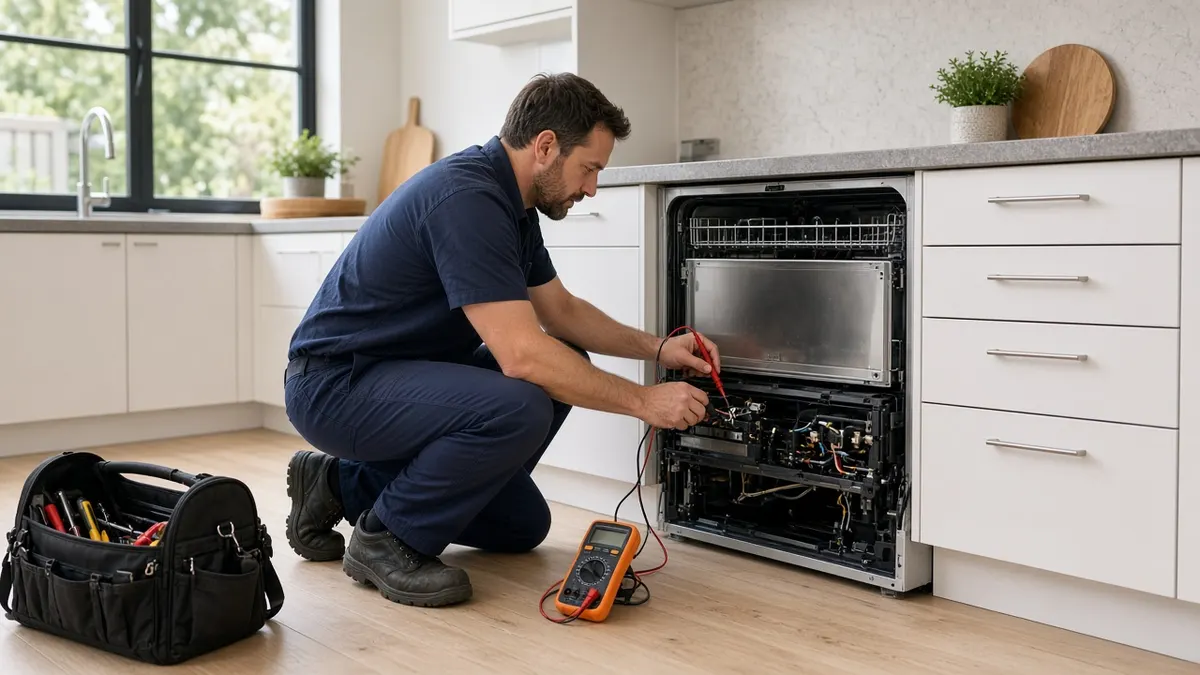
A typical appliance repair in Australia costs between $150 and $450 once you add up the call-out fee, about an hour of labour and a standard part such as a pump, element or door switch. Complex faults like a refrigerant leak, a failed inverter control board or worn drum bearings can cost $400 to $1,200, which is the point where many owners start pricing a new machine instead.
The prices in this guide are indicative 2026 figures in AUD including GST. Rates vary by city, brand and the age of the appliance, so treat them as a yardstick, describe the fault clearly when you ring around, and get at least three written quotes for anything beyond a basic fix.
Typical repair prices by appliance
These ranges cover the most common single-fault repairs, including call-out, labour and parts. They exclude after-hours surcharges and unusual parts that need to be imported.
| Appliance | Common repair range (inc. GST) | Higher-end repairs |
|---|---|---|
| Washing machine (front or top loader) | $180 to $400 | $400 to $750 for bearings or control boards |
| Clothes dryer | $150 to $320 | $350 to $550 for motors or heat pump faults |
| Dishwasher | $180 to $380 | $400 to $650 for circulation pumps or boards |
| Fridge or freezer | $180 to $450 | $600 to $1,200 for compressor or gas leaks |
| Electric wall oven | $160 to $380 | $400 to $700 for control boards |
| Gas cooktop or oven | $150 to $350 | $350 to $600 for gas valves or controls |
| Induction or ceramic cooktop | $200 to $450 | $500 to $1,000 for glass or power boards |
| Rangehood | $140 to $300 | $300 to $450 for motors |
| Microwave (built-in) | $150 to $300 | Benchtop models are rarely worth repairing |
Small benchtop appliances such as kettles, toasters, air fryers and cheap microwaves are almost never worth a technician's visit. The call-out alone usually costs more than a replacement.
How technicians charge
Almost every appliance technician uses some mix of a call-out fee, labour time and parts. Knowing how each one works makes quotes easier to compare.
Call-out and diagnosis fees
A call-out fee of $80 to $180 is standard in the capitals. It usually covers travel and the first 15 to 30 minutes on site, which is often enough to diagnose the fault. Some businesses credit the call-out against the repair if you go ahead. Others charge a flat diagnosis fee whether you proceed or not. Ask which applies before you book.
Hourly labour
Labour typically runs $90 to $160 per hour, often billed in 15 or 30 minute blocks after the first period. Brand-authorised service agents sit at the upper end. Independent technicians who cover many brands are often cheaper, though they may need to order parts in.
Parts
Parts are usually marked up on the wholesale price, which covers the technician's time sourcing them and the warranty they give on the repair. Genuine parts cost more than generic ones but tend to fit and last better, particularly control boards and sensors. Expect $30 to $120 for things like door switches, belts and igniters, $80 to $250 for pumps, elements and motors, and $200 to $600 or more for electronic control boards.
After-hours and weekend work
A fridge dying on a Saturday is annoying, but paying an emergency rate is often worse. After-hours and weekend call-outs commonly cost 50 to 100 percent more. If the fridge is the problem, moving food to an esky or a friend's freezer and booking for Monday usually saves $100 to $250.
What common faults cost to fix
| Fault | Typical fix | Approx. total (inc. GST) |
|---|---|---|
| Washing machine not draining | Clear blockage or replace drain pump | $150 to $320 |
| Washer door will not open or lock | Door interlock replacement | $150 to $280 |
| Washer loud and rumbling on spin | Bearing and seal replacement | $350 to $650 |
| Dryer drum not turning | Drive belt or idler pulley | $150 to $260 |
| Dryer runs but no heat | Element or thermal fuse | $170 to $320 |
| Dishwasher not draining | Filter clean, drain pump or hose | $150 to $350 |
| Dishwasher not heating | Heating element or heat pump | $200 to $400 |
| Fridge warm, freezer fine | Fan motor, defrost heater or sensor | $200 to $380 |
| Fridge not cooling at all | Leak repair, re-gas or compressor | $600 to $1,200 |
| Oven not heating | Bake or fan element | $160 to $320 |
| Oven temperature wrong | Thermostat or sensor | $180 to $350 |
| Gas burner will not light | Igniter, spark module or thermocouple | $150 to $300 |
Refrigeration faults are the most expensive group because a sealed system repair involves finding the leak, brazing, pulling a vacuum and recharging the refrigerant. On a fridge more than eight to ten years old, a sealed system fault is often the moment to replace.
Repair or replace: a rule that holds up
A simple test most technicians would agree with: if the repair costs more than about half the price of a comparable new appliance, and the machine is past the middle of its expected life, replacing it is usually the better call. A $350 pump on a four-year-old $1,200 washer is an easy yes. A $650 board on a twelve-year-old $900 dishwasher is an easy no.
| Appliance | Typical lifespan | Usually worth repairing up to |
|---|---|---|
| Washing machine | 8 to 12 years | About 6 to 7 years for major faults |
| Clothes dryer | 10 to 13 years | Most faults are cheap at any age |
| Dishwasher | 9 to 12 years | About 6 to 8 years for major faults |
| Fridge | 10 to 15 years | About 8 years for sealed system faults |
| Wall oven | 12 to 18 years | Elements and seals are worth fixing at most ages |
| Cooktop | 12 to 18 years | Gas parts yes, cracked ceramic glass often no |
Other things push the decision one way or the other. Built-in ovens and integrated dishwashers cost more to replace than the sticker price suggests, because the new unit has to fit the existing cavity and may need cabinetry or electrical changes. A fridge that is old and inefficient may cost far more to run than a new one, which shifts the maths towards replacing. And if a part has been discontinued, the decision is made for you.
Authorised service agent or independent technician
Most big appliance brands have a network of authorised service agents. They are trained on that brand, have access to service manuals and diagnostic software, and are usually the only option for warranty repairs. If your appliance is still under the manufacturer's warranty, book through the brand, not a technician you found yourself, or you may void the warranty and end up paying for something that should have been free.
Out of warranty, an independent technician is often cheaper and quicker to book. A good independent who works on many brands will know the common faults on popular models and may carry the usual parts. The trade-off is that some newer appliances, especially those with complex electronics or Wi-Fi controls, need brand software to diagnose properly, and independents may not have it. For a premium European oven or an integrated fridge, the authorised agent is usually worth the extra $30 to $60 an hour.
Whoever you book, ask whether they use genuine parts. Generic parts can be fine for belts, filters and simple switches. For control boards, pressure sensors and anything that affects safety, genuine parts are the safer choice.
Running costs belong in the decision
The repair price is only one side of the sum. An old fridge running 24 hours a day can use far more electricity than a new one with a higher star rating, and over the five or more years you plan to keep it, the difference can be a few hundred dollars. Older top loaders also use a lot more water than modern front loaders. Check the energy rating label on any replacement you are considering, and compare the kWh per year figure with what your current appliance is rated at, if you can find the label or model details.
This does not mean every old appliance should go. A basic oven or a dryer used once a week costs little to run whatever its age. The running cost argument matters most for fridges, freezers and anything that runs daily.
How location changes the bill
Labour rates and travel time are the main reasons prices differ around the country.
- Sydney and Canberra tend to have the highest call-out fees, commonly $120 to $180, and hourly rates near the top of the range.
- Melbourne and Brisbane sit in the middle, with plenty of competition among independent technicians across most suburbs.
- Perth and Adelaide are similar to Brisbane in metro areas, but outer suburbs and hills areas can attract a travel surcharge.
- Hobart and Darwin have fewer authorised service agents for some brands, so parts may need to be freighted in and waits can be longer.
- Regional and rural areas often pay extra travel charges of $50 to $200, or wait for a technician's scheduled run through town.
Three repair bills broken down
Dishwasher not draining in Chermside, QLD
A six-year-old freestanding dishwasher leaves dirty water in the base. The technician cleans a badly blocked filter, finds the drain pump impeller cracked and replaces the pump.
| Line item | Cost (inc. GST) |
|---|---|
| Call-out including first 30 minutes | $120 |
| Additional labour, 30 minutes | $60 |
| Replacement drain pump (genuine) | $140 |
| Total | $320 |
Front loader with failed bearings in Werribee, VIC
A nine-year-old 8 kg front loader roars on spin. The technician confirms worn drum bearings. On this model the drum and tub are sealed as one unit, so the repair means replacing the whole tub assembly.
| Line item | Cost (inc. GST) |
|---|---|
| Call-out and diagnosis | $110 |
| Labour, about 2.5 hours | $325 |
| Tub and drum assembly with bearings | $420 |
| Total | $855 |
A comparable new machine costs around $800 to $1,100. At nine years old, most technicians would tell this owner to pay the diagnosis fee and replace the machine.
Fan-forced oven not heating in Morley, WA
A ten-year-old hardwired electric wall oven heats on grill but not on fan-forced. The technician replaces the fan element. The technician holds the right electrical licence for appliance work, so no separate electrician is needed.
| Line item | Cost (inc. GST) |
|---|---|
| Call-out including first 30 minutes | $110 |
| Additional labour, 15 minutes | $30 |
| Fan-forced element | $95 |
| Total | $235 |
That is a classic repair worth doing. Ovens are simple machines, and a new built-in oven plus installation would cost several times more.
Warranty and your consumer rights
Before paying for any repair, check whether you need to pay at all. The manufacturer's warranty is usually one to two years, sometimes longer on motors or compressors. Beyond that, the consumer guarantees under the Australian Consumer Law say goods must be of acceptable quality and last a reasonable time given their price and type. That right can apply after the manufacturer's warranty has ended. A $2,500 fridge that dies at three years old may well qualify for a free repair, replacement or refund through the retailer.
The ACCC's consumer rights information explains how the guarantees work and how to approach the retailer. Keep receipts and photos of the model plate. Extended warranties sold at the counter often overlap with rights you already have, so read what they add before paying for one.
Also check for recalls. Some appliances, including certain dryers and dishwashers, have been recalled over fire risks, and recalled products are normally repaired or replaced free. Search the brand and model on the Product Safety Australia recalls site.
Licences: gas, electrical and who can do what
Licensing is where appliance repair gets tricky, because the rules depend on whether the appliance plugs in, is hardwired or runs on gas.
- Gas appliances. Any work on gas cooktops, ovens, heaters or gas connections must be done by a licensed gasfitter or a technician holding the appropriate gas licence for appliance servicing. Gas regulators include NSW Fair Trading, Energy Safe Victoria and the gas safety areas of state regulators elsewhere. Our gas installation cost guide covers connection and new gas line pricing.
- Hardwired appliances. Wall ovens, cooktops and some rangehoods are connected to fixed wiring. Disconnecting and reconnecting them is electrical work. It must be done by a licensed electrician, or by an appliance technician holding a restricted electrical licence that covers that work in your state. Ask to see it. The electrician cost guide lists typical call-out and hourly rates if you need one separately.
- Plug-in appliances. Washing machines, dryers, dishwashers and fridges are usually serviced by appliance technicians. Rules on electrical repairs to appliances differ between states, so if you are unsure, check with the electrical regulator, such as the Electrical Safety Office in Queensland, Energy Safe Victoria or NSW Fair Trading.
- Refrigerant. Opening a fridge's sealed system or recovering refrigerant requires a refrigerant handling licence from the Australian Refrigeration Council.
- Water connections. Connecting a dishwasher or washing machine to existing taps is generally fine, but installing new taps, a new waste point or plumbing behind the wall needs a licensed plumber. See our plumber cost guide for rates.
Checks to do before you book
A surprising number of call-outs end with the technician fixing something the owner could have checked. These checks are safe and need no tools beyond a torch.
- Check the power point with another appliance, and check whether a safety switch or circuit breaker has tripped at the switchboard.
- Clean the dishwasher filter in the base of the tub. A blocked filter causes poor cleaning and draining problems.
- On front loaders, find the small pump filter door at the bottom front and clear coins, hair ties and lint. Put a towel and a shallow tray down first.
- Clean the dryer lint filter and check the vent hose is not crushed or blocked.
- For a warm fridge, check the temperature setting, make sure the door seals close fully and vacuum dust off the coils at the back.
- For gas burners, check the gas supply is on and the burner caps are seated correctly and dry.
Do not open up the casing of a plugged-in appliance, and leave microwaves alone entirely. Microwave capacitors can hold a dangerous charge even when unplugged.
Booking a technician: questions and red flags
When you call, have the brand, the model number and serial number from the rating plate, the age of the appliance and a clear description of the fault, including any error code. That helps the technician bring the right part and avoid a second visit.
Questions worth asking:
- What is the call-out fee, and is it credited if I go ahead with the repair?
- What is your hourly rate after the first period, and how is it billed?
- Do you use genuine parts, and what warranty do you give on parts and labour?
- Are you an authorised service agent for this brand?
- For gas or hardwired appliances, what licence do you hold, and what is the number?
Red flags include refusing to give a call-out price over the phone, demanding cash only, pushing an expensive repair on an old machine without mentioning replacement, no warranty on the repair and no written invoice with an ABN.
What happens when the technician arrives
Clear a path to the appliance and make sure there is room to pull it out. Technicians commonly lose 15 minutes, which you pay for, dragging a washer out of a cramped laundry or emptying a fridge. Empty the dishwasher, take clothes out of the washer and move food from the fridge to an esky before they arrive.
The technician will usually run the appliance to see the fault, check error codes, then isolate the power or gas and open the casing. Once the fault is found, they should tell you the price of the repair before going further. If you decline, you pay only the call-out or diagnosis fee. If they do the repair, they should test the appliance through a full cycle, or at least the relevant part of it, before leaving, and give you a written invoice that lists the parts, labour and warranty terms.
Habits that prevent the next call-out
- Clean the dishwasher filter every two to four weeks and run an empty hot cycle with a cleaner every month or two.
- Leave the washing machine door and detergent drawer open after use to stop mould on the door seal, and do not overload the drum, which wears bearings faster.
- Clean the dryer lint filter every load, and have the vent and duct checked every year or two.
- Vacuum fridge condenser coils once or twice a year and leave the gap the manufacturer specifies around the cabinet so heat can escape.
- Replace a split oven door seal early. A leaking seal makes the element and thermostat work harder.
- Plug major appliances into their own power points rather than power boards, and fit surge protection if your area has frequent outages.
Installing a new one and getting rid of the old one
If the answer is replace, budget for delivery, installation and removal. Retailers commonly charge $30 to $80 to take away an old appliance when they deliver a new one. Councils run hard waste collections or accept whitegoods at transfer stations, sometimes for a small fee. Fridges and freezers need their refrigerant recovered by a licensed technician before scrapping, which councils and scrap metal recyclers usually arrange.
Freestanding appliances are simple to swap. Built-in ovens, cooktops and integrated dishwashers often need an installer, plus an electrician, gasfitter or plumber for the connection. You can browse appliance installers on Yakka for the fitting side.
Help from Yakka
Repairs themselves belong with qualified appliance technicians. You can search for appliance repair technicians near you on the platform, then check their licences, warranty terms and reviews before booking.
Yakka is useful for the heavy, awkward bits. A worker hired by the hour can pull a fridge or washer out of a tight space so the technician can get to it, carry a dead machine down the stairs, or take old whitegoods and packaging to the tip. If you are clearing out several old appliances at once, a rubbish removal worker with a ute or trailer is often cheaper than paying separate take-away fees.
Frequently asked questions
How much is a call-out fee for appliance repair in Australia?
Call-out fees usually range from $80 to $180 in the capital cities, with Sydney and Canberra at the higher end. The fee normally covers travel and the first 15 to 30 minutes on site, which is often enough to diagnose the fault. Some technicians credit the call-out against the repair if you proceed, while others charge a separate diagnosis fee either way.
Is it worth repairing a 10 year old washing machine?
Usually only for cheap faults. A drain pump, door lock or belt costing $150 to $300 is worth fixing on a ten-year-old machine that otherwise runs well. Bearings, control boards or a tub replacement often cost $500 to $850, which is close to the price of a new machine, so most technicians would suggest replacing it at that age.
How much does it cost to fix a fridge that is not cooling?
It depends on the cause. A faulty fan motor, defrost heater or temperature sensor typically costs $200 to $380 including the call-out. If the sealed system has a refrigerant leak or the compressor has failed, expect $600 to $1,200. On a fridge older than about eight to ten years, a sealed system fault often makes replacement the better choice.
Do I need a licensed electrician to repair an oven?
A hardwired wall oven or cooktop is connected to fixed wiring, so disconnecting and reconnecting it is electrical work. It must be done by a licensed electrician or an appliance technician who holds a restricted electrical licence covering that work in your state. Many oven repair technicians hold this licence. Ask for the licence number before work starts.
Can I get a free repair after the warranty has expired?
Possibly. Under the Australian Consumer Law, goods must be of acceptable quality and last a reasonable time for their price and type. That right can apply after the manufacturer's warranty ends. If an expensive appliance fails early, contact the retailer first with your receipt and the model details. The ACCC website explains the consumer guarantees and how to make a claim.
How long does an appliance repair take?
Many repairs are done in one visit of 30 to 90 minutes if the technician carries the part. Common parts like pumps, belts and elements are often in the van. Control boards, door glass and less common parts may need to be ordered, which can mean a second visit several days to a couple of weeks later, longer for imported brands.
How much does dishwasher repair cost?
Most dishwasher repairs cost $180 to $380, including call-out, labour and a common part such as a drain pump, inlet valve or heating element. Circulation pumps and control boards push the price to $400 to $650. Before booking, clean the filter in the base of the tub, because a blocked filter is one of the most common causes of draining and cleaning problems.
Official sources
Award rates, licences and safety rules change. Check the official source before you hire or take on a shift.
- Workplace Health and Safety QueenslandHigh-risk work licences and the Electrical Safety Office in Queensland
- NSW Fair TradingTrade licence checks for electricians, plumbers and builders in New South Wales
- Energy Safe VictoriaElectrician licensing in Victoria