Interior cost guide
Flyscreen Installation Cost: 2026 Australian Price Guide
Typical cost in Australia (2026, inc. GST)
$60 to $250 per window
standard aluminium frame flyscreen with fibreglass mesh, supplied and installed
A standard aluminium-framed flyscreen with fibreglass mesh usually costs $60 to $150 per window supplied and installed, or up to $250 for large custom sizes. Rescreening an existing frame costs about $30 to $80. Flyscreen doors run $200 to $550, retractable screens $300 to $1,800, and stainless steel security screens $350 to $1,600. Size, mesh type, frame colour and access drive the price.
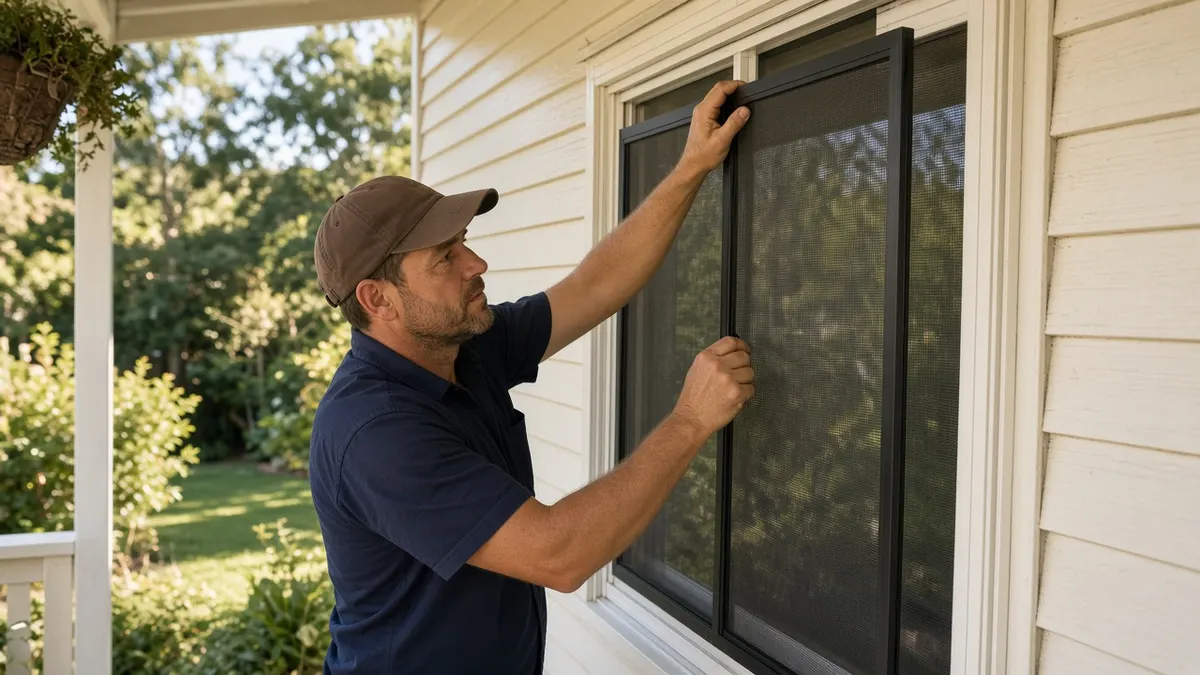
A new flyscreen for a standard window costs $60 to $150 supplied and installed in most of Australia, with large or awkward custom sizes reaching $250. If the frame is fine and only the mesh is torn, rescreening is cheaper at $30 to $80 per screen. Doors, retractable screens and security screens are a step up in price, from about $200 for a basic sliding flyscreen door to $1,600 or more for a stainless steel security door.
The figures below are indicative 2026 prices in AUD including GST. Screen makers usually measure on site and build to size, so your quote will depend on your exact windows and doors. Get at least three written quotes, and compare the mesh type, frame quality and warranty as well as the price.
Price by screen type
| Screen | Typical installed price (inc. GST) | Best for |
|---|---|---|
| Standard window flyscreen, fibreglass mesh | $60 to $150 per window | Most sliding, awning and double-hung windows |
| Large or custom window flyscreen | $150 to $250 per window | Big picture windows, odd shapes, bay windows |
| Rescreen existing frame (new mesh) | $30 to $80 per screen | Torn or sagging mesh on a sound frame |
| Sliding flyscreen door | $200 to $450 | Patio and balcony sliding doors |
| Hinged flyscreen door | $250 to $550 | Front, back and laundry doors |
| Retractable window screen | $300 to $800 | Casement and awning windows, kitchen servery windows |
| Retractable door screen | $600 to $1,800 | French doors, single and double doors |
| Retractable screen for bifold or stacker doors | $1,500 to $4,000 | Wide openings to the alfresco area |
| Stainless steel mesh security window screen | $350 to $900 per window | Ground-floor windows, security and insect control |
| Hinged or sliding security door, stainless mesh | $600 to $1,600 | Front and back entries |
| Diamond grille security door | $350 to $700 | Budget security with fibreglass insect mesh behind |
Many screen businesses have a minimum job charge, often $100 to $200, so a single small screen can cost more than the per-window rate suggests. Bundle all your windows into one visit if you can.
Mesh options and what they add
The mesh is where you decide how tough, how see-through and how secure the screen will be. Standard fibreglass is fine for most windows. Upgrades make sense where pets, kids, bushfire rules or security come into it.
| Mesh | Added cost per standard window | Notes |
|---|---|---|
| Standard fibreglass | Included | Cheap, flexible, good visibility, easily torn by pets |
| Fine "midge" mesh | $10 to $30 | Keeps out tiny insects near wetlands and the coast, slightly reduces airflow |
| Pet-resistant mesh | $20 to $50 | Thicker vinyl-coated polyester, resists claws and paws |
| Aluminium mesh | $15 to $40 | Stiffer than fibreglass, can be used for some ember protection |
| Solar or privacy mesh | $20 to $60 | Cuts glare and heat, gives daytime privacy, darker view out |
| Marine-grade stainless steel (ember mesh) | $60 to $150 | Used where bushfire rules require metal mesh |
| Stainless steel security mesh | $250 to $700 | Requires a heavy-duty frame and fixing to work as a security screen |
A tip from the trade: if your dog or cat goes through standard flyscreens like paper, pay for pet mesh on the doors and the low windows they reach, and leave the high windows in fibreglass. You do not need the upgrade everywhere.
What sets the price
Size and shape
Screens are priced by size, and most makers have bands. A small bathroom awning window and a standard 1200 by 900 mm sliding window often cost about the same. Once the screen gets above about 2 metres on a side, it may need a midrail to stop the mesh bowing, and the price jumps. Arched, angled and bay windows cost more because each piece is cut individually.
Frame type and colour
Standard aluminium frames come in a range of powdercoat colours to match common window frames. Matching an unusual colour or a heritage timber window can add cost or lead time. Timber-framed flyscreens for period homes are made by a smaller number of specialists and cost more than aluminium.
Window type and fixing
Sliding windows usually take a simple screen that clips into the frame. Awning and casement windows open outward, so the screen goes on the inside, sometimes with a winder access flap or a retractable screen. Older timber windows may need clips or a new sub-frame to hold the screen square.
Access and height
Ground-floor windows are straightforward. Upper-storey windows that can only be fitted from outside need ladders or scaffolding and may need two installers, which adds labour. Most fitters install from inside where the window design allows.
Number of screens
The per-screen price drops as the job gets bigger. The measure-up, travel and set-up costs are spread across more screens, and many makers discount whole-house orders.
Prices around the country
For a standard window flyscreen with fibreglass mesh, supplied and installed as part of a job of several screens, expect roughly:
| City or area | Per standard window | Why it differs |
|---|---|---|
| Sydney | $80 to $160 | Higher labour and travel costs, more two-storey homes |
| Melbourne | $75 to $150 | Large, competitive market |
| Brisbane | $70 to $140 | High demand, lots of local manufacturers |
| Perth | $70 to $145 | Many single-storey homes, spread-out suburbs |
| Adelaide | $65 to $135 | Lower labour costs |
| Hobart | $70 to $150 | Fewer makers, materials freighted in |
| Canberra | $80 to $160 | Higher labour costs, bushfire zoning in some suburbs |
| Darwin | $85 to $170 | Freight, humidity and corrosion-resistant hardware |
| Regional areas | $65 to $150 plus travel | Lower rates, but makers may batch jobs by area |
In the tropics and coastal areas, insect pressure keeps demand high year-round, and hardware should be marine grade or stainless to stand up to salt air. In bushfire-prone parts of the ACT, Victoria, NSW, WA and SA, metal ember mesh is often a requirement rather than a choice.
Three screen jobs priced out
Rescreening and new screens in Campbelltown, NSW
A three bedroom brick veneer with aluminium sliding windows. Eight existing screens have torn or sagging mesh, three windows never had screens, and the patio sliding flyscreen door has a bent frame.
| Line item | Cost (inc. GST) |
|---|---|
| Rescreen eight existing frames on site with fibreglass mesh (8 at $45) | $360 |
| Three new custom window flyscreens (3 at $110) | $330 |
| Replace sliding flyscreen door | $320 |
| Measure, travel and disposal of old frames | Included |
| Total | $1,010 |
Security doors and windows in Ipswich, QLD
A lowset brick home with front and back entries and four ground-floor bedroom windows. The owners want stainless steel mesh security screens that also keep insects out.
| Line item | Cost (inc. GST) |
|---|---|
| Two hinged stainless mesh security doors (2 at $1,050) | $2,100 |
| Four stainless mesh security window screens (4 at $520) | $2,080 |
| Removal and disposal of old screens | $80 |
| Total | $4,260 |
This job is above the QBCC licensing threshold, so the contractor should hold the right QBCC licence for the work, and the quote should show the licence number.
Retractable screens for a new alfresco in Mornington, VIC
A 4.2 metre wide bifold door opens onto a covered alfresco, and two kitchen servery windows open outward onto the same area. Fixed screens would block the openings, so the owners choose retractable screens.
| Line item | Cost (inc. GST) |
|---|---|
| Double retractable screen for 4.2 m bifold opening | $2,600 |
| Two retractable servery window screens (2 at $550) | $1,100 |
| Total | $3,700 |
If you are planning a covered outdoor area, our pergola cost guide covers the structure itself, and some owners enclose the whole area with fixed screen panels instead.
Fixed, retractable or security: choosing the right screen
Fixed flyscreens are the cheapest and simplest option for windows you open often. They do one job well and last 10 to 20 years with occasional rescreening.
Retractable screens roll away into a cassette when not in use. They suit doors and windows where a fixed screen would get in the way, such as bifolds, French doors and outward-opening windows, and they keep the view clear when you do not need them. They cost more and have more moving parts, so pick a supplier that offers a decent warranty and spare parts.
Security screens combine insect screening with protection against forced entry. To work as a security screen, the whole system matters: the mesh, the frame, the lock and the way it is fixed to the building. Look for products tested to the Australian Standard for security screen doors and window grilles, AS 5039, and installed to AS 5040. A security mesh in a flimsy frame or fixed with short screws into soft timber is not a security screen.
For many homes, the practical mix is security doors at the entries, security screens on accessible ground-floor windows, and standard fibreglass flyscreens everywhere else.
Bushfire areas and ember protection
If your home is in a designated bushfire-prone area, the construction standard AS 3959 sets requirements based on the property's Bushfire Attack Level (BAL). For most BAL ratings, openable windows and some doors need screens made of corrosion-resistant metal mesh, such as stainless steel, bronze or aluminium, with a small maximum aperture, commonly 2 mm, to stop embers getting in. Fibreglass mesh does not meet this requirement because it melts.
The requirement is triggered most often by new builds and renovations that need approval, but it is worth meeting voluntarily if you live near bushland. Your council, building certifier or the property's BAL assessment will tell you what applies. Expect ember-rated stainless mesh screens to cost roughly 1.5 to 2.5 times the price of a standard fibreglass screen.
Flyscreens and child safety
A standard flyscreen is designed to keep insects out, not to keep children in. Every year children are injured falling through open windows with only a flyscreen between them and the ground.
The National Construction Code requires openable bedroom windows in new work, where the floor is 2 metres or more above the ground outside, to have either an opening restriction or a compliant screen that resists an outward force. Standard flyscreens do not meet that test. If you have young children and upstairs windows, fit window restrictors or a screen designed and tested for fall protection. The Australian Building Codes Board publishes the NCC and guidance on window fall protection.
Licences and who can do the work
Fitting a flyscreen to a window is minor work that does not need a licence on its own in most states. Licensing can apply when the job is larger or involves building work:
- Queensland: building work over the QBCC threshold of $3,300, including labour and materials, generally needs a licence. Larger screen and security screen jobs often exceed this. Check licence classes with the Queensland Building and Construction Commission.
- NSW: residential building work over the Fair Trading threshold needs a contractor licence. Check the current threshold with NSW Fair Trading. Our guide to what a handyman can do without a licence in NSW explains the rules in plain terms.
- Victoria: domestic building work above a set contract value needs a registered builder. Check the current threshold with the Building and Plumbing Commission.
- Other states: check with Building and Energy (WA), Consumer and Business Services (SA), CBOS (TAS), Access Canberra or the NT Building Practitioners Board.
Security screen installers in some states also need a security licence for certain work. Ask the installer what licences they hold for the job you are quoting.
DIY or professional
Rescreening is one of the easier home jobs to do yourself. A roll of fibreglass mesh, a spline roller and new rubber spline from a hardware store cost $20 to $40 and will do several screens. The trick is keeping the mesh tight and square without bowing the frame. Expect the first one to take an hour and the rest to take 20 minutes each.
New screens are a different matter. Custom screens need to be measured precisely, cut and assembled with corner stakes and fitted with the right clips or turn buttons for your window. Off-the-shelf DIY screen kits exist, but they rarely look as neat or seal as well as made-to-measure screens. Security screens and retractable systems should be installed by the supplier, because the warranty and the security rating depend on correct installation.
Timeframes
Most screen businesses visit to measure first, then make the screens in their workshop. Lead time is usually one to two weeks for standard flyscreens and two to four weeks for security and retractable screens, longer in spring and early summer when everyone wants screens before the mosquitoes arrive.
Installation is quick. A fitter can usually install 10 standard window flyscreens in one to two hours. Security doors take one to two hours each, and a large retractable screen for a bifold opening takes two to four hours. Rescreening on site runs at roughly 15 to 30 minutes per screen for an experienced installer.
Repairs that save replacing the screen
Not every tired screen needs replacing. Several common problems have cheap fixes.
| Problem | Typical fix | Approx. cost (inc. GST) |
|---|---|---|
| Sliding screen door jumps the track or drags | New rollers and adjustment | $60 to $150 |
| Screen door will not latch | New latch or closer, realign | $60 to $180 |
| Torn or sagging mesh | Rescreen the existing frame | $30 to $80 |
| Screen falls out of the window | New clips, turn buttons or spring plungers | $20 to $60 per screen |
| Bent corner or frame | Straighten or replace the frame section | $50 to $120 |
Replace the whole screen when the frame is badly bent, corroded through, or the corners have split, as rescreening a warped frame never sits right.
How to spend less
- Rescreen rather than replace where the frames are straight and the corners are sound.
- Do the whole house at once. Minimum charges and travel costs make single-screen visits poor value.
- Book outside peak season. Late autumn and winter are quieter for screen makers, and lead times are shorter.
- Use upgrades selectively. Put pet mesh, security mesh and retractable screens only where they earn their keep.
- Remove old screens yourself if they simply lift out, and label them by window so the fitter can match sizes quickly.
Looking after your screens
- Clean mesh with a soft brush or vacuum attachment and mild soapy water a couple of times a year. Avoid pressure washers, which stretch and tear fibreglass mesh.
- Wipe tracks and rollers on sliding screen doors and add a little dry lubricant so they do not jump the track.
- Rinse stainless mesh and hardware with fresh water every few months in coastal areas to slow tea staining and corrosion.
- Repair small holes early with a patch kit before they spread.
- If you are painting window frames, take the screens off first. The house painting cost guide covers repaint pricing.
Well-made aluminium flyscreens last 10 to 20 years, with rescreening every 5 to 10 years depending on sun exposure, pets and kids. Stainless steel security screens can last 20 years or more.
Checklist for comparing quotes
- A list of every window and door, with the screen type, mesh and frame colour for each.
- Whether the price includes measuring, installation, removal of old screens and disposal.
- For security screens, the Australian Standard the product is tested to and the lock type.
- For retractable screens, the brand and the warranty on the cassette and mechanism.
- Lead time and installation date.
- Warranty on frames, mesh and workmanship.
- Licence numbers where the job value or state rules require one, plus ABN and insurance.
Red flags include a quote without anyone measuring, a large deposit for a small job, prices for "security screens" that are far below the market without any standard mentioned, and no written warranty.
Screens also do more than stop flies. Good screens let you open windows on mild nights instead of running the air conditioner, and they cut down the number of insects that get inside in the first place. If you are dealing with an established infestation, though, screens alone will not fix it, and the pest control cost guide covers treatment prices.
Rescreening and installation help through Yakka
Rescreening, swapping clip-in screens and fitting simple off-the-shelf screen doors are jobs a capable handyperson can do. You can book a handyman near you on Yakka to work through a whole house of torn screens in a morning, often at a lower total cost than separate visits from a screen business.
For made-to-measure screens, security doors and retractable systems, compare flyscreen specialists and security screen and door installers listed on the platform. Check their licence numbers where the job size requires one, and ask which Australian Standard their security products meet.
Frequently asked questions
How much does it cost to rescreen a flyscreen?
Having a professional rescreen an existing frame usually costs $30 to $80 per screen, depending on the size, the mesh and how many screens you have done in one visit. Pet-resistant or fine midge mesh costs more. Doing it yourself costs $20 to $40 in mesh, spline and a roller tool for several screens, though getting the mesh tight takes some practice.
How much is a flyscreen door installed?
A sliding flyscreen door for a patio usually costs $200 to $450 supplied and installed, and a hinged flyscreen door $250 to $550. Retractable door screens cost $600 to $1,800. Stainless steel mesh security doors that also keep insects out typically cost $600 to $1,600, depending on size, lock and the standard they are tested to.
Are retractable flyscreens worth it?
Retractable screens are worth it for openings where a fixed screen gets in the way, such as bifold and stacker doors, French doors and outward-opening windows. They keep the view clear when not in use. They cost several times more than fixed screens and have more moving parts, so choose a supplier with a solid warranty and available spare parts.
What is the best flyscreen mesh for pets?
Pet-resistant mesh, a thicker vinyl-coated polyester, is the usual choice. It resists scratching and pushing far better than standard fibreglass and costs about $20 to $50 more per standard screen. For dogs that jump at doors, a stainless steel security mesh door is tougher still. Many owners use pet mesh only on doors and low windows.
Do I need a licence to install flyscreens?
Fitting a few flyscreens generally does not need a licence. Larger jobs can cross state licensing thresholds for building work. In Queensland, work over $3,300 including labour and materials generally needs a QBCC licence, and NSW and Victoria also have thresholds. Check with your state regulator, and ask security screen installers which licences they hold.
How long does flyscreen installation take?
After the measure-up, standard flyscreens usually take one to two weeks to make, and security or retractable screens two to four weeks. On installation day, a fitter can typically put in 10 standard window screens in one to two hours. Security doors take one to two hours each, and a large retractable screen two to four hours.
Do flyscreens stop children falling out of windows?
No. Standard flyscreens are designed to keep insects out and can give way under a child's weight. For upstairs windows, fit window restrictors that limit the opening or a screen that is designed and tested for fall protection. The National Construction Code sets requirements for bedroom windows in new work where the floor is 2 metres or more above the ground.
Official sources
Award rates, licences and safety rules change. Check the official source before you hire or take on a shift.
- Queensland Building and Construction Commission (QBCC)Contractor, plumbing and drainage licence search in Queensland
- Consumer and Business Services SALabour hire licensing in South Australia
- NSW Fair TradingTrade licence checks for electricians, plumbers and builders in New South Wales
- Building and Plumbing Commission (Victoria)Builder and plumber registration, domestic building insurance and licence checks in Victoria
- Consumer, Building and Occupational Services (Tasmania)Building, plumbing and electrical licensing in Tasmania
- Access CanberraConstruction occupation licences and building approvals in the ACT