Outdoor cost guide
Tree Removal Cost Australia (2026): Prices by Height and Access
Typical cost in Australia (2026, inc. GST)
$400 to $5,000 per tree
small to large tree on a suburban block, includes chipping and clean-up, stump grinding extra
Tree removal in Australia costs about $400 to $900 for a small tree under 5 metres, $900 to $2,500 for a medium tree of 5 to 10 metres and $2,000 to $5,000 or more for large trees in 2026, including GST. Very large trees needing a crane can pass $10,000. Access, nearby buildings or powerlines, stump grinding and any council permit or arborist report add to the cost.
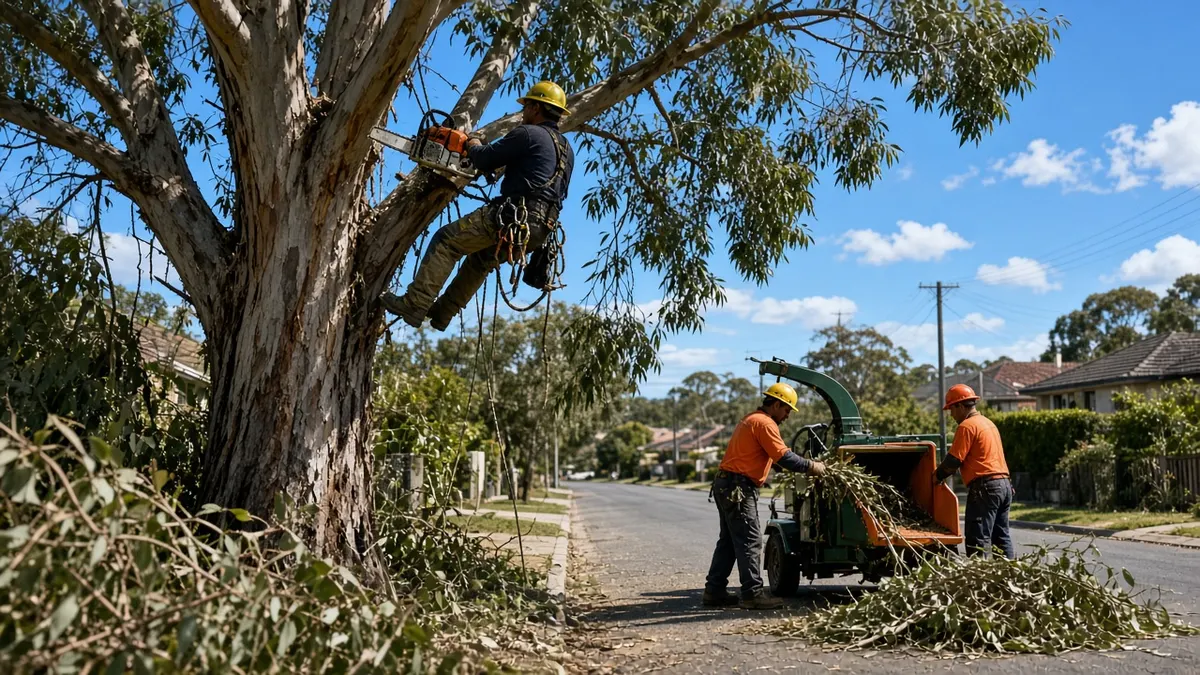
Removing a tree in Australia costs between $400 and $5,000 for most suburban jobs in 2026, with a medium tree of 5 to 10 metres usually landing between $900 and $2,500. Very large trees, or trees leaning over a house that have to be taken down piece by piece with a crane, can cost $7,000 to $15,000 or more.
Height is the obvious factor, but it is rarely the one that blows out a quote. What the tree is near matters more. A 12-metre gum in an open paddock can be felled in one cut. The same tree hanging over a roof, a neighbour's pool and a powerline has to be climbed, rigged and lowered in sections, which can triple the price.
All prices here are indicative, include GST and assume a qualified arborist crew with a chipper. Get at least three written quotes, and check whether your council needs to approve the removal before anyone starts cutting.
Removal prices by tree height
| Tree size | Typical examples | Price range | Usual crew time |
|---|---|---|---|
| Small, under 5 m | Ornamental trees, small fruit trees, young natives, shrubs grown into trees | $400 to $900 | 1 to 3 hours |
| Medium, 5 to 10 m | Established fruit trees, jacarandas, bottlebrush, small gums and palms | $900 to $2,500 | Half a day |
| Large, 10 to 15 m | Mature eucalypts, camphor laurels, liquidambars, pines | $2,000 to $4,500 | Half a day to a full day |
| Very large, 15 to 25 m | Big gums, figs, mature pines and cypress | $3,500 to $8,000 | 1 to 2 days |
| Giant or crane job, 25 m plus | Very old eucalypts, large trees over buildings | $7,000 to $15,000+ | 1 to 3 days with a crane |
Palms sit at the cheaper end for their height because they have no branches to rig. A 6 to 10 metre palm often costs $400 to $1,200 to remove. Big date palms are the exception: they are heavy, spiky and slow to cut up.
How the tree comes down changes the price
The arborist picks a method based on space, the tree's condition and what is underneath. Each method has a very different cost.
Straight felling
The tree is cut at the base and dropped in one piece into clear space. It is the fastest and cheapest method, but it needs a drop zone at least as long as the tree is tall, with nothing in the way. On most suburban blocks that space simply does not exist.
Sectional dismantling by climbing
A climber ascends the tree with ropes and a harness, removes branches and then the trunk in sections, lowering heavy pieces on ropes rather than dropping them. This is the standard method in suburbs and the reason most quotes involve a crew of two or three for half a day or more.
Cherry picker or EWP
A cherry picker or tracked platform lets the arborist cut from a basket instead of climbing. It is faster and safer on dead or brittle trees. Expect $300 to $900 extra a day for the machine, though the faster work can offset some of that.
Crane removal
For large trees over houses, with poor access or with dead wood that is unsafe to climb, a crane lifts whole sections out over the house. Cranes are expensive, typically $1,500 to $5,000 or more for the job depending on size and time, but they can turn a three-day climbing job into one day and avoid damage to roofs and fences. Cranes may also need a council permit to stand on the road and traffic controllers to manage the street.
Arborist crew rates and other line items
Most tree work is quoted per job, but behind every quote is a crew rate. Knowing the typical components helps you read a quote.
| Item | Typical cost |
|---|---|
| Arborist crew of 2 to 3 with chipper, full day | $1,800 to $3,500 |
| Half-day crew booking | $1,000 to $2,000 |
| Cherry picker or tracked EWP | $300 to $900 per day |
| Crane with operator | $1,500 to $5,000+ per job |
| Traffic control for road work | $700 to $1,500 per day |
| Log removal and disposal | $150 to $800, depending on volume |
| Arborist report for a permit | $400 to $1,500 |
| Emergency or storm call-out | Often 1.5 to 2 times normal rates |
Branches and foliage are normally chipped on site and the mulch either taken away or left for your garden. Large trunk sections are the expensive part to remove. If you can use firewood or are happy to have rounds left stacked on site, ask for a price that excludes log removal.
Stump grinding and removal
Most tree removal quotes cut the tree down close to the ground and leave the stump. Grinding it out is usually a separate charge.
| Stump size (diameter at ground level) | Typical grinding cost |
|---|---|
| Small, up to 30 cm | $150 to $250 |
| Medium, 30 to 60 cm | $250 to $450 |
| Large, 60 to 100 cm | $450 to $900 |
| Very large, over 1 m | $900 to $1,500+ |
| Removing the grindings and backfilling with soil | $50 to $200 extra |
| Full stump and root extraction by excavator | $500 to $1,500 |
Grinding normally goes 200 to 300 mm below ground, enough to lay turf or plant over the spot. If you want to build a slab, pool or extension there, tell the contractor, because deeper grinding or full extraction will be needed. Many operators charge a minimum of $150 to $200 even for one small stump, so it pays to do several stumps in one visit.
Leaving the stump is cheaper in the short term, but some species, including camphor laurel, privet and some eucalypts, can sucker from the stump and roots. Ask the arborist whether yours will regrow.
Council permits and protected trees
This is the part people skip, and it can be expensive. Many Australian councils protect trees on private land, and removing a protected tree without approval can lead to heavy fines and orders to replant. Rules vary widely from one council to the next, even between neighbouring suburbs, so do not assume what applied at your last house applies now.
Protections usually come from the council's planning controls, tree protection or significant tree register, local laws or heritage listings. Common triggers include:
- The tree's height, trunk circumference or canopy spread passing a size set by the council
- The species being native, locally indigenous or listed on a significant tree register
- The property being heritage-listed or in a heritage area
- The tree being in bushland, near a waterway or in an environmental overlay area
What a permit typically involves:
- An application to council, with a fee that varies by council from nothing to a few hundred dollars
- Photos and, often, a report from a qualified consulting arborist explaining why the tree should go
- A wait of anywhere from a couple of weeks to a few months
- Conditions such as replacement planting or an offset payment
Many councils have a process for dead, dying or dangerous trees, but you usually still need to notify them or provide evidence, often from an arborist. The safest move is to call your council or search its website for "tree permit" before booking the work. A reputable arborist will ask whether you have checked.
Bushfire-prone areas
Some states have separate rules for clearing around homes in bushfire-prone areas. In NSW, the Rural Fire Service runs the 10/50 vegetation clearing scheme, which in designated areas lets owners clear trees within 10 metres of a home without council approval, subject to conditions. Check eligibility for your exact address with the RFS tool. Victoria and other states have their own bushfire vegetation exemptions; check with your fire authority and council.
Neighbours and boundary trees
A tree on the boundary, or a neighbour's tree overhanging your yard, needs a conversation before any work. You generally cannot remove a neighbour's tree, and cutting back overhanging branches can still require council approval if the tree is protected. In NSW, disputes about trees between neighbours can go to the Land and Environment Court. Other states have their own processes, usually through council or a tribunal.
Wildlife
Native animals are protected under state wildlife laws. If the tree has hollows, nests or possums living in it, the arborist may need to arrange a licensed wildlife handler or time the work to avoid breeding season.
Three priced examples
All figures include GST. Permit fees are examples only because they vary by council.
Small tree in a Perth front yard
A 4-metre ornamental plum with roots lifting the front path in a Morley front yard. Open access, no permit needed after checking with council.
| Item | Cost |
|---|---|
| Removal by two-person crew, chipping and clean-up | $480 |
| Grind 25 cm stump and surface roots | $200 |
| Total | $680 |
Medium tree in a Ryde backyard, NSW
A 9-metre tree beside a fibro garage and a Colorbond fence, with 1.5 m side access. The council required a permit and an arborist report because of the tree's size.
| Item | Cost |
|---|---|
| Consulting arborist report for the permit application | $550 |
| Council permit application fee (example; varies by council) | $100 |
| Sectional dismantle by climbing, 3-person crew, half day | $1,650 |
| Log removal (wheelbarrowed through side access) | $300 |
| Grind 45 cm stump | $350 |
| Total | $2,950 |
The fibro garage is a flag. If it was built before 1990 it may contain asbestos, so the crew should lower every section rather than risk a branch cracking the sheeting.
Large gum over a house in The Gap, QLD
An 18-metre eucalypt with a heavy limb over the roof, a steep driveway and a powerline along the street. Removal approved by council after an arborist assessment. Crane parked on the street.
| Item | Cost |
|---|---|
| Arborist assessment and report | $700 |
| Crane with operator, full day | $2,800 |
| Arborist crew of 3, full day | $3,000 |
| Traffic control, 2 controllers, full day | $1,200 |
| Log removal and disposal | $700 |
| Grind 90 cm stump and remove grindings | $850 |
| Total | $9,250 |
Without a crane, this job would take two or three days of climbing with a higher risk of roof damage. The crane adds cost but removes that risk.
Tree removal costs by city
Typical prices for a medium tree of 5 to 10 metres with average access.
| City | Medium tree | Local factors |
|---|---|---|
| Sydney | $1,100 to $2,800 | Tight blocks, lots of protected trees, high green waste disposal costs |
| Melbourne | $1,000 to $2,600 | Planning overlays and heritage areas in older suburbs |
| Brisbane | $900 to $2,400 | Fast-growing trees, frequent storm work in summer |
| Perth | $900 to $2,300 | Wider blocks often allow easier access |
| Adelaide | $850 to $2,200 | Competitive market; regulated and significant tree rules apply in many areas |
| Canberra | $1,000 to $2,600 | Protected tree rules apply to many large trees; check with Access Canberra |
| Hobart | $950 to $2,500 | Steep blocks and bushland edges |
| Darwin | $1,000 to $2,700 | Cyclone-season demand, heat limits working hours |
| Regional and rural | Varies widely | More space to fell, but travel time and fewer crews |
What else moves the quote
- Access. No side access means every log goes out by hand or over the house by crane. A chipper that can't reach the backyard means dragging every branch to the street.
- Targets underneath. Roofs, glasshouses, pools, fences, sheds and powerlines all slow the work and raise the risk.
- Tree condition. Dead, rotten or storm-damaged trees can be unsafe to climb, pushing the job to a platform or crane.
- Species. Hardwoods such as ironbark are heavy and hard on chainsaws. Palms and pines are softer and faster.
- Powerlines. Only workers authorised for vegetation work near electrical lines can work close to them. Sometimes the network operator has to make the line safe first, which adds time.
- Slope and ground. Steep blocks, soft lawns that can't take a loaded chipper or truck, and retaining walls near the trunk all limit where machinery can go. Ground protection mats or extra hand work add time, and some crews will not bring heavy gear onto wet clay at all.
- Urgency. After a storm, demand spikes and emergency rates apply.
- Disposal. Leaving mulch and firewood on site saves money; removing everything costs more.
When pruning beats removal
Plenty of trees that people want gone could stay with the right pruning. A tree that drops limbs, shades solar panels or scrapes the roof can often be fixed with selective work, and pruning rarely needs the same council approval as removal, although protected trees can still need a permit for significant pruning.
| Pruning job | Typical price, medium tree | What it solves |
|---|---|---|
| Deadwooding | $300 to $800 | Removes dead branches that could fall |
| Crown lifting | $300 to $900 | Raises low branches over driveways, paths and lawns |
| Crown thinning | $500 to $1,200 | Lets light and wind through, reduces storm load |
| Crown reduction | $700 to $2,000 | Reduces height and spread while keeping the tree's shape |
| Roof and powerline clearance (service line to house) | $300 to $900 | Keeps branches off roofs, gutters and the house service line |
Avoid anyone offering to "top" a tree by cutting all the main branches back to stubs. Topped trees regrow with weakly attached shoots that are more likely to fail later, and the job often ends up costing more over time. Who is responsible for clearing trees from the service line to your house varies by state and network, so call your electricity distributor if you are not sure.
What happens on removal day
A professional crew starts by walking the site, agreeing which tree is coming down and setting up an exclusion zone with cones or tape. Cars should be moved off the driveway and out of the drop zone, and pets and children kept inside. Tell your neighbours, especially if branches will be lowered over a shared fence or a truck will block the street for a few hours.
Chippers are loud. Expect noise from start to finish, usually within local permitted hours. At the end, a good crew rakes and blows the area, leaves any agreed firewood stacked neatly and shows you the stump before grinding.
DIY or call an arborist?
You can safely remove a small tree or large shrub yourself if it is under about 3 to 4 metres, well away from buildings, fences and lines, and you can cut it from the ground. A pruning saw or a small chainsaw, a rope to guide it and someone watching is enough. Check council rules first, even for small trees, as some councils protect particular species regardless of size.
Anything bigger should go to a professional. Chainsaw work from a ladder is one of the classic ways people end up in hospital, and a falling limb behaves unpredictably. Look for an arborist who holds a Certificate III in Arboriculture or higher, carries public liability insurance and follows safe work practices. Safe Work Australia publishes a guide to managing risks of tree trimming and removal work that covers what a professional crew should be doing on site.
For reports used in council applications, councils usually want a consulting arborist, commonly with a Diploma of Arboriculture or higher qualification. Check your council's requirements before you commission one.
Reading a tree removal quote
A clear quote should state:
- Which tree or trees, by species and location, so there is no confusion on the day
- The removal method and whether a crane or platform is included
- Whether the stump is ground, how deep, and whether grindings are removed
- What happens to logs, branches and mulch
- Who is responsible for checking and obtaining council approval
- Public liability insurance and the qualifications of the climbing arborist
- What happens if there is damage to fences, roofs or gardens
Be wary of door knockers after storms offering cheap removal for cash, anyone who says "council doesn't need to know", and quotes that cannot name the insurer. A tree dropped on a roof by an uninsured crew is your problem.
Cutting the cost of tree work
- Keep the wood. Firewood rounds left on site save on log removal.
- Keep the mulch. Fresh woodchip is useful on garden beds and paths once it has aged a few months.
- Batch the work. Removing two trees, pruning a third and grinding stumps in one visit uses the crew's day efficiently.
- Team up with neighbours. If several houses in a street need work, a shared booking can cut travel and setup costs.
- Plan ahead. Avoid emergency rates by dealing with leaning or dying trees before storm season.
- Prune instead. A good arborist will tell you if crown reduction or removing one problem limb would solve the issue for a fraction of the cost.
Help with the clean-up
Arborists handle the felling and climbing. The clean-up afterwards, such as raking, stacking firewood, loading leftover green waste and clearing the area for turf or a new garden bed, is often done by the owner. Yakka Labour lets you book a labourer for a few hours or a day for that work, which can be cheaper than paying a full arborist crew to stay on.
Find qualified arborists and tree felling services near you, or book rubbish removal for leftover branches and debris. Climbing, chainsaw work at height and anything near powerlines should stay with qualified arborists.
Related costs once the tree is gone
Removing a tree often leads to other jobs. A large tree that dropped leaves into gutters for years may have left them blocked or rusted; our gutter cleaning cost guide covers that. A skip may be cheaper than paying for log removal if you are also clearing other garden waste, so compare with our skip bin hire cost guide. Ongoing care for the rest of the garden is covered in the garden maintenance cost guide.
Frequently asked questions
How much does it cost to remove a tree in Australia?
Most tree removals cost between $400 and $5,000 in 2026. Small trees under 5 metres are usually $400 to $900, medium trees of 5 to 10 metres $900 to $2,500 and large trees $2,000 to $5,000 or more. Trees over houses that need a crane can cost $7,000 to $15,000. Stump grinding and permits are usually extra.
How much does stump grinding cost?
Stump grinding typically costs $150 to $250 for a small stump, $250 to $450 for a medium stump and $450 to $900 for a large one in 2026. Very large stumps over a metre wide can cost more than $1,000. Removing the grindings and backfilling with soil usually adds $50 to $200, and most operators have a minimum charge.
Do I need council permission to remove a tree on my property?
Often, yes, but it depends entirely on your council and the tree. Many councils protect trees over a certain size, particular species, trees in heritage areas or trees in environmental zones. Some have exemptions for dead or dangerous trees, but may still want evidence. Check your council website or call them before booking any removal.
Who pays to remove a tree on the boundary?
Responsibility usually depends on whose land the trunk stands on, and boundary trees are often shared. Talk to your neighbour first and agree in writing who pays. Protected trees need council approval no matter who owns them. If you cannot agree, state processes apply; in NSW, tree disputes between neighbours can go to the Land and Environment Court.
How long does it take to remove a tree?
A small tree can take one to three hours. A medium tree with average access usually takes a crew half a day, and a large tree a full day. Very large trees, crane jobs and multiple trees can take two or three days. Council permits can add weeks before work starts, so allow time if approval is needed.
Does home insurance cover tree removal?
Home insurance often covers removing a tree that has fallen and damaged your home in a storm, but usually not removing a healthy standing tree or one you are worried about. Policies differ, so check your product disclosure statement and call your insurer before booking emergency work if you plan to claim.
Can I remove a tree myself?
You can usually remove a small tree under about 3 to 4 metres that is clear of buildings, fences and powerlines, cutting from the ground. Check council rules first. Anything larger, anything near structures and any chainsaw work from a ladder should be left to a qualified arborist with insurance, because falling timber is unpredictable.
Official sources
Award rates, licences and safety rules change. Check the official source before you hire or take on a shift.
- Safe Work AustraliaNational work health and safety framework, including high-risk work licences
- Asbestos Safety and Eradication AgencyWhere asbestos is found in homes and how to deal with it safely
- Access CanberraConstruction occupation licences and building approvals in the ACT