Interior cost guide
Epoxy Flooring Cost 2026: Garage and Home Prices in Australia
Typical cost in Australia (2026, inc. GST)
$45 to $170 per m²
solid colour to metallic systems, professionally installed on a sound slab
Epoxy flooring in Australia costs about $45 to $80 per m² for a solid colour coat, $60 to $100 per m² for a flake system and $100 to $170 per m² for metallic finishes in 2026, including GST. A double garage of about 36 m² with flakes usually costs $2,200 to $3,800. Slab preparation, moisture, cracks, the topcoat type and minimum job charges move the price most.
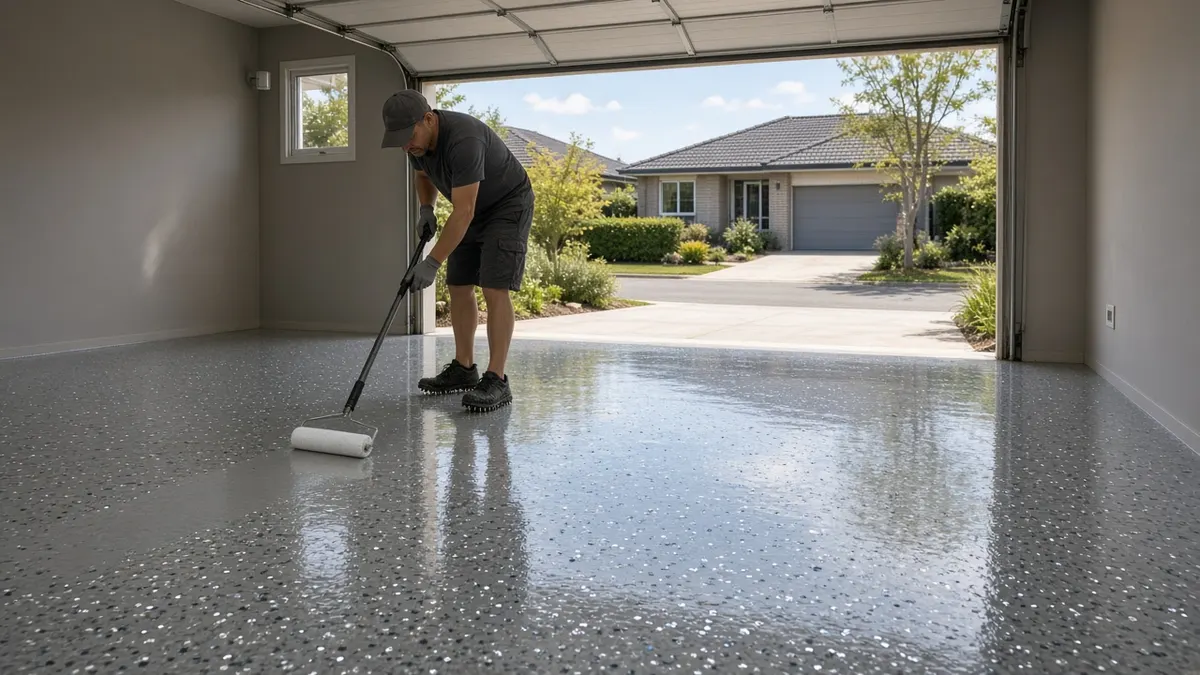
Epoxy flooring costs about $45 to $170 per m² in Australia in 2026, including GST, when a professional installs it. Most people asking the question are pricing a garage, and a typical double garage with a decorative flake finish comes in around $2,200 to $3,800.
The coating you can see is only part of the bill. A large share of a good quote is grinding, repairing and testing the slab underneath, and that is also where cheap jobs cut corners. This guide covers garages, workshops, home interiors and small commercial floors. For polished or ground concrete in living areas, read the concrete flooring cost guide instead. The numbers below are indicative, so get at least three written quotes that spell out the full system.
Epoxy floor prices by coating system
| System | Description | Price per m² (incl. GST) |
|---|---|---|
| Solid colour epoxy | Primer plus one or two pigmented coats. Plain, practical, easy to clean. | $45 to $80 |
| Flake system | Epoxy base coat with coloured vinyl flakes broadcast to refusal, then a clear topcoat. The usual garage choice. | $60 to $100 |
| Quartz or anti-slip broadcast | Coloured quartz sand locked between coats for grip and wear resistance. | $80 to $130 |
| Self-levelling epoxy | A thicker poured layer, often 2 to 3 mm, for warehouses, workshops and showrooms. | $90 to $150 |
| Metallic or marble effect | Pearlescent pigments manipulated by hand for a swirled stone look. Labour-heavy and artistic. | $100 to $170 |
| Urethane cement | Heavy-duty, heat and chemical resistant. Used in commercial kitchens and food production. | $100 to $180 |
| Minimum job charge | Typical floor for any job, covering grinding gear and travel. | $1,200 to $1,800 |
What a garage floor usually costs
Australian garages come in fairly standard sizes, so it is possible to give a ballpark for the whole job. These figures assume a flake system on a slab in reasonable condition.
| Space | Approximate area | Flake system total (incl. GST) |
|---|---|---|
| Single garage | 18 to 20 m² | $1,400 to $2,200 (minimum charges often apply) |
| Double garage | 36 to 40 m² | $2,200 to $3,800 |
| Triple garage | 54 to 60 m² | $3,300 to $5,600 |
| Garage plus workshop or shed | 70 to 90 m² | $4,200 to $8,000 |
Small garages look expensive per square metre because the crew brings the same grinder, vacuum and mixing gear whatever the size. Adding a laundry, a porch or a patio to the same visit often costs less than you might expect for that reason.
Preparation is where the money goes
Epoxy is an adhesive coating. It only performs as well as its bond to the concrete, and that bond depends on what happens before any colour goes down. When a coating peels within a year, the cause is nearly always poor prep or moisture, rarely the product itself.
Diamond grinding
A professional crew grinds the whole floor with a planetary or walk-behind diamond grinder, connected to an industrial vacuum. This removes the weak surface layer (called laitance), opens the pores and gives the coating something to grip. Expect grinding to account for $8 to $15 per m² of the price. Acid etching is the cheaper alternative used in many DIY kits, but it is less reliable and leaves residue if not rinsed thoroughly.
Moisture testing
Slabs breathe. If moisture rises through the concrete, it builds pressure under a non-breathable coating and pushes it off in blisters. Older garages without a vapour barrier, slabs on wet sites and anything below ground level are the usual suspects. A good installer tests moisture before quoting a standard system and will suggest a moisture-tolerant primer where needed, which adds roughly $10 to $25 per m².
New slabs
Fresh concrete needs time to cure and dry before epoxy goes on. Most manufacturers call for at least 28 days, and many installers prefer longer or test first. If you are building, tell your concreter the slab will be coated so they can skip curing compounds that may need grinding off later. For a new garage or shed slab, the concrete slab cost guide covers pricing, and the concreter hourly rate guide explains what concreters charge for small repair jobs.
Repairs and old coatings
Cracks and control joints are cut out and filled with an epoxy or polyurea filler. Oil stains are degreased and sometimes treated with a primer that tolerates contamination. Old paint or a failed DIY coating has to be ground off completely, which can add $10 to $20 per m². Patchy, crumbling concrete may need a skim coat or a repair mortar first.
Flake, metallic, solid colour or quartz: which suits your floor?
Flake is the default garage finish for good reason. The texture hides dust, tyre marks and small imperfections in the slab, and a full broadcast gives mild slip resistance. Colour blends are endless, though greys and charcoals hide dirt best.
Solid colour suits workshops, storerooms and anywhere you want a clean, bright surface that shows spills quickly. It also shows every scratch and hair, so it reads more industrial.
Metallic floors are the showpiece option for home bars, rumpus rooms, retail fit-outs and offices. No two are the same, and the finish depends heavily on the installer's skill. Look at photos of their actual jobs, not manufacturer samples. Metallic floors are slippery when wet unless a texture additive is used.
Quartz broadcast is the pick for ramps, wash bays, commercial bathrooms and pool surrounds where grip matters more than looks.
Epoxy, polyaspartic or polyurethane on top
Many quotes call everything "epoxy" when the top layer is actually something else. The topcoat decides how the floor ages.
- Epoxy topcoat. Hard and cheaper, but most epoxies yellow (amber) in sunlight. Fine in a closed garage, poor on a floor that gets afternoon sun through an open roller door.
- Polyaspartic. A fast-curing coating that is UV stable and tough. It allows one-day or two-day installs and adds about $5 to $15 per m² over a plain epoxy topcoat.
- Polyurethane. UV stable with good scratch and chemical resistance. Slower to cure, and some products contain isocyanates, which need careful ventilation and respiratory protection during application.
Hot tyre pickup is the other thing to ask about. Cheap single-coat products can soften under hot tyres in a Queensland or WA summer and lift off with the tyre. Proper two-pack systems at the right thickness do not have this problem.
Prices around Australia
These are typical flake system rates per m² on a sound slab. Labour costs and how far the installer travels explain most of the difference.
| City or region | Flake system per m² (incl. GST) | Notes |
|---|---|---|
| Sydney | $70 to $110 | High labour costs and traffic-heavy travel between jobs. |
| Melbourne | $65 to $105 | Big market with lots of new estate garages. |
| Brisbane | $60 to $95 | Strong competition. Ask about UV stability for sun-exposed garages. |
| Perth | $60 to $95 | Mostly slab homes. Summer heat speeds up cure times. |
| Adelaide | $55 to $90 | Lower labour rates. |
| Canberra | $65 to $105 | Cold winters slow curing, which can push jobs into warmer months. |
| Hobart | $65 to $105 | Fewer installers. Cold slabs need longer cure windows. |
| Darwin | $75 to $115 | Freight, humidity and wet-season moisture issues. |
| Regional areas | $60 to $110 | Travel fees often added outside the installer's base area. |
Worked examples with full breakdowns
Double garage in Kellyville, 38 m² flake floor
A 2008 brick home with a sound slab, a few hairline cracks and an oil patch where the old car leaked. The owners chose a grey flake blend with a polyaspartic topcoat because the garage faces west.
| Item | Cost |
|---|---|
| Diamond grinding with dust extraction, 38 m² at $12 | $456 |
| Crack and control joint repair | $300 |
| Moisture test and oil stain treatment | $150 |
| Primer, epoxy base, full flake broadcast and polyaspartic clear coat, 38 m² at $58 | $2,204 |
| Front lip and step edge detailing | $250 |
| Subtotal (ex GST) | $3,360 |
| GST | $336 |
| Total | $3,696 (about $97 per m²) |
Metallic feature floor in a Joondalup rumpus room, 32 m²
The owners pulled up carpet and wanted a dark bronze metallic finish under a home bar and pool table.
| Item | Cost |
|---|---|
| Carpet glue and tack strip removal | $350 |
| Diamond grinding, 32 m² at $14 | $448 |
| Primer and self-levelling base coat, 32 m² at $35 | $1,120 |
| Metallic pigment layer, 32 m² at $55 | $1,760 |
| UV-stable polyurethane topcoat, 32 m² at $15 | $480 |
| Subtotal (ex GST) | $4,158 |
| GST | $415.80 |
| Total | $4,573.80 (about $143 per m²) |
Farm workshop near Bendigo, 72 m² solid colour with anti-slip
A 12 m by 6 m steel shed with a ten-year-old slab, used for machinery maintenance. Function over looks.
| Item | Cost |
|---|---|
| Diamond grinding, 72 m² at $10 | $720 |
| Crack repair and joint filling | $450 |
| Two-coat solid colour epoxy, 72 m² at $38 | $2,736 |
| Anti-slip aggregate in topcoat, 72 m² at $4 | $288 |
| Travel and mobilisation | $200 |
| Subtotal (ex GST) | $4,394 |
| GST | $439.40 |
| Total | $4,833.40 (about $67 per m²) |
DIY epoxy kits: when they work and when they peel
Hardware store garage kits cost roughly $300 to $800 for a single or double garage, and they are tempting next to a $3,000 quote. Some people get a decent result. Many get a floor that looks good for a year and then lifts under the car tyres.
The difference is almost always preparation and thickness. Kits are often a single thin coat over an acid-etched floor. A professional system is usually three layers over a diamond-ground floor, with a total thickness several times higher. If you want to DIY properly, budget for:
- Grinder hire with a vacuum, roughly $200 to $350 a day, plus diamond tooling.
- A two-pack primer, base coat and a UV-stable topcoat bought from a coatings supplier rather than a single-coat kit.
- Crack filler, degreaser, rollers, spiked shoes and a respirator with the right cartridges.
- A full weekend of work plus cure time, with the car parked on the street for several days.
Done that way, DIY materials and hire for a double garage often reach $1,000 to $1,600. That is still cheaper than a pro, but the gap is smaller than it first looks. DIY makes most sense for a workshop where appearance matters less, or a small single garage.
Beyond the garage: epoxy in homes and businesses
Epoxy turns up in more places than garages, and each use changes the specification and the price.
Living areas. Metallic and solid colour floors work in modern homes, studios and granny flats, especially over a slab that is too patchy to polish. They feel warmer than tiles and have no grout lines. On the downside, they scratch under chair legs and pet claws, and a high-gloss finish shows every footprint. A satin or matte polyurethane topcoat is easier to live with than full gloss. Budget $90 to $170 per m² for a decorative interior system, and check that the installer is comfortable with skirting details and transitions to other flooring at doorways.
Laundries and bathrooms. Epoxy can work in wet areas, but it does not replace a waterproofing membrane where the building code requires one. Wet area waterproofing has its own rules and, in several states, its own licence class. Talk to a waterproofer or builder before coating a bathroom floor.
Shops, offices and showrooms. A self-levelling epoxy gives a hard, flat surface that copes with trolleys and foot traffic. Expect $90 to $150 per m² and a schedule built around trading hours, which often means night or weekend work at a premium.
Warehouses and factories. Large areas bring the per m² price down, but forklift traffic, line marking, chemical spills and joint armouring push it back up. These jobs are usually specified by the client or an engineer and priced from drawings.
Commercial kitchens and food production. Urethane cement is the usual choice because it handles hot water washdowns, fats and thermal shock that standard epoxy cannot. Coved skirting where floor meets wall is normal for hygiene, and drainage falls have to be right before coating. These floors often cost $100 to $180 per m² plus coving by the linear metre.
Rules, licences and safety
Epoxy coating is not a licensed trade in its own right in most states, but larger jobs still fall under home building rules. In NSW, residential building work over $5,000 in labour and materials needs a licensed contractor and a written contract; check the details with NSW Fair Trading. In Queensland, ask the installer whether the job needs a QBCC licence, which is required for building work valued over $3,300. In other states, check the current threshold with your building regulator.
Safety is a bigger day-to-day issue than licensing. Grinding concrete releases crystalline silica dust, so installers should use on-tool extraction and appropriate respirators. Some coatings release strong solvent vapours, and some polyurethanes contain isocyanates that can cause occupational asthma. Safe Work Australia publishes guidance on both hazards. Keep children and pets away during the install, ventilate well, and do not run gas appliances or pilot lights nearby while solvent-based products cure.
Commercial floors bring extra requirements. Food premises have to meet food safety standards set through your council and state food authority, and workplaces need floors with suitable slip resistance for the use. Ask the installer for the slip rating of the finished system tested to AS 4586.
Lifespan, cleaning and resale
A well-installed flake system in a residential garage should last 10 to 20 years before it needs more than cleaning. Metallic floors in living areas last a similar time, though scratches show more. Heavy commercial use shortens that, and a recoat of the clear topcoat every five to ten years extends it, typically $25 to $45 per m² after a light sand.
Cleaning is simple. Sweep, then mop with warm water and a mild pH-neutral cleaner. Avoid harsh solvents. Put felt pads under heavy shelving and a mat under motorbike stands, since point loads can dent the coating. If the floor has picked up grime over years, a soft-wash with a pressure cleaner on a low setting works, but keep the nozzle well back. The pressure cleaning cost guide covers professional rates.
As for resale, a tidy coated garage photographs well and suggests a well-kept house. It will not add its full cost to a sale price, but a stained, cracked garage floor is one of those small things buyers notice.
Reading and comparing quotes
Two quotes for "epoxy flooring" can describe completely different floors. Line them up against these points:
- Preparation method: diamond grinding or acid etching.
- Moisture testing and what happens if the slab fails.
- Each layer named: primer, base coat, flake or pigment, topcoat type (epoxy, polyaspartic or polyurethane).
- Total system thickness, or at least the number of coats.
- Crack, joint and step detailing included or extra.
- Cure time before walking, before parking a car and before full chemical resistance.
- Written warranty, what it covers (peeling, hot tyre pickup, yellowing) and for how long.
- Licence number where your state requires it, plus public liability insurance.
Warning signs include a price far below the others, a single-coat system sold as "commercial grade", no mention of grinding, large upfront deposits and pressure to sign on the day.
How the install day runs
A standard flake garage usually takes two to three days with an epoxy topcoat. Day one is grinding, repairs and the primer or base coat. Day two is the flake broadcast, scraping and the clear coat. Some polyaspartic systems are done in a single long day.
Expect noise and some dust during grinding, even with good extraction. Foot traffic is usually fine after 24 hours. Cars should stay off for three to seven days depending on the product and temperature, since full chemical cure takes longer than surface dry. Cold weather slows everything down, so winter jobs in Canberra, Hobart or the Victorian highlands can need extra days.
Ways to spend less
- Clear the garage completely before the crew arrives. Paying a coating crew to move boxes is an expensive way to shift boxes.
- Pick a flake blend over metallic for garages. It hides more and costs less.
- Combine areas into one visit to spread the mobilisation cost.
- Skip the upturn cove and wall skirting in a home garage unless you need washdown hygiene.
- Book outside the busy pre-summer period, when many installers are fully booked.
Getting help with the labour
The coating itself should go to an experienced installer, but the heavy lifting around it does not need one. Emptying a packed garage, hauling old shelving and junk to the tip, pulling up carpet before a rumpus room job and cleaning up afterwards are the kind of tasks you can book a worker for on Yakka Labour. Our guide on how to hire a labourer for a day covers how that works and what it costs.
When you are ready to price the floor, compare floor coating installers in your area. If you have a lot to throw out first, local rubbish removal services can take it away before the grinding starts.
Frequently asked questions
How much does epoxy flooring cost per m2 in Australia?
Professionally installed epoxy flooring costs about $45 to $170 per m² in 2026, including GST. Solid colour coats sit at $45 to $80, flake systems at $60 to $100 and metallic finishes at $100 to $170. Small jobs often attract a minimum charge of $1,200 to $1,800 because the installer needs the same equipment regardless of area.
How much does it cost to epoxy a double garage?
A double garage of about 36 to 40 m² usually costs $2,200 to $3,800 for a professionally installed flake system, including GST. Expect more if the slab has an old coating to remove, moisture problems or lots of cracks, or if you choose a polyaspartic or polyurethane topcoat for UV stability.
Is epoxy flooring worth it for a garage?
For most people who use their garage as a workshop, gym or tidy car space, yes. A proper system resists oil, is easy to sweep and hides dust and tyre marks. It is less worthwhile on a slab with ongoing moisture problems, where coatings can blister, or in a rental you are about to leave.
How long does an epoxy floor last?
A professionally installed residential garage floor typically lasts 10 to 20 years before it needs more than cleaning. Lifespan depends on prep quality, coating thickness, UV exposure and traffic. A recoat of the clear topcoat every five to ten years in heavy-use areas helps it last longer.
Why is my epoxy floor peeling?
Peeling usually comes from poor preparation, such as acid etching instead of grinding, coating over oil or old paint, or moisture rising through the slab. Thin single-coat products can also lift under hot tyres. Fixing it normally means grinding off the failed coating and starting again with a proper primer and system.
Can you put epoxy over tiles or an old painted floor?
Sometimes, but it is risky. Glazed tiles need heavy grinding or a special primer, and grout lines can telegraph through thin coatings. Old paint or failed coatings normally have to be ground back to bare concrete first. Many installers prefer to remove tiles and coat the slab, which costs more but gives a reliable bond.
How long before I can park on a new epoxy floor?
Most systems allow foot traffic after about 24 hours, but cars should stay off for three to seven days depending on the product and temperature. Polyaspartic topcoats cure faster than epoxy. Cold weather slows curing, so ask your installer for the specific cure times of the system they are using.
Official sources
Award rates, licences and safety rules change. Check the official source before you hire or take on a shift.
- Safe Work AustraliaNational work health and safety framework, including high-risk work licences
- Queensland Building and Construction Commission (QBCC)Contractor, plumbing and drainage licence search in Queensland
- NSW Fair TradingTrade licence checks for electricians, plumbers and builders in New South Wales