Rates
Concreter Hourly Rate Australia (2026): Rates per m2
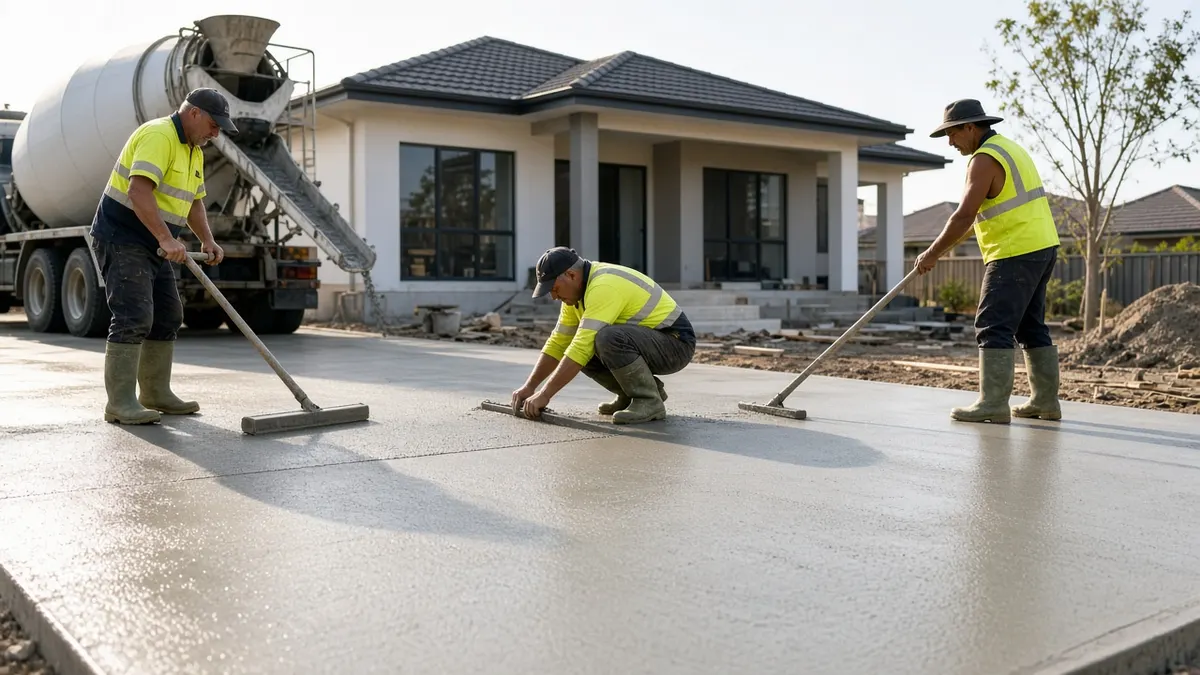
The concreter hourly rate in Australia in 2026 is typically $40–52/hr for a concrete labourer, $48–68/hr for an experienced finisher and $50–72/hr for a formworker, while concreting businesses charge homeowners about $70–110/hr per person or quote by the square metre, roughly $75–150/m² for driveways. These are indicative market observations; check award minimums on Fair Work.
Below are rates by role, per-m² prices for common jobs, what drives the cost on pour day and a worked crew costing. Yakka Labour is the hiring marketplace, not the workwear brand with a similar name.
How much do concreters charge per hour?
| Role | Typical work | Indicative casual hourly (AUD) | Indicative day, 8 hours (AUD) |
|---|---|---|---|
| Concrete labourer | Barrowing, spreading, raking, set-up and clean-up | $40–52 | $320–416 |
| Concrete finisher | Screeding, floating, trowelling, edging, finishes | $48–68 | $384–544 |
| Formworker | Setting forms, levels, set-downs and edge boards | $50–72 | $400–576 |
| Pump line hand | Running the pump line and hose on pour day | $45–58 | $360–464 |
| Concreting business, charge-out | Per person on residential jobs | $70–110 | $560–880 |
All figures are indicative 2026 market observations. Early starts, weekend pours and commercial or CBD sites sit at the top of each band.
What is the difference between a concrete labourer, a finisher and a formworker?
A concrete labourer moves and spreads concrete, sets up barrows and boards, and cleans tools and the site. It is heavy, fast work but needs little formal skill beyond a white card. A finisher controls the surface: screeding to level, floating, trowelling and applying broom, exposed aggregate or stamped finishes. Timing matters, which is why good finishers command higher rates. A formworker sets up the forms that hold the concrete, gets levels and falls right and installs set-downs and edge rebates. Mistakes here cost the most, so experienced formworkers are often the best paid on a residential crew.
Two other roles often appear on bigger pours. Steel fixers place and tie the reinforcement before the pour, and concrete pump operators run the boom or line pump. Licensed boom pump operators are usually supplied with the pump hire and charged as part of it, rather than hired separately by the hour.
What are concrete rates per m²?
Homeowners are usually quoted per square metre, including labour, concrete, reinforcement and a standard finish. Indicative 2026 ranges:
- Plain or broom-finish driveway: $75–110 per m²
- Exposed aggregate driveway: $95–150 per m²
- Coloured or stamped concrete: $110–170 per m²
- Paths and small pads: $65–110 per m², with minimum job charges common
- Removal and disposal of old concrete: often an extra $30–60 per m²
Access for the truck or pump, excavation, slope, thickness, reinforcement, cutting joints and sealing all change the price. Ask what thickness and steel the quote assumes.
Before accepting a per-m² quote, ask these questions so you can compare like with like:
- What thickness, concrete strength and reinforcement are included?
- Is excavation, base preparation and removal of spoil included?
- Are control joints cut, and is the surface sealed?
- Who books the concrete, the pump and any council crossover inspection?
- What happens to the price if rain delays the pour?
- What warranty applies to cracking and finish?
What does a pour-day crew cost? A worked example
A homeowner in Werribee is replacing a 60 m² exposed aggregate driveway. The concreting contractor has done the excavation and formwork and needs extra hands for pour day.
- 2 finishers × 8 hours × $60/hr = $960
- 2 concrete labourers × 8 hours × $45/hr = $720
- Pour-day labour: $1,680, before super and workers comp
- Concrete: priced per cubic metre and varies by supplier, strength, aggregate and short-load fees; a 100 mm slab of 60 m² needs about 6 m³ plus a margin
- Pump hire if the truck cannot reach the forms: charged separately
At $95–150 per m², the whole job from a concreting business would come to about $5,700–9,000 including materials, formwork and finish. Pour day is the one day you cannot be short-staffed, so book extra labour early. The labour-only route suits a contractor who already has the forms, tools and concrete order sorted; a homeowner without that experience is usually better off with a full per-m² quote. For labour-only budgeting, see the labourer day rate guide, and for project allowances on bigger sites see site allowance explained.
What is the award rate for concreters?
Concrete workers on construction sites are covered by the Building and Construction General On-site Award (MA000020). The award places concrete gang workers and concrete floaters at CW/ECW 1 and concrete finishers at CW/ECW 2. From 1 July 2026, base minimum hourly rates are $26.67 for a new-entrant CW/ECW 1 and $28.62 for CW/ECW 2 (clause 19.1 of the award text), before allowances and the 25% casual loading. The industry allowance differs between general building ($67.15 a week) and residential work ($53.72 a week). Check the Fair Work pay guide for your classification.
Does a concreter need a licence?
For residential work over set values, yes in several states. In NSW, a licence or certificate is needed for residential general concreting worth more than $5,000 in labour and materials including GST (NSW general concreting rules). In Queensland, QBCC says a licence is needed for building work valued over $3,300, and concreting is one of its licence classes. Other states have their own rules. Labourers and finishers working for a licensed contractor do not need their own contractor licence.
For homeowners, the licence check is worth the two minutes it takes. Search the contractor's name or licence number on the state register before paying a deposit, and make sure the name on the licence matches the name on the quote and invoice. Unlicensed work over the threshold can also leave you without the home warranty protections that apply to licensed residential building work in some states.
Why do concreting rates vary so much?
- Weather: rain and heat cancel or rush pours, and crews price that risk in.
- Early starts: many pours start at first light to beat the heat, and overtime applies under the award outside ordinary hours.
- Access: tight side access means pumping or barrowing, which adds labour.
- Finish: exposed aggregate and stamped finishes need more skill and time than a broom finish.
- Job size: small pads and paths carry the same set-up, travel and minimum truck costs as bigger jobs, so the per-m² price climbs.
- Demand: in busy building periods good finishers are booked out, and short-notice pours pay a premium.
- Location: CBD sites with traffic control, parking limits and pump-only access cost more than an open suburban block.
For builders, the cheapest pour is usually the one that goes right the first time. A slab that needs grinding, patching or replacing because the crew was short-handed costs far more than an extra labourer on the day. Book the full crew, confirm start times the afternoon before and have a plan for rain.
How do you hire concreters on Yakka?
- Post the job with the suburb, pour date and start time, crew roles needed (labourers, finishers, formworkers) and your rate.
- Browse concreter profiles near the site and check experience and tickets.
- Agree the rate, start time and what happens if weather delays the pour, in writing.
- Pay through the platform when the work is done.
Sydney builders can compare concreting labour hire Sydney or browse concretors by area.
Frequently asked questions
Why do concreters start so early?
Concrete starts to set as soon as it is mixed, and heat speeds that up. Starting at first light gives the crew cooler conditions and more time to place and finish the slab properly, especially in summer. Early pours also avoid afternoon storms in places such as Brisbane. Expect pour-day crews to arrive before 6am in hot weather.
How many people do I need for a concrete pour?
A small residential driveway or slab of 40–80 m² is usually handled by a crew of three to five: one or two finishers, two labourers and someone on the pump line if a pump is used. Larger pours or decorative finishes need more finishers. Being short-handed on pour day risks a poor finish that cannot be fixed later.
Do concreters supply the concrete?
When you hire a concreting business on a per-m² price, the quote usually includes ordering and paying for the concrete, reinforcement and standard materials. When you hire labour-only concreters, you or your builder order the concrete. Confirm who books the truck and pump, because getting delivery timing wrong is one of the most expensive mistakes on pour day.
Is it cheaper to pay concreters by the hour or per m²?
Per m² is simpler for homeowners because it bundles labour, materials and finish into one price and shifts the risk of slow work to the contractor. Hourly or day rates suit builders who manage their own pours and only need extra hands. For a one-off driveway, compare at least two per-m² quotes with the same thickness and finish.
Can concrete be poured in the rain?
Light drizzle may be manageable if the crew can protect the surface, but heavy rain damages the finish and can weaken the surface layer. Most concreters postpone pours when significant rain is forecast. Agree in advance how a weather cancellation is handled, including any charges for a booked truck or pump, and whether labour is paid for the lost day.
Official sources
Award rates, licences and safety rules change. Check the official source before you hire or take on a shift.
- Fair Work Ombudsman — pay guidesMinimum award rates, casual loading and penalty rates
- Fair Work Pay CalculatorWork out the minimum pay for a specific award and shift
- Safe Work AustraliaNational work health and safety framework, including high-risk work licences
- Queensland Building and Construction Commission (QBCC)Contractor, plumbing and drainage licence search in Queensland