Exterior cost guide
Colorbond Roof Cost in Australia: 2026 Prices per m²
Typical cost in Australia (2026, inc. GST)
$65 to $170 per m²
installed, from new build to tile-to-Colorbond re-roof
A Colorbond roof costs about $65 to $110 per m² installed on a new home, $85 to $140 per m² to replace an old metal roof, and $100 to $170 per m² to swap tiles for steel. For a 200 m² roof that is roughly $13,000 to $34,000. Profile, coastal grade, roof shape, storeys and what has to come off first set the final price.
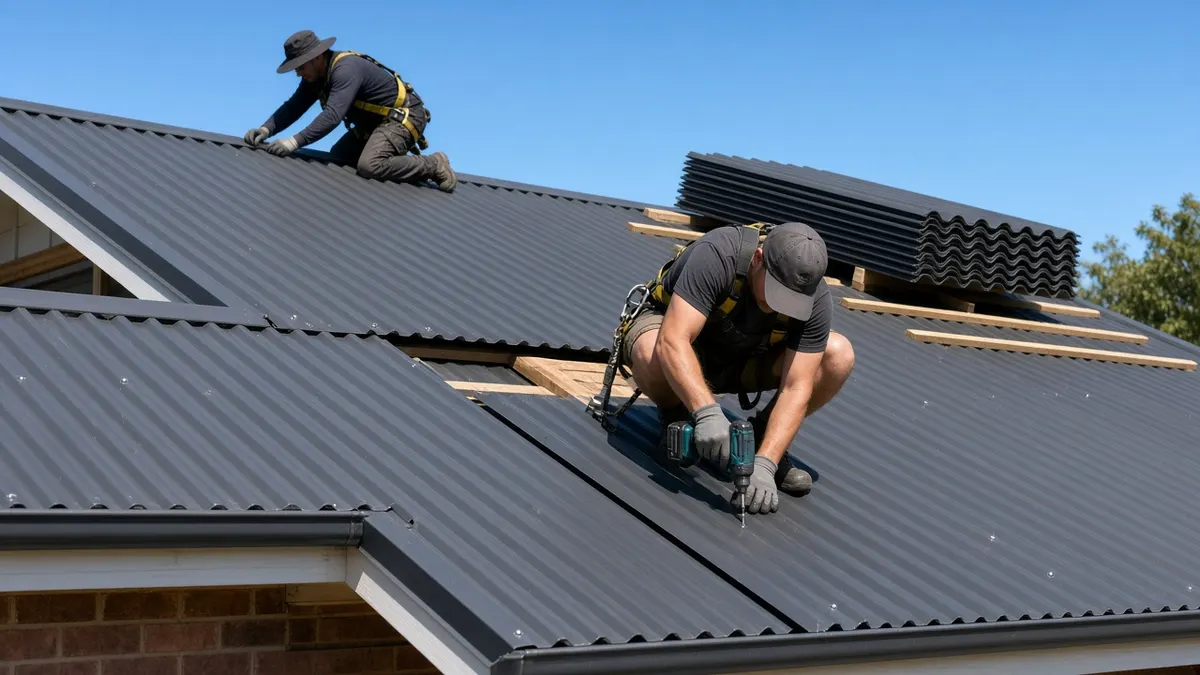
Colorbond roofing costs $65 to $110 per square metre installed on a new home in 2026, and $100 to $170 per m² if your existing tiles have to be stripped first. On a typical 200 m² house roof that means about $13,000 to $22,000 for a new build and $20,000 to $34,000 for a tile-to-steel conversion.
Colorbond is BlueScope's pre-painted steel, and it is on more new Australian roofs than any other product. This guide is only about Colorbond and other pre-painted steel: profiles, steel grades, colours, and the real costs of converting a tiled house. For roofer rates and a comparison with tiles and slate, see the general roofing cost guide. If you want the step-by-step costs of a full tear-off regardless of material, the roof replacement guide covers it.
Every figure below is indicative and includes GST. Steel prices move with the market, and labour varies a lot between crews, so get at least three written quotes from licensed roof plumbers or roofers.
Colorbond prices by type of job
| Job | Installed price per m² | 200 m² roof |
|---|---|---|
| New build, onto new trusses | $65 to $110 | $13,000 to $22,000 |
| Re-roof, old metal to new Colorbond | $85 to $140 | $17,000 to $28,000 |
| Re-roof, tiles to Colorbond | $100 to $170 | $20,000 to $34,000 |
| Re-roof, asbestos cement to Colorbond | $140 to $250 | $28,000 to $50,000 |
| Extension tie-in (small area) | $120 to $200 | Usually a fixed price of $3,000 to $10,000 |
The jump from new build to re-roof is mostly labour and disposal. The crew has to strip the old covering, check and fix the frame, swap tile battens for battens suited to steel, and haul the waste away before a single new sheet goes on.
Profiles and how they affect the price
"Colorbond" is the steel and its paint finish. The shape it is rolled into is called the profile, and that changes both the look and the price.
| Profile | Look | Price compared with corrugated | Best for |
|---|---|---|---|
| Corrugated (such as Custom Orb) | Classic rounded waves | Baseline | Most homes, heritage-style houses |
| Trapezoidal (such as Trimdek) | Square ribs, flat pans | About the same to 5% more | Modern homes, longer spans |
| Low rib (such as Spandek) | Low trapezoidal ribs | About 5% more | A cleaner look on modern homes |
| Concealed fix (such as Klip-Lok) | Wide pans, no visible screws | 20% to 40% more | Low pitches, skillions, fewer leak points |
| Standing seam (seamed on site) | Narrow raised seams | 40% to 80% more | Architectural and high-end homes |
Pitch decides what you can use. Corrugated sheet generally needs a steeper fall than wide-ribbed or concealed-fix profiles, which can go down to very low pitches. The manufacturer's minimum pitch for each profile is published, and your roof plumber should follow it. On a skillion roof with a 2 to 3 degree fall, corrugated is usually off the table.
Steel thickness and coastal grades
Standard roofing sheet is usually 0.42 mm base metal thickness. A heavier 0.48 mm sheet is stiffer, dents less in hail and spans further, and costs roughly 10% to 15% more for the material. On most suburban homes 0.42 mm is fine.
Location matters more than thickness. Standard Colorbond is designed for most suburban and rural sites. Homes close to breaking surf, or near heavy industry, need a more corrosion-resistant product such as Colorbond Ultra, and the most severe sites may need stainless steel or aluminium instead. BlueScope publishes distance guidance and warranty conditions for each product, and a good roof plumber will check your address against it. Expect the coastal-grade steel to add 10% to 20% to the material cost, or roughly $1,000 to $2,500 on a typical roof. Skipping it to save money on a beachside house is a false economy, because the warranty will not cover corrosion if the wrong grade was used.
Fixings need to match the grade too. Coastal jobs often call for higher-class screws, and you must never mix copper, lead or stainless flashings with Colorbond in a way that lets water run from one metal onto the other.
Does the colour change the cost?
Within the standard Colorbond range, colour does not usually change the price. Surfmist, Shale Grey, Dune, Basalt, Monument and Woodland Grey all cost the same per sheet. Matt and metallic finishes sit in a separate range and cost more, and not every profile is available in every colour.
Colour does affect running costs. A light roof such as Surfmist or Shale Grey reflects far more summer sun than Monument or Night Sky, which can make the roof space noticeably cooler in Brisbane, Perth or western Sydney. In NSW, the BASIX certificate for new homes and some renovations takes roof colour into account, so the colour on your approved plans may already be set. Some estates and heritage areas also restrict roof colours, so check your covenant or council conditions before you order.
Colorbond or Zincalume?
Zincalume is the same steel base without the paint layer. It has a bright metallic finish that dulls to a soft grey over a few years, and it is usually 10% to 20% cheaper on materials. On a 200 m² roof the installed saving is often $1,000 to $2,500, because labour is identical.
The trade-offs are real. Zincalume reflects a lot of heat when new but glare can bother neighbours, and some councils and estates do not allow it on houses for that reason. It also cannot sit next to some other materials: water running off a Zincalume roof onto copper, or off a lead flashing onto Zincalume, causes corrosion. Most homeowners pay the extra for Colorbond for the colour choice, the matching gutters and the resale appeal. Zincalume still makes sense on sheds, rural homes, and roofs nobody can see.
Extensions, alterations and partial roofs
Not every Colorbond job is a whole house. Common smaller jobs include a new roof over a rear extension, a skillion over a converted carport, or replacing one damaged section after a storm. These cost more per m² because the setup, edge protection and flashing work are about the same as on a bigger roof while the area is small.
| Partial job | Typical size | Typical installed price |
|---|---|---|
| Skillion roof over a rear extension | 25 to 40 m² | $4,000 to $8,500 |
| Tie-in of new roof to existing tiled roof | 30 to 50 m² plus junction | $6,000 to $11,000 |
| Replace storm-damaged sheets on one plane | 10 to 30 m² | $1,500 to $4,500 |
| Re-sheet a verandah roof | 15 to 30 m² | $2,500 to $5,500 |
Matching an old roof is the usual headache on partial jobs. Colorbond colours fade slightly over 15 or 20 years, so a new sheet in the same named colour can look a shade different next to old ones. Plan joins at a natural break, such as a change in roof plane or a ridge, where the difference is hard to see.
Can you install Colorbond yourself?
Owner-builders and handy homeowners do put steel roofs on sheds and small outbuildings, and the material is easy to buy cut to length. A house roof is a different story. In Victoria the work is licensed roof plumbing at any value. In other states, once the job is over the licensing threshold you need a licensed contractor or an owner-builder permit, and your home insurer may ask who did the work after a claim. Working on a roof also brings a real fall risk, which is why professional crews use edge protection and harnesses.
What you can sensibly do yourself is the prep and the clean-up: clear the yard, move cars and outdoor furniture, protect garden beds, and book the skip. That saves a little labour without touching the licensed part of the job.
Colorbond costs around Australia
| City | New build per m² | Tiles to Colorbond per m² | Local factors |
|---|---|---|---|
| Sydney | $75 to $115 | $115 to $175 | High labour rates, tight access in older suburbs |
| Melbourne | $70 to $110 | $105 to $165 | Licensed roof plumber required for steel roofing |
| Brisbane | $65 to $105 | $100 to $160 | Busy storm season, many lightweight Queenslanders |
| Perth | $65 to $105 | $100 to $160 | Big single-storey roofs bring the rate down |
| Adelaide | $60 to $95 | $95 to $150 | Lower labour costs |
| Hobart | $65 to $105 | $100 to $160 | Fewer crews, freight |
| Canberra | $70 to $110 | $110 to $170 | High wages, frost and wind exposure |
| Darwin | $85 to $130 | $130 to $200 | Cyclone-rated fixings and freight |
Regional towns are often 5% to 15% cheaper on labour, but a crew travelling from the nearest city will charge for travel time and accommodation on a multi-day job.
Swapping tiles for Colorbond: what is involved
Converting a tiled roof is the most common Colorbond job on an existing home. Concrete tiles weigh several times as much as steel sheeting, so taking them off reduces the load on an older frame. It also ends the cycle of repointing ridge caps and recoating tiles every 15 to 25 years.
The job usually runs like this:
- The crew sets up edge protection or scaffold and protects gardens and paths.
- Tiles and old battens come off one section at a time so the house is never left fully open. Tiles go into a skip or truck.
- The roofer checks rafters and fixes any sagging or rot. Battens suited to steel are fixed at the spacing the profile needs.
- A blanket or sarking goes down, then the sheets are fixed, with flashings at walls, chimneys and penetrations.
- Ridge and hip capping goes on, gutters are fitted or reconnected, and swarf (steel filings from cutting and drilling) is swept off so it cannot rust on the new paint.
Two-storey jobs and terraces with no rear access take longer. If you have solar panels, they must be removed and refitted by a licensed electrician, and the old roof penetrations for flues, vents and aerials all need new flashings.
Weather is the other variable. A good crew only strips what it can cover the same day, and keeps tarps on hand in case a storm rolls in. If your quote is far cheaper than the others, ask how they stage the strip-out. A roofer who pulls every tile off on day one and hopes for dry weather is gambling with your ceilings, and water damage to plasterboard, insulation and downlights can add thousands to the job. Expect a few lost days in a wet month, and do not push the crew to work on wet steel, which is slippery and dangerous.
Three Colorbond roofs, costed
Tiles to Colorbond, single-storey in Blacktown, NSW
A three-bedroom 1980s brick veneer, 190 m² of concrete tile roof, simple hip shape, corrugated Colorbond in Shale Grey, existing gutters kept.
| Item | Cost |
|---|---|
| Strip tiles and old battens | $2,600 |
| Tile disposal (two truck loads) | $1,400 |
| New battens for steel | $2,300 |
| Colorbond sheets and fixings | $6,900 |
| Roof blanket | $2,000 |
| Ridge, hip capping and flashings | $1,900 |
| Installation labour | $7,200 |
| Edge protection | $1,700 |
| Total including GST | $26,000 |
That is about $137 per m². New gutters and downpipes would add $3,000 to $5,000.
Old metal to coastal-grade steel, Gold Coast, Queensland
A low-set beachside home with 170 m² of rusting 1990s steel roof, a few hundred metres from the surf.
| Item | Cost |
|---|---|
| Remove old sheets | $1,800 |
| Scrap steel removal | $300 |
| Coastal-grade sheets and matching fixings | $7,800 |
| Roof blanket | $1,800 |
| Capping and flashings | $1,600 |
| Installation labour | $5,900 |
| Edge protection | $1,500 |
| Total including GST | $20,700 |
About $122 per m². In Queensland, work at this value needs a QBCC-licensed contractor, and you can look up any licence on the QBCC website.
Asbestos sheeting to Colorbond, Geelong, Victoria
A 1960s weatherboard home with 150 m² of corrugated asbestos cement roofing.
| Item | Cost |
|---|---|
| Licensed asbestos removal, disposal and clearance | $8,200 |
| Purlin and batten repairs | $1,200 |
| Colorbond sheets and fixings | $5,400 |
| Roof blanket | $1,600 |
| Capping and flashings | $1,500 |
| Roof plumber labour | $5,600 |
| Scaffold and edge protection | $1,800 |
| Total including GST | $25,300 |
About $169 per m². The removal line alone can swing by thousands depending on access and the state of the sheets. The asbestos removal cost guide explains how removalists price that work, and the national Asbestos Safety and Eradication Agency has plain guidance for homeowners.
Licences and compliance for steel roofing
The rules depend on your state:
- Victoria: laying metal roof sheeting, flashings and gutters is roof plumbing, which must be done by a licensed or registered plumber in the roofing (stormwater) class. For plumbing work over $750 the plumber must issue a compliance certificate. Ask for it at handover.
- NSW: residential building work over the current licensing threshold needs a contractor licence from NSW Fair Trading, and bigger jobs need home building compensation cover before work starts.
- Queensland: work over $3,300 needs a QBCC licence, typically roof and wall cladding for steel roofing.
- Other states and territories: check the current threshold with Building and Energy (WA), Consumer and Business Services (SA), CBOS (Tasmania), Access Canberra or the NT Building Practitioners Board.
A like-for-like re-roof generally does not need council approval, but changes to the roof shape, height or structure might, and heritage areas have extra rules. Bushfire-prone sites need roofing details that meet the property's bushfire attack level under AS 3959.
Heat, rain noise and condensation
A bare steel roof is loud in heavy rain and hot in summer. The fix is what goes underneath. A foil-faced roof blanket under the sheets reduces rain noise, adds insulation and controls condensation, and it is the standard choice on most re-roofs. It typically adds $8 to $15 per m² compared with plain sarking, and in most climates it is money well spent.
Condensation is the hidden problem with steel. Warm moist air from the house meets the cold underside of the sheet on winter nights and drips back onto the ceiling. A blanket or vapour-permeable membrane stops most of it. Bathrooms and laundries should be ducted outside, not into the roof space.
Looking after Colorbond and how long it lasts
Colorbond typically lasts 30 to 50 years in suburban conditions, less on harsh coastal sites if the wrong grade is used. Maintenance is light:
- Keep gutters clear so water cannot pond against the sheet ends.
- Hose down areas that rain does not reach, such as under eaves overhangs and wall junctions, a couple of times a year near the coast. BlueScope's warranty conditions refer to washing unwashed areas.
- Do not let anyone leave swarf, screws or off-cuts on the roof. They rust within days and stain the paint.
- Keep copper pipes, lead flashings and air-conditioner condensate from dripping onto the steel.
Faded Colorbond can be repainted, but most owners leave it alone until the end of its life. Rust-through at gutters is often the first sign of trouble, which is a separate job covered in the gutter replacement guide.
What to ask before you sign
- What profile, steel grade, thickness and colour are you quoting, and does that grade suit my distance from the coast?
- What goes under the sheets: sarking or blanket, and what R-value?
- Are new battens included, and what is your rate if rafters need repair?
- Are gutters, downpipes, fascia covers and solar removal included or extra?
- Who handles waste, and is it in the price?
- What is your licence number, and will I get a compliance certificate where my state requires one?
- How long is your workmanship warranty, and will you register the material warranty in my name?
Red flags are the same as for any roofer: cash-only pricing, no licence number on the quote, a deposit above your state's limit, or pressure to sign the same day.
Keeping the price sensible
- Choose the profile for the roof you have. Concealed fix and standing seam look great, but corrugated is the cheapest and suits most pitched roofs.
- Keep gutters that are still sound, and replace the rusted ones only.
- Do the job once. If you plan a skylight, solar or a new whirlybird, have the roofer flash it in during the re-roof.
- Ask about lead times. Some colours and profiles are rolled to order, and a flexible start date can get you a better price from a crew filling a gap.
- Leave the coastal grade in if your address needs it. It is the one upgrade you should never cut.
How Yakka fits into a Colorbond job
Yakka lets you book workers by the shift or job, and roofers and roof plumbers are listed on the platform alongside general labourers. On a re-roof, a couple of labourers can save the roofing crew time by clearing the yard, carrying tiles to the skip, cleaning up swarf and debris, and tidying gardens once the scaffold comes down. You can find a roofer near you or browse guttering trades if your gutters need doing at the same time.
The steel roofing itself, and in Victoria any roof plumbing, must be done by a licensed trade. Yakka is a way to find workers, not a substitute for checking a licence.
Frequently asked questions
How much does a Colorbond roof cost per m2?
A Colorbond roof costs about $65 to $110 per m² installed on a new home in 2026. Replacing an old metal roof costs $85 to $140 per m², and replacing tiles with Colorbond costs $100 to $170 per m² because the tiles must be stripped and disposed of and new battens fitted. Asbestos roofs cost more again because removal needs a licensed removalist.
Is it worth replacing a tile roof with Colorbond?
It is often worth it on an older home where the tiles, ridge pointing and battens are all worn. Steel is much lighter, needs less maintenance and suits rainwater tanks. If the tiles themselves are sound and only the ridge capping and coating are tired, a restoration costs far less and can add 15 years or more. Get a roofer to inspect before deciding.
Is Colorbond cheaper than tiles?
On a new build the installed price is similar, with corrugated Colorbond and concrete tiles both landing around $60 to $110 per m². Over the life of the roof, Colorbond usually works out cheaper because there is no ridge capping to repoint and no coating to renew. Terracotta tiles cost more than either upfront but last longer.
How long does a Colorbond roof last?
Most Colorbond roofs last 30 to 50 years in suburban and rural areas. Near the coast or heavy industry, life depends on using the right grade, such as a coastal product, and on washing areas that rain does not reach. Gutters and flashings often rust first, so keeping them clear of leaves and debris extends the life of the whole roof.
Do I need a licensed plumber to install a Colorbond roof in Victoria?
Yes. In Victoria, installing metal roof sheeting, flashings and gutters is roof plumbing work, so it must be done by a licensed or registered plumber in the roofing class. For plumbing work over $750 they must give you a compliance certificate. Ask to see the licence before work starts and keep the certificate with your house records.
Does the colour of Colorbond affect the price?
Standard Colorbond colours such as Surfmist, Monument, Basalt and Woodland Grey generally cost the same. Matt and metallic ranges cost more. Colour matters for heat, because light colours reflect much more sun, and in NSW the BASIX certificate for new homes and some renovations may specify a light, medium or dark roof, so check your approved plans first.
How long does it take to install a Colorbond roof?
A new Colorbond roof on a new single-storey home takes a two-person crew about three to five days. Replacing tiles with Colorbond on an existing house usually takes four to seven working days, depending on size, access, storeys and weather. Asbestos removal adds a day or two at the start, and rotten battens or rafters can add more.
Official sources
Award rates, licences and safety rules change. Check the official source before you hire or take on a shift.
- Queensland Building and Construction Commission (QBCC)Contractor, plumbing and drainage licence search in Queensland
- Consumer and Business Services SALabour hire licensing in South Australia
- NSW Fair TradingTrade licence checks for electricians, plumbers and builders in New South Wales
- Asbestos Safety and Eradication AgencyWhere asbestos is found in homes and how to deal with it safely
- Consumer, Building and Occupational Services (Tasmania)Building, plumbing and electrical licensing in Tasmania
- Access CanberraConstruction occupation licences and building approvals in the ACT