Interior cost guide
Downlight Installation Cost (2026): LED Prices per Light in Australia
Typical cost in Australia (2026, inc. GST)
$50 to $180 per downlight
installed by a licensed electrician; low end is a like-for-like LED swap, high end a new position with a quality dimmable fitting
Installing LED downlights in Australia costs about $50 to $100 per light to replace an existing fitting and $90 to $180 per light for a new position in 2026, installed by a licensed electrician. A typical living room with eight new downlights lands around $800 to $1,400. Roof access, ceiling type, insulation, dimmers and the quality of the fitting drive the price.
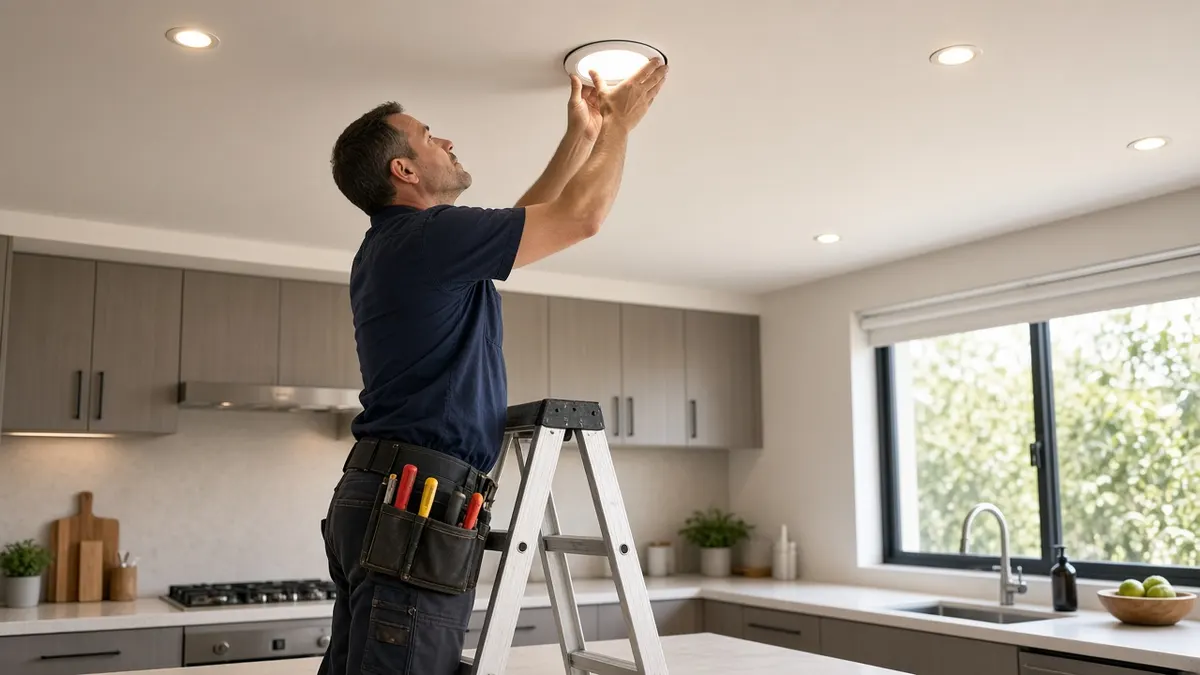
Expect to pay $50 to $100 per downlight to swap an old fitting for an LED, and $90 to $180 per downlight to install one in a new position, in 2026. That includes a mid-range LED fitting and a licensed electrician's labour, but most jobs also carry a call-out fee of $80 to $150, so a single light is never as cheap as the per-unit price suggests.
The good news is that downlights get cheaper per light as the number goes up. Once the electrician is in the roof with a ladder set up, each extra light takes 15 to 30 minutes. Below are realistic price ranges, totals for typical rooms and whole houses, the fitting choices that change the bill, and the insulation rules many homeowners have never heard of. All figures include GST and are indicative. Get at least three written quotes.
Downlight prices at a glance
| Type of job | Typical price per light (inc GST) | What is usually included |
|---|---|---|
| Swap halogen for LED, same hole size | $50 to $90 | Remove old fitting and transformer, fit LED, test |
| Swap halogen for LED, hole needs enlarging | $70 to $110 | As above plus cutting the ceiling to the new size |
| New downlight, new position, existing lighting circuit | $90 to $150 | Cut hole, run cable, fit LED, wire to switch |
| New downlight with premium dimmable fitting | $130 to $180 | Higher-grade fitting plus compatible dimmer setup |
| New lighting circuit from the switchboard | $300 to $700 extra | Needed if the existing circuit is overloaded or absent |
| Dimmer switch, LED-compatible | $90 to $200 each | Supply and fit one dimmer mechanism |
Some electricians quote a flat package price, such as ten LED downlights installed for a set figure. These deals can be good value in a single-storey home with a roomy roof space. Read the fine print: packages often assume a basic non-dimmable fitting and plasterboard ceilings, with extra charges for anything else.
Room and whole-house totals
Lighting designers often start from a rough guide of one downlight per 1.5 to 2.5 m² of floor area for general lighting, depending on ceiling height, beam angle and the brightness of the fitting. Kitchens need more light over benches. Bedrooms often need less than people think. Here is what common layouts cost with new positions and mid-range dimmable LEDs.
| Area | Typical number of lights | Approximate total (inc GST) |
|---|---|---|
| Hallway, 6 to 8 m long | 3 to 4 | $400 to $700 |
| Bedroom, 12 m² | 4 to 6 | $500 to $950 |
| Kitchen, 15 m² | 6 to 8 | $700 to $1,350 |
| Living room, 20 m² | 8 to 10 | $800 to $1,650 |
| Open-plan living and kitchen, 45 m² | 16 to 20 | $1,700 to $3,200 |
| Whole three-bedroom house, new positions | 30 to 40 | $3,000 to $6,000 |
| Whole house halogen to LED swap only | 30 to 40 | $1,700 to $3,400 |
The whole-house rows assume a single-storey home with a reasonable roof space. A two-storey house can add 20 to 40 percent, because the upstairs ceilings are easy but the downstairs ceilings have a floor on top of them and often need cutting and patching from below.
What you are paying for in the fitting
A downlight is a simple product, but the price spread is wide. A builder-grade fitting costs $15 to $30, a good mid-range fitting $30 to $60, and premium architectural downlights $70 to $150 or more. The differences are real.
Colour temperature
Warm white (around 3000K) suits living areas and bedrooms. Cool white (around 4000K) is popular in kitchens, laundries and garages. Daylight (5000K and above) looks harsh in most homes. Many fittings now have a switch on the driver that lets the electrician set warm, neutral or cool on site, which saves you guessing from a picture on a website.
Dimming
Not every LED dims smoothly, and not every dimmer suits every LED. A mismatch causes flicker, buzzing or lights that never quite turn off. Ask the electrician to supply the fittings and dimmers as a matched pair. It costs a little more but saves a callback.
Insulation contact rating
Fittings rated IC-4 can be covered by and abutted with ceiling insulation. Older and cheaper designs need a clearance around them, which leaves gaps in the insulation and lets heat escape. If you live in a cold climate or have just paid for new insulation, IC-4 fittings are worth the extra few dollars each.
Beam angle, trim and size
Wider beams spread light across a room, narrow beams highlight a bench or artwork. Trim colour (white, black, brushed) and cut-out size matter when you are replacing old fittings, because a smaller fitting leaves a gap in the ceiling and a larger one means cutting. The most common cut-out sizes are around 70 mm and 90 mm, so measure an existing hole before you buy.
| Fitting grade | Fitting price | Typical warranty | Best for |
|---|---|---|---|
| Builder grade, fixed colour, basic dimming or none | $15 to $30 | 1 to 3 years | Rentals, garages, budget swaps |
| Mid-range, switchable colour, dimmable | $30 to $60 | 3 to 5 years | Most homes |
| Premium, deep recessed, high colour rendering | $70 to $150 | 5 years or more | Kitchens, feature areas, architect-designed homes |
| Smart downlights with app control | $50 to $120 | 2 to 5 years | Homes already set up for smart lighting |
Halogen to LED: the swap that pays for itself
Plenty of homes built from the 1990s to the 2010s still have 50 W halogen downlights with a transformer sitting in the roof above each one. An equivalent LED draws around 8 to 10 W. On a house with 20 halogens running four hours a night, the difference is roughly 3.2 kWh a day, or close to 1,200 kWh a year. At a rough electricity price of 33 cents per kWh, that is about $390 a year. A swap costing $1,000 to $1,800 pays for itself in a few years and then keeps saving.
There is also a safety angle. Halogen downlights run hot, and old transformers fail. Fires caused by halogens in contact with insulation or roof timbers are a known risk, which is one reason electricians recommend replacing them rather than just changing globes. The Energy Rating website has background on lighting efficiency and running costs if you want to compare products.
What makes one ceiling cheaper than another
Roof space access
A single-storey home with a high-pitched tiled roof is the easiest job: the electrician can move around above the ceiling and drop cable where it is needed. A low-pitched metal roof, a cathedral ceiling or a flat roof with no cavity means fishing cable through tight spaces or cutting extra access holes, which adds labour and patching.
Ceiling material
Plasterboard cuts cleanly with a hole saw. Old fibrous plaster is brittle and cracks. VJ timber boards and pressed metal ceilings need more care and different tools. Concrete ceilings in apartments may need surface-mounted fittings or a dropped bulkhead. Some older ceilings and eaves linings contain asbestos and must not be cut until tested.
Insulation and heat
Moving insulation batts aside, fitting the light and putting them back properly takes time. In summer, roof spaces in Brisbane, Perth or Darwin can be dangerously hot by mid-morning, so electricians prefer early starts and may charge more for afternoon roof work in a heatwave.
Layout and switching
Downlights on one switch are simple. Splitting a room into zones, adding two-way switching at both ends of a hallway or putting each group on its own dimmer adds cable runs and switch mechanisms. Plan the switching before the electrician arrives.
The state of the existing wiring
If the electrician finds old rubber-insulated cable or a lighting circuit with no earth, they may need to replace part of the circuit before connecting new lights. If the switchboard has no safety switch on the lighting circuit, current wiring rules generally require one for new work, which our switchboard upgrade guide covers.
Insulation, fire risk and clearance rules
This is the part of downlight installation most homeowners never think about. The wiring rules set out clearance requirements around recessed light fittings that are not rated for insulation contact, and installers must follow the fitting manufacturer's instructions. In practice:
- Never push insulation back over an old halogen or a fitting without an IC rating. Leave the clearance the label specifies, or replace the fitting with an IC-4 rated one.
- If you are getting insulation installed after the downlights, tell the insulation installer what kind of fittings you have so they leave the right gaps or use approved covers.
- Keep fittings away from roof timbers, sarking and stored boxes in the roof space.
- Old transformers should be removed, not just disconnected and left lying in the insulation.
If you are doing both jobs, it is usually cheaper to get the downlights installed first and the insulation installer in afterwards, so batts only get moved once.
Downlights compared with other lighting
Downlights are not always the best answer, and a good electrician will tell you so. In a room with a 2.4 m ceiling and one central light point, two or three wide-beam oyster or surface-mounted LED fittings can light the space evenly for $250 to $500 installed, with no holes cut in the ceiling. Pendants over a kitchen island cost $150 to $300 per point to install plus the fitting, and they put light where you actually work. LED strip lighting under overhead cupboards costs $300 to $700 per kitchen run including the driver, and it removes the shadow that ceiling downlights cast on the bench when you lean over it.
In practice, the best result in a kitchen or living room is usually a mix: a modest number of downlights for general light, plus task lighting where you prepare food or read. That often costs less than filling the ceiling with 20 downlights and looks better at night. In apartments with concrete ceilings, recessed downlights may be impossible without a dropped bulkhead, and strata approval may be needed for work to common property, so check your by-laws first.
Sensors, smart fittings and outdoor downlights
Smart downlights that change colour and brightness from an app cost $50 to $120 each before installation. They suit people who already run a smart home system, but they depend on the manufacturer's app staying supported, so a standard fitting on a smart dimmer or smart switch is often the safer long-term choice. A smart switch or dimmer mechanism adds roughly $100 to $250 per switch location installed.
Downlights in eaves and under a patio roof need fittings rated for outdoor or damp locations. Expect $110 to $200 per light installed, a bit more than an indoor fitting, because outdoor wiring often runs through tighter spaces and must be protected from weather. A movement sensor for a porch or driveway adds $150 to $300 installed. Bathrooms also need suitable fittings depending on how close they sit to the shower or bath, and the electrician will choose a rating that matches the zone.
Prices by city
| City | New position, per light | LED swap, per light | Notes |
|---|---|---|---|
| Sydney | $100 to $180 | $60 to $100 | Higher labour and travel costs |
| Melbourne | $95 to $170 | $55 to $95 | Many older homes with fibrous plaster ceilings |
| Brisbane | $90 to $160 | $50 to $90 | Hot roof spaces push work to early mornings |
| Perth | $95 to $170 | $55 to $95 | Busy trade market |
| Adelaide | $85 to $150 | $50 to $85 | Generally lower labour rates |
| Hobart | $90 to $160 | $55 to $90 | Smaller pool of electricians |
| Canberra | $100 to $175 | $60 to $100 | IC-4 fittings popular for cold winters |
| Darwin | $105 to $185 | $65 to $105 | Freight on fittings and a small trade pool |
Two costed jobs
Open-plan living in a Kellyville project home, NSW
A single-storey four-bedroom home with a tiled roof and good roof space. The owners want 16 new dimmable LED downlights in a 40 m² open-plan kitchen and living area, split into two zones with two dimmers.
| Item | Cost (inc GST) |
|---|---|
| Call-out fee | $100 |
| Labour, 7 hours at $110 | $770 |
| 16 mid-range dimmable IC-4 LED downlights at $45 | $720 |
| 2 LED-compatible dimmers | $220 |
| Cable, connectors and sundries | $90 |
| Total | $1,900 (expect $1,700 to $2,400) |
That works out at roughly $119 per light, right in the middle of the new-position range.
Halogen swap in a Glenelg unit, SA
A two-bedroom 1990s unit with 12 halogen downlights. Same hole size, no dimmers, roof access through a manhole in the hallway.
| Item | Cost (inc GST) |
|---|---|
| Call-out fee | $90 |
| Labour, 3 hours at $100 | $300 |
| 12 builder-grade LED downlights at $25 | $300 |
| Removal and disposal of old transformers | $30 |
| Total | $720 (expect $600 to $900) |
About $60 per light. Choosing mid-range switchable-colour fittings would add roughly $250.
Who is allowed to install downlights
Installing, replacing or moving a downlight is fixed electrical work. It must be done by a licensed electrician in every state and territory, even when the old fitting comes out and the new one plugs into the same connector. You cannot legally fit them yourself, and online kits sold as easy installs do not change that. Electricians are licensed by NSW Fair Trading, Energy Safe Victoria, the Electrical Safety Office in Queensland, Building and Energy in WA, Consumer and Business Services in SA, CBOS in Tasmania, Access Canberra and the NT Electrical Workers and Contractors Licensing Board. You can check a NSW licence on the NSW Fair Trading website, and every other state has a similar online register.
A handyman cannot do it either. Our article on whether a handyman can do electrical work explains where the line sits. For broader rates on other electrical jobs, see the electrician cost guide.
Keeping the cost down
- Do the whole house at once. The call-out fee and ladder setup are spread across more lights, and the per-light price drops.
- Combine with other ceiling work. If you are planning a ceiling fan, get both installed on the same visit. Our ceiling fan installation guide covers that job.
- Avoid more lights than you need. Ten good downlights with a sensible beam angle often light a room better than 16 cheap ones.
- Keep the same cut-out size when replacing old fittings, so the ceiling does not need patching.
- Let the electrician supply matched fittings and dimmers. It avoids flicker problems and callbacks.
- Clear the roof access. Empty the linen cupboard under the manhole and move anything stored above the ceiling near the work area.
What a good downlight quote shows
- Number of lights, the exact fitting model, colour temperature and whether they are dimmable and IC-4 rated.
- Whether dimmers, switches and any new circuit are included.
- Whether old fittings and transformers will be removed from the roof space and disposed of.
- What happens if the ceiling needs patching, such as where an old fitting was bigger than the new one.
- The electrician's licence number and the contractor licence number.
- Confirmation that testing and the compliance certificate are included.
Be wary of a quote that names no fitting brand or model, a price that seems too low for the number of lights, or anyone offering to do it for cash without paperwork.
How Yakka can help around the job
Through Yakka Labour you can find an electrician who lists on the platform for the installation itself. The wiring and fitting must be done by a licensed electrician, and Yakka does not change that.
Where Yakka helps is the labour on either side. A general worker can clear years of stored boxes from the roof space before the electrician arrives, move furniture out of the way and take old fittings and packaging to the tip. If old, larger holes need filling, a handyman or plasterer can patch them before painting. Our plaster repair cost guide gives an idea of what that costs.
How long it takes and how long it lasts
An experienced electrician can swap 10 to 15 halogens for LEDs in two to three hours in an easy single-storey home. New positions take longer, typically 20 to 40 minutes per light, so a 16-light open-plan area is usually a full day. The power to the lighting circuit will be off for most of the job, but power points usually stay on.
Good LED fittings are commonly rated for 25,000 to 50,000 hours of use. At four hours a night, that is well over a decade. When an integrated LED fitting fails, you replace the whole fitting rather than a globe, which is why a longer warranty is worth paying a little extra for. Keep the receipt and the model number so a like-for-like replacement is easy later.
Frequently asked questions
How much does it cost to install 10 LED downlights?
Ten LED downlights in new positions typically cost $1,000 to $1,700 installed by a licensed electrician in 2026, including mid-range fittings and the call-out fee. Replacing ten existing halogens with LEDs in the same holes is cheaper, usually $550 to $950. Dimmers, two-storey access or ceiling patching add to those figures.
Can I install downlights myself in Australia?
No. Installing or replacing a hardwired downlight is fixed electrical work, and it must be done by a licensed electrician in every Australian state and territory. That applies even to like-for-like replacements with plug-in connectors. You can change a globe in a fitting that takes replaceable globes, but you cannot replace the fitting yourself.
Is it worth replacing halogen downlights with LEDs?
In most homes, yes. A 50 W halogen and its transformer use several times the power of a 9 W LED, so a house with 20 halogens can save hundreds of dollars a year on electricity. LEDs also run far cooler, which reduces the fire risk around insulation and roof timbers, and they last many years longer.
How many downlights do I need per room?
A common starting point is one downlight per 1.5 to 2.5 m² of floor for general lighting, adjusted for ceiling height, the brightness of the fitting and how the room is used. A 12 m² bedroom often needs four to six, while a 15 m² kitchen may need six to eight. A good electrician or lighting supplier can sketch a layout before you commit.
What does IC-4 mean on a downlight?
IC-4 is an insulation contact rating. It means the fitting is designed so ceiling insulation can be placed against and over it without needing a clearance gap. That keeps your insulation working properly and reduces heat loss. Older fittings and many halogens are not rated this way and need a gap around them, so check the label before insulation goes back.
How long does downlight installation take?
Swapping 10 to 15 halogens for LEDs usually takes two to three hours in a single-storey home with good roof access. New positions take longer because cable has to be run, typically 20 to 40 minutes per light. A whole-house job of 30 or more new downlights can take one and a half to two days.
Do downlights need a new circuit?
Usually not. Modern LED downlights draw very little power, so most can run on the existing lighting circuit. A new circuit from the switchboard may be needed if the existing circuit is very old, has no earth, or the room has no lighting circuit at all, which can add $300 to $700 to the job.
Official sources
Award rates, licences and safety rules change. Check the official source before you hire or take on a shift.
- Workplace Health and Safety QueenslandHigh-risk work licences and the Electrical Safety Office in Queensland
- Consumer and Business Services SALabour hire licensing in South Australia
- NSW Fair TradingTrade licence checks for electricians, plumbers and builders in New South Wales
- Asbestos Safety and Eradication AgencyWhere asbestos is found in homes and how to deal with it safely
- Consumer, Building and Occupational Services (Tasmania)Building, plumbing and electrical licensing in Tasmania
- Access CanberraConstruction occupation licences and building approvals in the ACT