Exterior cost guide
Concrete Driveway Cost Australia (2026): Prices by Finish
Typical cost in Australia (2026, inc. GST)
$75 to $180 per m²
new driveway on a prepared base, plain broom finish to stamped, excluding removal of old concrete
A new concrete driveway in Australia costs about $75 to $120 per m² for plain broom finish, $90 to $135 for coloured, $110 to $160 for exposed aggregate and $120 to $180 for stamped concrete in 2026, including GST. A single 45 m² driveway is often $3,400 to $7,200. Removing an old driveway, site access, slope and council crossover works add to that.
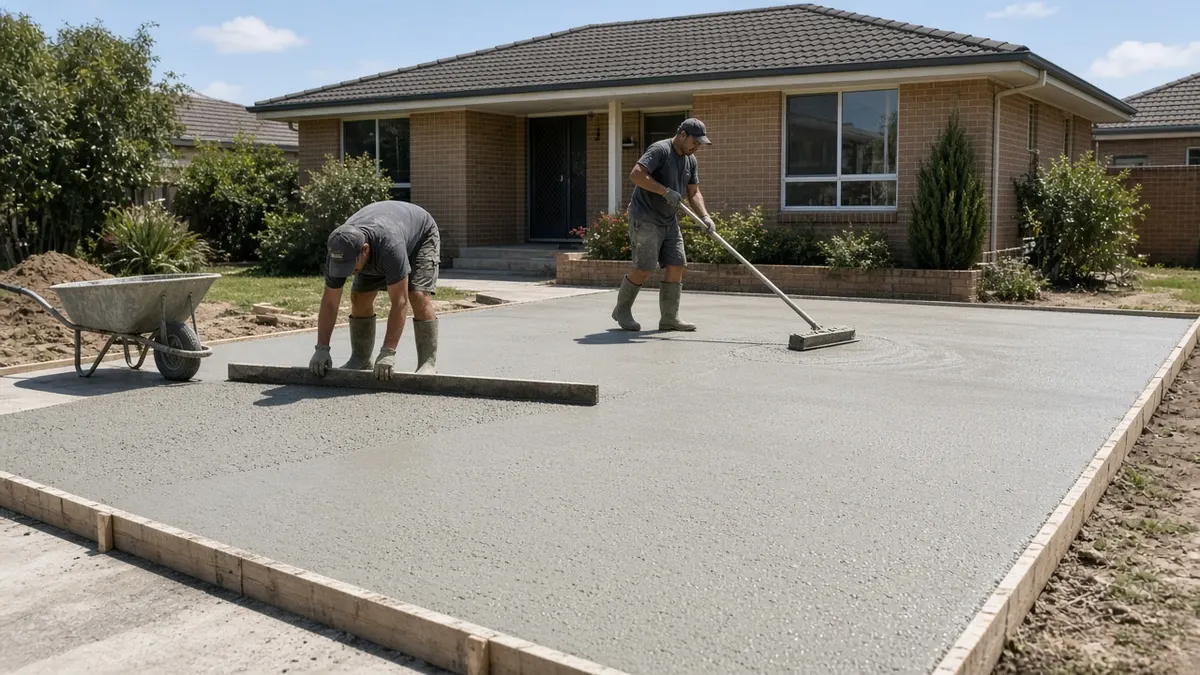
A new concrete driveway in Australia costs about $75 to $180 per m² in 2026, including GST, and the finish you choose decides where you land. Plain grey broom finish is the cheapest, exposed aggregate sits in the middle to upper part of the range, and stamped or pattern-imprinted concrete costs the most.
For a typical 45 to 60 m² suburban driveway, that works out to roughly $3,400 for a plain finish on an easy site through to $10,000 or more for a decorative finish with old concrete to break out first. This guide breaks those numbers down by finish, size and city, then walks through three priced examples. Treat every figure as indicative and get at least three written quotes. For other concrete jobs around the house, the concreting cost guide gives the bigger picture.
Driveway prices per m² by finish
| Finish | Price per m² (incl. GST) | Best for |
|---|---|---|
| Plain grey, broom finish | $75 to $120 | Budget jobs, rentals, long rural driveways |
| Coloured concrete (oxide through the mix) | $90 to $135 | Matching the house or softening the glare of grey |
| Exposed aggregate | $110 to $160 | Grip, hiding stains, the most popular decorative choice |
| Stencilled concrete | $110 to $160 | A paver or brick look without the joints |
| Stamped or pattern-imprinted | $120 to $180 | Stone, slate or cobble textures |
| Resurfacing an existing sound driveway | $40 to $80 | A new look without demolition |
| Removing old concrete and disposal | $35 to $70 extra | Any replacement job |
These rates assume a standard 100 mm thick residential driveway on a compacted base with mesh reinforcement, and include labour, concrete, formwork and finishing. They exclude demolition and council crossover works unless stated.
Ballpark totals for common driveway sizes
Driveways tend to fall into a few familiar sizes. Small jobs carry a minimum charge, often $1,800 to $2,500, because the crew, the truck and the pump cost the same whether the pour is 15 m² or 40 m².
| Driveway | Area | Plain | Exposed aggregate | Stamped |
|---|---|---|---|---|
| Short single (garage close to the street) | about 20 m² | $1,800 to $2,600 | $2,500 to $3,400 | $2,700 to $3,800 |
| Standard single, 3 m x 15 m | about 45 m² | $3,400 to $5,400 | $5,000 to $7,200 | $5,400 to $8,100 |
| Double, 6 m x 10 m | about 60 m² | $4,500 to $7,200 | $6,600 to $9,600 | $7,200 to $10,800 |
| Long or turning-bay driveway | about 100 m² | $7,500 to $12,000 | $11,000 to $16,000 | $12,000 to $18,000 |
Add $35 to $70 per m² if an old driveway has to be broken up and carted away, and more if it is thick, heavily reinforced or hard to reach with a bobcat.
What each finish gives you for the money
Plain broom finish
The concrete is screeded, floated and then dragged with a stiff broom to leave fine ridges for grip. It is fast, cheap and durable. The downsides are looks and stains: tyre marks, oil drips and rust from pot plants all show on plain grey, and the colour can vary slightly between truckloads. On a long rural driveway or a rental, it is the sensible choice.
Coloured concrete
An oxide pigment is mixed through the whole load at the plant, so the colour goes all the way through and does not wear off. Charcoal, sandstone and terracotta tones are common. Colour adds roughly $15 to $25 per m², mostly for the pigment. Darker colours get hot underfoot in summer and can show efflorescence (a white bloom) in the first year, which usually fades or can be cleaned.
Exposed aggregate
The surface paste is washed away to reveal the stones in the mix, giving a textured, non-slip finish that hides dirt well. It is the most popular decorative driveway in Australia. The price depends heavily on the aggregate blend you pick, since some river pebble and imported mixes cost far more per cubic metre than standard local stone. There is more detail in the exposed aggregate concrete cost guide.
Stencilled and stamped
Stencilled concrete uses paper stencils and a colour hardener to create a brick, tile or paver pattern on the surface. Stamped concrete uses rubber mats pressed into the wet slab to imprint stone or slate textures. Both need a skilled crew working against the clock while the concrete sets, which is why they cost more. Both also rely on a sealer for their colour and depth, so plan on resealing every two to three years. A worn stamped driveway that has not been sealed can look tired quickly.
Resurfacing
If your existing driveway is structurally sound but ugly, a polymer cement spray-on or stencil overlay can give it a new surface for less than half the price of replacement. It will not fix a driveway that is cracked through, sinking or lifted by roots. Those problems come back through any overlay.
What sits under the surface
The finish gets the attention, but the part of the quote that decides whether a driveway cracks in five years or lasts forty is what happens before the concrete arrives.
- Excavation and base. Topsoil and soft material are dug out and replaced with compacted crushed rock (roadbase), commonly 75 to 100 mm thick. Reactive clay sites in parts of Melbourne, Adelaide and western Sydney need extra care.
- Thickness. 100 mm is standard for cars. Thicken to 125 or 150 mm if you park a caravan, boat, motorhome or tradie truck on it, or if delivery trucks will use it.
- Reinforcement. Steel mesh on bar chairs, typically SL72 or SL82 for residential driveways, sitting in the right position within the slab rather than on the ground. Edge beams or thickened edges help where the driveway meets soft garden beds.
- Concrete strength. Driveways are usually poured with 25 or 32 MPa concrete. Ask what your quote includes.
- Control joints. Concrete shrinks as it cures. Saw-cut or tooled joints at regular spacing give it a planned place to crack. A driveway with no joints will crack randomly.
- Falls and drainage. Water must run away from the garage and house. A grated strip drain across the garage door is often needed on sloping blocks, and it has to connect to the stormwater system, which is plumbing work.
Driveway prices by city
Concrete supply prices, labour rates and how busy local crews are explain most of the difference. Regional areas can be cheaper for labour but pay more for delivery and travel.
| Location | Plain broom finish per m² | Exposed aggregate per m² |
|---|---|---|
| Sydney | $90 to $130 | $125 to $175 |
| Melbourne | $85 to $125 | $120 to $165 |
| Brisbane | $80 to $115 | $110 to $155 |
| Perth | $75 to $110 | $105 to $150 |
| Adelaide | $70 to $105 | $100 to $145 |
| Canberra | $85 to $125 | $120 to $165 |
| Hobart | $80 to $120 | $115 to $160 |
| Darwin | $95 to $140 | $130 to $185 |
| Regional | $70 to $115 | $100 to $155 |
Darwin and far north Queensland also have a wet season that limits pour days, and hot weather everywhere in summer shortens the finishing window, which can mean an extra worker on the crew.
Three driveways, priced in full
Replacing a cracked single driveway in Penrith
A 1990s brick veneer with a 3 m by 16 m plain driveway (48 m²), cracked and lifted near a street tree. The owners chose a new plain broom finish after the council approved and organised root pruning of the street tree.
| Item | Cost |
|---|---|
| Break out and remove old 100 mm driveway, 48 m² at $40 | $1,920 |
| Excavate, level and compact 75 mm roadbase, 48 m² at $10 | $480 |
| Formwork, SL82 mesh and bar chairs, 48 m² at $12 | $576 |
| 25 MPa concrete, 5.4 m³ at $310 | $1,674 |
| Line pump hire | $750 |
| Placing, screeding and broom finishing, 48 m² at $25 | $1,200 |
| Saw cutting control joints and edging | $300 |
| Subtotal (ex GST) | $6,900 |
| GST | $690 |
| Total | $7,590 |
Without the demolition, the new driveway itself worked out at about $114 per m² including GST, which is typical for western Sydney with a pump.
New double exposed aggregate driveway in Tarneit
A new house on a fresh estate block, 6 m by 9 m (54 m²), with a mid-range river pebble blend. The builder handed over with a dirt driveway, which is common on house and land packages.
| Item | Cost |
|---|---|
| Site preparation and excavation, 54 m² at $12 | $648 |
| Supply and compact roadbase, 54 m² at $10 | $540 |
| Formwork, mesh and thickened edges, 54 m² at $14 | $756 |
| Exposed aggregate mix, 6.0 m³ at $380 | $2,280 |
| Pump hire | $800 |
| Placing, retarder, wash-off and finishing, 54 m² at $34 | $1,836 |
| Saw cutting control joints | $350 |
| Acid wash and two coats of sealer, 54 m² at $9 | $486 |
| Council vehicle crossing permit and inspections (indicative) | $650 |
| Subtotal (ex GST) | $8,346 |
| GST | $834.60 |
| Total | $9,180.60 |
Leaving the permit aside, the driveway came to about $157 per m² including GST. Council fees vary a lot between councils, and some charge a bond as well, so check yours before budgeting.
Resurfacing a sound but tired driveway in Carseldine
A 42 m² plain driveway in good structural shape but stained and patchy. The owners chose a stencilled polymer overlay in a slate tone.
| Item | Cost |
|---|---|
| Pressure clean and degrease, 42 m² at $4 | $168 |
| Crack repair | $250 |
| Primer and stencilled polymer cement coat, 42 m² at $45 | $1,890 |
| Two coats of sealer, 42 m² at $8 | $336 |
| Subtotal (ex GST) | $2,644 |
| GST | $264.40 |
| Total | $2,908.40 (about $69 per m²) |
Extras that catch people out
- Truck access. If a concrete agitator cannot back up to the formwork, you need a pump. A line pump typically adds $600 to $1,000 to a residential pour, and a boom pump for long reaches costs more.
- Slope. Steep driveways need stiffer mixes, more labour to stop the concrete slumping downhill, and a heavier texture for grip. Retaining walls along cut edges are a separate cost.
- Tree roots. Roots under the old slab have to be dealt with, and street trees are council property. Never cut significant roots without the council's say-so.
- Services. Water meters, sewer inspection openings, stormwater pits and NBN pits must stay accessible and at the right level. Adjusting them can need a licensed plumber or the service provider. Lodge a free Before You Dig Australia enquiry before any excavation.
- Strip drains. A grated channel drain across the garage door or at the bottom of a slope can add several hundred to a couple of thousand dollars, including the plumber's stormwater connection.
- Rain and heat. A washed-out pour day costs the crew time. Very hot or windy days can need retarders, evaporation control and extra hands.
- Disposal. Old concrete is heavy. Tip fees for concrete are often lower than for mixed waste, because it can be recycled, but transport still costs money.
Council rules, licences and the crossover
The section of driveway between your front boundary and the road, usually called the vehicle crossing, crossover or layback, sits on council land. Almost every council requires a permit for new or replacement crossings, sets its own thickness and reinforcement specification, and inspects the formwork before the pour. Some councils build the crossing themselves or keep a list of approved contractors. Ask your council before you sign a quote, since a crossover that fails inspection may have to be ripped out at your cost.
Inside your boundary, a replacement driveway is usually straightforward. In NSW, many driveways and hard-stand areas can be exempt development if they meet the conditions in the state codes, and the NSW Planning Portal explains those rules. Other states have their own versions. Changes that affect flooding, overland flow, heritage areas or retaining walls may need approval.
On licensing, a driveway is residential building work once it passes your state's dollar threshold. In NSW, work over $5,000 in labour and materials needs a licensed contractor and a written contract, and you can check a licence with NSW Fair Trading. Concreting is its own licence class in Queensland, where the QBCC requires a licence for building work valued over $3,300. In Victoria, check with the Building and Plumbing Commission whether your job needs a registered practitioner and a major domestic building contract. In WA, SA, Tasmania, the ACT and the NT, check the current threshold with Building and Energy, Consumer and Business Services, CBOS, Access Canberra or the NT Building Practitioners Board. Any work on stormwater connections needs a licensed plumber in every state.
How long a driveway lasts and what it needs
A properly built concrete driveway lasts 30 to 50 years. Most failures come from a weak base, no control joints, tree roots or heavy vehicles on a slab that was never designed for them.
Plain concrete needs little more than an occasional wash. Decorative finishes need sealing. Exposed aggregate and stamped driveways usually get a fresh coat of sealer every two to three years, which costs roughly $8 to $15 per m² including a clean if you hire it out. Oil stains are easier to lift from a sealed surface, and a professional clean every year or two keeps the colour bright. The pressure cleaning cost guide has typical rates.
Hairline cracks are normal and cosmetic. Cracks that widen, step or let one slab sink below the next point to a base or root problem and are worth having a concreter look at.
Concrete or something else?
Concrete is the default in most suburbs, but it is worth comparing before you commit.
| Surface | Rough installed price per m² | Trade-off |
|---|---|---|
| Gravel or crushed rock | $25 to $50 | Cheap, needs topping up, dusty and hard to keep tidy |
| Asphalt | $45 to $90 | Quick to lay, softens in heat, needs resealing |
| Plain concrete | $75 to $120 | Durable and low maintenance, plain looking |
| Decorative concrete | $110 to $180 | Good looks, needs resealing |
| Pavers | $100 to $200 | Easy to repair one section, can shift without a solid base |
Pavers are covered in the paving cost guide, and asphalt contractors are listed under asphalt services.
Can you pour a driveway yourself?
A 50 m² driveway needs around five and a half cubic metres of concrete, which weighs over 12 tonnes and starts going off within an hour or two of the truck arriving. Placing, screeding, floating, edging and finishing that much concrete takes a practised crew of three or four. Most DIY driveway disasters come down to too few hands, the wrong tools and a hot day.
Where owners can save is the work before and after the pour: breaking up and removing the old driveway, digging out garden edges, moving pot plants and clearing the area, and cleaning up. A small path or shed pad is a better first concrete job. If you want to understand what crews charge for their time, the concreter hourly rate guide sets out typical labour rates.
What a good driveway quote should spell out
- Area, thickness, concrete strength (MPa) and mesh type.
- Base depth and material, and how it will be compacted.
- Finish, aggregate or colour name, and number of sealer coats.
- Control joint layout and whether joints are saw cut or tooled.
- Demolition, disposal, pump hire and strip drains, each listed.
- Who arranges the council crossing permit and inspections.
- Licence number where required, public liability insurance and a written warranty.
- A deposit within your state's legal limit and a payment schedule tied to stages.
Be wary of quotes far below the rest, cash-only pricing, crews who cannot tell you the mesh or MPa they plan to use, and anyone who wants to pour without a permit for the crossing.
Timeline from quote to car on the driveway
A typical residential driveway takes two to four days on site. Day one is demolition, excavation and base. Day two is formwork and mesh, with a council inspection of the crossing if one is required. The pour is usually day two or three, and exposed aggregate needs a return visit the next day to wash off and later to seal.
Walk on it after a day. Keep cars off for at least seven days and heavy vehicles off for longer, since concrete gains strength over about 28 days. Booking lead times are often two to six weeks, longer in spring and early summer.
Booking help through Yakka
Plenty of the cost of a driveway replacement is plain labour. Breaking up an old slab with a jackhammer, barrowing rubble to a skip, digging out garden edges, shifting pavers and pots, and cleaning up after the pour are tasks you can book a worker for on Yakka Labour by the hour or day, which can trim the concreter's quote if you agree the split upfront. A skip or tipper truck is usually the cheapest way to get the rubble off site.
The pour, the finish and any council crossing work should go to an experienced concreter with the right licence for your state. You can compare local concreters and ask each one to quote the same specification so the prices line up.
Frequently asked questions
How much does a concrete driveway cost per m2?
In 2026, a new concrete driveway costs about $75 to $120 per m² for plain broom finish, $90 to $135 for coloured concrete, $110 to $160 for exposed aggregate and $120 to $180 for stamped finishes, including GST. Removing an old driveway adds roughly $35 to $70 per m², and council crossover permits are extra.
How much does a double concrete driveway cost?
A double driveway of about 60 m² usually costs $4,500 to $7,200 for plain concrete, $6,600 to $9,600 for exposed aggregate and $7,200 to $10,800 for stamped concrete. Demolition of an old slab, a pump for difficult access, strip drains and council crossing works can add several thousand dollars on top.
Is exposed aggregate more expensive than plain concrete?
Yes, usually by $30 to $50 per m². Exposed aggregate costs more because the decorative stone mix is pricier, the crew returns to wash the surface, and it needs sealing. Many owners think it is worth it because it hides stains, offers good grip and looks better for longer than plain grey concrete.
Do I need council approval for a new driveway?
The crossover between your boundary and the road almost always needs a council permit and inspection. Work inside your property is often exempt if it meets your state's planning conditions, but heritage areas, flood zones, retaining walls and changes to stormwater can need approval. Check with your council before signing a quote.
How long before I can drive on a new concrete driveway?
You can usually walk on new concrete after about 24 hours, but cars should stay off for at least seven days. Concrete keeps gaining strength for about 28 days, so keep heavy vehicles such as trucks, caravans and skip bins off for longer, and avoid parking right at the edges early on.
How thick should a concrete driveway be?
Most Australian residential driveways are 100 mm thick with steel mesh on a compacted roadbase. If you park a caravan, boat, motorhome or work truck on it, or expect delivery trucks, ask for 125 to 150 mm with heavier reinforcement. Thickened edges help where the driveway meets soft garden beds.
Why does my concrete driveway have cracks?
Concrete shrinks as it dries, so some cracking is normal and control joints are there to guide it. Problem cracks usually come from a poorly compacted base, missing joints, tree roots or loads the slab was not designed for. Hairline cracks are cosmetic. Wide, growing or stepped cracks are worth having a concreter inspect.
Official sources
Award rates, licences and safety rules change. Check the official source before you hire or take on a shift.
- Queensland Building and Construction Commission (QBCC)Contractor, plumbing and drainage licence search in Queensland
- Consumer and Business Services SALabour hire licensing in South Australia
- NSW Fair TradingTrade licence checks for electricians, plumbers and builders in New South Wales
- Building and Plumbing Commission (Victoria)Builder and plumber registration, domestic building insurance and licence checks in Victoria
- Consumer, Building and Occupational Services (Tasmania)Building, plumbing and electrical licensing in Tasmania
- Access CanberraConstruction occupation licences and building approvals in the ACT