More cost guide
Switchboard Upgrade Cost Australia 2026: Prices, RCDs and Asbestos
Typical cost in Australia (2026, inc. GST)
$1,500 to $4,000 per job
typical single-phase house board replaced with circuit breakers and safety switches; asbestos boards and three-phase cost more
A switchboard upgrade for a typical Australian house costs $1,500 to $4,000 in 2026, done by a licensed electrician. Adding a single safety switch to an existing board can be $250 to $600, while an asbestos-backed meter board, consumer mains replacement or a three-phase upgrade can push the total to $5,000 or more. Circuit count, asbestos, meter work and distributor fees drive the price.
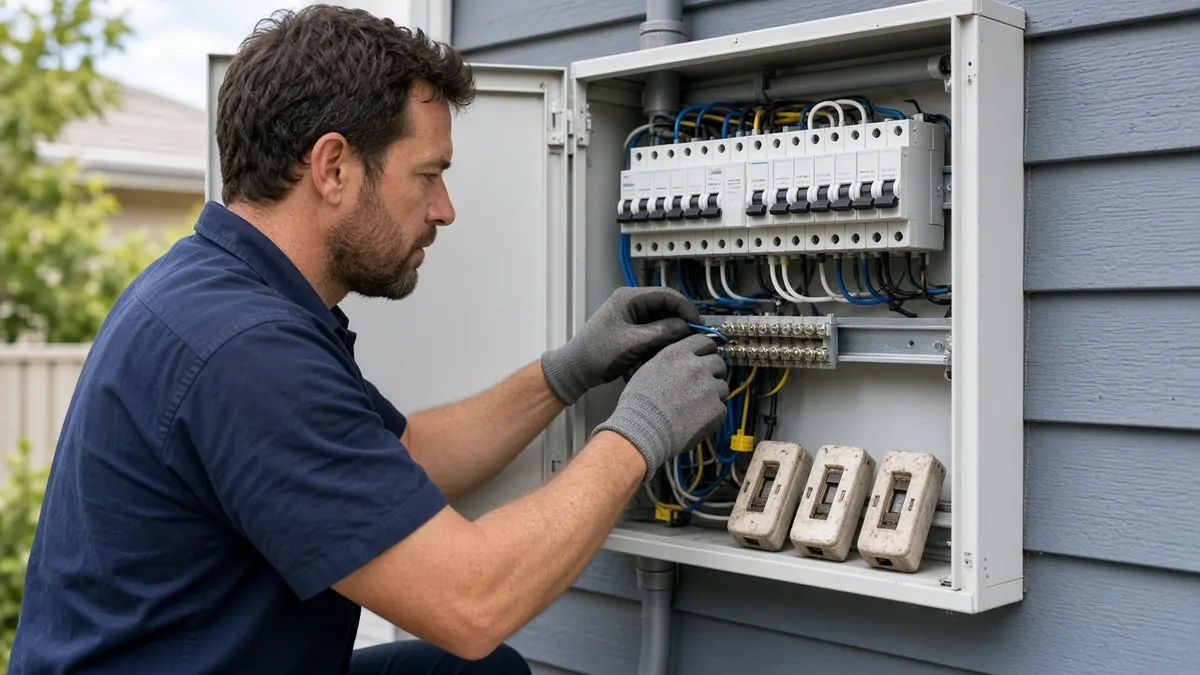
Most Australian homes pay $1,500 to $4,000 to upgrade a switchboard in 2026. The low end covers swapping old rewireable fuses for circuit breakers and safety switches inside an existing enclosure. The high end covers a new enclosure with an RCBO on every circuit, surge protection and room for solar or an EV charger. An asbestos-backed meter board, new consumer mains or a move to three-phase power can take the bill past $5,000.
The switchboard is the one part of a home's wiring that affects everything else. If it is old, many electricians will not add circuits to it, insurers may ask questions, and new appliances like induction cooktops, batteries and EV chargers may not be possible without an upgrade. This guide explains what each type of upgrade costs, how to tell if yours is due, how asbestos and meter work change the price, and the state rules on safety switches. All prices include GST and are indicative. Get at least three written quotes from licensed electricians.
Switchboard upgrade costs by type of job
| Job | Typical price (inc GST) | What it involves |
|---|---|---|
| Add one safety switch (RCD) to an existing board | $250 to $600 | Only possible if the board has space and is in fair condition |
| Add two RCDs and tidy an existing board | $500 to $1,000 | Splits power and lighting circuits across two safety switches |
| Replace fuses with circuit breakers and RCDs, existing enclosure | $1,000 to $2,000 | New chassis or rail inside the old box, 6 to 10 circuits |
| Full switchboard replacement with RCBOs | $1,800 to $4,000 | New enclosure, an RCBO per circuit, main switch, labelling |
| Asbestos meter board replacement plus new switchboard | $2,500 to $5,000 | Asbestos procedures, new meter panel, new enclosure |
| Sub-board for a garage, shed or granny flat | $800 to $2,000 | Plus the cost of the feed cable and any trenching |
| Consumer mains upgrade | $1,500 to $5,000 | New cable from the point of supply to the meter, depends on length and route |
| Single-phase to three-phase upgrade | $3,000 to $8,000 or more | Board, mains and distributor work, highly variable |
| Surge protection device added | $200 to $450 | Often done during a board upgrade |
These figures assume normal access to the board and no major wiring faults. When the electrician tests the circuits during the upgrade, they sometimes find faults that were hidden while the old fuses were in place. Safety switches trip on faults that fuses ignore, so a budget allowance of $200 to $600 for fault finding and repairs is sensible in older homes.
Signs your switchboard is due for an upgrade
Not every old board needs replacing tomorrow, but these are the common triggers:
- Ceramic rewireable fuses. If you replace fuse wire when the power goes out, the board predates modern protection. Fuses protect cables from overload but do not protect people from electric shock.
- No safety switches. A safety switch (RCD) cuts power within a fraction of a second when current leaks to earth, such as through a person. A board without one leaves your household unprotected.
- Safety switches on only some circuits. Many 1990s and 2000s homes have one RCD covering power points but nothing on lighting or the oven.
- Black or brown fibrous backing panel. Many meter boards installed before the late 1980s have backing panels that contain asbestos.
- Signs of heat. Scorch marks, a burning smell, buzzing, or breakers that feel warm need attention straight away.
- No room for new circuits. Renovations, a split system, induction cooking, solar, a battery or an EV charger often need spare space the old board does not have.
- Nuisance tripping. Breakers or RCDs that trip often can point to faults, overloaded circuits or tired equipment.
Age on its own is not a reason to replace a board. A 25-year-old board with circuit breakers, safety switches on every circuit and no signs of heat may only need an RCD tested and a couple of labels fixed. A 40-year-old board with fuses and a crumbling backing panel is a different story. Ask the electrician to explain which of the problems they found are safety issues and which are nice-to-haves, and get that in writing so you can compare quotes on the same basis.
If you have just bought an older home, a switchboard inspection is a good first job. Many electricians will look over the board while they are on site for something else and give you a rough figure.
Fuses, breakers, RCDs and RCBOs in plain English
Quotes use a handful of terms that are worth understanding before you compare prices.
| Device | What it does | Typical part cost |
|---|---|---|
| Rewireable fuse | Melts to cut an overloaded circuit, then needs new fuse wire | Obsolete for new work |
| Circuit breaker (MCB) | Switches off an overloaded or short-circuited circuit, then resets | $20 to $40 |
| Safety switch (RCD) | Cuts power fast when current leaks to earth, protecting people; usually covers several circuits | $80 to $160 |
| RCBO | A circuit breaker and safety switch combined for a single circuit | $70 to $150 |
| Main switch | Turns off the whole installation | $40 to $90 |
| Surge protection device | Limits voltage spikes from lightning and network events | $100 to $250 |
| Enclosure | The box and cover that houses the devices | $100 to $400 depending on size |
An RCBO on every circuit costs more up front than two or three shared RCDs, but it has a practical advantage. When a fault trips an RCBO, only that one circuit goes off. With a shared RCD, a faulty outdoor light can knock out the fridge, the lights and half the house at 2 am. For a family home, most electricians now recommend RCBOs for that reason, and the price difference on a 10 circuit board is usually a few hundred dollars.
Asbestos meter boards
Meter boards in many homes built before the late 1980s were mounted on a backing panel made from a material containing asbestos. While it is intact and left alone, the risk is low. Drilling, cutting or breaking it releases fibres. That matters because any switchboard upgrade involves screws and fixings going in and out of that panel.
Electricians who work on these boards should follow specific asbestos procedures, and the rules on who can remove the panel, how it must be wrapped and where it goes for disposal are set by your state WHS regulator and environment authority. Some electricians are trained to remove small asbestos meter panels under those rules. Others bring in a licensed asbestos removalist. Either way, expect to pay $300 to $1,000 more than for a non-asbestos board, depending on the approach and the disposal costs in your area. Our asbestos removal cost guide explains the broader rules and costs. Never drill or sand a board you suspect contains asbestos, and do not let anyone without the right training do it either.
The meter, the mains and the distributor
Meter panels and smart meters
Your electricity meter belongs to the metering provider, not to you. If the board upgrade means the meter has to move or the meter panel is replaced, the meter usually needs to be removed and refitted by someone authorised by the network or metering provider. In many areas the electrician lodges a request through your retailer. Some upgrades trigger a free or low-cost smart meter installation, while others carry a fee. Ask the electrician what applies on your network.
Disconnection and reconnection
To work on the incoming supply, the power has to be disconnected at the point of attachment or the service fuse. In NSW, that work is done by a Level 2 Accredited Service Provider, and some electricians hold that accreditation themselves. In other states the network business or its contractors may need to attend. Fees vary by network and can range from nothing to several hundred dollars, and waits can stretch from a few days to several weeks in busy areas.
Consumer mains
The consumer mains are the cables that run from the point of supply on your property to the meter. In older homes they may be too small for modern loads, especially if you are adding an EV charger, ducted air conditioning or a battery. Replacing them costs $1,500 to $5,000 depending on whether the supply is overhead or underground, the cable length and how hard the route is. An underground run that needs trenching across a driveway sits at the top of that range.
Single phase or three phase?
Most Australian homes have single-phase power, which is enough for normal household use, a split system or two and a modest EV charger. Three-phase supply spreads the load across three active conductors. It suits large homes with ducted air conditioning, big solar and battery systems, workshops with heavy machinery or fast EV charging.
A three-phase upgrade is one of the most variable jobs in residential electrical work. It needs network approval, possibly a new service cable, new consumer mains, a three-phase meter and a new switchboard. Budget $3,000 to $8,000 or more, and get the electrician to confirm with the network what the supply upgrade will involve before you commit. For many households, a well-planned single-phase board with load management is a cheaper answer.
Prices by city
| City | Typical full board upgrade (inc GST) | What moves the price |
|---|---|---|
| Sydney | $1,800 to $4,500 | Higher labour rates, many older homes with asbestos boards |
| Melbourne | $1,700 to $4,200 | Large stock of pre-war homes with tired fuse boards |
| Brisbane | $1,500 to $4,000 | Timber homes, often easier board access |
| Perth | $1,700 to $4,300 | Strong demand, double brick limits cable routes |
| Adelaide | $1,400 to $3,800 | Lower labour rates |
| Hobart | $1,500 to $4,000 | Older housing stock, smaller trade pool |
| Canberra | $1,800 to $4,500 | High wages, many 1960s and 1970s homes |
| Darwin | $2,000 to $5,000 | Freight on parts and a small trade pool |
Network and metering fees sit on top of these figures and vary by distributor rather than by city. Regional homes also pay travel, and some regional networks have longer waits for disconnection and reconnection.
Three upgrades, costed
Asbestos board in a Mayfield fibro, NSW
A 1960s fibro house in Newcastle with ceramic fuses on an asbestos-backed meter board on an outside wall. The electrician fits a new meter panel and enclosure with eight RCBO-protected circuits.
| Item | Cost (inc GST) |
|---|---|
| Licensed electrician, 8 hours at $115 | $920 |
| Apprentice, 6 hours at $65 | $390 |
| New enclosure and meter panel | $450 |
| 8 RCBOs at $95 | $760 |
| Asbestos panel removal, wrapping and disposal | $350 |
| Disconnect and reconnect (Level 2 accredited service provider) | $250 |
| Total | $3,120 (expect $2,800 to $4,200) |
Fuse board refresh in a Prospect villa, SA
A 1920s Adelaide villa with a sound non-asbestos enclosure but rewireable fuses and no safety switches. The house was partly rewired in the 1990s. The electrician fits a new chassis with circuit breakers and two RCDs across six circuits, and allows time for any faults the RCDs expose.
| Item | Cost (inc GST) |
|---|---|
| Labour, 5 hours at $100 | $500 |
| 2 RCDs at $110 | $220 |
| 6 circuit breakers at $25 | $150 |
| Main switch and new chassis | $180 |
| Fault-finding allowance | $300 |
| Total | $1,350 (expect $1,100 to $1,900) |
Ready for solar, battery and EV in Buderim, QLD
A 2000s brick home on the Sunshine Coast. The existing board has one RCD on the power circuits and no spare space. The owners are adding solar, a battery and an EV charger, so they want a larger board with an RCBO per circuit and surge protection, set up before the solar installer arrives.
| Item | Cost (inc GST) |
|---|---|
| Labour, 7 hours at $115 | $805 |
| Larger enclosure with spare capacity | $350 |
| 12 RCBOs at $90 | $1,080 |
| Main switch and surge protection device | $280 |
| Total | $2,515 (expect $2,300 to $3,300) |
The EV charger circuit and the solar and battery connections are quoted separately by the installers. If you are going down this path, the solar installers you talk to can tell you what spare capacity they need on the board.
Licensing and safety switch rules by state
Switchboard work is licensed electrical work everywhere in Australia, with no exceptions for homeowners. It must be done by a licensed electrician working for a licensed electrical contractor, and you should receive the compliance certificate your state requires. Electricians are licensed by NSW Fair Trading, Energy Safe Victoria, the Electrical Safety Office in Queensland, Building and Energy in WA, Consumer and Business Services in SA, CBOS in Tasmania, Access Canberra and the NT Electrical Workers and Contractors Licensing Board.
For new work, the wiring rules (AS/NZS 3000) generally require RCD protection on circuits in homes, which is why an electrician adding circuits to an old board will usually insist on safety switches. Some states go further for existing homes:
- Western Australia requires at least two RCDs protecting power and lighting circuits before a home is sold, rented or hired. Building and Energy has the current details.
- Queensland has safety switch requirements for power circuits in rental homes, plus obligations that can apply when a home is sold. Check the current rules with the Electrical Safety Office.
- Other states rely mainly on the wiring rules for new work, but landlords and sellers can have extra duties. Check with your state regulator or tenancy authority.
A handyman cannot work on a switchboard in any capacity, including swapping a breaker. Our article on whether a handyman can do electrical work covers where the line sits.
Getting a better price without a worse board
- Combine it with other electrical work. If you are planning smoke alarms, extra power points or a split system, have them quoted together. Our smoke alarm installation guide is a common companion job, especially before a sale or lease.
- Size the board for the future. An enclosure with spare space costs $50 to $150 more now and saves a second upgrade when you add solar, a battery or an EV charger.
- Ask about RCBOs versus shared RCDs. Get both prices. The gap is often smaller than you expect.
- Book the distributor early. Network appointments can be the slowest part. Ask your electrician to lodge requests as soon as you accept the quote.
- Fix access problems yourself. Clear plants, sheds and junk away from the meter box so the electrician is not paying to work around them.
- Do not choose the cheapest quote blindly. A price far below the others may leave out asbestos handling, fault finding or network fees, which then appear as variations.
What to look for in a switchboard quote
- The electrician's licence number and the contractor licence number.
- The number of circuits and whether each gets an RCBO or shares an RCD.
- The enclosure size and how much spare space it leaves.
- Whether asbestos is suspected and how it will be handled and disposed of.
- Who arranges disconnection, reconnection and meter work, and whether those fees are included.
- An allowance or hourly rate for faults found during testing.
- Surge protection, labelling of circuits and the compliance certificate.
- Payment terms. A modest deposit for parts is normal. A large upfront payment for a job that takes one day is not.
Red flags include no licence number, cash-only pricing, vague answers about asbestos, and anyone offering to swap fuses for breakers without adding safety switches.
Where Yakka fits
A switchboard upgrade is strictly a job for a licensed electrician. You can find a licensed electrician on Yakka among the tradies listed on the platform, and they will handle the board, the testing and the paperwork.
Yakka can help with the jobs around it. Meter boxes are often hidden behind overgrown shrubs, old timber, bins and garden junk. A general worker can clear the area the day before so the electrician starts work straight away. After the job, a worker can help tidy up packaging and take old non-hazardous materials to the tip. Anything that may contain asbestos stays with the electrician or a licensed removalist.
Timing and what to expect on the day
A straightforward board replacement takes four to eight hours. Asbestos boards, consumer mains work and three-phase upgrades can take longer and may be split across two visits around the network's appointment. The power will be off for most of the job, so plan for no electricity from early morning to mid-afternoon. Empty the freezer of anything precious or keep the doors shut, and charge laptops and phones the night before.
Once the new board is in, the electrician tests every circuit, checks each safety switch trips within the required time and labels the circuits. Ask them to show you how to reset a tripped RCBO and how to test the safety switches using the test button. Pressing that button every few months keeps the mechanism working. A good modern switchboard should last decades with little more than that routine test and a check whenever you add a major appliance. The electrician cost guide covers rates for that sort of follow-up work.
Frequently asked questions
How much does it cost to upgrade a switchboard in Australia?
Most homes pay $1,500 to $4,000 in 2026 for a switchboard upgrade by a licensed electrician. Simple fuse-to-breaker conversions in an existing enclosure can be closer to $1,000 to $2,000. Asbestos meter boards, new consumer mains and three-phase upgrades can push the total above $5,000, plus any network fees for disconnection and meter work.
How much does it cost to add a safety switch?
Adding one safety switch (RCD) to an existing board usually costs $250 to $600 if the board has space and is in reasonable condition. Two RCDs and a tidy-up typically cost $500 to $1,000. If the board is old, full or has an asbestos backing panel, the electrician will often recommend a full switchboard replacement instead.
Do I have to upgrade my switchboard when selling my house?
It depends on the state. Western Australia requires at least two RCDs protecting power and lighting circuits before a home is sold, rented or hired, and Queensland has safety switch rules for rental homes and some sales. Other states rely mainly on the wiring rules for new work. Check current requirements with your state electrical regulator before listing.
How long does a switchboard upgrade take?
A typical single-phase board replacement takes four to eight hours on site, with the power off for most of that time. Asbestos boards, consumer mains replacement and three-phase upgrades take longer. Waiting for the energy network to disconnect, reconnect or move the meter can add days or weeks to the overall timeline.
Is my meter box asbestos?
Many meter boards installed before the late 1980s have a backing panel containing asbestos, often a dark brown or black fibrous sheet. You cannot tell for sure by looking. Do not drill, cut or sand it. Your electrician can advise, and a sample can be tested by an accredited laboratory if needed before any work begins.
What is the difference between an RCD and an RCBO?
An RCD is a safety switch that protects several circuits at once by cutting power when current leaks to earth. An RCBO combines a circuit breaker and a safety switch for one circuit. With RCBOs, a fault trips only the affected circuit instead of half the house, which is why many electricians recommend them for new boards.
Do I need a switchboard upgrade for solar or an EV charger?
Often, yes. Solar, batteries and EV chargers need space on the board and protection for their circuits, and older boards often have neither. A board with spare capacity and RCBO protection makes later additions simpler. Ask your solar or EV installer what they need before choosing an enclosure size.
Official sources
Award rates, licences and safety rules change. Check the official source before you hire or take on a shift.
- Workplace Health and Safety QueenslandHigh-risk work licences and the Electrical Safety Office in Queensland
- Consumer and Business Services SALabour hire licensing in South Australia
- NSW Fair TradingTrade licence checks for electricians, plumbers and builders in New South Wales
- Asbestos Safety and Eradication AgencyWhere asbestos is found in homes and how to deal with it safely
- Consumer, Building and Occupational Services (Tasmania)Building, plumbing and electrical licensing in Tasmania
- Access CanberraConstruction occupation licences and building approvals in the ACT