Interior cost guide
Plastering Cost in Australia 2026: Set, Skim and Solid Plaster
Typical cost in Australia (2026, inc. GST)
$20 to $100 per m²
set and finish, skim coat or solid plaster, labour and materials, excluding board supply
Plastering in Australia costs about $20 to $100 per m² in 2026, depending on the work. Setting and finishing plasterboard that is already hung costs $20 to $35 per m², a skim coat over existing walls $30 to $60, and two-coat solid plaster on brick $50 to $100. Plasterers charge roughly $60 to $100 an hour or $500 to $850 a day. Height, access and preparation move the price.
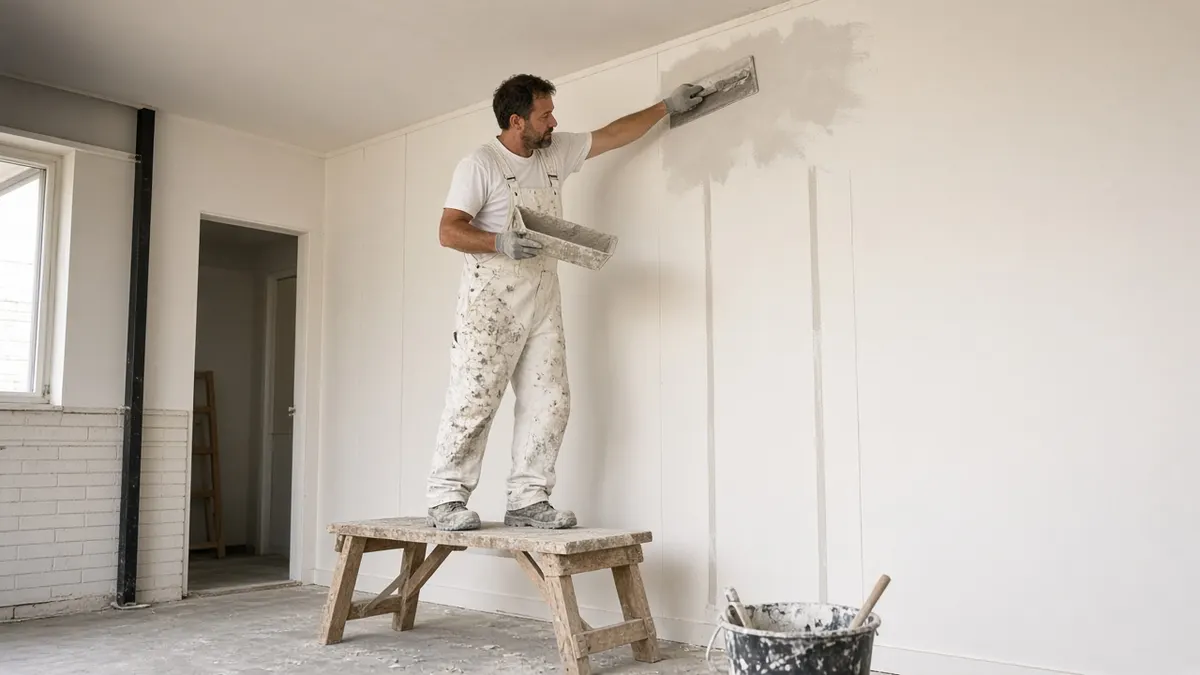
Plastering costs between $20 and $100 per m² in Australia in 2026, and the type of plastering decides where you land. Setting and finishing plasterboard joints is at the cheap end, skim coating tired walls sits in the middle, and solid plaster on brick or block costs the most.
This guide covers new plastering work: finishing new board, skim coats and solid plaster. If you need sheets supplied and hung, see our Gyprock installation cost guide, and for cracks and holes see the plaster repair cost guide. All figures include GST and are indicative only. Get at least three written quotes before you commit.
Plastering prices by type of work
| Type of plastering | Typical cost per m² | Where it is used |
|---|---|---|
| Set and finish only, boards already hung | $20 to $35 | New builds, extensions, owner-builder jobs |
| Supply, hang and set plasterboard | $40 to $90 | Renovations, relines, new rooms |
| Skim coat over existing plasterboard or plaster | $30 to $60 | Damaged walls after wallpaper removal, patchy old walls |
| Set coat only over sound render | $30 to $55 | Renewing the finish on masonry walls |
| Two-coat solid plaster on brick or block | $50 to $100 | Double brick homes, new masonry walls |
| Lime plaster for heritage work | $80 to $160 | Period homes, walls with damp issues |
| Polished or Venetian plaster finish | $120 to $300 | Feature walls and high-end interiors |
The ranges assume walls and ceilings at standard height, reasonable access and a single-storey home. Ceilings cost a little more than walls, and anything that needs scaffolding costs more again.
Plasterer rates by the hour and day
Small jobs and work with an uncertain scope are often charged by the hour or day. Larger, defined jobs are usually priced per m² or as a fixed sum. These are typical rates for an experienced plasterer in 2026.
| City or area | Hourly rate | Day rate |
|---|---|---|
| Sydney | $70 to $100 | $600 to $850 |
| Melbourne | $65 to $95 | $550 to $800 |
| Brisbane | $60 to $90 | $500 to $750 |
| Perth | $65 to $95 | $550 to $800 |
| Adelaide | $55 to $85 | $480 to $700 |
| Hobart | $55 to $85 | $480 to $720 |
| Canberra | $65 to $95 | $560 to $820 |
| Darwin | $75 to $105 | $620 to $900 |
| Regional | $55 to $90 | $450 to $750 |
Minimum charges of $250 to $400 are common for small jobs. In Perth, where many homes have hard-plastered double brick walls, solid plasterers are a bigger part of the trade than in eastern cities, where plasterboard dominates. A plasterer and labourer team costs roughly $850 to $1,250 a day.
Labour versus materials
Plastering is a labour-heavy trade. On a set and finish job, compound, tape, beads and screws are only a few dollars per m², so 80 percent or more of the price is the plasterer's time. On a skim coat, materials are still minor. Solid plaster uses more material by weight, with cement, sand, lime and hard plaster, but labour still dominates because each wall is screeded and trowelled by hand.
That has two consequences. First, cheaper materials will not save much, and the best way to reduce the price is to reduce the hours: good preparation, clear access and a sensible program. Second, a quote that is far cheaper than others is usually cheaper because of fewer hours, which tends to mean fewer coats or less sanding.
Set and finish: what you are paying for
When boards are already hung, the plasterer's job is to make the joints, screw heads and corners vanish. That means taping each joint, then applying three coats of compound: a base coat to bed the tape, a second coat to fill and widen, and a topping coat feathered out wide and thin. Corner beads go on every external corner. Once dry, everything is sanded smooth.
Each coat has to dry before the next, so a plasterer typically visits three or four times across several days. That is why setting a small room can cost almost as much as setting a large one: the trips back are the same.
The normal target in a house is a Level 4 finish under AS/NZS 2589, the plasterboard finishing standard, which suits flat and low-sheen paints. Check the work in raking light before the painter starts. Hold a torch flat against the wall or look along it from one end. Ridges and hollows are cheap to fix at this stage and expensive after two coats of paint.
Skim coating old walls
A skim coat is a thin layer of finishing compound or plaster spread over the entire wall, then sanded. It turns a patchwork of old repairs, torn paper and dents into one even surface. It is the usual answer after wallpaper removal, when the paper face of the board often tears, or in older homes where decades of patching show through every repaint.
Skim coating costs $30 to $60 per m² depending on the condition of the wall and whether one or two coats are needed. Torn paper must be sealed first, or the moisture in the compound raises bubbles. Gloss-painted walls need sanding or a bonding primer so the skim coat grips.
The alternative is to strip and reline with new plasterboard. As a rough guide, skim coating makes sense when the wall is sound and mostly flat. Relining wins when the board is soft, water damaged, badly cracked or when you want to run new cables and insulation inside the wall anyway.
Solid plaster on brick and block
Solid plastering, also called hard plastering or wet plastering, is applied directly to masonry. A typical system is a sand and cement render coat of 10 to 15 mm, straightened with a long screed, followed by a thin hard set coat that is trowelled smooth. It is slower, heavier work than plasterboard, which is why it costs more per m².
It is the standard finish inside double brick homes in Perth and in many older homes elsewhere. It also comes up when a new internal brick wall is built, when an electrician chases cables into brick walls, or when old plaster has blown and drummy patches need replacing.
Heritage homes with solid masonry walls and no damp course often suit lime plaster better than cement, because lime lets moisture escape. Cement-based plaster on a damp wall can trap moisture and push the problem further up. If you have a period home with damp walls, talk to a plasterer experienced in lime work before choosing a product. External walls are a different trade again, covered in our rendering cost guide.
Plasterboard or solid plaster for a new wall
If you are adding a wall, the choice usually follows the house. In a framed home, a timber or steel stud wall lined with plasterboard is cheaper, faster and easier to run cables through. In a double brick home, owners often want a brick wall with solid plaster so the new work sounds and feels like the rest of the house. That costs noticeably more, needs a bricklayer as well as a plasterer, and adds weight that the floor must be able to carry.
A middle path in masonry homes is a stud wall lined with plasterboard and then given a Level 5 finish so it reads like hard plaster under paint. It will not feel quite as solid when you knock on it, but it is cheaper and much quicker. Acoustic insulation in the cavity closes some of the sound gap.
Plastering in wet areas and kitchens
Bathrooms and laundries need moisture-resistant board, and areas that will be tiled only need joints set flat rather than a full paint-ready finish, which keeps the cost down. Ceilings in wet areas still need a proper finish and a paint system suited to humidity. Solid plaster in older bathrooms often needs patching around new pipework and fixtures, and blown or drummy plaster behind old tiles should be removed rather than tiled over.
Behind kitchen benches and splashbacks, a flat, well-set wall makes tiling or glass splashback installation easier. Ask your plasterer and kitchen installer to agree on who is finishing which surfaces before work starts, so nothing is set twice or left undone.
Cornices, ceiling roses and decorative work
| Item | Typical installed cost |
|---|---|
| Standard 75 to 90 mm cove cornice | $12 to $25 per linear metre |
| Larger contemporary cornice profiles | $20 to $40 per linear metre |
| Ornate period cornice, new | $40 to $120 per linear metre |
| Square set junction instead of cornice | Add $15 to $30 per linear metre over cove |
| Ceiling rose, supplied and fitted | $150 to $600 each |
| Restoring damaged ornate cornice in place | $150 to $400 per linear metre |
Matching old ornate cornice is specialist work. Some fibrous plaster workshops can make a mould from a sound section and cast new lengths. Others run the profile in place with a template. Either way, expect a premium for small runs.
Three worked examples
All totals include GST. Board supply, painting and electrical work are excluded unless listed.
Set and finish in a new extension in Ryde, Sydney
A rear extension with about 120 m² of plasterboard hung by the builder's carpentry crew. The plasterer was engaged to set, cornice and sand only.
| Line item | Cost |
|---|---|
| Set and finish, 120 m² at $28 | $3,360 |
| Cove cornice, 45 linear metres at $15 | $675 |
| Corner beads and compound sundries | $120 |
| Total (incl GST of about $378) | $4,155 |
That is about $35 per m² including cornice. The plasterer set it over four visits in a week.
Skim coat after wallpaper removal in a 1970s Adelaide home
Two bedrooms and a hallway, about 85 m² of wall. The owner stripped the wallpaper with a labourer's help, and the paper face of the board tore in several places.
| Line item | Cost |
|---|---|
| Seal torn paper, fill dents, 85 m² at $6 | $510 |
| Skim coat, 85 m² at $40 | $3,400 |
| Dust protection and clean-up | $250 |
| Total (incl GST of about $378) | $4,160 |
Relining the same walls with new board would have cost roughly $4,500 to $6,500 once removal was included, so the skim coat was the better value here.
Solid plaster in a Perth double brick renovation
A new 3.6 m internal brick wall, plastered on both sides, plus making good where an electrician chased cables into existing walls during a rewire.
| Line item | Cost |
|---|---|
| Two-coat solid plaster, 19.4 m² at $75 | $1,455 |
| Patch electrical chases, 25 linear metres at $25 | $625 |
| Feather set coat into existing walls | $450 |
| Clean-up and rubbish | $150 |
| Total (incl GST of about $244) | $2,680 |
Solid plaster needs time to dry before painting. The owner left it several weeks and used a sealer recommended for new plaster.
What pushes plastering prices up
- Height: ceilings above 2.7 m, stairwells and raked ceilings need scaffolds or mobile platforms and slow the work.
- Bad board hanging: if someone else hung the board with butt joints in the wrong places or screws too deep, the plasterer spends longer fixing it.
- Small areas: one wall still needs three or four visits, so minimum charges kick in.
- Weather: cold, damp conditions slow drying and stretch the job out.
- Access: apartments without lifts, tight terraces and no parking add time carrying materials and waste.
- Level 5 finish: a full skim over set joints for walls in harsh light adds $10 to $20 per m².
- Heritage requirements: lime plaster and matching ornate cornice take specialist skill.
Licences and safety
Plastering is licensed trade work in several states once it passes a dollar threshold. In NSW, both dry plastering and wet plastering are licence categories, and a contractor licence is needed for residential work over $5,000 in labour and materials including GST. The NSW Government wet plastering page explains what solid plastering covers. In Queensland, the QBCC requires a licence for building work valued over $3,300, as set out on its page about when you need a licence. In Victoria, domestic building work over $10,000 generally needs a registered practitioner, so check with the Building and Plumbing Commission. In WA, SA, Tasmania, the ACT and the NT, check current requirements with Building and Energy, Consumer and Business Services, CBOS, Access Canberra or the NT Building Practitioners Board.
Sanding compound creates a lot of fine dust. Good plasterers use vacuum sanders and dust sheets, and wear masks. Cutting fibre cement and grinding masonry can release respirable crystalline silica, which needs proper controls. In homes built before 1990, test old linings, textured ceilings and fibre cement sheets for asbestos before anyone sands or demolishes them. Old paint in homes built before about 1970 may contain lead, which matters if walls are being sanded before a skim coat.
Preparing for the plasterer, and what you can do yourself
Plastering is one of those trades where the finish shows every shortcut, and most owners are better off paying a professional for the setting itself. There is still plenty you can do to reduce the bill:
- Empty the rooms completely, or move furniture to the centre and cover it.
- Strip wallpaper, remove picture hooks and take down curtain tracks before the plasterer arrives.
- Get electrical and plumbing rough-in finished first, so no one cuts holes in new work.
- Arrange somewhere for the plasterer to mix and wash out, with water and a power point nearby.
- Plan for rubbish removal, especially if old plaster is coming off.
DIY setting is possible on a garage or shed where the finish matters less. In a living room, uneven joints show for years under paint.
How long plastering takes
Set and finish on a few rooms usually takes three to five days because each coat dries overnight. A skim coat on a couple of rooms takes two to four days. Solid plaster is slower: the render coat needs time to cure before the set coat, and the finished plaster needs to dry before painting, which can take a few weeks in cool weather depending on thickness.
Expect noise from mixers and sanders, dust despite protection, and wet plaster on boots near the work area. Keep pets and children away, and ventilate well. Painters can usually start soon after a plasterboard job, once the surfaces are dust-free. See the house painting cost guide for typical painting prices, or find local painters to follow on.
Booking and scheduling
Good plasterers are often booked two to five weeks ahead in the capital cities. On a renovation, plastering sits between the rough-in trades and the painter, so a delay here pushes everything back. Book once your framing and rough-in dates are firm, and confirm a few days before. Winter jobs take longer to dry, so allow extra days between coats, especially for solid plaster in unheated rooms.
How long new plaster lasts
Well-set plasterboard and solid plaster last as long as the house if they stay dry. Hairline cracks at joints and cornices are common in the first year or two as a new frame shrinks and settles, and many builders include a return visit to patch them before the final repaint. In older homes on reactive clay soils, cracks open and close with the seasons, and flexible fillers at cornices hold up better than rigid compound.
Solid plaster is harder wearing than plasterboard and shrugs off knocks that would dent board, which is one reason some owners of brick homes stick with it. Its weak point is moisture: plaster on walls with rising or penetrating damp will eventually blow and need replacing, so fix the damp first.
How to compare plastering quotes
A useful quote sets out the area in m² for each type of work, the system and products used, the level of finish, cornice type and length, how many visits are planned, who handles rubbish, and what preparation the plasterer expects from you. It also shows a licence number where required, plus proof of public liability insurance.
Watch for vague quotes that just say plastering, prices far below the rest, cash-only deals and large deposits. NSW caps deposits for residential building work at 10 percent. Victoria caps them at 10 percent for contracts under $20,000 and 5 percent above that. In other states, check with the regulator. Ask to see recent work, ideally in person and in daylight. You can compare local tradespeople in our directory of plasterers and Gyprock installers.
Getting plastering help through Yakka
Yakka Labour connects you with local workers by the shift or by the job. On a plastering project, that is useful for stripping wallpaper, removing old plaster once asbestos is ruled out, carrying bags of compound and sheets of board, protecting floors, and the clean-up that follows any plastering job. Plasterers working on larger programs can also find extra hands this way, and our post on plastering labour hire in Sydney explains the commercial side.
Plasterers listed on Yakka can quote for the plastering itself. For work above your state's licence threshold, check that whoever you hire holds the right licence and insurance.
Frequently asked questions
How much does a plasterer charge per m2?
In 2026, setting and finishing plasterboard that is already hung usually costs $20 to $35 per m². Supply, hang and set is typically $40 to $90 per m². A skim coat over old walls is $30 to $60 per m², and two-coat solid plaster on brick runs $50 to $100 per m², depending on access and condition.
How much does a plasterer charge per hour?
Most plasterers charge $60 to $100 per hour in 2026, with day rates of about $500 to $850. Sydney, Canberra and Darwin sit at the higher end, while Adelaide, Hobart and regional areas are usually lower. Expect a minimum charge of $250 to $400 for small jobs.
Is skim coating cheaper than replacing plasterboard?
Usually, if the existing walls are sound and fairly flat. A skim coat costs $30 to $60 per m², while stripping and relining with new board often costs $55 to $110 per m² once removal is included. Relining is the better choice when board is water damaged, soft or badly cracked.
What is the difference between solid plastering and plasterboard?
Solid plastering applies wet render and a hard set coat directly to brick or block walls. Plasterboard is a factory-made sheet fixed to a timber or steel frame, then joints are set. Solid plaster is harder wearing but slower and more expensive. Plasterboard is quicker and is used in most framed homes.
Do plasterers need a licence in NSW?
Yes, for larger jobs. In NSW, dry plastering and wet plastering are both licence categories, and a contractor licence is needed for residential work worth more than $5,000 including labour and materials. For smaller jobs, a licence is not required, but insurance and experience still matter.
How long after plastering can I paint?
Plasterboard joints can usually be painted once the final coat is fully dry and sanded, often a day or two after the last visit. Solid plaster takes much longer, sometimes several weeks in cool weather, depending on thickness. Use a sealer or primer suited to new plaster before the top coats.
Is square set more expensive than cornice?
Square set usually adds $15 to $30 per linear metre compared with standard cove cornice. It needs stopping beads and a careful, straight finish where wall meets ceiling, and it shows movement cracks more readily. Cornice is cheaper and more forgiving, especially in older homes where frames move.
Official sources
Award rates, licences and safety rules change. Check the official source before you hire or take on a shift.
- Queensland Building and Construction Commission (QBCC)Contractor, plumbing and drainage licence search in Queensland
- Consumer and Business Services SALabour hire licensing in South Australia
- Building and Plumbing Commission (Victoria)Builder and plumber registration, domestic building insurance and licence checks in Victoria
- Asbestos Safety and Eradication AgencyWhere asbestos is found in homes and how to deal with it safely
- Consumer, Building and Occupational Services (Tasmania)Building, plumbing and electrical licensing in Tasmania
- Access CanberraConstruction occupation licences and building approvals in the ACT