Outdoor cost guide
Fencing Cost in Australia: 2026 Prices per Metre by Material
Typical cost in Australia (2026, inc. GST)
$90 to $250 per linear metre
standard 1.8 m side or rear fence, supply and install, excluding removal of an old fence
A new 1.8 m residential fence in Australia usually costs $90 to $250 per linear metre installed in 2026, including GST. Treated pine paling and Colorbond sit at the cheaper end, timber slat screens and aluminium in the middle, and rendered masonry or frameless glass at the top. Length, ground conditions, removal of the old fence, gates and access drive most of the difference between quotes.
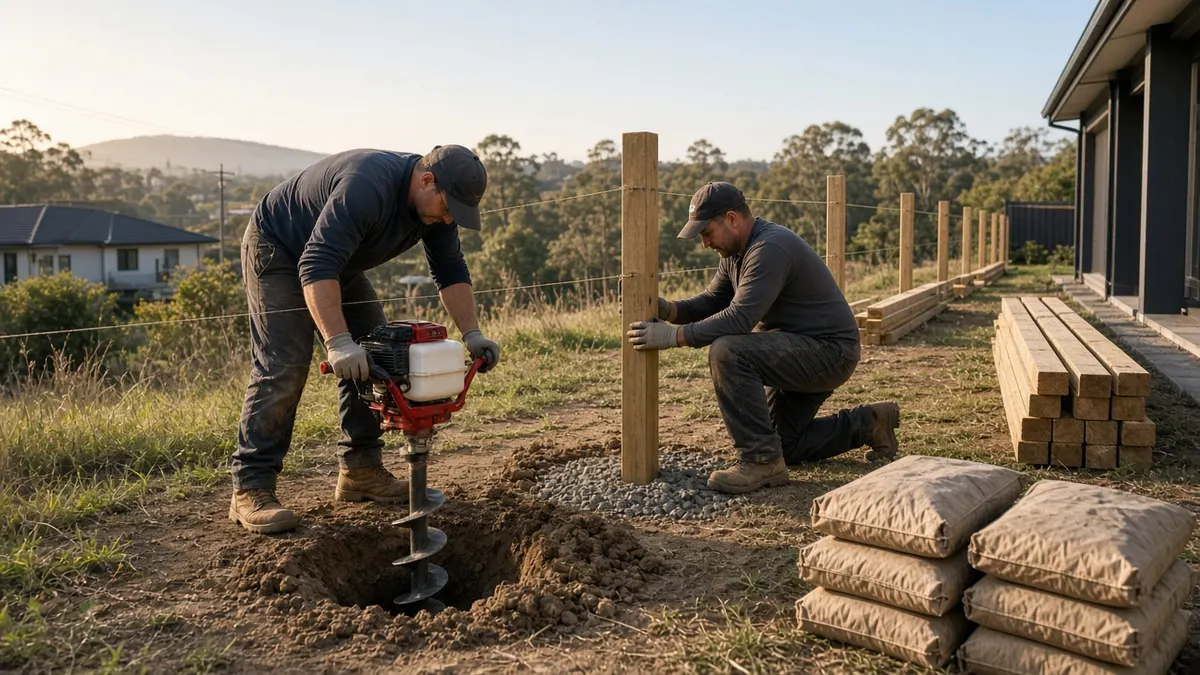
Most new residential fences in Australia cost between $90 and $250 per linear metre installed in 2026, GST included. A typical 30 m back or side boundary in Colorbond or treated pine paling lands somewhere around $3,500 to $6,500 all up, and if it is a dividing fence your neighbour usually pays half.
That range is wide because 'a fence' covers everything from a basic paling run on flat sandy soil to a rendered block wall with piers. This guide breaks the price down by material, by city and by the things that blow out a quote, then walks through three real-world examples and the dividing fence rules in each state. All figures here are indicative. Get at least three written quotes before you commit, and make sure each one is for the same height, material and scope.
Fence prices by material
The table below covers supply and installation of a standard fence on reasonably flat, diggable ground. Heights are 1.8 m for boundary fences unless noted, which is the default height for side and rear fences in most Australian suburbs.
| Fence type | Typical height | Installed price per linear metre | Expected lifespan |
|---|---|---|---|
| Treated pine paling (butted) | 1.8 m | $90 to $150 | 15 to 20 years |
| Hardwood paling, lapped and capped | 1.8 m | $130 to $220 | 20 to 25 years |
| Colorbond steel sheet | 1.8 m | $110 to $190 | 25 to 30+ years |
| Timber picket (front fence) | 0.9 to 1.2 m | $120 to $260 | 15 to 20 years with painting |
| Timber slat or batten screen | 1.8 m | $250 to $450 | 15 to 25 years |
| Aluminium slat or batten | 1.8 m | $220 to $450 | 25+ years |
| Composite (wood plastic) panels | 1.8 m | $250 to $450 | 20 to 25 years |
| Chain wire mesh | 1.2 to 1.8 m | $35 to $90 | 15 to 25 years |
| Rural ringlock, plain or barbed wire | 1.1 to 1.2 m | $10 to $30 | 20+ years |
| Aluminium pool fencing | 1.2 m | $150 to $300 | 20+ years |
| Frameless glass pool fencing | 1.2 m | $400 to $700 | 25+ years |
| Rendered block or brick | 1.2 to 1.8 m | $350 to $800 | 50+ years |
Treated pine paling is still the cheapest way to fence a suburban boundary, but the gap to Colorbond has narrowed. Most fencers now quote steel and pine within $20 to $40 a metre of each other, and steel wins on maintenance. If you want the detail on either, see our Colorbond fencing cost guide and the timber fencing cost guide, which cover sheet profiles, timber species, sleeper plinths and lattice extensions.
Pool fences are a separate category because they have to meet barrier rules, and the gate hardware alone can cost several hundred dollars. The glass pool fencing cost guide covers frameless and semi-frameless options and the inspection and certificate costs that come with them.
Why two quotes for the same fence can be $2,000 apart
Fencers price by the metre, but the metre rate hides a lot of variables. When you compare quotes, these are the items that move the number most.
Removing the old fence
Pulling out an old timber or steel fence, digging out the concrete footings and taking it all to the tip usually adds $15 to $40 per metre. Some fencers include it, some list it separately, and some assume you have already done it. Old fibro (asbestos cement) fences are a different story, covered further down.
Ground conditions
Post holes are typically 450 to 600 mm deep for a 1.8 m fence, and more in sandy or reactive clay soil. Sand in Perth or on the coast digs fast. Shale, sandstone floaters, tree roots and old concrete slow everything down. Rock that needs a core drill or jackhammer can add $20 to $50 per post hole, and fencers often add a 'rock clause' to the quote so they can charge extra if they hit it.
Slope and retaining
On a sloping block the fence has to step down or rake with the ground. Stepped panels leave triangular gaps under each panel, which get filled with plinths or sleepers at roughly $20 to $60 per metre. Where one side of the fence holds back soil, a fence is not a retaining wall. Steel and timber panels will bow and rot if they are used to hold soil. You need a proper wall first, which is a separate cost covered in the retaining wall cost guide.
Access
A fencer who can back a ute up to the line and auger post holes with a machine finishes in a day. A boundary behind a house with a narrow side path, steps or a pool means every sheet, bag of concrete and post goes in by hand. Expect a surcharge or a higher metre rate for hard access.
Gates
A single pedestrian gate in the same material as the fence typically adds $400 to $1,200 installed. Double driveway gates and sliding gates are a bigger job again, from about $1,500 for a manual pair to well over $8,000 for an automated slider. The driveway gate cost guide has the full breakdown.
Height and extras
Going from 1.8 m to 2.1 m adds material, longer posts and possibly council approval. Lattice or slat extensions on top of an existing fence run about $40 to $90 per metre. Plinths, capping, decorative post caps and colour-matched hardware all add small amounts that pile up on a long run.
Length
Short runs cost more per metre. A fencer still has to load up, drive out, set out the line and mix concrete for a 6 m job. Many have a minimum charge somewhere between $600 and $1,200, so a tiny repair or a short return can look expensive on a per-metre basis.
Fencing costs in each capital city
Labour rates, freight and soil type make the same fence cost noticeably more in some cities. These ranges are for a standard 1.8 m Colorbond or treated pine paling fence, installed, on an average suburban block.
| City or region | Colorbond per metre | Treated pine paling per metre | Why it differs |
|---|---|---|---|
| Sydney | $130 to $200 | $105 to $160 | Highest labour rates, tight access, sandstone in many suburbs |
| Melbourne | $120 to $185 | $100 to $150 | Reactive clay in the north and west, strong competition among fencers |
| Brisbane | $115 to $180 | $95 to $150 | Wind ratings in some areas, termite-resistant posts preferred |
| Perth | $105 to $170 | $95 to $145 | Sandy soil digs fast; limestone retaining often needed first |
| Adelaide | $105 to $170 | $95 to $145 | Lower labour rates, reactive clay in some suburbs |
| Hobart | $120 to $190 | $100 to $155 | Steep blocks and dolerite rock, smaller pool of fencers |
| Canberra | $125 to $195 | $105 to $160 | Higher labour rates, freezing winters slow concrete curing |
| Darwin | $140 to $220 | $115 to $175 | Cyclone-rated posts and footings, freight, termites |
| Regional centres | $100 to $180 | $90 to $145 | Cheaper labour, but travel charges for outlying properties |
In practice the spread inside a city is often bigger than the spread between cities. A fencer working in their own patch with a full week of jobs will usually beat someone driving 60 km for a one-off.
Who pays for a dividing fence in each state
Every state and territory has a law that makes neighbours share the cost of a dividing fence between two private properties. The general rule is the same everywhere: each owner pays half of a basic, 'sufficient' or 'adequate' fence. If one neighbour wants something better than that, such as a taller fence, rendered masonry or a timber slat screen instead of plain paling, they normally pay the difference.
The process also follows a similar pattern. You talk to your neighbour first, then if needed you serve a formal written notice that describes the fence, the boundary, the quote and how the cost will be split. If you do not reach agreement within the set period, you can go to mediation and then to a court or tribunal for an order. Build first and ask later, and in most states you lose the right to recover your neighbour's share.
| State or territory | Main law | Cost sharing | Where disputes go |
|---|---|---|---|
| NSW | Dividing Fences Act 1991 | Equal share of a sufficient fence; fencing notice served first | Community Justice Centres for mediation, then the Local Court |
| Victoria | Fences Act 1968 | Equal share unless one owner benefits more; fencing notice served first | Dispute Settlement Centre of Victoria, then the Magistrates' Court |
| Queensland | Neighbourhood Disputes (Dividing Fences and Trees) Act 2011 | Equal share of a sufficient fence; notice to contribute served first | Mediation through the Dispute Resolution Branch, then QCAT |
| Western Australia | Dividing Fences Act 1961 | Equal share of a sufficient fence, often defined by council local laws | Magistrates Court |
| South Australia | Fences Act 1975 | Equal share of an adequate fence; notice of intention served first | Magistrates Court |
| Tasmania | Boundary Fences Act 1908 | Equal share of a fence suitable for the land use | Magistrates Court |
| ACT | Common Boundaries Act 1981 | Equal share of a fence of a standard type for the area | ACT Civil and Administrative Tribunal (ACAT) |
| Northern Territory | Fences Act | Equal share of a sufficient fence | Check the current process with the NT Community Justice Centre |
A few points trip people up. Councils and state governments are usually exempt from contributing when your fence borders a park, reserve or other public land, so you may be paying 100% on that side. Tenants are not responsible; the owners are. In strata or community title schemes, the by-laws and the owners corporation may decide fences, not the dividing fence law. And if a neighbour damages the fence, for example by dropping a tree on it, they can be liable for the whole repair rather than half.
For the official process in your state, start with NSW Fair Trading, the Dispute Settlement Centre of Victoria or QCAT in Queensland. Each has notice templates and plain-English guides. Fencing law is detailed, so treat the table above as a summary and check the current rules before you serve a notice.
Worked example 1: Colorbond dividing fence in Penrith, NSW
A three-bedroom brick veneer on a standard 600 m² block in Penrith. The 30 m side boundary has a sagging 25-year-old treated pine paling fence. Both neighbours agree on a 1.8 m Colorbond fence in a mid-grey colour, with one pedestrian gate on the owner's side. The ground is clay with no rock. Access is good from the front yard.
| Line item | Cost (incl. GST) |
|---|---|
| Colorbond sheets, rails and posts, 30 m | $2,050 |
| Concrete, fixings and delivery | $300 |
| Labour to set out and install, 30 m | $1,850 |
| Remove and dispose of old paling fence | $750 |
| Colorbond pedestrian gate with latch, installed | $650 |
| Total | $5,600 |
The fence itself works out at $4,200, or $140 per metre, which sits in the middle of the Sydney range. Removal adds $25 per metre. Under the NSW rules each owner would usually pay $2,475 for the fence and removal, and the owner who wants the gate pays the $650 for it. That split is a common arrangement, but neighbours can agree on anything they like as long as it is in writing.
Worked example 2: Painted picket front fence in Brisbane
A Queenslander in Paddington wants a 15 m front fence in 1.2 m treated pine pickets, painted white, with a matching pedestrian gate. There is no dividing fence cost sharing here because the front boundary faces the street, so the owner pays it all.
| Line item | Cost (incl. GST) |
|---|---|
| Posts, rails, pickets and capping, 15 m | $1,250 |
| Labour to install, 15 m | $1,400 |
| Prime and two coats of exterior paint | $750 |
| Picket gate with hinges and latch | $700 |
| Remove old low brick fence and dispose | $600 |
| Total | $4,700 |
The fence and paint come to $3,400, or about $227 per metre, toward the top of the picket range because of the paint finish. Supplying pre-primed pickets and doing the top coats yourself would save $400 to $600. If the house is in a heritage or character overlay, check with Brisbane City Council before you choose the design, because front fences in those areas often have height and style rules.
Worked example 3: Acreage boundary in regional Victoria
A 10-acre lifestyle block near Ballarat needs 400 m of new stock fence along one boundary to keep a few sheep in. The plan is ringlock with a top strand of plain wire, treated pine strainers at each end and corner, and steel star pickets at about 4 m spacing.
| Line item | Cost (incl. GST) |
|---|---|
| Ringlock, plain wire, star pickets and strainers | $4,200 |
| Labour, two fencers for about three days | $3,600 |
| Clearing the line of scrub and old wire | $900 |
| Total | $8,700 |
That is about $22 per metre, in line with typical rural rates. Rural dividing fences fall under the same Victorian Fences Act, so the neighbouring landowner may be liable for half of a fence suitable for the land use. A plain stock fence is usually the benchmark, so if you want something fancier, such as a timber post and rail, you would normally pay the extra.
Labour, materials and trade rates
On a standard suburban fence, materials and labour usually split roughly 50/50. Steel and aluminium tilt toward materials. Masonry and complicated timber screens tilt toward labour.
- Fencing contractors generally charge $65 to $110 per hour, but most quote per metre or as a fixed price rather than by the hour.
- A two-person crew can usually install 20 to 40 m of Colorbond or paling in a day on easy ground, plus a second visit if the concrete needs to set before the sheets or palings go on.
- Bricklayers for a masonry fence charge $70 to $120 per hour, plus a renderer if you want a rendered finish.
- General labourers for demolition, digging and carting rubbish typically cost $45 to $70 per hour. Our guide to labourer day rates has more detail on what to pay.
Materials have gone up steadily since 2021. Steel prices in particular move with global markets, so a quote that is three months old may not hold. Ask how long the quoted price is valid.
Council approval, licences and safety
Most side and rear boundary fences up to about 1.8 m, and lower front fences, can go up without council approval in most of Australia, as long as they are not in a heritage area, a bushfire zone with special rules, a flood zone or on a corner block where they block sight lines for drivers. Taller fences, masonry fences above about 1.2 m, fences on top of retaining walls and anything on a heritage-listed property often need approval. The rules sit with your local council and state planning system, so check before you order materials. In NSW the state planning website explains exempt and complying development for fences.
Licensing depends on the state and the value of the job. In NSW, residential building work over $5,000 generally needs a licensed contractor under rules run by NSW Fair Trading, and Fair Trading issues licences that cover fencing. In Queensland the QBCC licensing threshold is $3,300 for most building work. In Victoria, the regulator formerly known as the Victorian Building Authority (VBA) became the Building and Plumbing Commission in 2025, and it sets the registration rules for domestic building work. Fencing can be treated differently from other building work, so ask the fencer for their licence number and check it with your state regulator before you sign.
Three safety issues come up regularly:
- Underground services. Post holes can hit gas, water, power, NBN and stormwater lines. Lodge a free Before You Dig Australia enquiry before anyone digs.
- Asbestos. Many fences put up before 1990 are corrugated fibro, which contains asbestos. Do not cut, drill or break it. Under national WHS rules a business removing more than 10 m² of non-friable asbestos needs a licence, and a 30 m fibro fence is well over that. Homeowner DIY limits vary by state, so check with SafeWork or WorkSafe in your state. Licensed removal typically adds $40 to $90 per metre plus disposal. The asbestos removal cost guide covers this in more detail.
- Electrical work. Gate motors, intercoms and fence lighting need a licensed electrician for the hard-wired parts, in every state.
Choosing a material that suits the block
Price per metre is only part of the decision. A few practical trade-offs:
- Colorbond is close to maintenance free, termite proof and gives full privacy. It gets hot in direct sun, dents if hit, and some people find a long run of steel looks stark. It is also the easiest fence for neighbours to agree on.
- Treated pine paling is cheap and easy to repair a section at a time. It needs staining or oiling every few years if you want it to look good, and posts eventually rot at ground level unless they are steel or set in concrete above the soil line.
- Hardwood lapped and capped looks better and lasts longer than butted pine. The overlapping palings hide gaps as the timber shrinks.
- Timber or aluminium slats are what most people want on a front or courtyard boundary now. They let air through and look sharp, but cost two to three times more than paling.
- Masonry is the most expensive and the most permanent. It also blocks traffic noise better than anything else, which matters on a main road.
In bushfire-prone areas, a non-combustible fence such as steel or masonry close to the house is sensible and may be required, depending on the bushfire attack level for your site.
How to cut the cost without a worse fence
- Share it. If it is a dividing fence, talk to your neighbour early. Halving the cost is the biggest saving available.
- Do the demolition yourself, or hire help for it. Pulling out an old timber fence is hard physical work but needs no licence. Do not do this with fibro.
- Clear the line. Cut back hedges, move pot plants and get vegetation off the boundary before the fencer arrives, so you are not paying trade rates for gardening.
- Keep it to standard heights and sheet sizes. Custom heights mean cut sheets and wasted material.
- Book outside spring. Fencers are busiest from September to December as people get yards ready for summer. Late autumn and winter quotes are often sharper.
- Combine jobs. If you need a fence, a gate and a short retaining wall, one contractor quoting the lot can be cheaper than three separate visits.
What a proper fencing quote should include
A good written quote is specific. It should list:
- The total length in metres and where the fence runs, ideally with a sketch.
- Height, material, colour, sheet or paling type, post size and spacing, and post material.
- Footing depth and whether posts are concreted.
- Whether removal of the old fence, tip fees and site clean-up are included.
- Gates, plinths, steps for slope and any rock or extra excavation clause.
- The contractor's ABN, licence number where your state requires one, and public liability insurance.
- Payment terms. Deposits are capped by law in several states for jobs that fall under home building rules, so a demand for 50% upfront on a domestic job is a red flag.
Other warning signs: cash-only pricing with no invoice, no fixed start date, pressure to sign on the day, and a quote that does not mention where the boundary is. If you are not sure where the boundary runs, a surveyor's peg-out is cheap insurance compared with building on the wrong line. Our article on how to find trusted tradies has more on checking a contractor before you hire.
How long a new fence takes
A straightforward 30 m Colorbond or paling fence is usually a one or two day job. Day one is removing the old fence, setting out the line and concreting the posts. Day two, after the concrete has had time to firm up, is rails, sheets or palings, gates and clean-up. Masonry fences take one to three weeks with curing and rendering. Lead times are often the bigger wait: busy fencers can be booked four to eight weeks out in spring.
Expect noise, a small skip or trailer on the verge, and that pets will need to be kept in for a day or two while the boundary is open. Let your neighbour know the dates.
Getting help with the heavy work
A lot of the cost and time on a fencing job goes into labour that does not need a fencer: pulling out old palings and posts, breaking up old footings, clearing scrub along the boundary, carrying sheets down a narrow side path and doing tip runs. You can book workers through Yakka by the shift for that part, then have a fencer do the install. You can also find a fencer near you on the platform.
Yakka does not replace licensed trades. Asbestos removal, electrical work for gate motors and any work your state requires a licensed contractor for still needs the right licence holder. For green waste and old fence timber, a rubbish removal service or a skip is usually cheaper than multiple trailer loads.
Frequently asked questions
How much does fencing cost per metre in Australia?
Most residential fences cost $90 to $250 per linear metre installed in 2026, including GST. Treated pine paling starts around $90, Colorbond around $110, timber and aluminium slat screens $220 to $450, and rendered masonry or frameless glass $350 to $800. Removal of an old fence, rock, slope and gates are extra. Treat these as indicative figures and compare at least three written quotes.
Do I have to pay half of my neighbour's new fence?
Usually yes, if it is a dividing fence between two private properties and the fence is a basic, sufficient fence for the area. Each state has a dividing fence law that sets out a notice process before work starts. If your neighbour builds without serving notice or chooses a more expensive fence, you may not have to contribute, or only to the cost of a standard fence.
What is the cheapest type of fence in Australia?
For a suburban boundary, butted treated pine paling is usually the cheapest at around $90 to $150 per metre installed. Chain wire mesh is cheaper again at $35 to $90 per metre but gives no privacy. On rural land, ringlock or plain wire fencing costs around $10 to $30 per metre. Colorbond costs a little more than pine but needs far less maintenance.
Do I need council approval for a new fence?
Most side and rear fences up to about 1.8 m and lower front fences do not need approval in most councils, but rules change with heritage areas, bushfire zones, corner blocks, flood zones and fences on top of retaining walls. Masonry and taller fences often need approval. Check with your local council or state planning website before ordering materials.
How long does it take to install a 30 metre fence?
A two-person crew can usually remove an old fence and install 30 m of Colorbond or timber paling in one to two days on easy ground. The posts are concreted first and the panels go on once the concrete has firmed up. Rock, steep slopes and hard access can stretch the job to three or four days. Masonry fences take one to three weeks.
Is Colorbond cheaper than timber fencing?
Treated pine paling is still slightly cheaper upfront in most cities, usually by $20 to $40 per metre. Colorbond tends to work out cheaper over 20 years because it does not need staining, does not rot and is not affected by termites. Hardwood lapped and capped timber usually costs about the same as or more than Colorbond.
Who pays for a fence next to a council park or reserve?
In most states, councils and state government agencies are exempt from contributing to dividing fences next to public land such as parks, reserves and drainage corridors. That means the private owner normally pays the full cost. Some councils have their own policies or contribution schemes, so it is worth asking your council before you get quotes.
Official sources
Award rates, licences and safety rules change. Check the official source before you hire or take on a shift.
- Queensland Building and Construction Commission (QBCC)Contractor, plumbing and drainage licence search in Queensland
- NSW Fair TradingTrade licence checks for electricians, plumbers and builders in New South Wales
- Building and Plumbing Commission (Victoria)Builder and plumber registration, domestic building insurance and licence checks in Victoria
- Asbestos Safety and Eradication AgencyWhere asbestos is found in homes and how to deal with it safely