Exterior cost guide
Gutter Replacement Cost Australia 2026: Per Metre and Whole House
Typical cost in Australia (2026, inc. GST)
$45 to $95 per linear metre
Colorbond quad or half-round, single-storey, old gutters removed
New gutters cost about $45 to $95 per linear metre supplied and installed for Colorbond quad or half-round profiles, including removal of the old gutters. A typical single-storey house with 45 to 60 metres of gutter and four or five downpipes costs $3,000 to $6,000. Two-storey homes, box gutters, fascia replacement, scaffolding and premium materials such as copper push the price higher.
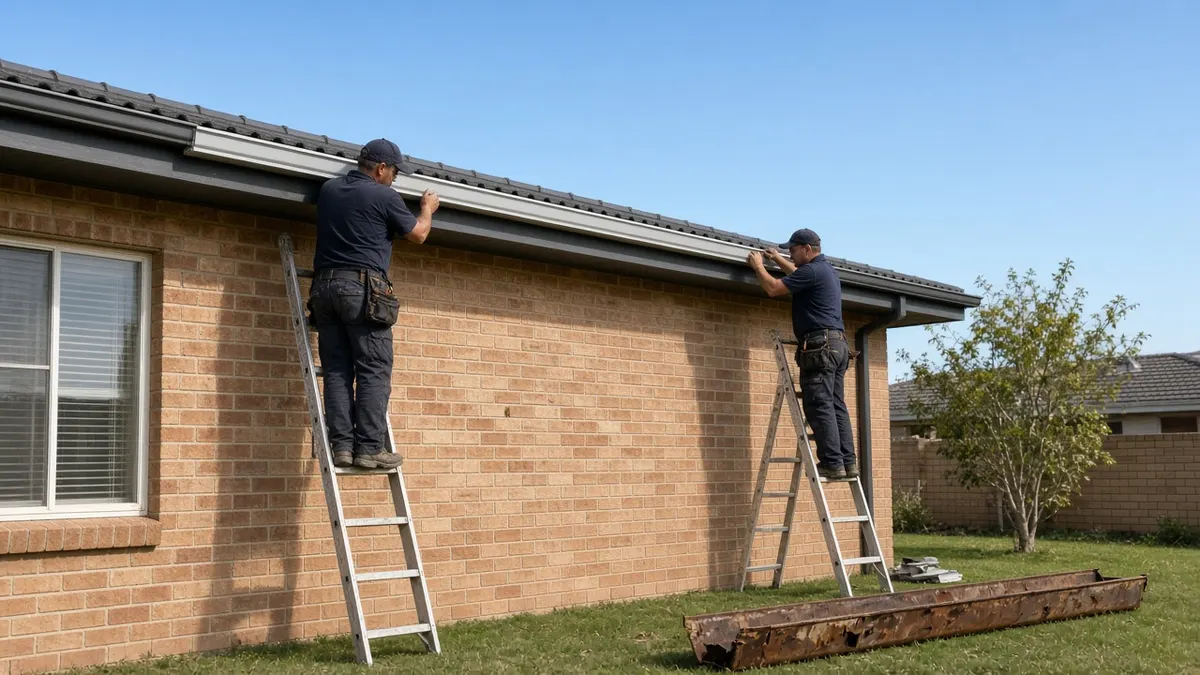
Replacing gutters costs about $45 to $95 per linear metre in 2026 for the Colorbond profiles most Australian homes use, supplied, installed and with the old gutters taken away. For a typical single-storey house that works out to $3,000 to $6,000 once downpipes are included, while two-storey homes and jobs that need new fascia boards often land between $6,000 and $12,000.
Gutters are a quiet part of the house until they fail. When they rust through, sag or overflow, water ends up in the eaves, the wall cavity and the footings. The good news is that a well-installed steel gutter lasts 20 years or more, so this is a job most owners only pay for once or twice. All figures below are indicative 2026 prices including GST. Treat them as a starting point and collect at least three written quotes from licensed roof plumbers.
Cost per metre by gutter material
Most roof plumbers price new gutters per linear metre, with downpipes and extras listed separately. These rates include removing the old gutter, new brackets, stop ends, outlets and installation at single-storey height.
| Material and profile | Installed cost per metre (incl. GST) | Typical lifespan |
|---|---|---|
| Zincalume quad | $40 to $70 | 15 to 20 years |
| Colorbond quad or OG | $45 to $85 | 20 to 30 years |
| Colorbond half-round or square line | $55 to $95 | 20 to 30 years |
| Aluminium (quad or half-round) | $55 to $100 | 25 to 40 years |
| Fascia-integrated steel system | $80 to $140 | 20 to 30 years |
| Copper half-round | $150 to $300 | 50 years and more |
| PVC (sheds and outbuildings) | $25 to $50 | 10 to 20 years |
| Box gutter, custom folded | $150 to $350 | 20 to 30 years |
Colorbond quad is the default for brick veneer and project homes because it is cheap, strong and comes in every roof colour. Half-round suits Federation, Californian bungalow and Queenslander homes and is often specified in heritage areas. Aluminium costs a bit more but shrugs off salt air, which is why it is common on beachside houses. Copper is a heritage and architectural choice that weathers to a brown and then green patina.
Whole-house prices by home size
Here is what owners typically pay for a complete gutter and downpipe replacement in Colorbond, excluding fascia work.
| Home | Gutter length and downpipes | Typical total (incl. GST) |
|---|---|---|
| Small single-storey, unit or cottage | 30 to 40 m, 3 downpipes | $1,800 to $3,800 |
| Standard single-storey, 3 to 4 bed | 45 to 60 m, 4 to 5 downpipes | $3,000 to $6,000 |
| Large single-storey or L-shaped | 60 to 80 m, 5 to 7 downpipes | $4,200 to $8,000 |
| Two-storey, standard | 55 to 75 m, 5 to 7 downpipes | $5,500 to $11,000 |
| Single-storey, gutters plus new fascia | 45 to 60 m | $6,000 to $11,500 |
Two-storey prices climb because of safety. Work at that height usually needs edge protection or scaffolding along the eaves, which can add $1,200 to $3,500 on its own depending on the length of the perimeter and how long it stays up.
Choosing a profile and material
Quad
The quad profile has a curved front and is the most common gutter in Australia. It holds a decent volume of water, is easy to source and is the cheapest Colorbond option. It is a sensible choice on most post-1960 houses.
Half-round
Half-round gutters suit older homes and are usually hung on external brackets rather than fixed straight to the fascia. They clean out easily because there are no internal corners for sludge to collect in. They cost a little more to install because of the bracket work.
Square line and fascia-integrated systems
Square line, sometimes called box-front, gives a crisp modern edge. Fascia-integrated systems combine a steel fascia and gutter in one, replacing timber fascia boards that rot. They cost more upfront but remove a future maintenance item, which makes them attractive when the existing fascia is already tired.
Box gutters
Box gutters sit inside the roof line, usually behind a parapet or between two roof sections. They are common on terraces and some architect-designed homes. They are also the gutter most likely to cause a serious leak, because when a box gutter overflows the water goes into the ceiling, not over the edge. They must be sized properly, have sumps and overflows, and be built to the stormwater plumbing standard, AS/NZS 3500.3. Expect a box gutter replacement to cost several times more per metre than an eaves gutter.
Material in coastal areas
Salt spray eats standard steel faster. If you live close to the surf coast, ask your roof plumber about Colorbond Ultra or aluminium. The extra cost is usually 10 to 25 percent and it can double the life of the gutter in harsh marine air.
Downpipes, fascia and the line items that add up
The gutter itself is often less than half the bill. These are the extras that show up on most quotes.
- Downpipes: $150 to $350 each installed at single-storey height, more for two-storey runs and offsets around eaves. Round 90 mm and rectangular 100 x 50 mm are the common sizes.
- Rainwater heads: $150 to $300 each. Useful on two-storey homes and as an overflow point on box gutters.
- Removal and disposal of old gutters: often built into the per-metre rate, otherwise about $3 to $8 per metre. Old steel gutters go to scrap metal.
- Fascia replacement: timber fascia costs about $40 to $90 per metre to replace and paint; steel fascia about $35 to $75 per metre.
- Edge protection or scaffolding: $1,200 to $3,500 for a typical two-storey perimeter.
- Gutter guards: $25 to $45 per metre for aluminium mesh if fitted at the same time.
- Stormwater changes: moving a downpipe or connecting to a new drain is plumbing work, often $300 to $1,200 depending on digging and pipe length.
Roof plumbers typically charge $90 to $140 per hour for small repair work. On full replacements they quote the whole job, which is usually better value than an hourly rate.
Gutter replacement prices around Australia
This table assumes a standard single-storey house with 50 metres of Colorbond quad gutter and four downpipes.
| Location | Typical total | What moves the price |
|---|---|---|
| Sydney | $3,400 to $6,200 | High labour rates, parking, steep blocks in the north and east |
| Melbourne | $3,200 to $5,900 | Strong competition among roof plumbers, compliance paperwork |
| Brisbane | $3,000 to $5,600 | Highset homes need longer downpipes and more ladder work |
| Perth | $3,000 to $5,500 | Mostly single-storey brick and tile, long travel distances |
| Adelaide | $2,800 to $5,200 | Lower labour costs |
| Hobart | $3,000 to $5,700 | Fewer roof plumbers, freight on some materials |
| Canberra | $3,300 to $6,000 | Tight trade availability, cold-weather scheduling |
| Darwin | $3,600 to $6,800 | Cyclone-rated fixings, freight, heat limits working hours |
| Regional | $2,800 to $6,000 plus travel | Lower rates offset by travel and material delivery |
Three replacement jobs, costed
All amounts include GST.
Single-storey brick veneer in Werribee, VIC
A 1990s three-bedroom house with 52 metres of rusted zincalume quad gutter and four downpipes. The fascia is sound. New Colorbond quad in a colour to match the roof.
| Item | Cost |
|---|---|
| Remove and dispose of old gutters, 52 m | $260 |
| Colorbond quad gutter, brackets, stop ends, outlets | $1,150 |
| Labour, two roof plumbers for about a day and a half | $1,900 |
| Four new downpipes with offsets | $720 |
| Sealant, rivets and sundries | $120 |
| Total | $4,150 |
Excluding downpipes, that is about $66 per metre, squarely in the middle of the Colorbond range.
Two-storey home in Castle Hill, NSW
A 2000s two-storey with 68 metres of gutter, six downpipes and two rainwater heads. Edge protection needed around the upper eaves.
| Item | Cost |
|---|---|
| Edge protection, erect and hire for two weeks | $1,800 |
| Remove and dispose of old gutters | $400 |
| Colorbond quad gutter and fittings, 68 m | $1,700 |
| Labour, two roof plumbers over three days | $3,600 |
| Six downpipes, two-storey runs | $1,500 |
| Two rainwater heads | $360 |
| Total | $9,360 |
Federation semi with a box gutter in Newtown, NSW
A semi-detached terrace with a leaking internal box gutter behind the front parapet, rotted timber under it, and a short run of half-round gutter at the back.
| Item | Cost |
|---|---|
| Strip old box gutter and inspect substrate | $450 |
| Carpenter to replace rotted sole boards and plywood | $650 |
| Custom-folded Colorbond box gutter, 9 m at $220 per metre | $1,980 |
| New sump and rainwater head overflow | $480 |
| Half-round eaves gutter at rear, 7 m at $85 per metre | $595 |
| Disposal | $120 |
| Total | $4,275 |
A short job, but a fiddly one. Box gutters are where you want the most experienced roof plumber you can find, not the cheapest.
Repair, patch or replace?
Not every rusty gutter needs replacing. A roof plumber will usually tell you which way to go based on a few signs.
- Patch it if there are one or two small rust holes or a leaking joint in otherwise sound steel. A patch and reseal costs $150 to $400.
- Replace a section if one run is badly rusted, often the one under a tree or at the low point of the roof. A single 6 to 10 metre run costs $500 to $1,200 installed.
- Re-bracket and re-fall if gutters hold water because the brackets have sagged. This costs $300 to $900 for a typical house and can add years of life.
- Replace the lot if rust is widespread, joints leak in several places, the gutters are undersized for the roof, or you are re-roofing anyway.
Timing matters. If the roof itself is near the end of its life, replace the gutters as part of a re-roof. Roofers fit gutters before the new sheets go on, and doing them together saves a second round of edge protection. Our roof replacement cost guide covers that bigger job, and the Colorbond roofing guide explains material choices that match your new gutters.
Who is allowed to replace gutters
Gutters and downpipes carry stormwater, and stormwater work is regulated. This is one job where the licence matters.
- Victoria: roof plumbing is a licensed plumbing class, regulated by the Building and Plumbing Commission, which took over from the Victorian Building Authority in 2025. A licensed or registered roof plumber must do the work and, above a set value, issue a compliance certificate. Ask for it.
- New South Wales: gutter and downpipe replacement is generally treated as residential building work, which needs a contractor licence once the job is worth more than $5,000 including labour and materials. Connections to stormwater drains are plumbing and drainage work. Check the right licence class and look up the tradie on the register at NSW Fair Trading.
- Queensland: roof drainage is regulated by the QBCC. Use a licensed plumber or roof plumber, and check their licence on the register at the QBCC website.
- Western Australia, South Australia, Tasmania, the ACT and the NT: licensing rules for roof plumbing and stormwater differ. Check with Building and Energy (WA), Consumer and Business Services (SA), CBOS (TAS), Access Canberra or the NT Building Practitioners Board before you hire.
A handyperson can clean gutters and help with removal and clean-up, but should not install new stormwater gutters and downpipes as the responsible tradie. If the job is done badly, overflowing gutters can damage the house and void warranties.
Approvals, standards and site safety
Like-for-like gutter replacement on a house usually needs no council approval. Exceptions are heritage-listed homes and heritage conservation areas, where changing the profile, colour or material can need consent. If your home is in a heritage area, call the council before you swap half-round for quad.
Gutters and downpipes should be designed and installed to AS/NZS 3500.3 and the National Construction Code. In practice, that means the gutter is sized for your roof area and local rainfall intensity, has enough downpipes, falls toward the outlets, and has an overflow path so that heavy rain spills outside rather than into the eaves. A good roof plumber does this without being asked. A cheap one simply copies what was there before, even if it never worked.
In bushfire-prone areas, check whether your home has a bushfire attack level. That can affect what leaf guards and materials are acceptable. In cyclone regions of Queensland, WA and the NT, bracket spacing and fixings are more demanding.
Working at heights is the main safety risk. Licensed roof plumbers will use ladders correctly for short tasks and edge protection or scaffolding for longer or higher work. If your house has fibro eaves or an older fibro roof, assume it may contain asbestos until tested. Drilling, cutting or breaking those materials needs care and, above the limits set in your state, a licensed asbestos removalist.
Getting quotes you can compare
Ask every roof plumber to quote the same scope, in writing, covering:
- Profile, material and colour of gutter, and the size and number of downpipes
- Price per metre and total price including GST
- Removal and disposal of old gutters
- Whether brackets, fall, overflows and sealing are included
- Edge protection or scaffolding, and who supplies it
- Any fascia repair, with a rate per metre for rotten boards found once the old gutter is off
- Licence number, ABN and public liability insurance
- A workmanship warranty and the manufacturer's material warranty
- For Victoria, confirmation a compliance certificate will be issued
Watch for big deposits. In NSW, the deposit on residential building work is capped at 10 percent. In Queensland and Victoria, the cap is 10 percent for contracts under $20,000 and 5 percent at $20,000 or more. Other states have their own rules, so confirm with your regulator. Be wary of a quote that does not mention downpipes, a price far below the others, cash-only offers, and anyone who cannot give you a licence number.
Lifespan and looking after new gutters
Colorbond gutters typically last 20 to 30 years in a suburban setting and less right on the coast. Zincalume lasts closer to 15 to 20 years. The biggest killer of steel gutters is not weather but wet leaf sludge left sitting against the metal, which keeps the coating damp and starts rust from the inside.
A clean once or twice a year, more under gum trees, is the cheapest way to protect a new install. Our gutter cleaning cost guide has current prices. Rinse off salt build-up on coastal homes during dry spells, and keep the bottom of downpipes clear so water does not pool against the slab.
What happens on installation day
A typical single-storey replacement runs like this. The crew arrives early, sets ladders or edge protection, and pulls the old gutters off in sections, cutting them down for the scrap bin. With the fascia exposed, they check for rot and loose nails and tell you if any boards need replacing before going further. That is the moment a quote can change, so it helps if the rate for fascia repair was agreed in writing beforehand.
Next, they run a string line to set the fall, usually somewhere around 1 in 500 or steeper toward each outlet, and fix brackets along it. Gutters go up in the longest lengths possible to cut down on joins, with corners and stop ends riveted and sealed. Downpipes are fitted last and connected to the existing stormwater risers. A good crew finishes by running a hose along each length to prove the fall, then cleans up offcuts and swarf, the tiny steel filings from cutting that leave rust spots on Colorbond roofs if they are not swept off.
Expect some noise, ladders against the walls and restricted access around the house for a day or two. Move cars, outdoor furniture and pot plants away from the eaves.
Ways to bring the price down
- Match the job to the roof. If your roof has five or more years of life left, replace the gutters now and move on. If it is close to the end, wait and do both together to share the edge protection.
- Keep the downpipes if they are sound. Downpipes rust more slowly than gutters because they drain dry. Reusing good ones can save $600 to $1,500.
- Stick with standard profiles and colours. Quad in a stock Colorbond colour is cheaper and faster to source than special profiles or custom folds.
- Book outside storm season. Roof plumbers are flat out after big storms. Late winter and early spring are usually easier to book.
- Prepare the site yourself. Clearing garden beds, moving furniture and trimming shrubs along the walls saves the crew time. It will not halve the bill, but it helps.
Where Yakka fits on a gutter job
Installing new gutters and downpipes is licensed roof plumbing work, and it should be quoted and done by a licensed roof plumber. Yakka Labour does not replace that. Where the platform helps is on the labour around the job: a labourer to carry materials to the back of a tricky block, strip and stack old gutters for scrap, or clean up the site afterwards. You can browse tradies listed under guttering to compare options.
Many owners also book a gutter cleaner near them a year after the install, then on a regular schedule. It is cheap insurance for a job you only want to pay for once.
Frequently asked questions
How much does it cost to replace gutters per metre?
Supplied and installed, new Colorbond quad or half-round gutters cost about $45 to $95 per linear metre at single-storey height, including removal of the old gutters. Zincalume is a little cheaper, aluminium a little dearer, and copper can reach $150 to $300 per metre. Downpipes, scaffolding and fascia repairs are usually priced on top.
How much does it cost to replace gutters on a whole house?
A standard single-storey house with 45 to 60 metres of gutter and four or five downpipes usually costs $3,000 to $6,000 in Colorbond. Small cottages can come in under $3,000. Two-storey homes often cost $5,500 to $11,000 because of edge protection or scaffolding, and replacing rotten fascia at the same time can add several thousand dollars.
Do I need a licensed plumber to replace gutters?
In most states, yes. Gutters and downpipes are stormwater roof plumbing. In Victoria, a licensed or registered roof plumber must do the work and issue a compliance certificate above a set value. In Queensland, roof drainage is QBCC-regulated plumbing work. In NSW, licensing depends on the job value and whether stormwater connections are involved. Check your state regulator.
How long does gutter replacement take?
Most single-storey homes take one to two days with a two-person crew, including removing the old gutters, installing brackets and new gutters, and fitting downpipes. Two-storey homes take two to four days, plus time to put up and take down edge protection. Box gutters and fascia repairs can extend the job, especially if rotten timber is found.
How long do Colorbond gutters last?
Colorbond gutters usually last 20 to 30 years in typical suburban conditions, provided they are cleaned regularly so wet leaves do not sit against the steel. Near the surf coast, salt spray shortens that life, which is why many roof plumbers recommend Colorbond Ultra or aluminium for beachside homes. Zincalume tends to last 15 to 20 years.
Should I replace gutters and fascia at the same time?
If the timber fascia is rotten, cracked or soft, replacing it with the gutters is usually cheaper than doing it later, because the gutters have to come off anyway. Steel fascia or a fascia-integrated gutter system removes the need for painting. If the fascia is sound, simply prepare and repaint it while the gutters are off.
Can I replace my own gutters?
Replacing gutters on a shed or outbuilding with PVC is a common DIY job. On a house, licensing rules in several states mean stormwater gutters and downpipes should be installed by a licensed roof plumber, and DIY work may cause problems with insurance or compliance when you sell. Working at height is also a serious safety risk.
Official sources
Award rates, licences and safety rules change. Check the official source before you hire or take on a shift.
- Queensland Building and Construction Commission (QBCC)Contractor, plumbing and drainage licence search in Queensland
- Consumer and Business Services SALabour hire licensing in South Australia
- NSW Fair TradingTrade licence checks for electricians, plumbers and builders in New South Wales
- Building and Plumbing Commission (Victoria)Builder and plumber registration, domestic building insurance and licence checks in Victoria
- Asbestos Safety and Eradication AgencyWhere asbestos is found in homes and how to deal with it safely
- Consumer, Building and Occupational Services (Tasmania)Building, plumbing and electrical licensing in Tasmania